- The paper presents a novel approach that reframes Bayesian inference as a density-of-states estimation problem using Wang-Landau sampling.
- It identifies a critical temperature (τ* = 0.24) via Fisher information peaks, yielding sharpened posteriors and improved predictive accuracy.
- The method bypasses iterative resampling challenges, offering robust inference even with model misspecification while enhancing computational efficiency.
Statistical Mechanics-Inspired Bayesian Inference: Tempered Posteriors and Wang-Landau Sampling
This work introduces a principled algorithmic approach that synergistically combines tempered Bayesian posteriors with Wang-Landau density-of-states sampling to address foundational and practical challenges in real-world Bayesian inference. The method leverages the formal analogy between statistical physics and Bayesian inference, treating the negative log joint (likelihood × prior) as an energy, and mapping Bayesian posteriors to canonical ensembles parametrized by a fictitious temperature τ. The core innovation is the realization that the density of states g(E), obtained via Wang-Landau sampling, encapsulates the global structure of the posterior landscape, enabling efficient and comprehensive exploration at all temperatures from a single simulation.
Addressing Misspecification and Computational Bottlenecks
In typical Bayesian workflows with imperfect models and noisy data, iterative model refinement and resampling are time- and resource-intensive due to intractable evidence integrals and algorithmic limitations (e.g., inefficiency and ergodicity issues in Metropolis-Hastings MCMC). The approach in this paper circumvents these limitations by recasting posterior sampling as a density-of-states estimation problem. By obtaining g(E), it becomes straightforward to compute tempered posteriors for any τ value through reweighting, effectively decoupling the computational cost from the number of different temperature values of interest.
This formalism reveals that signals analogous to phase transitions—such as inflection-like features in the “heat capacity” (d⟨E⟩τ/dτ) and maxima of the Fisher information—indicate optimal temperature τ∗ for the posterior, resulting in improved predictive performance without manual modifications of the likelihood or prior.
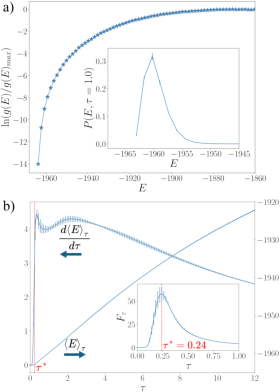
Figure 1: (a) Density of states g(E) spanning multiple orders of magnitude, and corresponding P(E,τ=1.0); (b) ⟨E⟩τ with its first derivative and Fisher information, highlighting the critical temperature τ∗=0.24 as the optimal point for predictive performance.
Quantitative Implementation and Empirical Results
The authors demonstrate the method on calibration of an analytic equation of state (EOS) for the FCC phase of platinum, with high-dimensional, correlated parameters, and messy, multi-source data. The process involves:
- Constructing the “energy” g(E)0.
- Estimating the density of states g(E)1 via Wang-Landau sampling in parameter space.
- Computing moments (e.g., g(E)2) and information-theoretic quantities (Fisher information) as functions of g(E)3.
- Identifying g(E)4 from the Fisher information maximum as the temperature yielding optimal, information-rich posteriors.
- Comparing model parameter marginal distributions between critical and untempered posteriors (g(E)5 vs. g(E)6).
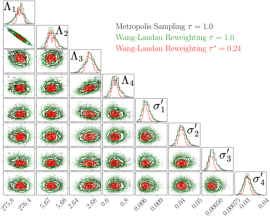
Figure 2: Marginal and pairwise parameter distributions for the EOS model from Wang-Landau sampling, contrasting the critical (red, g(E)7) and untempered (green, g(E)8) posteriors—the critical posterior exhibits systematically narrower credible intervals and sharpened correlations.
The quantitative effect is marked: at the critical posterior (g(E)9), the model parameters are more tightly constrained, and the predictive distributions for the EOS observables fit the experimental data more accurately compared to the underfit, untempered posterior. Notably, this improvement is achieved "for free" in the sense that no new model specification or resampling is required—only post-processing of g(E)0.
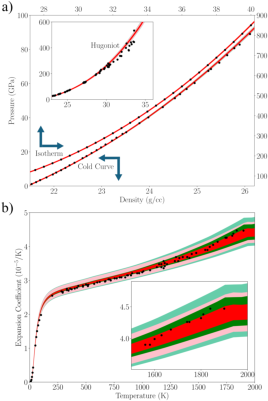
Figure 3: Posterior predictive model outputs for narrow and wide g(E)1 values; only the critical posterior (g(E)2) accurately tracks experimental data in key derived observables, such as the expansion coefficient, while the standard posterior (g(E)3) underfits.
The claim that the critical temperature inferred from the Fisher information directly marks the optimal predictive regime is confirmed by substantial improvement in predictive performance, particularly for derived observables (e.g., the expansion coefficient), compared to standard untempered posteriors.
Theoretical and Practical Implications
This methodology offers several advances over current Bayesian practice:
- Automated posterior sharpening without resampling: By identifying the critical temperature via Fisher information or response function peaks, practitioners can bypass the computationally expensive process of model re-specification and iterative MCMC sampling.
- Robustness to model misspecification: The tempering procedure mitigates underfitting when priors or likelihoods are misspecified—a common occurrence in practical, non-idealized settings.
- Statistical-physical insight: The mapping to phase transitions provides a quantitative, information-theoretic criterion for posterior quality, supplanting more qualitative or ad hoc calibration of inference procedures.
- Bayesian computation efficiency: All posterior temperatures are accessible through reweighting g(E)4, enabling not only optimal predictive inference but also facilitating computation of evidence for model selection.
Moreover, this approach points to further developments: histogram reweighting for small additional gains, explicit entropy-based transition detection (microcanonical inflection-point analysis), and streamlined evidence computations as an alternative to nested sampling or path sampling.
Relevance to Model Selection and Future Directions
The Wang-Landau-based density-of-states strategy naturally supports efficient marginal likelihood (evidence) calculations, critical for Bayesian model selection and hypothesis testing—domains with persistent computational difficulties due to high-dimensional integrals. The methodology could be extended to adaptive density of states algorithms for large-scale posterior landscapes and integrated with automated differentiation tools for application in deep probabilistic modeling.
While this work is motivated by physical sciences inference problems (EOS calibration), the theoretical foundations and empirical findings are directly transferable to any high-dimensional, correlated, noisy data scenario, including areas such as neural network uncertainty quantification, complex system biology inference, and robust AI model evaluation—especially where calibration and misspecification are paramount.
Conclusion
By recasting Bayesian inference in the language of statistical mechanics and leveraging Wang-Landau density-of-states sampling, this work demonstrates a practical, computationally efficient, and theoretically grounded method to identify and exploit the optimal tempered posterior for superior predictive modeling. The identification of the critical temperature via Fisher information maxima marks a shift from qualitative to quantitative posterior evaluation and model refinement, with implications for uncertainty quantification, model selection, and robust inference in science and AI alike.