- The paper demonstrates that replacing LayerNorm with dynamic tanh (DyT) acts as an implicit regularizer, particularly benefiting low-data, overparameterized transformer models.
- It quantifies performance trade-offs, revealing up to a 27.3% improvement in validation loss in low-data regimes and significant penalties in high-data settings.
- The study provides a practical calibration recipe using activation saturation as a predictive tool for determining when DyT will be beneficial across different architectures.
Regime-Dependent Effects of Removing LayerNorm: Activation Bounding as Implicit Regularizer
Introduction
The paper "When Does Removing LayerNorm Help? Activation Bounding as a Regime-Dependent Implicit Regularizer" (2604.23434) systematically investigates the performance implications of removing LayerNorm in transformer architectures, replacing it with Dynamic Tanh (DyT) activation bounding. DyT parameterizes normalization-free transformers via a learned tanh(αx), hypothesized to operate as an implicit regularizer whose efficacy varies with both model capacity and data regime. The core contribution is a rigorous phase diagram quantifying when DyT acts as a beneficial regularizer and when it becomes detrimental, together with mechanistic analysis and deployment guidance for practitioners.
Regime-Dependent Effects and Empirical Findings
The primary experimental axis explores DyT across GPT-2-family models (64M–3.78B parameters), varying training datasets (1M–118M tokens) to comprehensively sample the token-to-parameter ratio (T/P). Validation loss improvements are regime dependent: DyT confers a 27.3% improvement at 64M/1M but a 18.8% penalty at 64M/118M, and at higher capacities, DyT's benefit vanishes (1.7% at 3.78B/1M) while the penalty escalates (27.9% at 3.78B/118M).
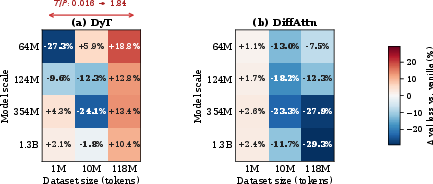
Figure 1: Delta validation loss vs.\ vanilla across GPT-2-family scales and data regimes shows DyT as a regularizer in low-data, overparameterized regimes, and a penalty in high-data, underfit regimes.
DyT enables robust implicit regularization by activation bounding in overparameterized contexts (low T/P): the fraction of activations saturated by tanh (i.e., ∣αx∣>2.0) is 49% in 1M tokens and drops to 23% for 118M tokens. Controls with HardTanh, α-sweeps, and matched dropout demonstrate that the regularization mechanism is specifically due to bounded activations.
Mechanistic Analysis
Detailed mechanistic probes verify that DyT’s regime dependence derives from its activation saturation behavior, not merely convergence dynamics. In low-data settings, tanh saturation imposes a capacity bottleneck that prevents memorization, resulting in a marked train/validation loss gap reduction. For example, at 64M/1M, vanilla memorizes (train loss 0.12, train/val gap 9.22) while DyT prevents memorization (train loss 2.47, gap 4.31). In higher data regimes, DyT operates near-linearly and thus adds computational overhead without meaningful regularization.
The implicit regularization via DyT is independently confirmed through heavy-tailed self-regularization (HTSR) spectral analysis: DyT consistently produces lower power-law exponents in weight spectra, signifying more structured weights, but this does not correlate with generalization when DyT becomes a convergence bottleneck.
Cross-Architecture Validation and Instability
Regime-dependent regularization transfers directionally to Llama-style models (RoPE, SwiGLU, GQA) and Vision Transformer, but architectural specificity is critical. In Llama-family configurations, DyT sometimes induces catastrophic instability localized to SwiGLU gating, with a 33% failure rate. Ablation studies demonstrate that the multiplicative gating in SwiGLU amplifies activation magnitudes, driving DyT into extreme saturation and training collapse. Activation saturation (above threshold) is a perfect classifier for collapse across seeds in these ablations.
Screening Recipe and Deployment Guidance
A practitioner-oriented recipe is provided: a 500-step DyT calibration with saturation measurement offers accurate, directional guidance on whether DyT will help or harm in a given (T, P) regime. The threshold σ>0.43 for fraction of saturated activations accurately predicts DyT benefit in 75% of in-sample GPT-2 calibration cells and all cross-architecture Llama checks. However, the heuristic does not generalize as a universal rule—accuracy drops to 50% in leave-one-scale-out validation—as the crossover point is scale-dependent.
Causal Evidence and Practical Implications
HardTanh as a function-class control reproduces DyT’s regime pattern, confirming that activation bounding rather than tanh’s smoothness is responsible. Increasing α in DyT reduces the regularization effect in data-rich regimes, but LayerNorm remains superior in these settings. Dropout-equivalence tests show vanilla LayerNorm with dropout (p=0.5) matches DyT's data-rich loss, reinforcing that DyT acts as a regularizer whose strength adapts to the data regime through learned saturation.
Theoretical and Practical Implications
The results challenge recent trends advocating normalization-free transformers and underscore the necessity of regime-aware architectural choices. DyT is not a universal LayerNorm replacement; its sign and magnitude depend not only on T/P0, but on precise architectural details (e.g., gating in SwiGLU). Practitioners are advised to calibrate normalization interventions rather than rely on phase-diagram priors alone, especially in capacity-rich or modern architectures. The evidence also suggests that theoretical analyses of activation bounding need to incorporate emergent scaling dynamics and architectural interaction terms.
Speculation on Future Directions
Future research should investigate DyT and normalization-free approaches in Chinchilla-optimal pretraining regimes (T/P1), as compute-limited findings may not extrapolate. Activation bounding could potentially be tuned dynamically as a regularization schedule, or integrated in combination with other normalization paradigms. Open questions remain regarding the generalization-transfer properties of capacity-enhancing modifications like Differential Attention and their robustness for downstream tasks under diverse data regimes.
Conclusion
DyT provides activation bounding as a regime-dependent implicit regularizer, but its efficacy is sharply dependent on data, capacity, and architectural context. Removing LayerNorm via DyT only benefits in overparameterized, low-data settings; in data-rich or modern architectures, DyT imposes a significant convergence penalty and can induce catastrophic instability. Calibration via short-run activation saturation is the recommended deployment strategy. This work delineates a clear boundary for normalization-free transformer design and offers actionable screening protocols for practitioners.