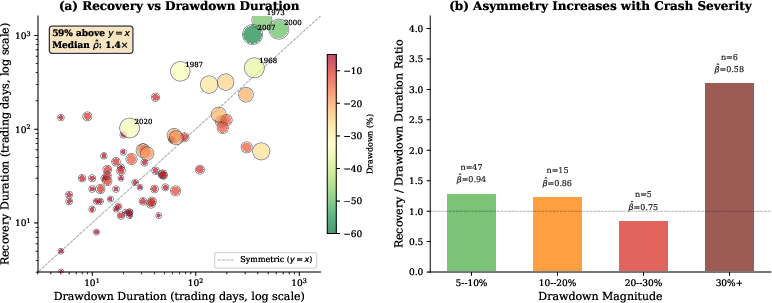
- The paper introduces a regime-conditional functional-form restriction where exposures contract multiplicatively in stress regimes and recover additively in calm periods.
- It empirically validates the MC–AR restriction using FINRA margin debt and S&P 500 drawdown-recovery durations, with statistically significant regime-dependent effects.
- The findings have practical implications for risk management policy and intermediary behavior, highlighting limitations of return-only models.
Regime-Conditional Restrictions on Risk Exposure Dynamics
Theoretical Foundation of Multiplicative Contractions and Additive Recoveries
This paper introduces and tests a functional-form restriction on aggregate risk-exposure dynamics, motivated by VaR-constrained intermediary asset pricing models. The central theoretical assertion is the existence of a regime-conditional asymmetry: exposures contract multiplicatively during binding-capital-stress periods, while they grow additively, in a level-independent manner, during calm regimes. The multiplicative contraction follows directly from capital constraints (standard in liquidity-spiral and procyclical-leverage models), where intermediaries adjust positions in proportion to their current size under constraint activation. However, the additive recovery dynamic is newly formalized here, derived under the assumption of constant-rate capital replenishment. This yields a distinctive “MC–AR” restriction: the stress regime induces exposure dynamics of the form Xt+1=ηˉtXt with ηˉt<1, and the calm regime produces E[Xt+1−Xt]=ϕ>0, Cov(ΔXt,Xt)=0.
The analytical core comprises two propositions: one for multiplicative contraction (mechanical from binding VaR constraints) and one for additive replenishment (driven by constant-rate inflows and level-independence). The regime-switch directly informs empirical design: the expected growth rate switches from proportional to additive as regime changes, and the functional form is nested in a regression model, isolating these properties via interaction terms.
The paper reports robust empirical evidence using monthly FINRA margin debt (1997–2026), detrended against the secular expansion of market capitalization to isolate cyclical changes. The primary regression model interacts the regime indicator (stress vs. calm, classified by volatility thresholding) with the lagged margin-debt level, producing regime-specific slope estimates for exposure growth.
- Calm periods exhibit a slope of −0.040 (p=0.082), statistically consistent with additive, level-independent growth.
- Stress periods exhibit a slope of −0.205 (p<0.001), consistent with multiplicative contraction.
- The regime × level interaction coefficient (b^S=−0.165, HAC SE $0.052$) is highly significant (ηˉt<10).
- The stress slope is approximately 5x larger than the calm slope, rejecting equal level-dependence at the ηˉt<11 significance level.
The robustness of these results is tested against alternative volatility thresholds, detrending methods, and sub-sample analyses. The negative interaction remains stable across all variants.
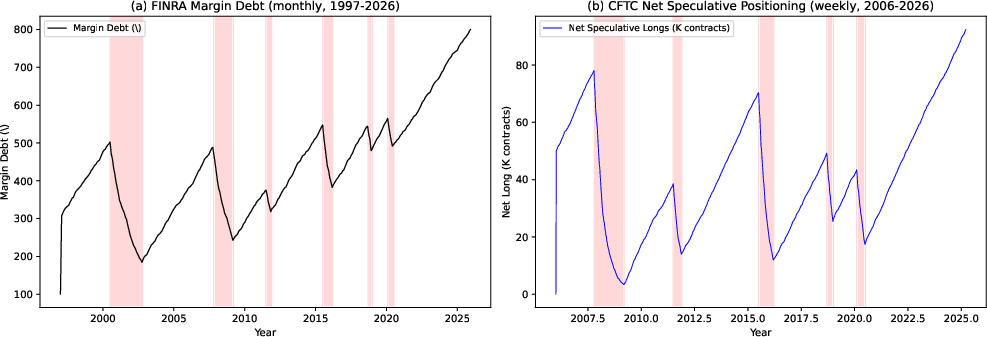
Figure 1: Raw FINRA margin debt time series from 1997 to 2026, highlighting stress episodes with sharp proportional contractions and calm periods with approximately constant-rate additive growth.
Price-Level Consequences: Drawdown-Recovery Duration Ratios
A direct implication of the MC–AR restriction at the price level is an asymmetric relationship in drawdown-recovery durations: deeper crashes should take disproportionately longer to recover relative to their contraction phase. This is tested via the S&P 500 daily series (1950–2026), identifying drawdown-recovery episodes according to a maximal-interval algorithm.
The empirical findings:
Discrimination Against Return-Only Null Models
To assess discriminatory power, calibrated Heston stochastic volatility, Markov regime-switching, and block-bootstrap null models are simulated. Each can reproduce observed price-level duration asymmetry (e.g., Heston median E[Xt+1−Xt]=ϕ>00, not rejected against empirical S&P 500 E[Xt+1−Xt]=ϕ>01), but crucially, none contain an exposure state variable; thus, they are silent regarding the regime-conditional functional-form flip observed in margin debt. The observed exposure-level asymmetry is logically external to these models.
Policy Implications and Theoretical Significance
The regime-conditional restriction refines the empirical targets available for testing intermediary mechanisms. It provides sharper identification than return-level moments alone, suggesting the necessity of intermediary-resolved exposure data for full mechanism identification. Practical implications include nuanced policy design for stress interventions (graduated margin/capital policies vs. binary circuit breakers) and improved calibration of volatility-regime risk management. The MC–AR restriction is consistent with multiple plausible micro-foundations, such as direct inflows, quadratic adjustment cost, and information acquisition; however, additive replenishment is challenged by asset-proportional inflow models, further underscoring its empirical distinctiveness.
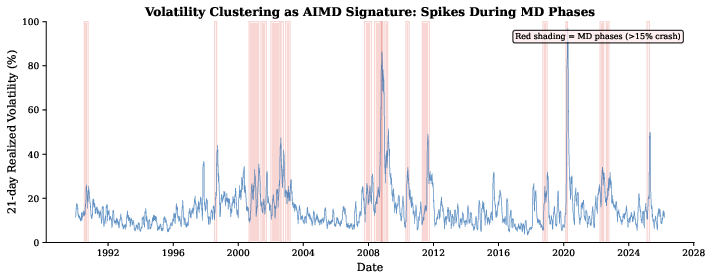
Figure 3: Realized volatility of S&P 500 log returns (1950–2026), with volatility clustering highly concentrated during stress-regime months classified above the 90th percentile.
Limitations and Directions for Future Research
The findings hinge on aggregate proxies (FINRA margin debt). Limitations include heterogeneous intermediary responses, noisy proxy effects mixing leveraged demand and revaluation, and lack of intermediary-level tests. The constant-rate replenishment assumption is robust in several foundation scenarios but remains open to theoretical strengthening. Regime classification is by single-threshold volatility; refinements using granular intermediary data could increase empirical power.
Future directions:
- Intermediary-level tests using filings/prime-broker data.
- Companion tests on CFTC speculative positioning.
- Structural models embedding endogenous capital evolution.
- Time-varying restriction strength assessment as leading indicator for mechanism activation.
Conclusion
This paper formalizes and empirically tests a regime-conditional functional-form restriction (“multiplicative contraction, additive replenishment”) on risk exposure dynamics, derived from VaR-constrained intermediary models. The restriction is confirmed on FINRA margin debt and price-level drawdown-recovery data, and is shown to discriminate against prominent return-level null models. While the results are consistent with constrained-intermediary mechanism operation, intermediary-resolved exposure evidence remains essential. The regime-conditional restriction thus advances empirical testing in asset pricing theory, offering new diagnostic targets beyond return-level statistics.
(2604.23315)