- The paper reveals that AI-generated content achieves aggregate engagement primarily through volume scaling, despite similar per-capita views compared to human-generated content.
- The study employs matching-based causal inference and time-series econometrics to quantify exposure suppression and engagement disparities on a large short-video platform.
- Findings indicate that algorithmic distribution moderates the supply-driven visibility of AIGC, underscoring the need for design adjustments to enhance content ecosystem health.
Scale-over-Preference: Quantitative Analysis of AIGC in Large-Scale Content Platforms
Introduction
The paper "Scale over Preference: The Impact of AI-Generated Content on Online Content Ecology" (2604.01690) executes a large-scale, methodologically rigorous investigation into the behavioral and distributional effects of Artificial Intelligence-Generated Content (AIGC) within a major Chinese short-video platform (400M DAUs). Integrating matching-based causal inference and extensive time-series econometrics, the study provides empirical quantification of the “scale-over-preference” (SoP) dynamic: AIGC-enabled creators achieve aggregate engagement returns through volume scaling rather than consumer-preference alignment. Critically, the research interrogates how platform algorithmic distribution engines modulate these emergent tensions, thereby defining the contours of future content-ecosystem health.
Quantifying Behavioral and Preference Mismatches
A fundamental result is the persistent divergence between content supply (AIGC vs. HGC) and consumer revealed preference. Through matched comparisons, AIGC creators exhibit substantially higher content production volumes than their HGC counterparts (median difference = +4 videos per matched creator, p<0.001) but fail to secure superior per-capita engagement (valid-view and full-view counts statistically indistinguishable). The decomposition demonstrates that gains are wholly attributable to expansion in AIGC video output, with little evidence of augmented productivity in conventional HGC modes.
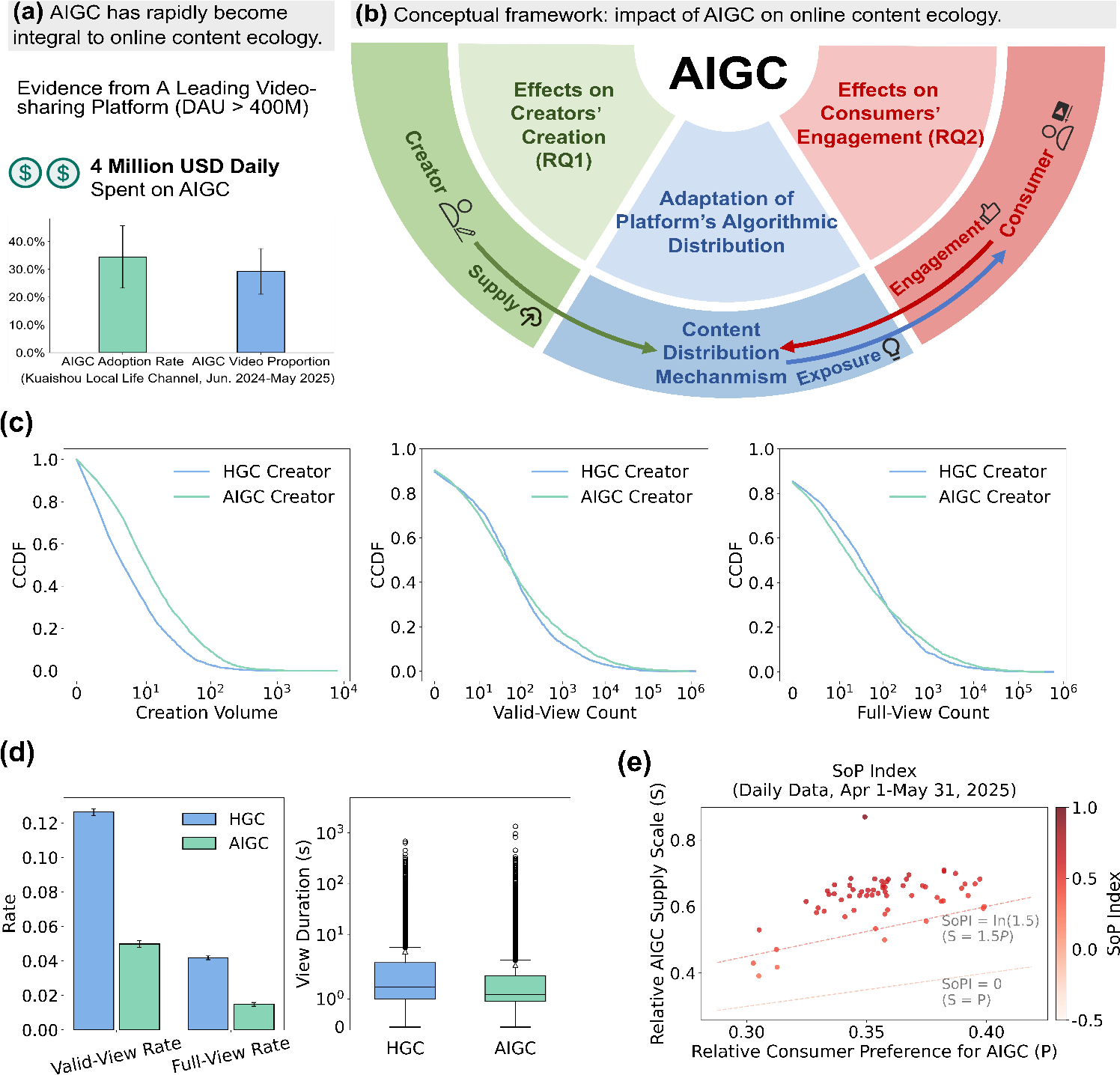
Figure 1: The integration and behavioral consequences of AIGC on a leading short-video platform, including content production and return metrics, and the persistent divergence captured by the SoP index.
Consumer-level analyses reinforce these mismatches: users consistently show attenuated engagement depth for AIGC relative to HGC content (e.g., valid-view rate Δ = –0.076, p<0.001; full-view rate Δ = –0.027, p<0.001; median view duration Δ = –0.213s). This persists after rigorous matching for user history, video meta, and temporal context, indicating robustness against confounding. The SoP index SoPI=ln(S/P), with S = relative AIGC supply scale and P = relative consumer preference, remains stably elevated (SoPI>ln(1.5)) across weeks, signaling a continuously supply-driven, not preference-driven, content ecology.
Algorithmic Distribution as a Tension Moderator
Unlike naïve “neutral” distribution, the platform’s algorithmic content engines respond structurally to the SoP tension. Matched-pair analyses reveal that AIGC videos receive not only lower cumulative exposure (–59 median impression difference, p<0.001) but also a more compressed lifecycle of visibility. Panel-level Granger causality and dynamic regression analyses show that increases in AIGC supply Granger-cause systematic downscaling of new AIGC video exposure (F=3.322, p<0.0010), with higher supply positively associated with the lowest-exposure tier allocation but negatively (or insignificantly) associated at higher tiers.
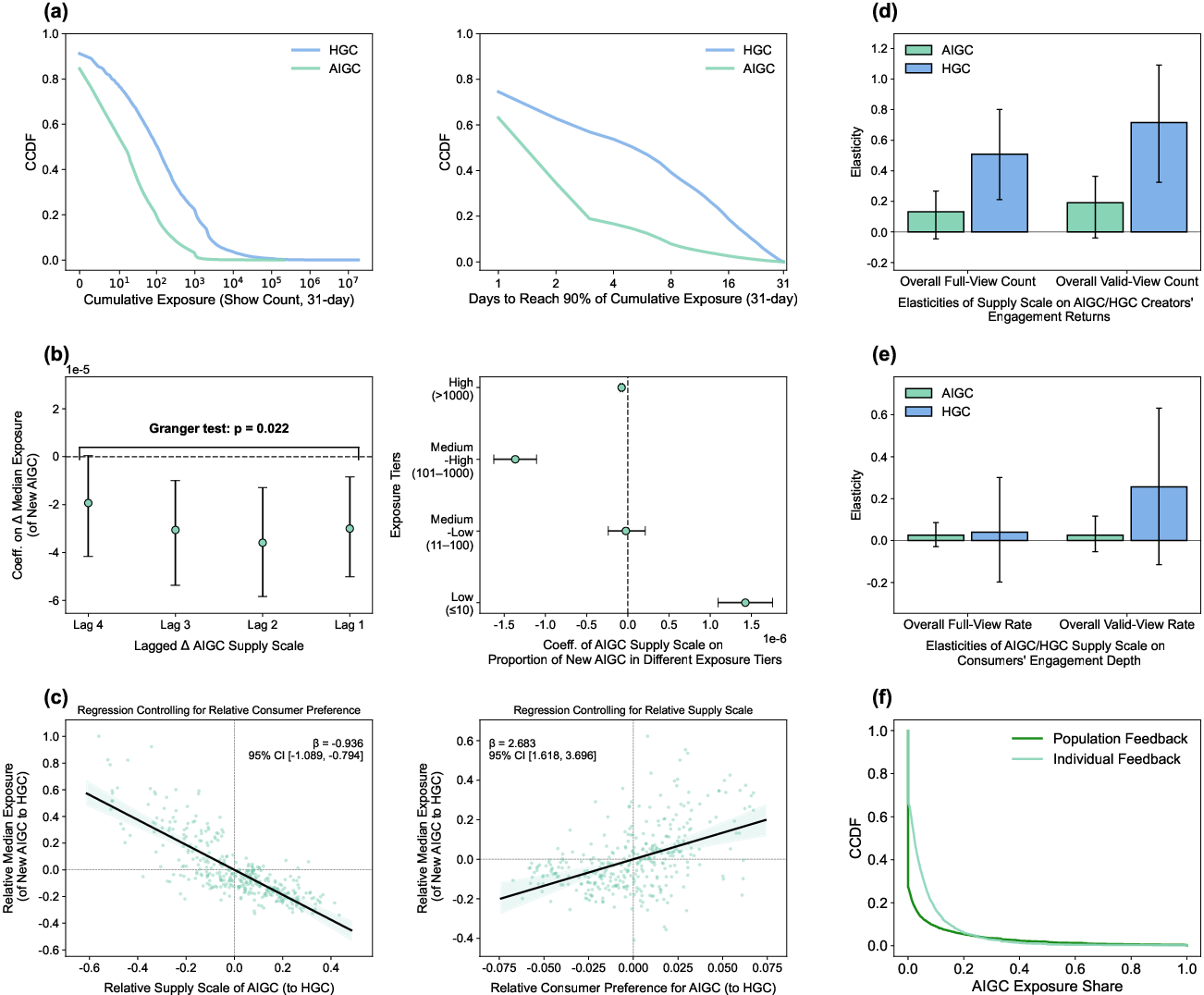
Figure 2: Algorithmic moderation patterns: from exposure suppression and lifecycle compression for AIGC, to negative supply-exposure elasticity as scale expands across quantiles, and the mediation of SoP effects by algorithm design.
Dynamic OLS estimates confirm dual-moderation: conditional on constant preference, as the AIGC supply scale rises, relative exposure declines (p<0.0011, 95% CI [–1.089, –0.794]). Holding supply constant, rising consumer preference is met with exposure increases (p<0.0012, 95% CI [1.618, 3.696]), confirming algorithmic decoupling between pure supply expansion and default visibility.
Crucially, the elasticity of aggregate creator engagement returns to supply expansion is substantially lower for AIGC (p<0.00130.13–0.19 per log unit) than HGC (p<0.00140.5–0.7), indicating diminishing marginal returns for scale-based AIGC creation. On the consumption side, engagement depth is stabilized near zero elasticity as AIGC supply increases, demonstrating that recommendation engines preserve consumer experience by suppressing the influx of low-preference AIGC exposures. Heterogeneous algorithmic architectures amplify this mediation: population feedback–driven recommendation designs enforce stronger suppression of AIGC visibility compared to individual feedback–driven variants.
Differential Mechanistic Pathways
The multilevel econometric framework in this study isolates both exposure- and engagement-level impacts. For creators, the SoP dynamic manifests as a large treatment effect for production (high robustness values in sensitivity analysis) but not for engagement returns. For consumers, negative AIGC coefficients in matched regressions are robust to confounders, confirming lower revealed preference is not a mere artifact of user or content selection. On the distributional axis, exposure suppression for AIGC is insensitive to unmeasured confounding, and DOLS block bootstrapped confidence intervals confirm statistical solidity.
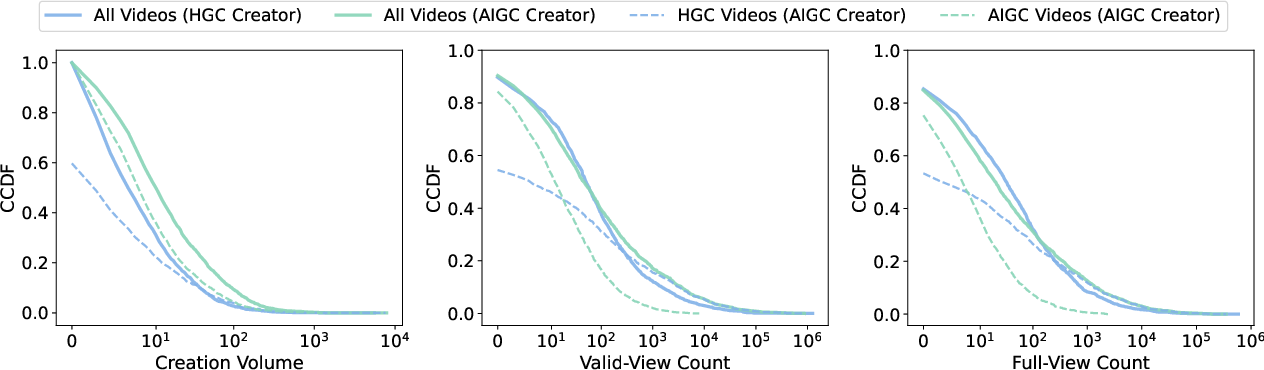
Figure 3: Decomposition of production and engagement for AIGC creators: increased output is solely explained by AIGC content, while HGC contributions remain dominant in actual engagement returns.
Supplementary analyses further show that, within AIGC creator pools, traditional HGC videos continue to drive a substantial proportion of engagement. Thus, while generative scaling inflates supply, it does not displace preference-aligned HGC as the core vector of consumer attention.
Implications and Future Directions
The empirical evidence converges toward several theoretical and practical implications:
- Supply-Driven Attention Dynamics: Unconstrained generative scaling creates ecological tensions, with platform incentives divorced from consumer revealed preference.
- Algorithmic Mediation Constraints: Distribution algorithms operate as functional moderators, dynamically suppressing marginal AIGC visibility when supply outstrips preference, thereby bounding misalignment externalities.
- Elasticity and Platform Health: The systemic reduction in exposure- and engagement-supply elasticity for AIGC under algorithmic moderation signals self-regulatory feedback, but does not eliminate supply–preference gaps entirely.
- Governance and Design: Optimal adaptation may require AIGC-sensitive distribution or even regulatory (e.g., quota, disclosure) mechanisms to sustain long-range content ecosystem quality as generative tools proliferate.
- Generalization and Architecture: The pronounced differences between population-level and individual-level feedback–driven recommendation imply that architecture selection is non-neutral for ecosystem outcomes—future theoretic work should address algorithmic design as an explicit mediating variable in digital content social dynamics.
Conclusion
This study offers rigorous evidence that, in large-scale online video platforms, AIGC triggers an ecological shift toward scale-driven content supply that is only partially, and nonlinearly, matched by consumer preference. Platform recommendation engines act as moderators, not amplifiers, of this SoP dynamic, enforcing diminished exposure returns to generative scaling and stabilizing end-user experience. Future research should address the adaptive co-evolution of generative creation, preference-signal–aware governance, and distributional architectures for healthy digital ecosystems in the era of ubiquitous AIGC.

