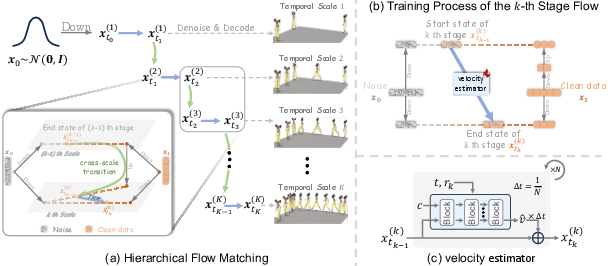
- The paper introduces a hierarchical, multi-scale flow matching technique that decouples semantic alignment from fine motion details.
- It employs a deterministic cross-scale transition within a topology-aware Motion VAE, boosting retrieval performance with stable R-Precision.
- Empirical results on HumanML3D and KIT-ML show superior R-Precision and FID, establishing the method's effectiveness for realistic text-to-motion synthesis.
Hierarchical Flow Matching for Text-to-Motion Synthesis: MotionHiFlow
Motivation and Problem Setting
Text-to-motion generation, which targets the synthesis of 3D human motion that semantically and physically aligns with given natural language, remains a central problem for animation, VR, and robotics. Prior frameworks predominantly conduct single-scale generation, thereby entangling high-level semantic alignment with fine-grained temporal coherence within a sole modeling stage. This unified treatment limits both the semantic alignment to text and the long-range coherence of resulting motions. "MotionHiFlow: Text-to-motion via hierarchical flow matching" (2604.23264) departs from this paradigm by proposing a hierarchical, multi-scale flow matching methodology. It establishes a progressive coarse-to-fine generation schedule to decouple the modeling of semantics and motion details, integrating them via deterministic cross-scale flows.
Empirical Evidence for Hierarchy
MotionHiFlow's hierarchical design is justified by systematic empirical analysis demonstrating the preservation of semantic content even after aggressive temporal downsampling. As shown, models trained on heavily downsampled (coarse) motion maintain stable R-precision in text-to-motion retrieval, evidencing robust semantic alignment in the absence of high-frequency details. Notably, overemphasis on fine granularity can degrade text-motion consistency, supporting the hypothesis that hierarchical architectures—mirroring cognitive models of motion generation—offer theoretical and practical gains.
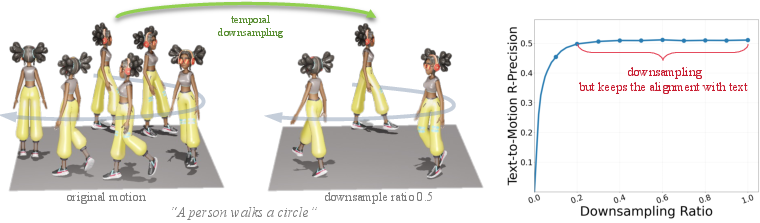
Figure 1: R-Precision remains stable under high temporal downsampling, indicating hierarchy preserves semantic alignment.
Methodology: MotionHiFlow Framework
MotionHiFlow operates via a hierarchical flow matching pipeline:
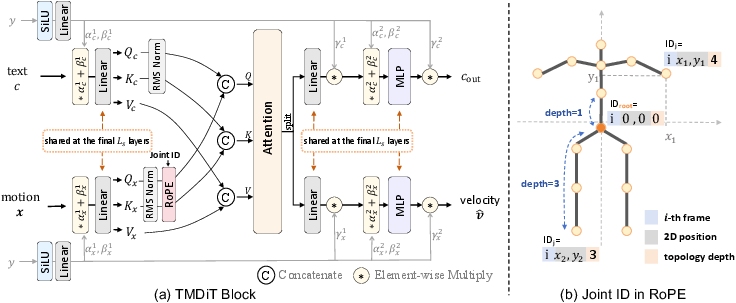
Text-Motion Diffusion Transformer and Joint RoPE
To operationalize hierarchical flow matching, the architecture incorporates two critical modules:
Experimental Results and Analysis
Quantitative and qualitative evaluations are conducted on HumanML3D and KIT-ML, two standard text-to-motion benchmarks. MotionHiFlow achieves:
- R-Precision: 0.563 (HumanML3D) and 0.482 (KIT-ML), exceeding prior SOTA (e.g., MoGenTS, BAMM).
- FID: 0.032 and 0.135 respectively, corresponding to the best distributional fidelity among all baselines.
- MultiModal Distance: 2.691 and 2.552, evidencing improved semantic and text-motion alignment.
The hierarchical flow matching significantly improves metrics relative to single-scale models, with ablation confirming the additive contributions of hierarchical scheduling, TMDiT, and the topology-aware Motion VAE.
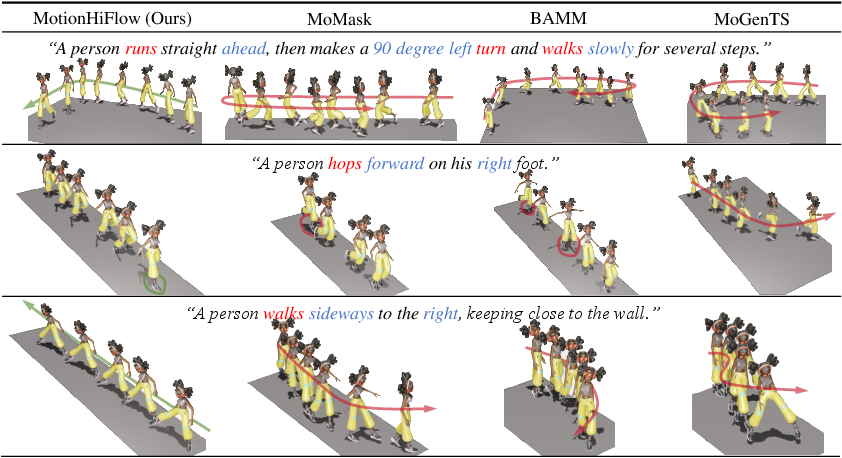
Figure 4: Visualizations comparing MotionHiFlow to baselines, where correct motion directionality (green) consistently matches input text.
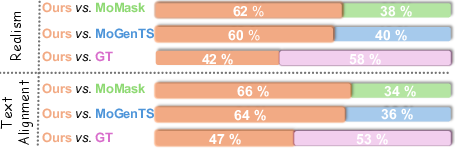
Figure 5: User study: MotionHiFlow preferred in realism and text alignment, often rivaling ground truth.
Implications and Future Directions
The work establishes a rigorously justified hierarchical framework, demonstrating that semantic and structural aspects of motion should be decoupled and modeled at appropriate scales. Practically, this architecture sets new performance standards for text-to-motion generation, with direct implications for interactive content creation, digital avatars, and robotics. Theoretically, it motivates further study of hierarchical, flow-matched modeling regimes for continuous, structured data.
Potential future work involves extending hierarchical flow matching to joint multimodal generation (e.g., text–audio–motion), integrating physics-based constraints for real-world deployment, and investigating richer modalities of cross-scale knowledge routing. Additionally, exploration of parameter-efficient tuning or online adaptation for downstream tasks (e.g., personalized avatars, dynamic control) is a promising trajectory.
Conclusion
MotionHiFlow (2604.23264) demonstrates that hierarchical flow matching, informed by both cognitive theory and empirical study, is highly effective for text-to-motion generation. By explicitly structuring the generation pipeline around temporally progressive flows and integrating topological priors, the system achieves superior semantic alignment, temporal coherence, and output realism compared to previous approaches. The results underline the importance of hierarchical modeling and inductive architectural bias for structured generative tasks in AI.