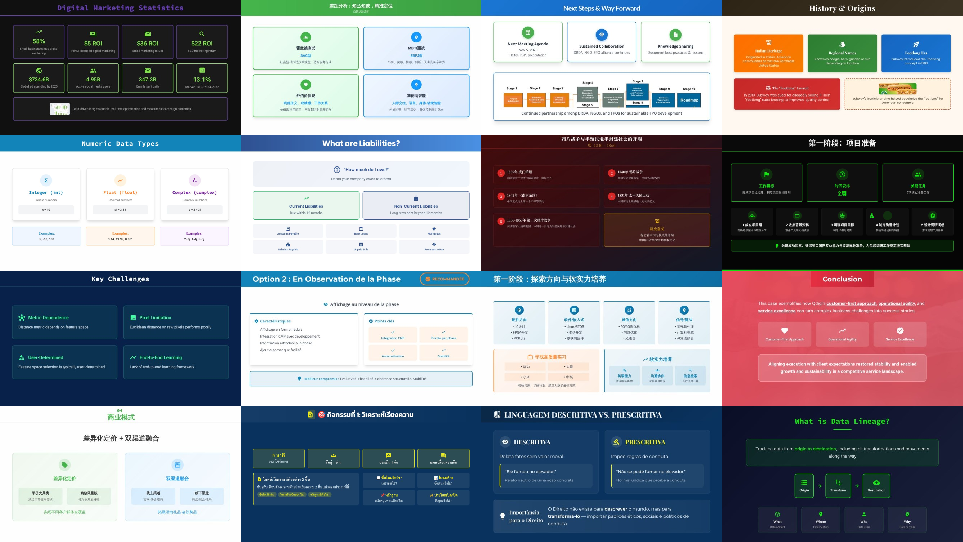
- The paper introduces a reinforcement learning framework using explicit verifiable aesthetic metrics to address common slide layout issues.
- It employs Group Relative Policy Optimization with KL divergence regularization and reward shaping to enhance aspect ratio, whitespace, collision, and balance metrics.
- Experimental results demonstrate significant improvements, including aspect ratio compliance up to 85% and higher human evaluation scores.
AeSlides: Reinforcement Learning with Verifiable Rewards for Aesthetic Slide Generation
Introduction
The paper "AeSlides: Incentivizing Aesthetic Layout in LLM-Based Slide Generation via Verifiable Rewards" (2604.22840) systematically investigates the modality gap in LLM-based slide generation, where text-dominant generation left unsupervised by visual criteria leads to frequent aesthetic deficiencies. The authors focus on four core visual layout issues: distorted aspect ratio, excessive whitespace, element collision, and visual imbalance. Prior work typically addressed these either with template-based systems or agentic, multimodal iterative refinement. Most recent agentic frameworks, although effective for coarse layout pathologies, exhibit high inference overhead with limited efficacy for fine-grained visual factors. On the other hand, supervised fine-tuning on large datasets provides only weak, implicit, and indirect aesthetic supervision.
This work proposes reinforcement learning (RL) with a set of verifiable aesthetic metrics as explicit reward signals to address the limitations above. A suite of algorithmically precise, cheap, high-throughput metrics is introduced, decomposing aesthetic quality into reliably measurable components. These verifiable rewards are integrated into a Group Relative Policy Optimization (GRPO) RL paradigm, guiding the generation model to favor layouts that satisfy quantifiable aesthetic constraints.
Verifiable Aesthetic Metrics
The framework defines four principal metrics:
- Distorted Aspect Ratio: This is programmatically measured post-render by extracting the final width and height of the slide in a browser context and checking the deviation from the target (typically 16:9). The metric pipeline normalizes for browser quirks and excludes reward hacking strategies such as min-height/overflow manipulation.
- Excessive Whitespace: A local pixel variance map is computed on the rendered image, with binarization to estimate the proportion of content vs. whitespace. The vision-based approach is monotonic, robust to fine-grained variations, and largely immune to artifacts like textual backgrounds due to pre-filtering.
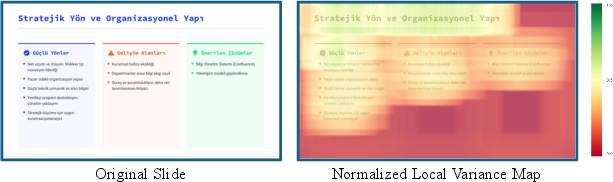
Figure 1: Excessive whitespace detection overlays a normalized variance heatmap to identify under-utilized regions in red.
- Element Collision: DOM-based heuristics detect overlaps among visible semantic units, overflow from parent containers, and out-of-bounds elements, with explicit handling to avoid penalizing unimpactful artifacts such as watermarks.
- Visual Imbalance: The centroid of visual elements is computed and normalized using elliptical tolerances to measure perceptual imbalance.
A comprehensive meta-evaluation demonstrates that these metrics outperform even frontier VLMs (e.g., GPT-5.2) in F1/ROC-AUC, efficiency, and cost (by orders of magnitude). Notably, VLMs systematically fail at aspect ratio detection, confirming their unsuitability for this role. The fidelity and efficiency of the verifiable metrics ensure low-latency, cheap RL signals scalable to large-scale rollout generation.
Reinforcement Learning with Explicit Visual Rewards
AeSlides uses GRPO as the RL backbone, augmented with several mechanisms:
- KL Divergence Regularization: Crucial for slide generation; omitting it rapidly collapses policy diversity, with the model degenerating into highly-conservative template patterns (see Section on Failure Cases and ablation).
- Reward Shaping: Asymmetric shaping for aspect ratio (penalizes overlong slides more sharply); monotonic smoothstep transformations with clipping for other metrics to discretize extremes and maintain robust optimization gradients.
- Reward-Decoupled Normalization (GDPO-inspired): Ensures each reward dimension remains a principal source of gradient, avoiding dominance/collapse effects observed in naively normalized reward sum variants.
Error handling is implemented by zeroing the reward for invalid HTML or failed renderings, preventing degenerate exploitation of malformed outputs.
Datasets and Experimental Regime
Two datasets underpin the study:
- AeSlides-Reward-Bench: For metric meta-evaluation and annotation, with fine-grained layout flaw categories.
- AeSlides-7k: For RL policy optimization and quantitative evaluation, filtering structurally trivial pages and preserving multilingual and variate content-rich slides.
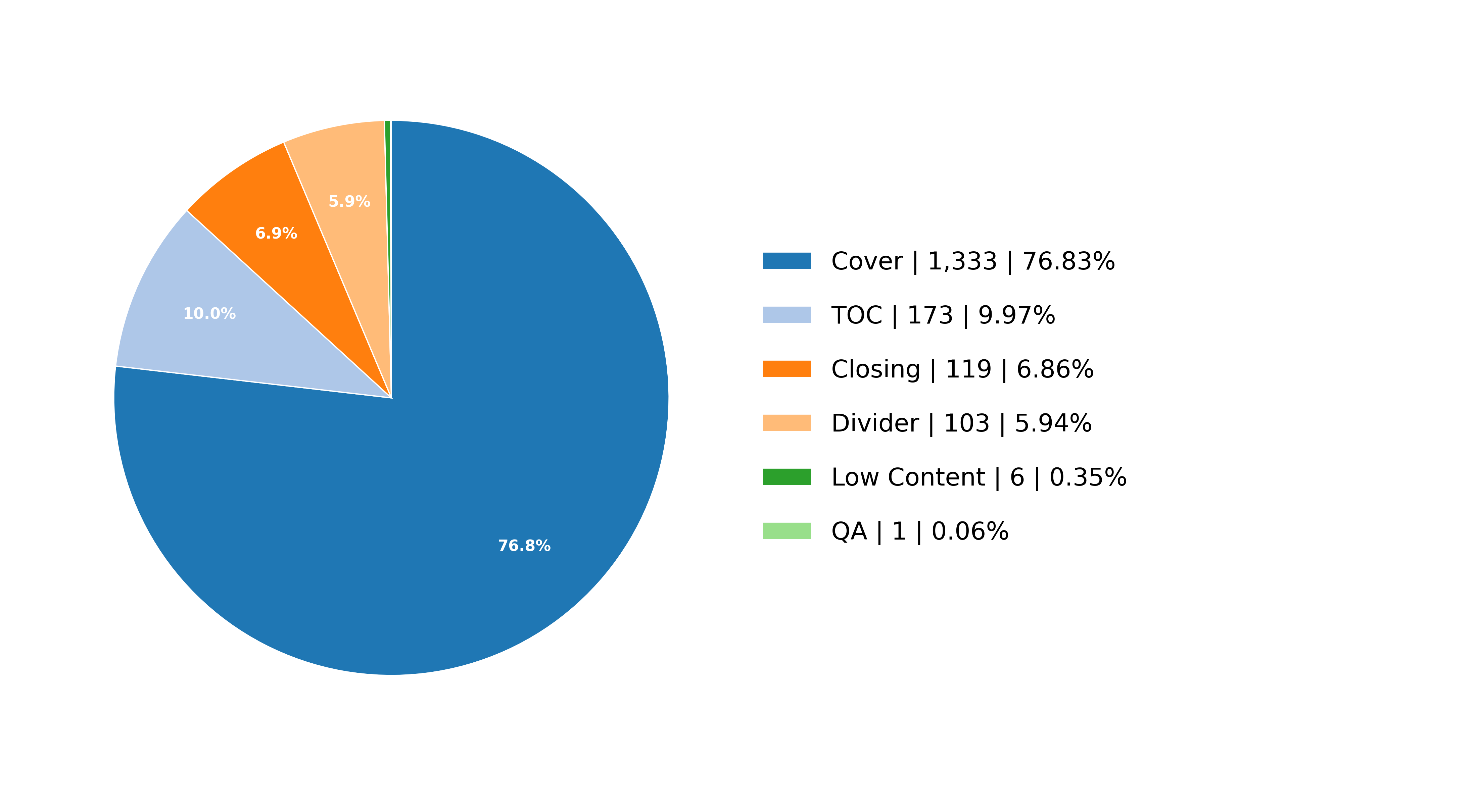
Figure 2: Structurally simple page filtering in AeSlides-7k reveals a balanced focus on semantically nontrivial slide content.
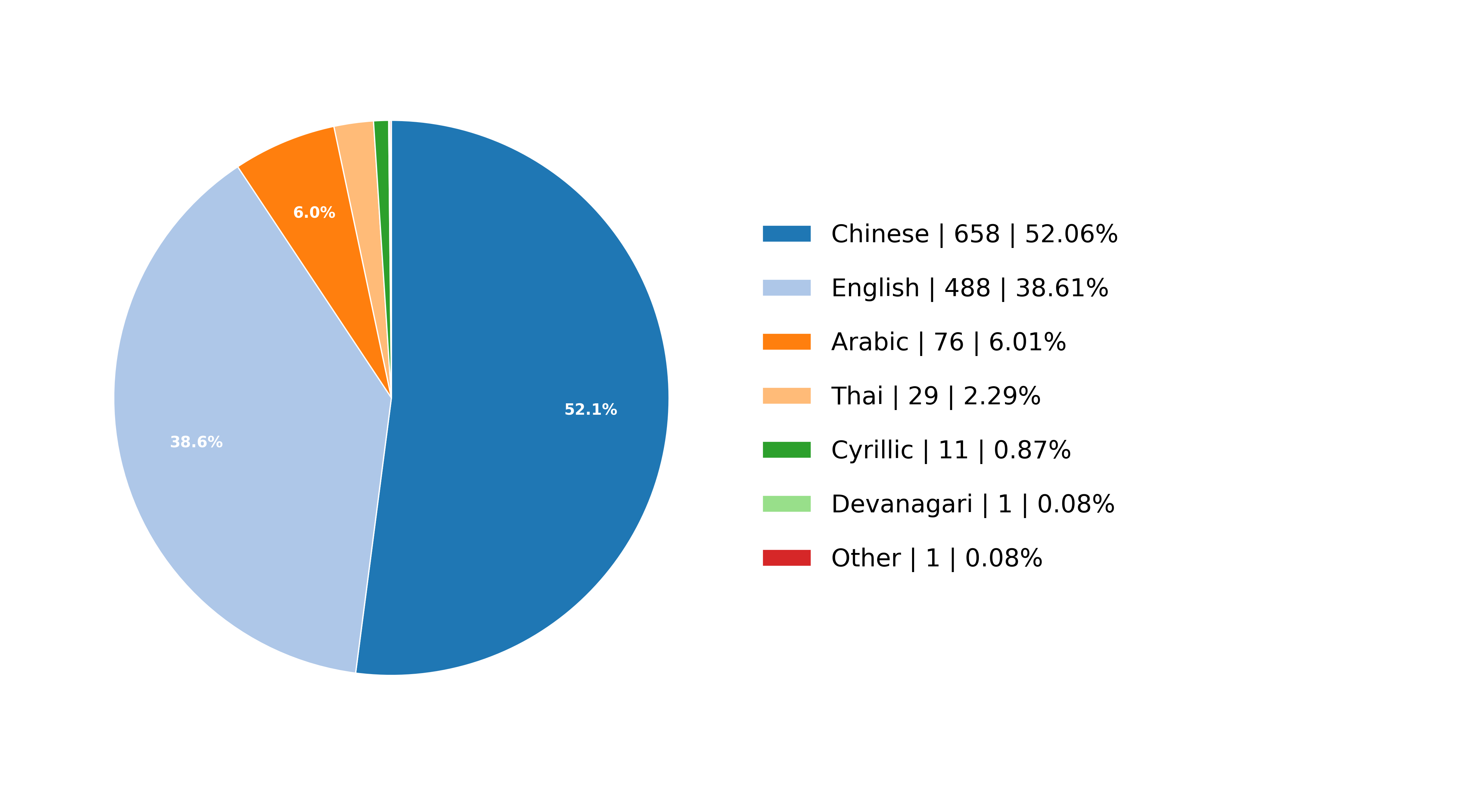
Figure 3: Language distribution confirms broad multilingual support in AeSlides-7k, with significant non-English content.
Main Results
Experiments utilize GLM-4.7-Flash (30B-A3B), pre-trained with SFT on slide data. RL is conducted on 8xH100 nodes with ~5K training prompts. Evaluation compares:
- AeSlides (verifiable rewards),
- RL with model-based rewards (VLM-scored, static or visual variants, using GPT-5-mini/nano),
- Agentic iterative reflection (DeepPresenter [zheng2026deeppresenter] with GLM-4.6V-Flash),
- Strong proprietary baselines (Claude-Sonnet-4.5, GPT-5.2),
- The static SFT base model.
Key quantitative findings:
- Aspect ratio compliance increases from 36% to 85%
- Whitespace reduced by 44%, collisions by 43%, imbalance by 28%
- Human evaluation score increases from 3.31 to 3.56 (+7.6%)
- AeSlides matches/edges out Claude-Sonnet-4.5 and consistently outperforms agentic and VLM-rewarded RL methods
Notably, model-based reward RL and agentic methods exhibit reward hacking and policy collapse phenomena, with VLM feedback insufficient for fine-grained optimization. Statistical tests and paired comparison bootstraps confirm the significance of AeSlides' gains.
Ablation and Failure Analysis
Systematic ablations demonstrate:
Failure cases outside the supervised dimensions—such as user demand for atypical content-volume per slide, or font/color granularity—are observed but rare and qualitatively attributable to limitations of query/planning, not the verifiable reward methodology.
End-to-End Case Studies
Full-deck inference demonstrates that prefix-conditioned, page-level aesthetic RL produces coherent, content-aligned slide decks across rich topics.

Figure 5: Case study—AeSlides generates a visually balanced, aspect-ratio-compliant deck with minimal whitespace on a technical topic.
Theoretical and Practical Implications
The introduction of verifiable, RL-optimized aesthetic supervision closes the text-vision modality gap that has bottlenecked layout quality in modern slide-generation pipelines. The results demonstrate that:
- For structured, programmatically verifiable visual qualities, RL with explicit metric rewards is categorically superior to either VLM-based reward modeling or computationally heavy agentic reflection schemes.
- Current VLMs are insufficient, both as reward signalers and as judges, consistently assigning inappropriately high scores and exhibiting strong self-preference and regression-to-the-mean artifacts.
- Reward shaping and normalization are essential in multi-objective RL for maintaining balanced improvement; naive reward mixing collapses under variance imbalance.
Limitations and Prospects
AeSlides does not directly address non-layout aspects such as color schemes, semantic coherence, or style adaptation to user intent; these remain open future directions. Additionally, the reliance on heuristics for collision and imbalance introduces engineering debt and opposes pure learning-based solutions. A major research avenue is the design of further verifiable, efficiently computable aesthetic metrics that cover broader dimensions and enable more fine-grained or personalized visual supervision. Finally, extending the paradigm to adaptive or personalized aesthetic expectations is left for subsequent work.
Conclusion
This paper establishes that reinforcement learning guided by meticulously designed verifiable visual rewards enables LLMs to generate slides with layout quality that is both quantitatively and qualitatively state-of-the-art. The avoidance of VLM-based or agentic feedback loops unlocks new levels of efficiency, diagnosis, and interpretability in visually-grounded RL for content generation, with substantial implications for future multimodal system design and evaluation (2604.22840).