- The paper establishes that low-order (N=3–N=4) confinement scaling models optimize extrapolative reliability by emphasizing plasma current as the primary driver.
- It employs advanced statistical tests and Bayesian uncertainty analysis to quantify error inflation and wall-related penalties in fusion performance predictions.
- The findings advocate for higher plasma currents (≈20 MA) in compact, HTS-enabled tokamaks to achieve gigawatt-class fusion energy.
Motivation and Context
The study "Revisiting confinement scalings and fusion performance with a perspective optimized for extrapolation" (2604.22728) examines the empirical foundations and uncertainties in reactor performance projections derived from plasma confinement scaling laws. Recent advances in high-temperature-superconductor (HTS) technology enable higher toroidal magnetic fields and renew interest in compact, high-field tokamak designs. Given the contemporary update of the ITPA global H-mode database, the authors critically reassess standard confinement scaling methodologies with explicit attention to extrapolative reliability for reactor design, presenting a systematic search for minimally complex, yet robust, empirical models.
A central thesis of the study is that projections of fusion performance, particularly for next-generation reactors, are fundamentally constrained by plasma current (Ip). The stagnation in fusion performance records is directly tied to the stagnation in accessible plasma current, as illustrated through historical machine data.
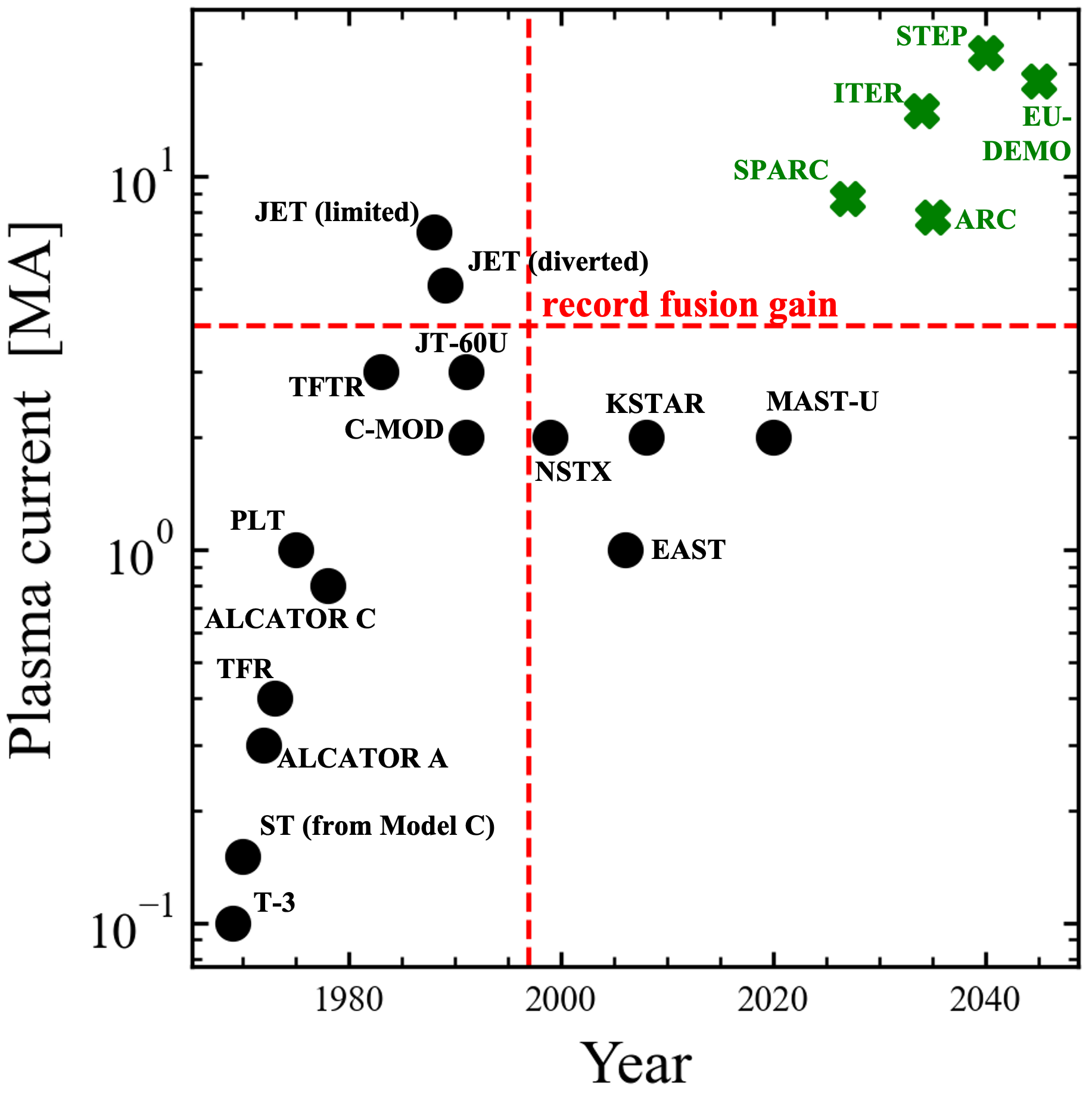
Figure 1: Peak plasma current achieved across major tokamaks, underscoring persistent limitations since JET and the anticipated jumps with ARC and EU-DEMO.
Optimal Model Complexity and Confinement Scaling
Empirical confinement scalings are typically formulated as power-law regressions over machine-level engineering parameters. Increasing model order (i.e., the number of parameters) improves in-sample fit but degrades extrapolative robustness by capturing statistical noise. The authors systematically evaluate models of order N=1 to N=9, identifying a sharp trade-off ("knee") in variance capture beyond N=3, with additional parameters yielding marginal improvements in R2.
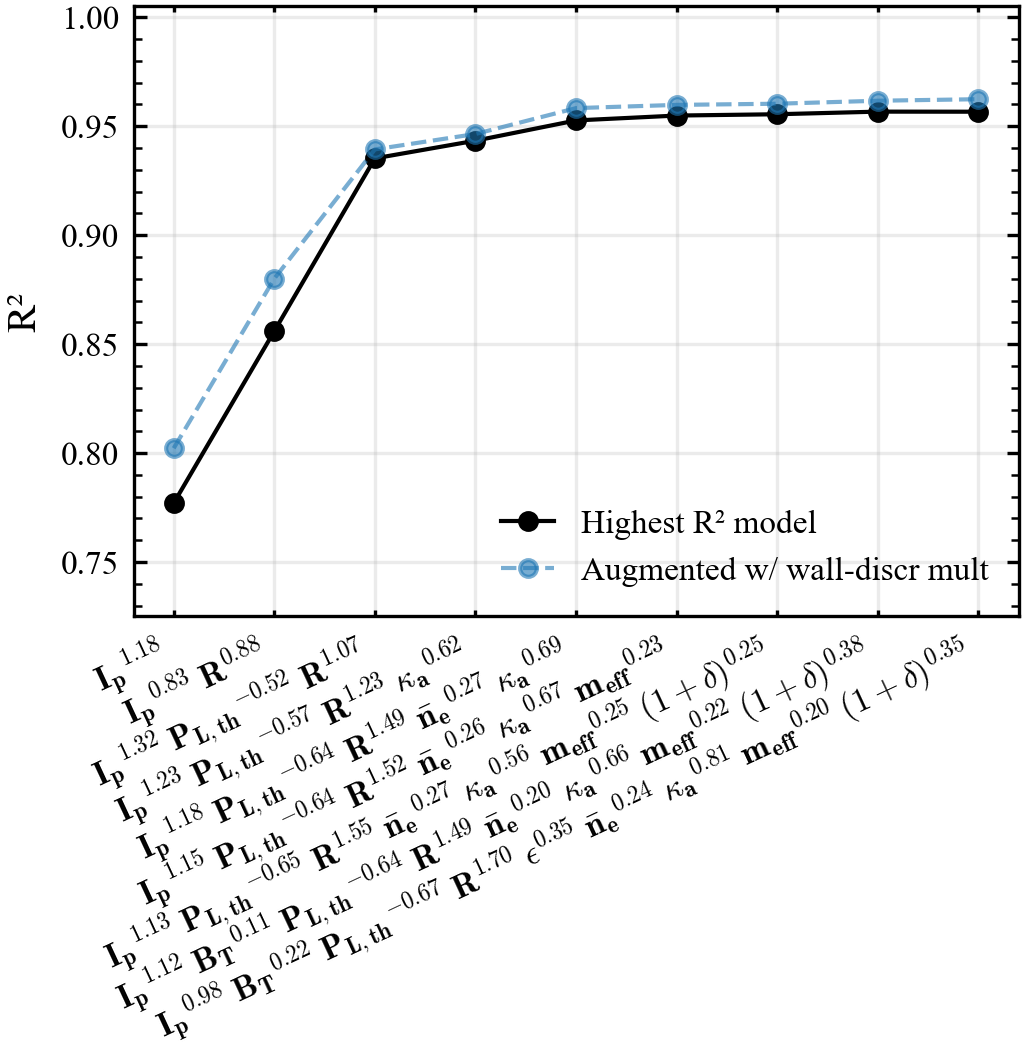
Figure 2: Confinement-time scalings R2 as a function of model complexity, with wall discrimination retrofitted to each order. The knee near N=3 marks optimal complexity.
Through two complementary analyses—a percentile-shell noninferiority test and a machine-extrapolation test—the study finds that low-order models (N=3 to N=4) offer the best balance of bias and variance for predictive extrapolation to unbuilt reactors. The N=3 model emerges as the principal choice, with the N=10 model serving as a secondary reference. These analyses favor predictive robustness for high-confinement and future machines based on preceding devices.
Error inflation in overly simple (N=11, N=12) models and variance in models with N=13 are quantified both over the distribution of N=14 and in machine-based historical extrapolation.
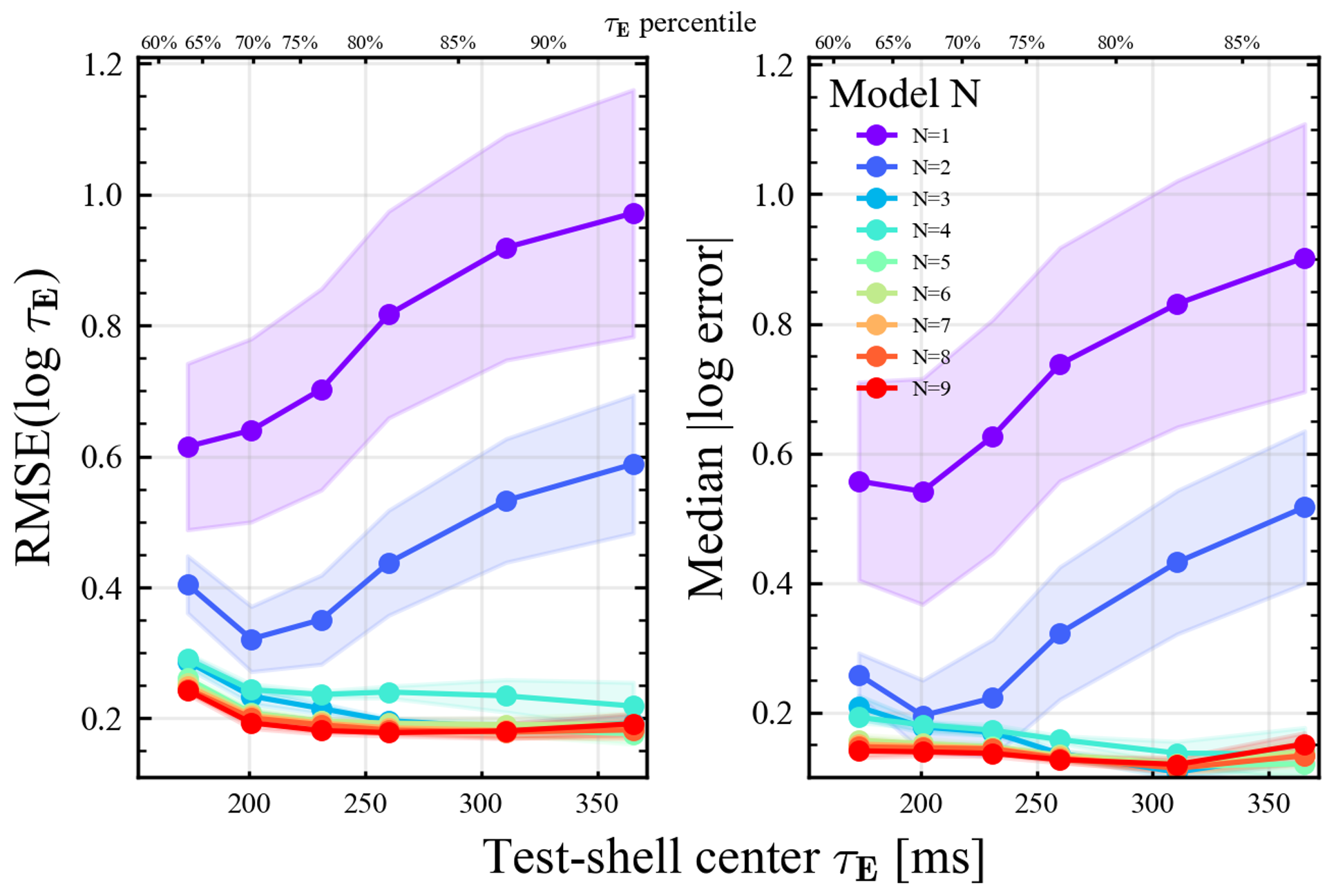
Figure 3: Extrapolation RMSE of N=15 in the far tail, demonstrating error inflation as model complexity departs from optimal regime.
Dominant Engineering Levers and Wall Effects
The optimal N=16 low-order empirical scaling for H-mode thermal energy confinement is:
N=17
where high-Z walls incur a confinement penalty (coefficient 0.896, converging toward 0.85 as complexity increases) compared to low-Z materials. The dominant engineering levers are plasma current, machine size (major radius), and input power.
Further analysis shows that inclusion of metal walls produces a nontrivial penalty and significantly impacts reactor-scale predictions. Advanced Bayesian uncertainty analysis (RBAYES) reveals substantial uncertainty in certain exponents, and the revised database bifurcates predictions based on wall material, especially for SPARC and ITER.
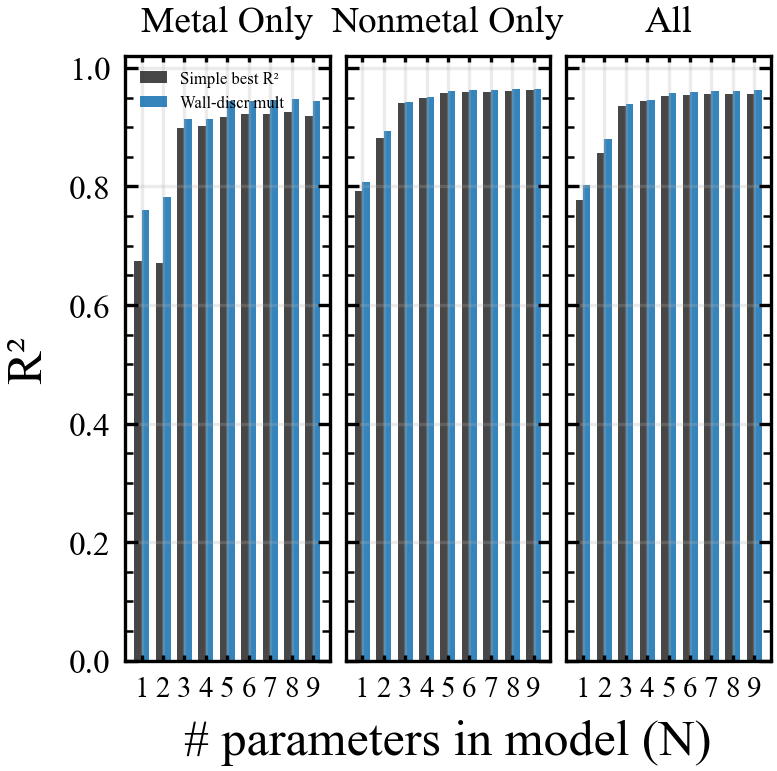
Figure 4: Model N=18 as a function of complexity and wall composition, demonstrating convergence and wall penalty stability.
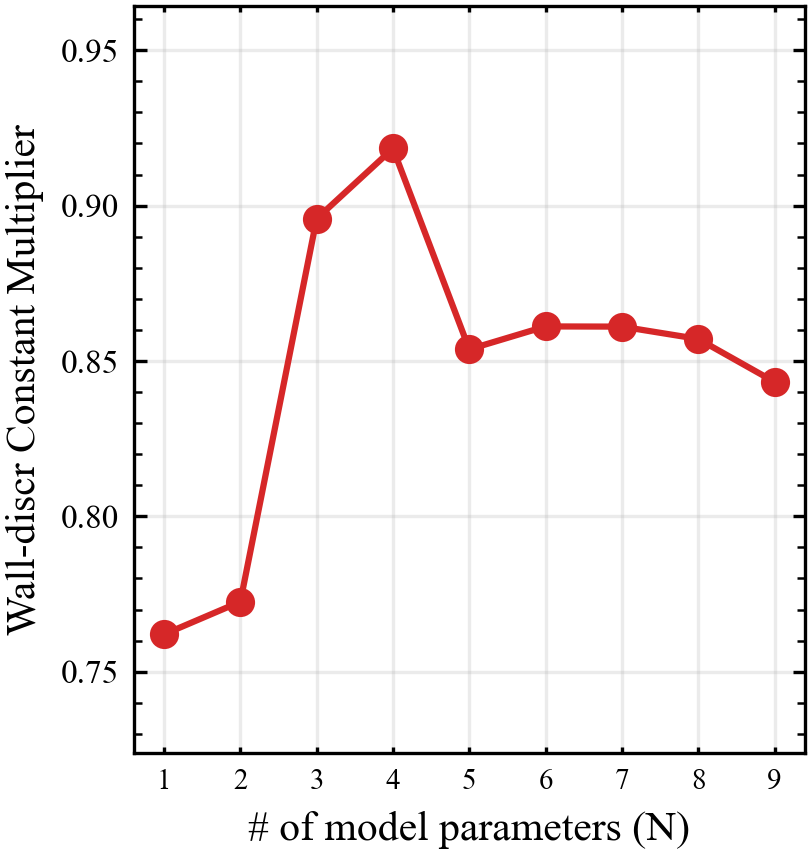
Figure 5: Variation of wall-discriminating coefficient with model complexity.
Scaling Laws for Fusion Triple Product and Power
The study recasts empirical scalings in reactor performance terms. The fusion triple product is shown to scale as:
N=19
mirroring earlier L-mode results and aligning aspect ratio and H-factor enhancement with quadratic dependence on plasma current. For conventional aspect-ratio tokamaks, fusion power (N=90) also demonstrates a near-quadratic scaling in N=91:
N=92
Power-law fits indicate N=93 for achieved results (N=94), rising to N=95 (N=96) when including projections (ITER, SPARC). Alternative regressions relating N=97 to N=98, geometric major radius, and other variables yield substantially lower explained variance.
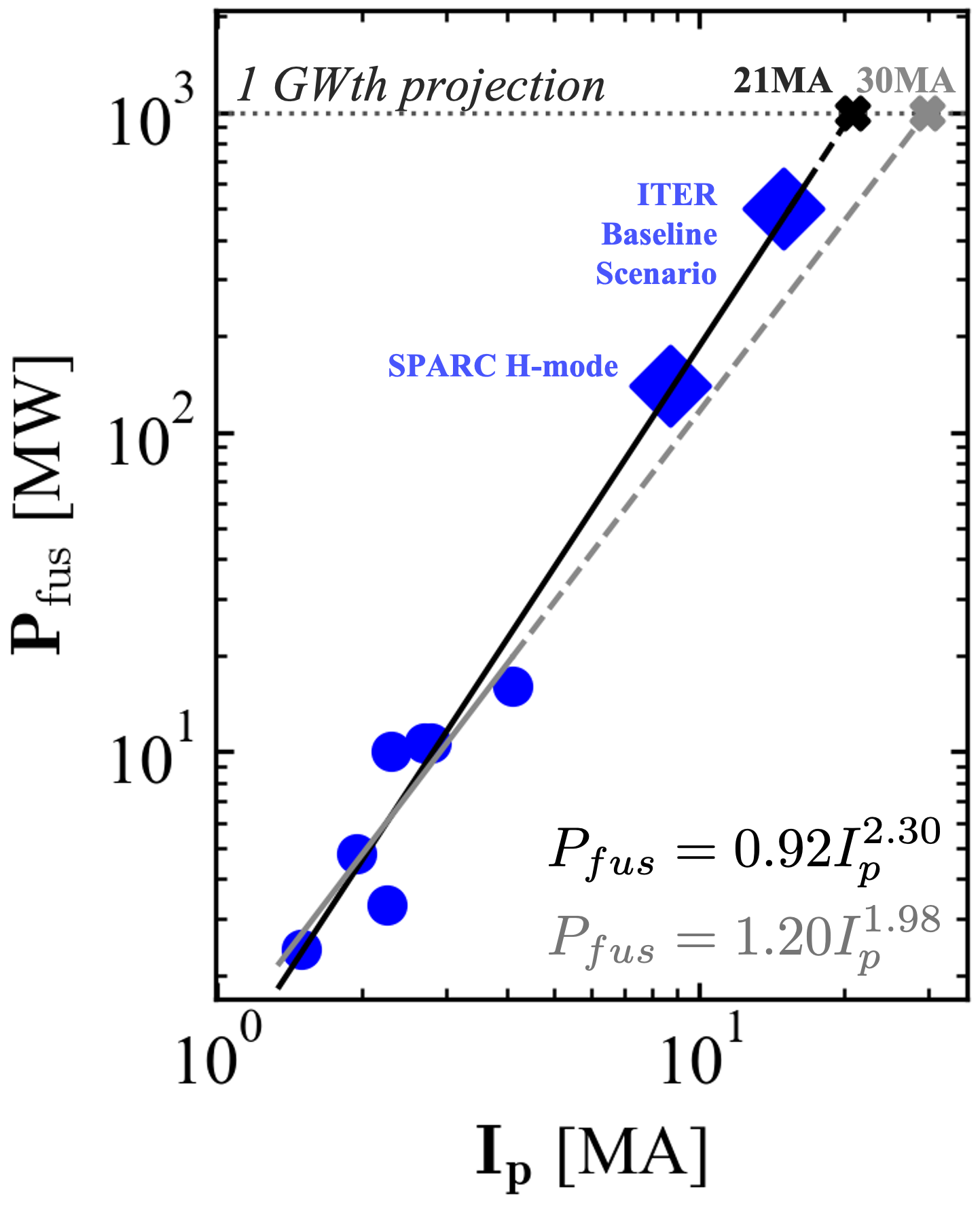
Figure 6: Empirical fusion power scaling with plasma current for both achieved and planned machines.
Implications for Reactor Design
Applying these scalings to reactor projections underscores several design implications:
Confinement projections for SPARC’s H-mode scenario, applying optimal low-order scalings, indicate a necessity for higher plasma current (N=34 to N=35 MA) than traditional models predict for reference N=36. The required machine parameters for stable operation at N=37 are derived and tabulated.
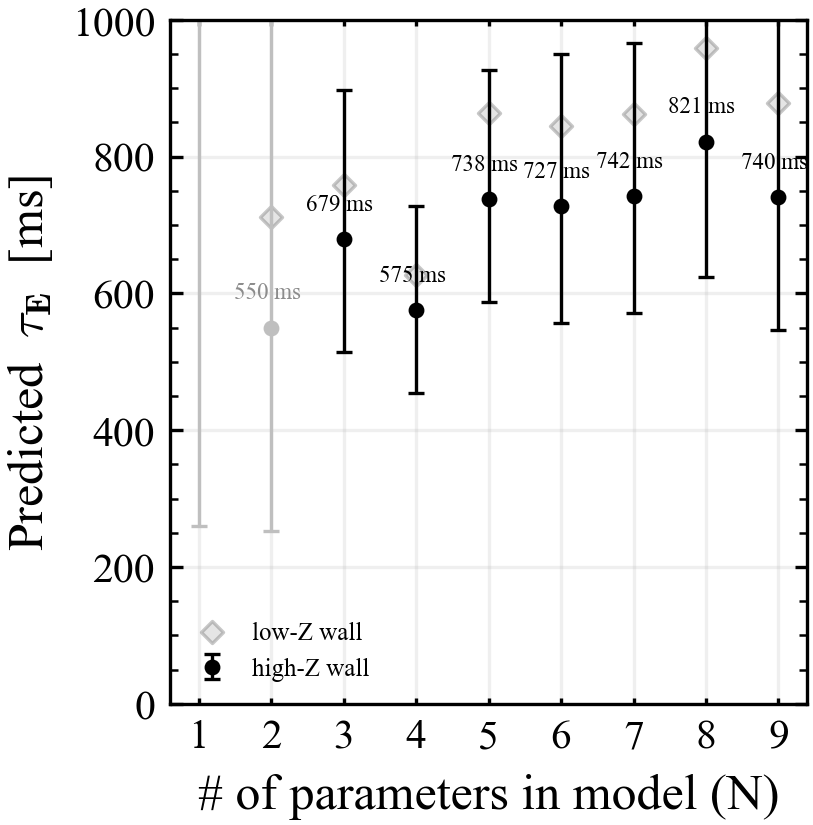
Figure 8: N=38 predictions for SPARC H-mode reference scenario across N=39 to R20 models, with wall-discriminating effects.
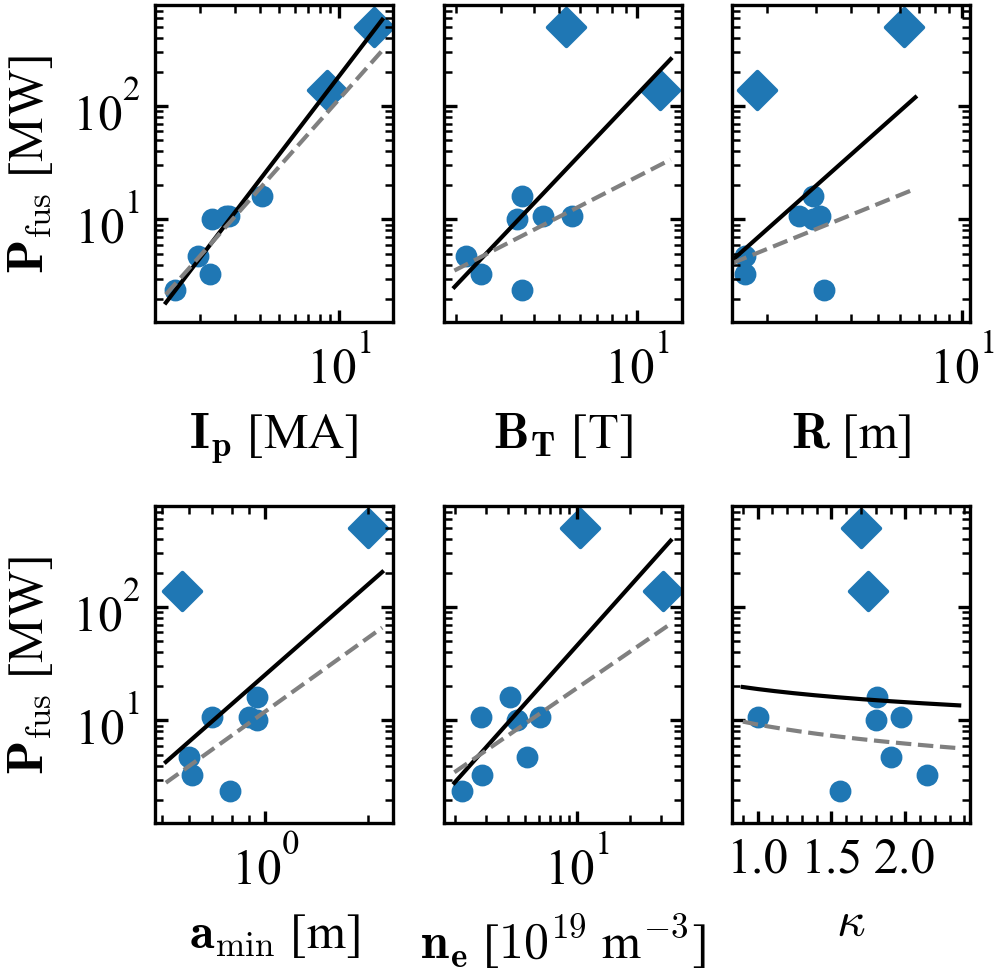
Figure 9: Single-variable power-law regressions for fusion power across engineering variables.
Discussion and Theoretical Implications
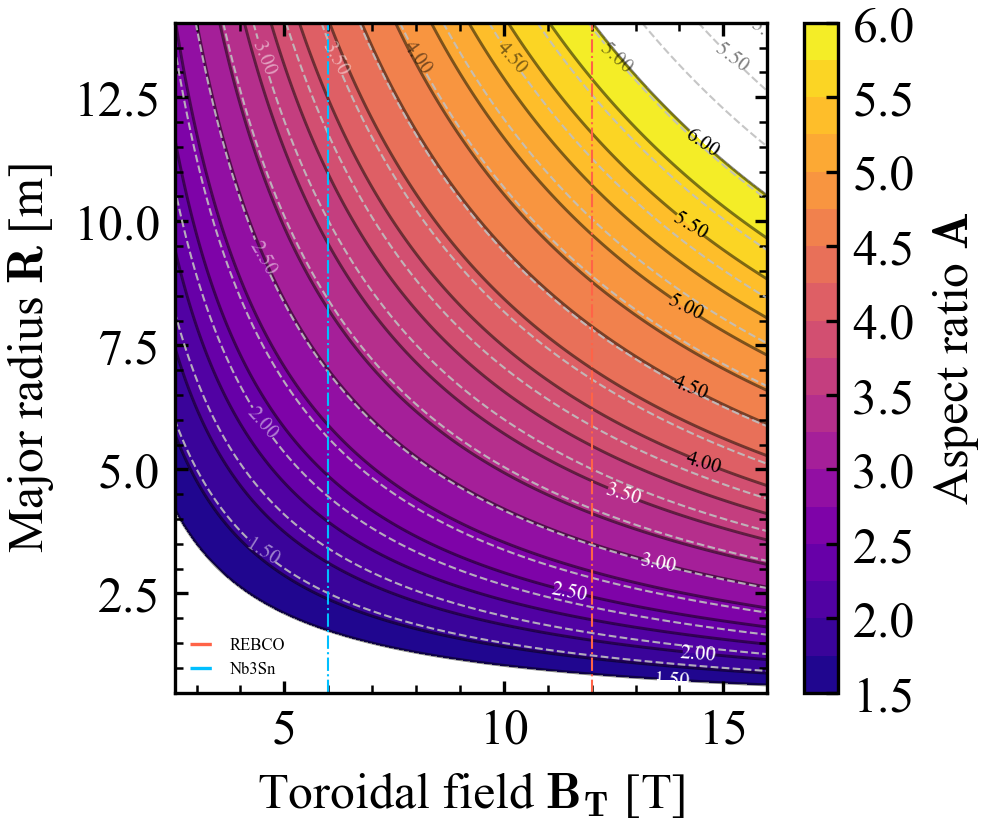
The empirical findings reinforce long-standing theoretical observations—primarily, that plasma current dominates fusion performance, while toroidal field contributes through stability and equilibrium constraints. The form of the scaling differs from traditional R21 expectations but is not inconsistent, as recasting the R22-based scaling under fixed safety factor retrieves a dependence on R23.
HTS magnet technology substantially reconfigures the design landscape, allowing access to high-R24 operation at reduced device size compared to LTS magnets. The practical requirement for gigawatt-class reactors now becomes designing devices capable of sustaining plasma current in the R25 MA range, with machine geometries optimized to operate at stable R26.
The study also touches on the potential for non-H-mode operation as an operationally simpler path to fusion milestones, albeit with significant performance risks relative to the H-mode regime.
Conclusion
This work establishes that forward extrapolation for reactor design is best grounded in empirically optimized, low-order confinement scalings that prioritize robustness over in-sample fit. Plasma current is reaffirmed as the principal engineering lever for fusion performance in conventional aspect ratio tokamaks, with wall material discrimination significantly impacting projections. These findings imply that future gigawatt-class reactors will require operation at higher plasma current than previously assumed, and HTS technology mainly serves to make such operation feasible in compact devices. Designers must secure stability at elevated R27 and account for performance degradation due to metallic walls in all critical predictions.
The study’s systematic methodology and cross-machine scaling perspective provide a more appropriate baseline for evaluating reactor designs and highlight critical directions for optimizing fusion performance and guiding future developments in fusion technology.