- The paper’s primary contribution is its detailed exploration of NT and QCE strategies to avoid edge-localized modes (ELMs) in EUROfusion tokamaks.
- It employs cross-machine experimental validation and ideal MHD models to demonstrate how plasma shaping influences pedestal stability and transport.
- The results highlight practical pathways for transferring ELM-free regime concepts to reactor-scale devices, with direct implications for ITER and future fusion reactors.
The Physics of ELM-Free Regimes in EUROfusion Tokamaks
Introduction
Edge-Localized Modes (ELMs), particularly large Type-I ELMs, present a significant challenge for the lifetime and stable operation of future fusion reactors. The EUROfusion program has therefore made the physics and operational viability of ELM-free regimes, particularly the negative triangularity (NT) and quasi-continuous exhaust (QCE) scenarios, a central research topic across devices such as ASDEX Upgrade (AUG), JET, and TCV. This paper delineates the physical mechanisms responsible for ELM avoidance, the role of pedestal transport and MHD stability, and the implications for reactor-scale plasmas.
Physics Mechanisms for ELM Avoidance
ELM occurrence is governed by the interplay between pedestal transport, often dominated by kinetic ballooning modes (KBMs), and the onset of global peeling-ballooning instabilities, commonly described in terms of stability boundaries in the j-α plane (peak edge current density j vs. normalized pressure gradient α). In conventional ELMy H-modes, plasmas are typically close to both transport- and MHD-limited boundaries. In contrast, ELM avoidance can be achieved via two principal routes:
- QCE/QH-mode strategy: Increasing the local stability limit by shaping and invoking additional edge transport via MHD activity (e.g., ballooning or kink/peeling modes at the separatrix), thus maintaining ELMy-like pedestal gradients without large ELMs.
- NT strategy: Reducing the stability limits such that the pedestal never enters the peeling-ballooning unstable domain, blocking H-mode access entirely.

Figure 1: Schematic illustration of ELM avoidance mechanisms for QCE (green) and NT (blue) relative to standard ELMy H-mode (red) in the j-α stability diagram.
A refined understanding of edge transport mechanisms, including the role of ballooning modes in different pedestal regions (top, mid, foot), is fundamental in predicting and controlling these regimes. For NT, preventing access to the second ballooning stability region is key, while QCE relies on retaining second stability access in the pedestal mid-region but invoking ballooning or KBM instabilities at the foot.
Negative Triangularity: Mechanism and Demonstration
NT as an ELM avoidance mechanism leverages robust modification of the global MHD stability boundary by tailoring the plasma shape to negative values of triangularity. TCV's shaping flexibility enabled the initial identification of the critical parameters for NT ELM avoidance and facilitated validation of predictive models. These models were successfully ported to AUG and JET, with TCV mock-ups confirming that the requisite shaping indeed blocks H-mode transition and avoids ELMs.
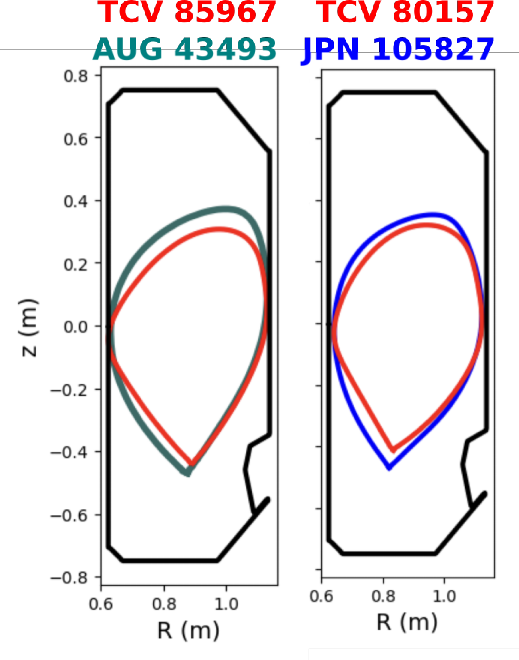
Figure 2: AUG and JET NT plasma shapes and their scaled counterparts on TCV.
Direct experimental campaigns in AUG substantiated the model predictions: weaker shaping resulted in standard ELMy H-mode, while stronger NT shaping prevented both H-mode entry and ELMs, even at heating powers well above conventional LH thresholds.
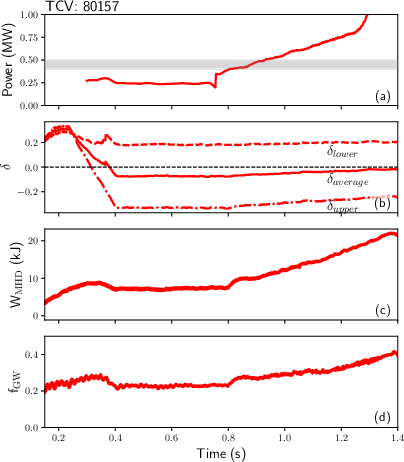
Figure 3: AUG experiments showing increased heating power in NT plasmas does not trigger H-mode or ELMs.
Similarly, in JET, NT-induced ELM avoidance was demonstrated at high power and current, confirming the transferability of these scenarios to reactor-scale devices.
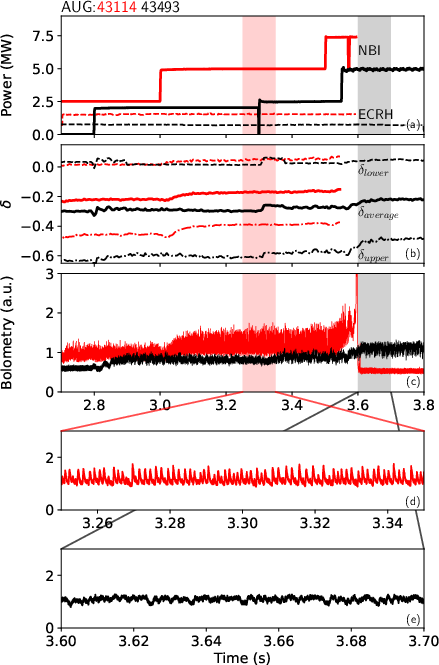
Figure 4: Time-trace comparison of ELM monitor signals in AUG NT discharges with and without ELMs.
The QCE regime is realized at high positive triangularity and high separatrix density. A key operational criterion is the accessibility of a critical normalized separatrix density, derivable via ideal MHD models, with successful cross-machine validation in AUG and JET. Transition to QCE is accompanied by the replacement of large ELMs with continuous, lower-amplitude filamentary activity, as demonstrated by divertor Langmuir probe signals and power deposition analysis.
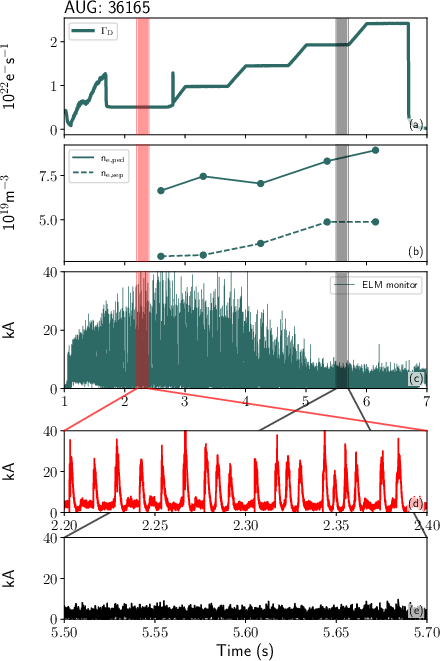
Figure 6: Main ion fueling, pedestal top and separatrix density evolution, and ELM signatures in AUG QCE discharge.
Predictive models based on the crossing of calculated critical αedge (from codes like HELENA and parametric scalings of λp) provide accurate lower bounds for the necessary separatrix density for QCE access on both AUG and JET, though models show discrepancies in TCV due to different edge physics.
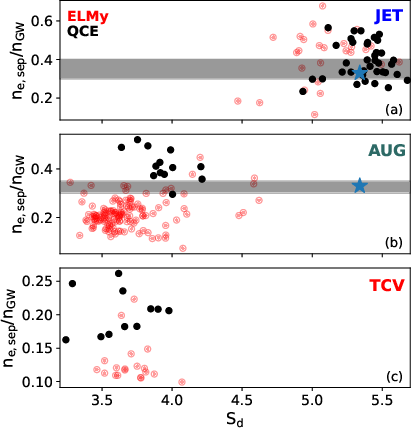
Figure 5: QCE access map in normalized separatrix density versus plasma shaping for JET, AUG, and TCV; ITER operating point overlap shown.
Pedestal top performance analysis reveals that, upon appropriate normalization (poloidal βe,pol,ped, nped/nGW), QCE plasmas achieve equivalent pedestal conditions as ELMy H-mode, with JET and AUG data lying directly on top of each other, and the QCE operational regime intersecting ITER's predicted pedestal domain.
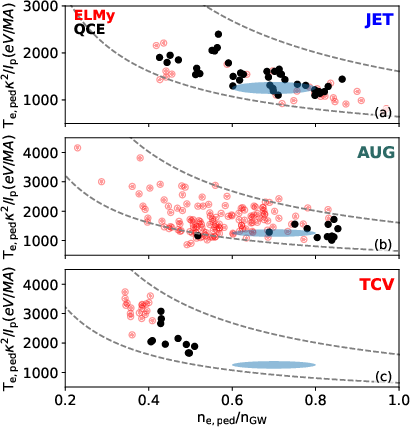
Figure 9: Normalized pedestal top temperature vs. density in QCE and ELMy plasmas across devices; ITER domain overlayed.
In JET, QCE performance was robustly demonstrated in both deuterium and DT operation, with improved pedestal pressures in DT due to density increases. Comparison with IPED model predictions confirms that experimental pedestals in QCE are consistent with ELMy H-mode expectations.
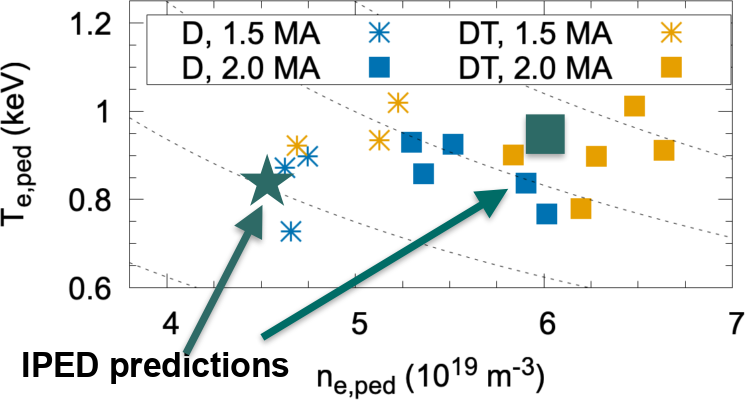
Figure 7: Pedestal top temperature vs. density in JET QCE at 1.5 MA and 2 MA in D and DT; IPED predictions overlayed.
Comparative Analysis: NT vs. QCE in JET
Direct comparison of JET pulses in QCE and NT configurations at equivalent current, field, and heating power elucidates their operational distinctions. QCE achieves higher plasma density and normalized confinement, with clear pedestal gradients and strong filament activity, whereas NT demonstrates robust ELM avoidance with lower normalized confinement but higher plasma volume, and, typically, reduced edge localized filament activity.
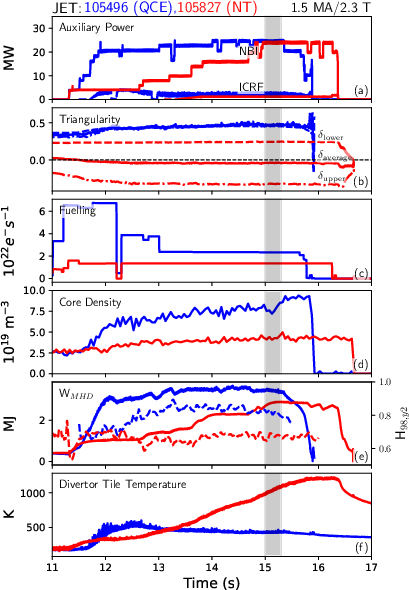
Figure 8: Time-traces of power, density, pedestal energy, ELM monitor, and tile temperature for QCE (blue) and NT (red) discharges in JET.
Profile analysis exposes nearly identical temperature profiles, but strong density pedestal in QCE versus a more core-like gradient in NT, suggesting different transport regimes in the pedestal.
(Figure 12)
Figure 10: Electron density and temperature profiles for QCE and NT in JET; QCE features pronounced edge density gradient.
Reactor Extrapolation and Future Implications
Model-based extrapolation points to accessible QCE operating space in ITER, SPARC, and EU-DEMO-class reactors, with both pedestal and separatrix requirements lying within already demonstrated parameter regimes on JET and AUG. NT and QCE access criteria are sufficiently parameterized by engineered quantities (shape, current, α0) to allow direct scenario planning for reactor design.
The QCE, with its ELMy H-mode-like pedestal but benign, distributed power exhaust via continuous filaments, is a prime candidate for operation in devices where ELM-tolerant divertors and first wall loads are imperative. The NT scenario offers a distinct pathway, leveraging shape-driven MHD stabilization to fully avoid ELMs, thus providing operational diversity for long-pulse, high-performance reactor operation.
Outstanding research priorities include the scaling of edge filamentary transport to reactor size, quantification of first wall and divertor heat loads in both QCE and NT regimes, expansion of QCE operational space to lower α1, and integration of detached divertor operation with high pedestal confinement.
Conclusion
This work establishes a comprehensive mechanistic and empirical framework for accessing and optimizing ELM-free regimes in current and future fusion devices. Both QCE and NT scenarios, underpinned by pedestal transport models and validated by cross-machine experiments, represent viable ELM-mitigation strategies. They are supported by robust operational criteria derived from ideal MHD analysis and pedestal physics. The demonstrated ability to accurately export scenario models across devices and up to reactor scale marks substantial progress towards high-confinement, ELM-free reactor operation and informs the future development of scenario optimization and integrated core-edge solutions in burning plasma experiments.

