- The paper demonstrates that hardware-aware partitioning using the fitv3 heuristic can reduce reconstruction error, matching or outperforming direct execution in structured circuits.
- It employs circuit cutting via quasi-probability decomposition to break large quantum circuits into manageable subcircuits, mitigating qubit connectivity and error limitations.
- The study highlights that the benefits of circuit partitioning depend on circuit structure and size, underscoring its potential for scalable, distributed quantum computing.
Quantum Circuit Partitioning for Effective Utilization of Quantum Resources: An Expert Analysis
Introduction and Motivation
The paper "Quantum Circuit Partitioning For Effective Utilization of Quantum Resources" (2604.22664) presents a systematic investigation of quantum circuit partitioning (QCP) as both a practical mitigation strategy for hardware limitations in the NISQ regime and a key enabler for distributed quantum computing (DQC). With current hardware constrained by limited qubit counts, connectivity, and high error rates, executing large circuits directly on quantum processing units (QPUs) remains unreliable. Circuit cutting—the process of decomposing large quantum circuits into subcircuits executed independently with results recombined via classical post-processing—has emerged as a practical route to circumvent these limitations.
The study contextualizes circuit cutting both for fidelity enhancement and for scaling quantum computation beyond single-device confines, with notable implications in modular and networked architectures.
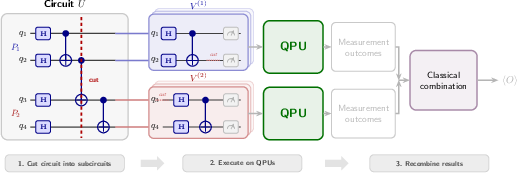
Figure 1: Quantum circuit cutting workflow—partitioning at selected locations for distributed QPU execution and classical recombination.
Circuit cutting leverages quasi-probability decomposition (QPD) to express non-local quantum operations across a cut as weighted sums of local operations. This enables observable estimation under hardware constraints, at the cost of exponential sampling overhead in the number of cuts. The literature recognizes two dominant cut strategies: wire cuts (interrupting qubit flow with state preparations/measurements) and gate cuts (decomposing multi-qubit gates into local operations) [Tang2021CutQC, brandhofer2023optimal].
The FitCut algorithm [Kan2024FitCut] applies community-detection techniques on circuit graphs to minimize cuts while maximizing QPU utilization, contrasting with Mixed Integer Programming (MIP) and Satisfiability Modulo Theories approaches that suffer from scalability bottlenecks. Hardware-aware compilation, as exemplified by DisMap [Du2024DisMap], optimizes cut placement and qubit routing to preferentially select low-noise inter-chip links, directly enhancing fidelity and reducing SWAP overhead.
The utilization of circuit cutting extends to distributed quantum computing, which relies on modular processors interconnected via entanglement resources (e.g., EPR pairs) for nonlocal operations.
Methodology
The authors implement an integrated pipeline based on Qiskit 2.0, combining FitCut-inspired partitioning, hardware-aware qubit mapping, and QPD-based reconstruction via qiskit-addon-cutting. Three execution strategies are evaluated: direct (uncut) execution, Qiskit's automatic cut finder, and a custom budget-aware heuristic (fitv3).
Benchmark circuits include GHZ, QFT, brickwork, and random circuits, with qubit counts ranging from 4 to 16. Evaluation focuses on observable-level accuracy, particularly mean absolute error (MAE) of reconstructed expectation values relative to ideal, noiseless execution.
Results and Analysis
The empirical findings demonstrate that fitv3 is generally stable, remaining close to the uncut baseline MAE across circuit families. The Qiskit automatic method produces substantially higher errors on random circuits, revealing its vulnerability to poor cut selection and excessive reconstruction overhead.
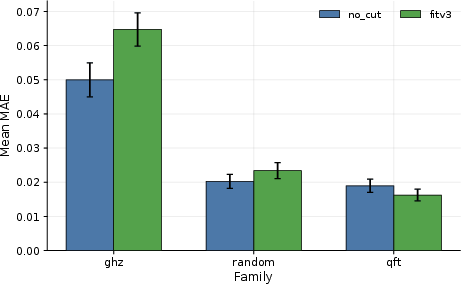
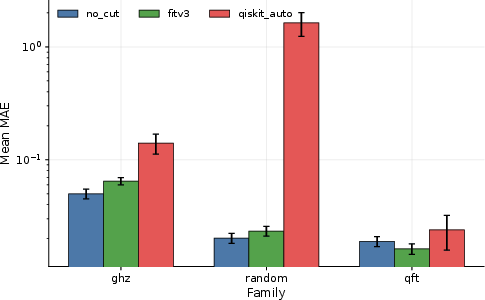
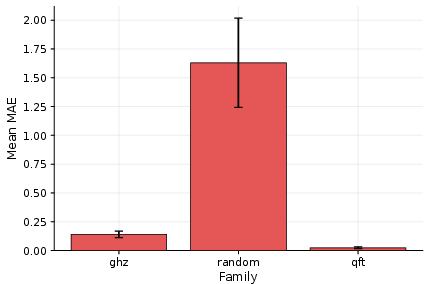
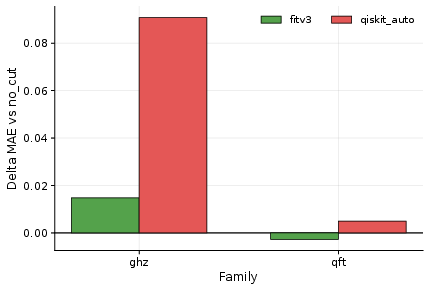
Figure 2: Family-level mean MAE comparison between direct execution and the fitv3 cutting heuristic—lower values indicate superior reconstruction fidelity.
Differential MAE Relative to No-Cut Baseline
Analysis of the ΔMAE metric shows that fitv3 often achieves parity or improvement in GHZ and QFT circuits, particularly at higher qubit counts, while offering no consistent gain for random circuits. The effect is circuit-structure dependent; QCP is effective for highly interconnected, structured circuits (e.g., GHZ, QFT) but degrades for brickwork/random families.
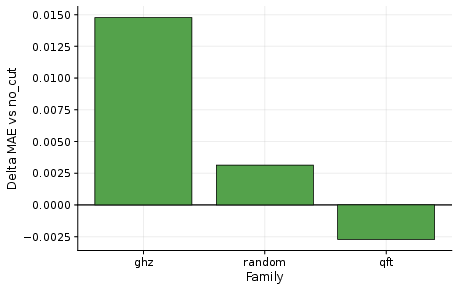
Figure 3: Family-level ΔMAE—fitv3 shows competitive performance or improvement relative to direct execution on structured families.
Size-Dependent Behavior
Size-dependent evaluation indicates that circuit cutting becomes beneficial in selected large instances—fitv3 outperforms direct execution at specific qubit counts, particularly in GHZ and QFT circuits, correlating with increased circuit complexity and inter-qubit connectivity. For random circuits, the effect is neutral.
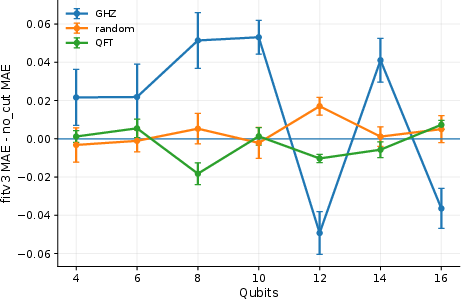
Figure 4: Difference in MAE between fitv3 and the no-cut baseline versus qubit count for each circuit family—highlighting size-dependent advantages.
Win-Rate Analysis
The fraction of repeated runs where fitv3 achieves lower MAE than the direct baseline quantifies method robustness. Fitv3 frequently wins for larger GHZ and QFT circuits, but results are mixed in random families, reinforcing the conclusion that structure and scale drive partitioning benefit.
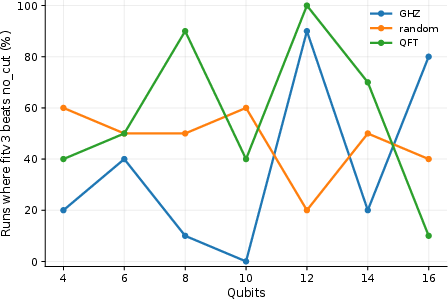
Figure 5: Per-size win-rate for fitv3 versus direct execution—a higher fraction reflects more consistent benefit from partitioning in structured circuits.
Failure Modes
The Qiskit automatic cut finder exhibits two main failure modalities: (1) infeasible cut sets due to excessive sampling overhead and (2) feasible but scientifically poor decompositions with high reconstruction error. Fitv3’s budget-aware criteria deliver more reliable performance, emphasizing the importance of cut quality beyond mere feasibility.
Implications and Future Perspectives
The work underscores that QCP is not universally superior but must be strategically applied, with circuit structure and hardware constraints being decisive. Wire cuts provide an entry-level mechanism, but integrating gate cuts—including QPD decomposition of multi-qubit unitaries—could yield further scalability and efficiency improvements. Hardware-aware and dynamically adaptive QPU routing will be essential as devices scale and noise profiles evolve over time.
The practical implications extend to distributed and modular architectures in DQC, where circuit cutting enables algorithms to utilize heterogeneous QPUs and to circumvent connectivity bottlenecks. As the quantum community approaches devices with thousands of qubits, scalable partitioning algorithms (e.g., FitCut), together with efficient classical reconstruction, will become pivotal.
Algorithm benchmarking across hardware platforms beyond IBM—such as IonQ and Quantinuum—will require tailored VST construction and partitioning strategies to accommodate varied gate sets and connectivity.
Conclusion
Quantum circuit cutting serves as a versatile tool for mitigating NISQ hardware limitations and facilitating distributed execution in scalable quantum systems. This work provides a rigorous empirical comparison of cutting strategies and demonstrates the practical feasibility of hardware-aware partitioning and execution pipelines. The fitv3 heuristic presents stable performance and occasional improvement over direct execution in structured, large-scale circuits, contingent upon careful cut selection and reconstruction budgeting. As quantum processors advance, future research must focus on gate cut integration, cross-platform compatibility, dynamic noise adaptation, and scalability of partitioning and post-processing tools.