- The paper introduces the HiLight framework, decoupling evidence selection from reasoning in frozen LLMs by highlighting key context elements.
- It formulates evidence highlighting as a weakly supervised RL problem and demonstrates significant performance gains across multi-hop QA and recommendation tasks.
- The strategy achieves efficient token-level focus with minimal context alteration, enabling robust, transferable improvements for black-box models.
HiLight: Evidence Emphasis for Long-Context Reasoning with Frozen LLMs
Motivation and Framework
The paper addresses a critical failure mode in Long Context LLMs: the inability to reliably extract and utilize sparse, pivotal evidence in lengthy, noisy inputs. This is acute in multi-hop question answering, sequential recommendation, and other scenarios where decisive signals are overwhelmed by distractors and irrelevant context. To this end, the authors introduce HiLight, a general framework for input-side evidence emphasis, which explicitly decouples evidence selection from reasoning in the LLM inference pipeline.
Unlike prompt optimization or lossy summarization-based approaches, HiLight operates by training a lightweight Emphasis Actor to insert minimal, explicit highlight tags around auto-selected spans in the unaltered context. The frozen downstream Solver LLM is then prompted with this annotated context, allowing it to focus its attention and reasoning on the surfaced evidence without any fine-tuning or architectural modification.
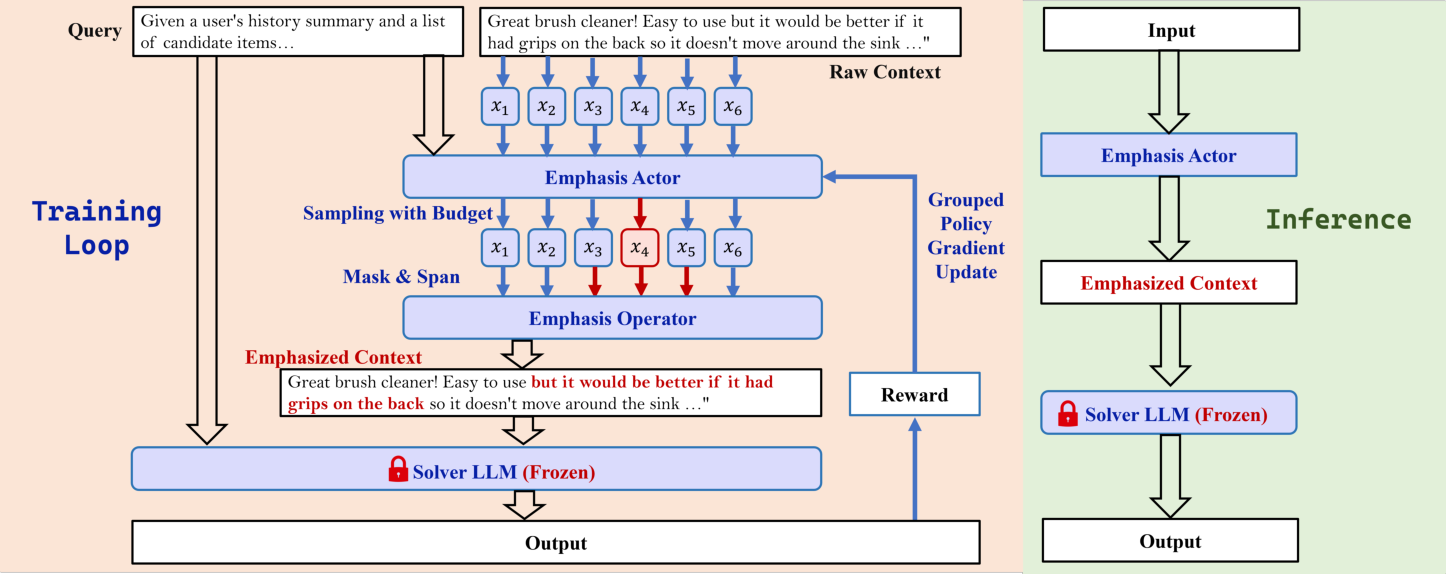
Figure 1: Overview of the HiLight framework, which decouples evidence selection (via Emphasis Actor) from downstream reasoning using a frozen LLM.
Evidence highlighting in HiLight is formalized as a weakly supervised RL problem:
- The Emphasis Actor observes a query Q and context X, and stochastically selects a budgeted binary mask M denoting evidence tokens to emphasize. A budget hyperparameter γ specifies the maximum fraction of emphasized tokens.
- The baseline Solver LLM, entirely frozen and possibly only API-accessible, is prompted with the minimally highlighted context to generate the task output.
- No explicit evidence annotations are required; the only training signal is the task reward received from the downstream Solver (e.g., EM/F1 for QA, HR/NDCG for recommendation), rendering the training compatible with black-box LLMs.
The actor policy is instantiated as a parameterized LM, assigning token importance scores conditioned on the query-context pair. Training is executed via policy gradients over grouped mask samples, and auxiliary loss terms for entropy and budget conformance are introduced to ensure robust and non-collapsing selection under the budget constraint.
Empirical Evaluation
Comprehensive experiments span sequential recommendation (Amazon-Beauty), multi-hop QA (HotpotQA), reading comprehension (SQuAD 2.0), and biomedical classification (PubMedQA). Across all tasks and metrics, HiLight delivers consistent and robust gains over strong prompt-engineering and automated prompt-optimization baselines. For instance, on Amazon-Beauty, HiLight achieves +27.5% improvement in HR@10 and +27.3% in NDCG@10 over manual instructions—a significant margin that isolates the impact of explicit evidence emphasis especially in high-distractor, sparse-signal regimens.
The performance uplift is particularly pronounced for metrics sensitive to fine-grained evidence attribution, such as F1 and ranking metrics, rather than binary correctness (i.e., EM/Acc.). This supports the claim that evidence highlighting primarily enhances the quality of evidence utilization, rather than simply causing binary output flips.
Budget Robustness and Selection Policy
A critical factor for any evidential emphasis system is robustness to the input budget γ. Sensitivity analysis on Amazon-Beauty demonstrates that HiLight maintains strong improvement over MI (manual instructions) for a wide budget range (γ∈[0.10,0.30]), with performance peaking near 0.25.
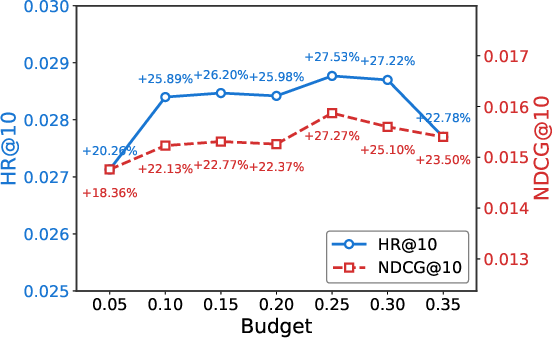
Figure 3: Sensitivity to highlight budget γ; even small budgets (γ≤0.10) yield notable gains, indicating the efficiency of selective emphasis.
These results suggest that surfacing even a small fraction of pivotal context is sufficient to meaningfully boost downstream LLM performance. This property supports practical deployment, as extensive per-task budget tuning becomes unnecessary.
Token-Level Analysis and Evidence Alignment
Fine-grained visualization on QA tasks, such as HotpotQA, shows that the learned importance distribution by the Actor is highly peaked and localized, overlapping substantially with ground-truth supporting facts. Notably, with no exposure to explicit evidence labels, the Actor achieves up to 0.78 F1 overlap with human-annotated evidence at 8B parameter scale, confirming that weak supervision from task reward suffices to recover the latent evidence structure.
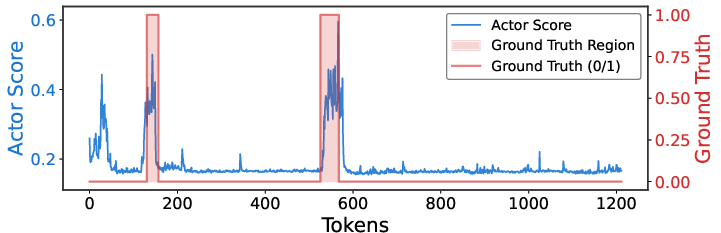
Figure 2: Token-level importance scores of the Actor concentrate on a minimal subset of context, aligning strongly with annotated supporting evidence.
Ablations and Comparative Analysis
- Non-destructive input emphasis outperforms pruning: On sparse-signal recommendation, aggressive pruning can be competitive, but on multi-hop QA pruning degrades performance. HiLight’s emphasis approach—surfacing evidence without context deletion—is essential for maintaining reasoning ability while guiding attention.
- Few-shot and random highlighting are less effective: Reference runs with random highlighting or static exemplars do not yield comparable improvements, indicating the necessity of instance-adaptive, RL-trained evidence policies.
- Policy transfer: An Actor trained with one Solver generalizes zero-shot to a spectrum of target Solvers (smaller/larger, open-weight/API-based), yielding +8.5–31.6% improvement on NDCG@10 depending on the setting. This demonstrates that the evidence selection policy is not overfit to model idiosyncrasies, but encodes reusable evidence extraction strategies.
Efficiency and Practical Implications
HiLight’s Actor imposes negligible inference and latency overhead compared to Solver LLMs, and training runs are orders of magnitude more efficient (5–10x fewer Solver queries) than prompt search-based methods. At deployment, the approach is interpretable: the highlighted evidence provides explicit, human-auditable rationales for the model’s outputs.
Implications and Future Directions
The HiLight paradigm offers a promising, architecturally non-invasive avenue for improving LLM performance in long-context, high-distractor tasks. Its compatibility with frozen, black-box Solvers (including commercial APIs), and zero-shot transferability to new model families, points toward a generalizable evidence-markup approach for context utilization.
Potential future extensions could integrate cache-aware reuse, conversational multi-turn evidence tracking, systematic comparison with rewrite/adaptive-compression methods, and consideration of additional budget-aware or adaptive emphasis constraints.
Conclusion
This work establishes explicit, policy-driven evidence highlighting as an effective and reliable mechanism for decoupling evidence selection from reasoning in long-context LLM pipelines. By eschewing compression and instead steering Solver focus via minimal, human-interpretable markup, HiLight robustly elevates LLM performance on tasks characterized by noisy and diluted context, with clear prospects for extensibility to general input-side LLM control strategies.