- The paper introduces a diagnostic task that separates symbolic markers from distributional cues for effective source-modality monitoring.
- It utilizes marker perturbations and layer-wise causal interventions to evaluate retrieval performance in contemporary VLMs.
- Findings reveal asymmetric reliance on explicit markers between visual and textual inputs, influencing robust future multimodal system design.
Source-Modality Monitoring Mechanisms in Vision-LLMs
Introduction
The paper "Source-Modality Monitoring in Vision-LLMs" (2604.22038) presents a comprehensive investigation into the mechanisms by which contemporary VLMs associate words such as "image" or "caption" in input prompts with the corresponding components of their multimodal inputs. Framed as a practical instantiation of the binding problem, the study rigorously evaluates the extent to which VLMs utilize explicit syntactic (symbolic) signals versus distributional (semantic) properties of modality-specific input spans to bind role words to source data. A combination of evaluation protocols across task variants, marker perturbations, and causal intervention techniques elucidate both the functional contributions and the limits of these mechanisms.
Task Design and Baseline Findings
The core diagnostic is the target-modality retrieval task. VLMs are presented with inconsistent image-caption pairs, and prompted to return information exclusively from a specified modality, with the competing (non-target) modality semantically mismatched via BERT-based filtering. This construction directly assesses the ability to resolve referential ambiguity in favor of the queried source, isolating source-modality monitoring from mere unimodal preference or input order effects.
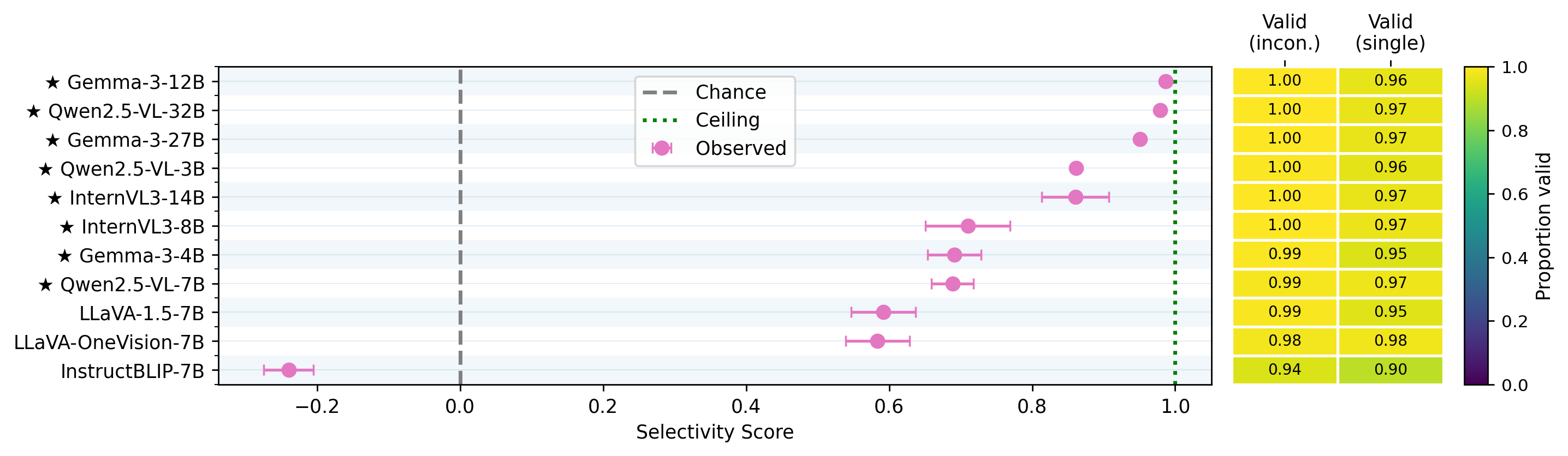
Figure 1: Left: Aggregated source-modality selectivity across VLMs and datasets. Right: Rate of valid responses for inconsistent and control settings.
Empirically, large contemporary VLMs such as Qwen2.5-VL-32B and Gemma-3-12B attain near-perfect selectivity, demonstrating robust retrieval from the designated input source. Models with explicit image wrapper tokens significantly outperform those without, and model scale correlates with selectivity. The findings substantiate that source-modality monitoring is widely implemented in modern VLM architectures, but is sensitive both to syntactic markers and to distributional signal quality.
Symbolic Binding and Distributional Cues
To dissociate symbolic and semantic binding, the authors first demonstrate that VLMs are capable of pure symbolic association: when input spans are labeled with arbitrary role labels (e.g., "Dax", "Wug"), top models near-perfectly bind these abstract symbols to their content.
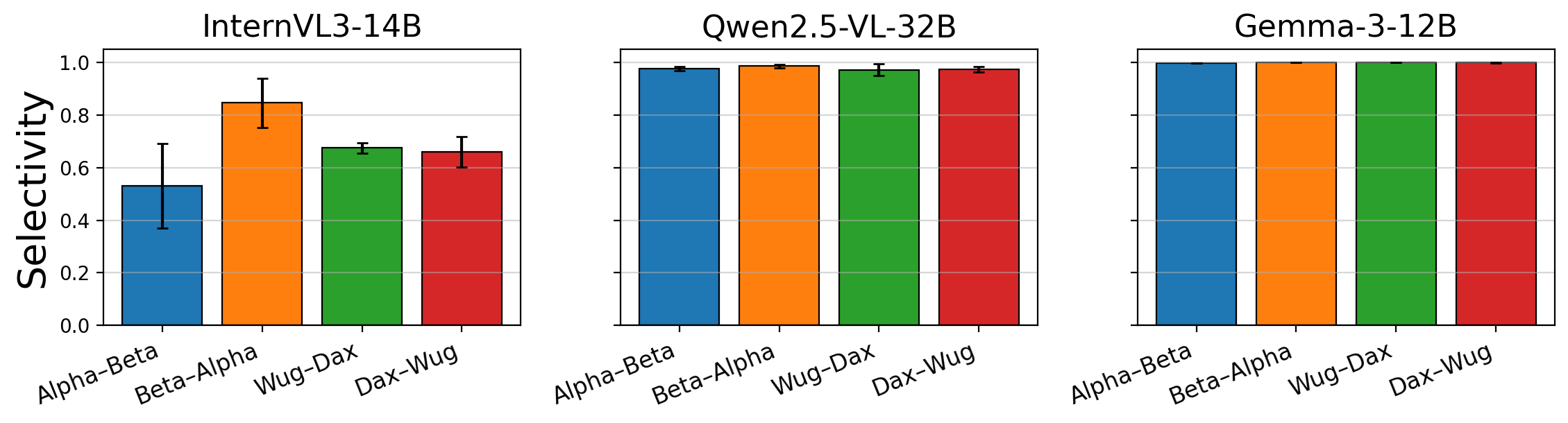
Figure 2: Selectivity in symbolic label retrieval tasks with arbitrary span labels.
Next, representational analysis at the embedding layer reveals that visual tokens and caption tokens are strongly linearly separable, with mean within-modality cosine similarity (0.21±0.06) much higher than cross-modality similarity (0.02±0.02), and 3-fold cross-validated linear probe accuracy near $1.0$. Thus, distributional signatures alone provide a powerful source identity cue, even absent explicit markers.
Structural perturbation of marker tokens (removal or swapping) results in sharply reduced, but nonzero, selectivity Figure 3, disproving a pure symbolic hypothesis: retrieval partially persists without explicit role tokens, as models fallback on semantic cues. Notably, the ability to retrieve image content is resilient, while caption-target retrieval degrades drastically, highlighting an asymmetry consistent with the relatively ambiguous distributional signature of caption tokens, especially when embedded among other text.

Figure 3: Selectivity under marker token removal or swap. Caption-target performance is acutely affected by marker manipulations, whereas image-target accuracy remains robust.
The effect of marker perturbations varies with the semantic class label assigned to the textual source ("caption", "text", or "document"), supporting the hypothesis that models encode prior expectations about the referents of these words and match them with content or structural markers accordingly.
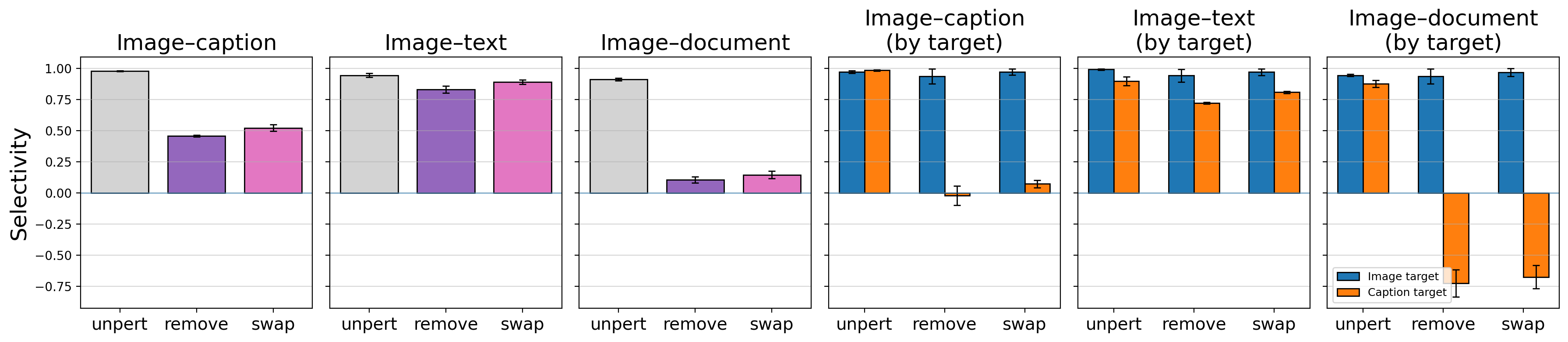
Figure 4: Selectivity in Qwen2.5-VL-32B across label/referent pairings and marker perturbations.
Contextualization and Causal Propagation
Through the freeze-remove protocol, the paper probes whether marker token information remains localized or is integrated into content token representations. By patching the contextualized content-token activations from a run with intact markers into a run without markers Figure 5, the authors show partial recovery of modality selectivity Figure 6. This outcome indicates that symbolic marker information is encoded into downstream token states, supporting a view in which binding occurs via contextual integration rather than by explicit matching of special tokens alone.

Figure 6: Selectivity following freeze-remove intervention underscores propagation of marker-derived information into content representations.
Layerwise Causal Interventions: Exploitability and Robustness
A series of layer-specific interventions with learned additive vectors (δ1, δ2) applied to marker tokens or content tokens Figure 7 quantifies the capacity to systematically reverse source-modality attribution.

Figure 7: Schematic of the learned-vector intervention for inducing model misattribution of source.
Applying marker-token interventions in early and intermediate layers is highly effective, frequently pushing selectivity below zero Figure 8. Content-token interventions are also effective, though with less pronounced effects. The effect is model-dependent: in Qwen2.5-VL-32B, marker-token interventions cause robust misattribution through a broad range of layers; in Gemma-3-12B and InternVL3-14B, the effect is more localized to early/middle layers and is attenuated in later processing stages (Figures 13, 14).
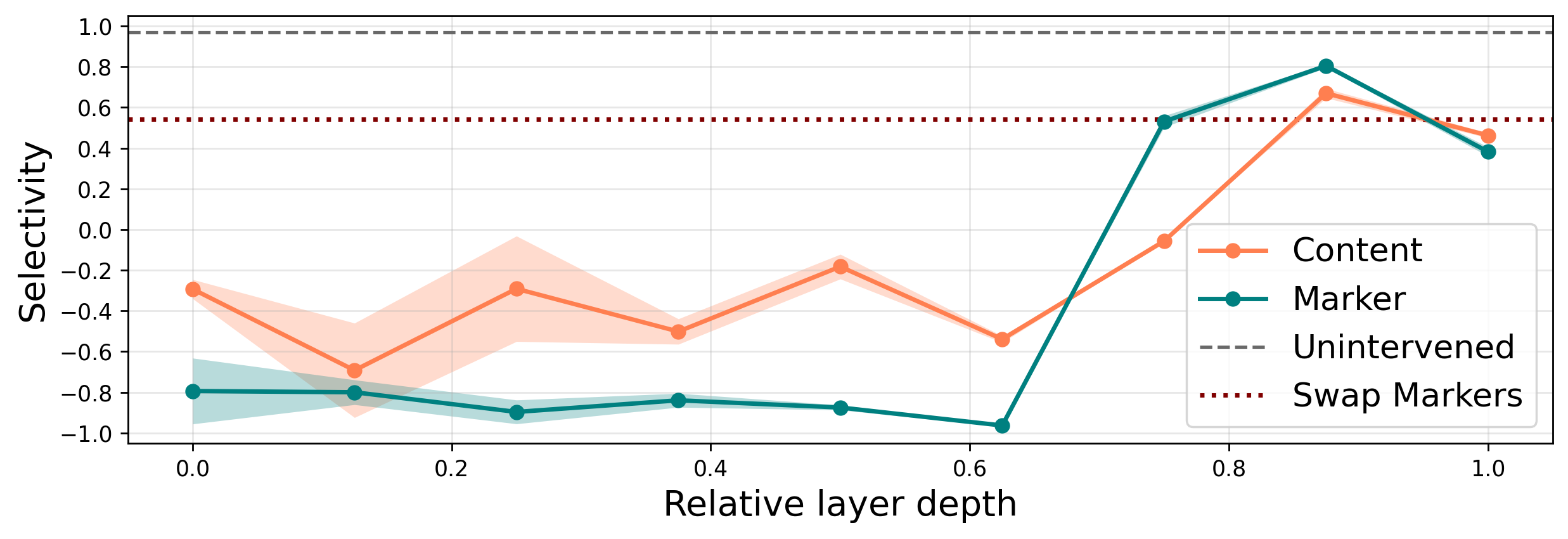
Figure 8: Layerwise selectivity of Qwen2.5-VL-32B under interventions demonstrates that marker-token representations are particularly causally accessible for source misattribution.
These results establish that source-modality is encoded in both subspaces but marker positions provide a privileged, causally accessible handle for attribute reversal—yet the influence fades as representations are further processed.
Theoretical Implications and Future Directions
The findings position source-modality monitoring as a distinctly hybrid symbolic-semantic binding mechanism. Unlike classic variable binding in connectionist architectures, modality attribution relies critically on the alignment and integration of explicit markers and distributional cues, with variable weighting depending on the reliability and distinctiveness of the available signals. The observed asymmetries between visual and textual source grounding point to a need for more nuanced training protocols, especially as multimodal models extend to settings where structural markers are unreliable or unavailable.
Practically, these results have implications for the design of robust multimodal and agentic models. The dependence on symbolic markers may leave systems brittle under input corruption, misaligned preprocessing, or adversarial attacks targeting special tokens. Conversely, the irreducible role of distributional cues means that advances in learned representation could compensate for future settings in which explicit markers cannot be systematically provided (e.g., heterogeneous input logs or dynamic perceptual streams).
In future work, extensions to less canonical input sources (e.g., temporal events, abstract memory slots, or referential expressions without distributional distinctiveness) will likely reveal the limits of current approaches and motivate new architectures for tracking provenance across arbitrarily fine-grained input "micromodalities." The causal accessibility of binding representations further suggests an avenue for dynamic model editing and controllability at inference time.
Conclusion
"Source-Modality Monitoring in Vision-LLMs" establishes the dual role of explicit markers and distributional semantics in supporting referential binding of input source words to multimodal content. The research articulates the interplay between syntactic and semantic mechanisms, quantifies their impact via causal interventions, and identifies the boundary conditions under which each mechanism dominates. These insights provide a rigorous foundation for both mechanistic interpretability and the design of robust, extensible multimodal systems.

