- The paper establishes that tensor network methods with belief propagation cannot feasibly simulate high-order OTOC experiments.
- It uses geometric entanglement arguments and numerical scaling to reveal the exponential growth in required bond dimensions.
- The work reinforces claims of quantum advantage by demonstrating TNBP's limitations and guiding future classical simulation strategies.
Tensor Networks with Belief Propagation: Limitations in Simulating Google's Quantum Echoes Experiment
Introduction and Motivation
The study systematically interrogates whether tensor network methods leveraging belief propagation (TNBP) can efficiently simulate the out-of-time-order correlator (OTOC) circuits realized by Google Quantum AI's quantum echoes experiment. While quantum computational advantage has been claimed in various experimental platforms, recent work has recalibrated many such claims through algorithmic advances in classical simulation, particularly with tensor networks. However, most tasks previously exhibiting putative quantum advantage were either statistical in nature or lacking reproducibility in measurement. The quantum echoes experiment addresses this by measuring high-order OTOCs with reproducible outcomes in large-scale 2D quantum circuits—thus constituting a nontrivial reproducible quantum advantage claim.
The TNBP method, fusing projected entangled pair state (PEPS) evolution and message-passing inspired truncations, had been pivotal in challenging classical hardness frontiers, especially for 2D local Hamiltonian dynamics on lattices with bounded tree-width. The present work establishes, both by geometric entanglement arguments and explicit scaling studies, that TNBP cannot feasibly match the experimental fidelity or sample complexity of the quantum echoes OTOC measurements, especially near the “frontier” regime (e.g., N=65 for OTOC(2) and N=95 for OTOC).
OTOC Circuit Structure and Quantum Lightcones
The OTOC for random quantum circuits is formulated as the expectation of a local observable in a nontrivially time-evolved state, expressible as ⟨ϕ∣M∣ϕ⟩, with ∣ϕ⟩=U†BU∣0⟩⊗N, where M is a local measurement and B the so-called butterfly operator. The experimental protocol leverages the lightcone structure of quantum circuits: both the 'geometric' lightcone (determined by circuit connectivity and gate layout) and the 'physical' lightcone (set by information propagation velocities for the specific random unitary ensemble).
The applicability of tensor network techniques is directly tied to the compressibility—or lack thereof—of the entanglement structure created within the intersection of these lightcones. When M is within or near the edge of B's physical lightcone, the OTOC exhibits large instance-to-instance fluctuations that can only be accurately captured by methods retaining extensive correlations, providing a rigorous test for any classical simulation ansatz.
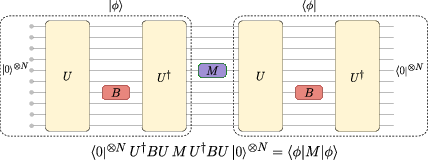
Figure 1: The OTOC, despite repeated time evolution, reduces to the expectation value of a local operator in a time-evolved state, ∣ϕ⟩=U†BU∣0⟩⊗N.
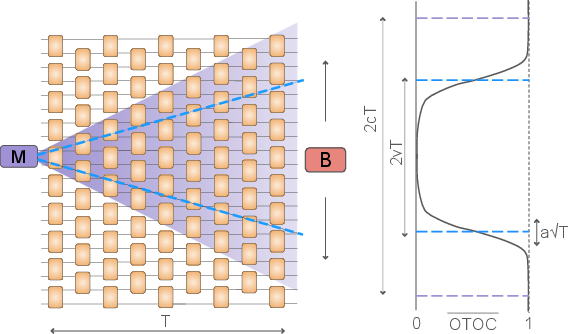
Figure 3: The average OTOC depends critically on the positions of (2)0 and (2)1 relative to geometric and physical lightcones, with large fluctuations near the physical lightcone edge.
TNBP Algorithmic Structure and Theoretical Scaling Bounds
TNBP proceeds by time-evolving the initial product state via a sequence of nearest-neighbor gates (arranged in brickwall patterns), recursively truncating the PEPS bond dimensions based on locally optimal belief-propagation-derived environments, and finally extracting expectation values via boundary matrix product states (bMPS).
A geometric entanglement argument derived in the work establishes that for random-circuit OTOCs, the maximal required PEPS bond dimension, (2)2, grows exponentially with the minimum of the (pruned) circuit depth or the linear system size (2)3 (in 2D, (2)4 for (2)5 qubits). This conclusion is robust even after accounting for possible partial compressibility outside the strict physical lightcone; only the “core” of the circuit—gates acting within the intersection of the measurement and butterfly operator lightcones—contributes essentially, but this core rapidly grows with circuit size.
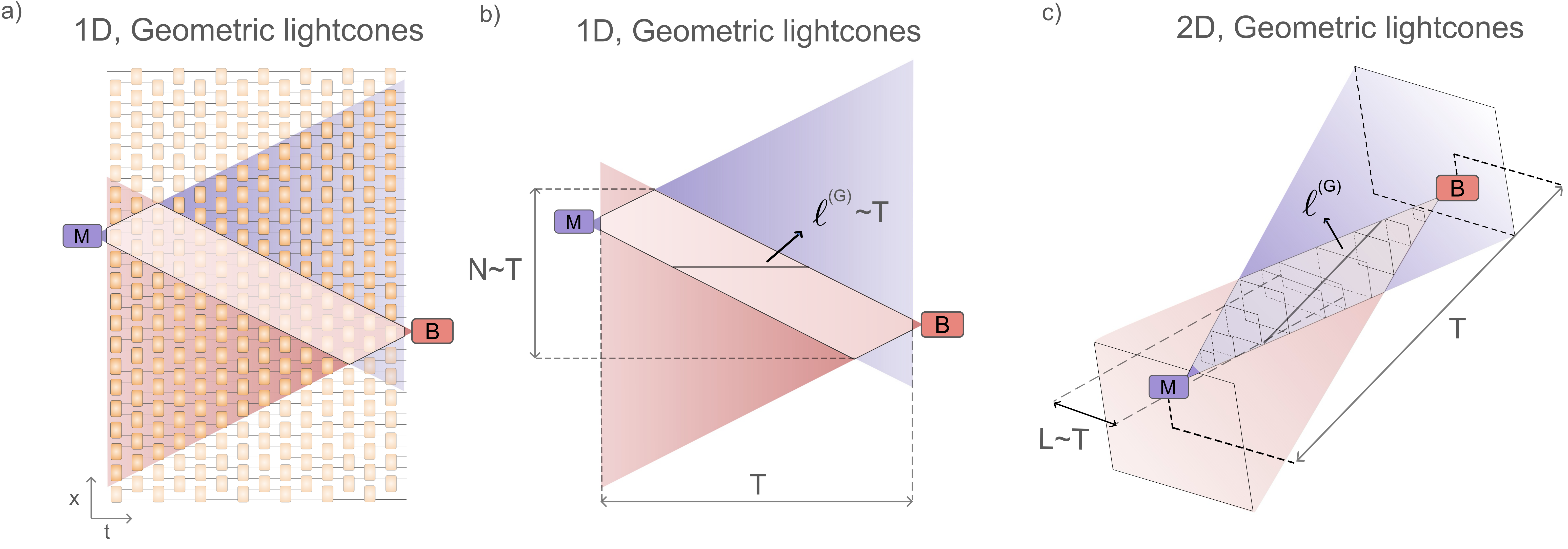
Figure 2: Only gates in the intersection of (2)6's (purple) and (2)7's (red) geometric lightcones contribute to OTOC entanglement, determining the region that must be retained for simulation.
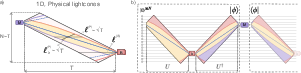
Figure 4: Regions outside the physical lightcones are partially compressible; nevertheless, the incompressible core, scaling with the circuit depth, governs the asymptotic cost.
Numerical Scaling and Empirical Evidence
Empirical simulations in both 1D and 2D architectures corroborate the exponential cost predicted by the geometric arguments. In 1D random circuits (using both Haar and iSWAP-like ensembles), the bond dimension (2)8 required to achieve fixed fidelity or SNR in OTOC computation grows as (2)9, with N=950 depending on the separation of N=951 and N=952 relative to the lightcone edge.
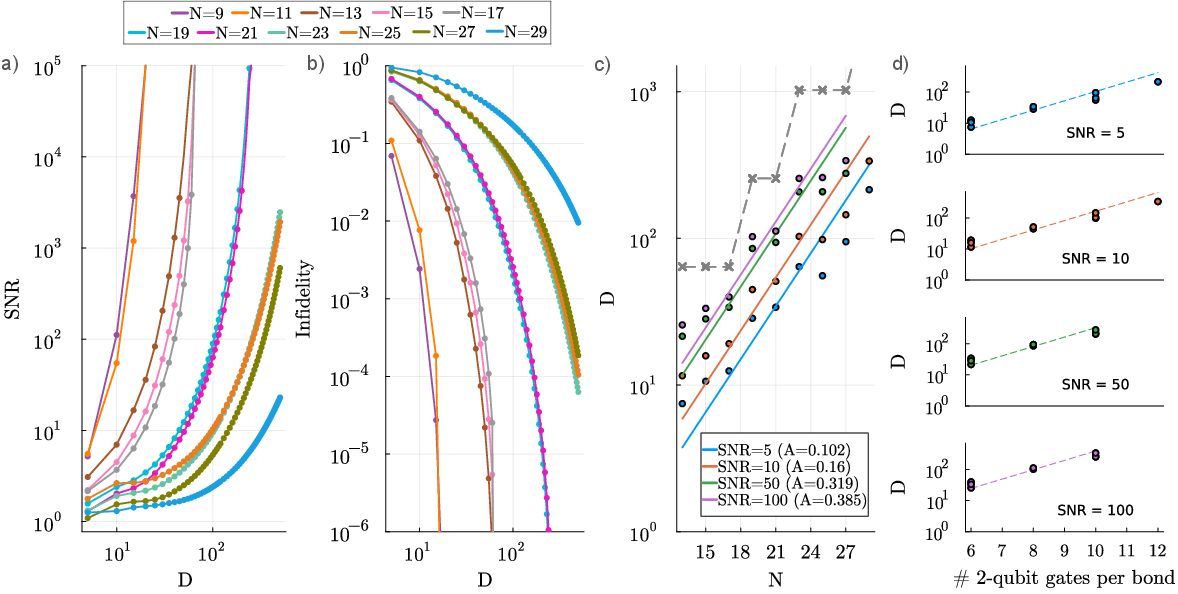
Figure 5: Required MPS bond dimension N=953 grows exponentially with system size N=954 for fixed SNR in 1D OTOC simulation with Haar random circuits.
In 2D, simulation of Google's 23-qubit quantum circuit instances—as well as analogous constructed circuits up to N=955—demonstrates that practical bond dimensions (N=956) are grossly insufficient to obtain SNR levels matching experiment or even MC-based tensor network contraction methods (TNMC). The performance deficit grows rapidly with system size or circuit depth.
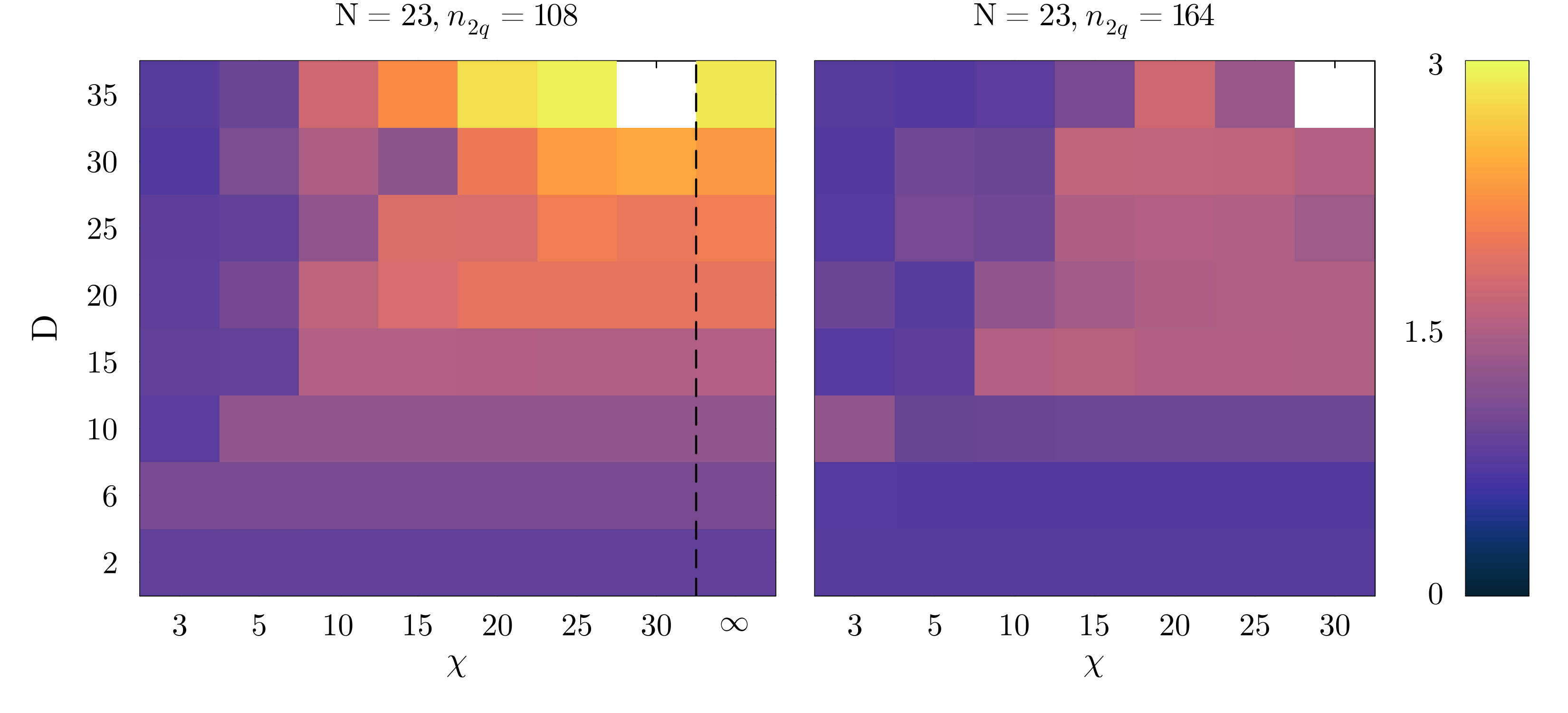
Figure 6: SNR achieved by TNBP (as a function of N=957 and N=958) for 23-qubit OTOC circuits, clearly showing non-convergence for achievable resources.
Further investigation reveals that the inability of TNBP to simulate faithfully is not an artifact of the truncation schedule but reflects a fundamental inability to compress the highly entangled states generated by deep random circuits. Single final global truncation after exact evolution still results in similar fidelity loss as repeated truncation.
When the underlying gates in N=959 are made less entangling (e.g., by tuning the iSWAP exponent), circuits become highly compressible and TNBP rapidly recovers accurate results, demonstrating that the observed hardness is not generic to all quantum circuits but rather a direct consequence of high entanglement/scrambling.
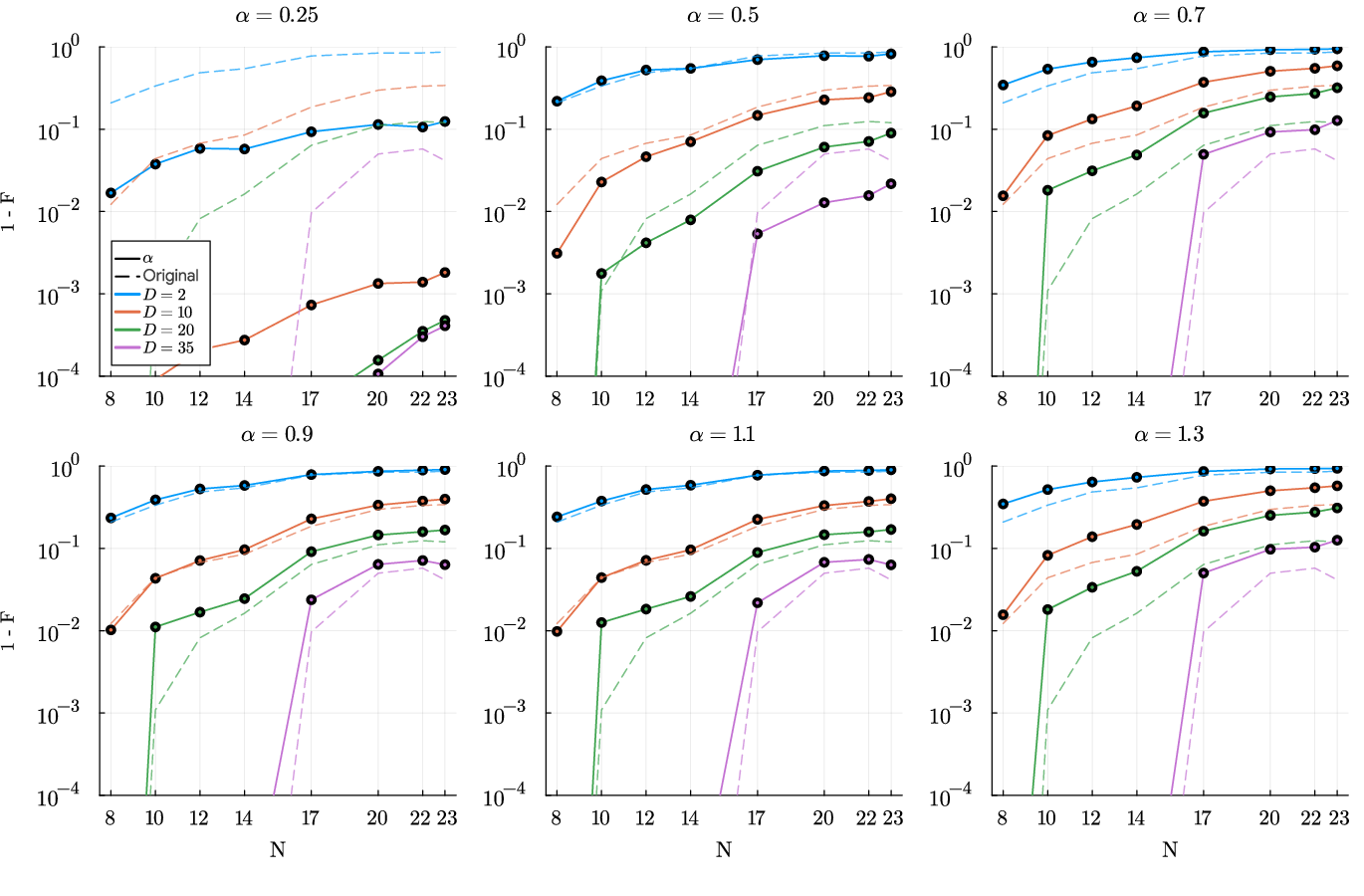
Figure 9: Simulation cost is directly tied to entanglement; for weakly entangling gates, required bond dimension for accurate OTOC drops precipitously.
Bounding the Classical Cost and Implications
Extrapolating from empirical and theoretical scaling, the required bond dimensions for frontier circuits (e.g., OTOC⟨ϕ∣M∣ϕ⟩0 on 65 qubits) are beyond the memory and computational capacity of current or foreseeable classical supercomputers—a single PEPS tensor would require orders of magnitude more storage than is present on state-of-the-art systems like Frontier. Moreover, even an "optimal" contraction in the TNBP approach is strictly more expensive than advanced classical contraction methods already benchmarked for these circuits, reinforcing that TNBP cannot reproduce the experiment with attainable resources.
Significantly, the work also clarifies that no alternative PEPS-based truncation (e.g., full update, cluster-corrected BP) can fundamentally circumvent the cost scaling imposed by circuit incompressibility. The only exception with improved scaling arises in specially tailored Heisenberg picture approaches, which, while polynomially reducing exponents, still entail exponential scaling in the relevant variable (e.g., ⟨ϕ∣M∣ϕ⟩1).
Outlook and Conclusions
This work imposes stringent bounds on the classical simulability of high-order, highly entangling random-circuit OTOCs, closing one of the plausible loopholes in claims of reproducible quantum advantage. The results are of immediate relevance for benchmarking quantum computing hardware, demarcating the boundary between classically efficiently simulable and genuinely quantum-intractable tasks, particularly for ensemble properties beyond random circuit sampling.
For future research, it is essential to refine the interplay between entanglement structure, circuit geometry, and simulation cost, especially for intermediate cases and other ensembles of physical relevance. Extensions to more advanced message-passing or hybrid simulation protocols may be considered, but absent nontrivial circuit compressibility, Schrödinger-picture TNBP methods are fundamentally noncompetitive in the 'frontier' regime. These findings inform both the design of quantum advantage protocols and the continued development of classical simulation algorithms.
Conclusion
The article provides a comprehensive, technically rigorous argument—supported by both theoretical and numerical results—that tensor networks with belief propagation truncations are infeasible for simulating large-scale, highly entangling OTOC experiments such as those performed in Google's quantum echoes experiment. The physical and computational intractability derive from intrinsic circuit-generated incompressibility that cannot be alleviated by current perturbative or local environment approximations in PEPS-based simulations. This consolidates the experimental assertion of quantum advantage for reproducible observable estimation in large random circuits via OTOCs and delineates a sharper frontier for classical simulation in quantum many-body dynamics (2604.15427).

