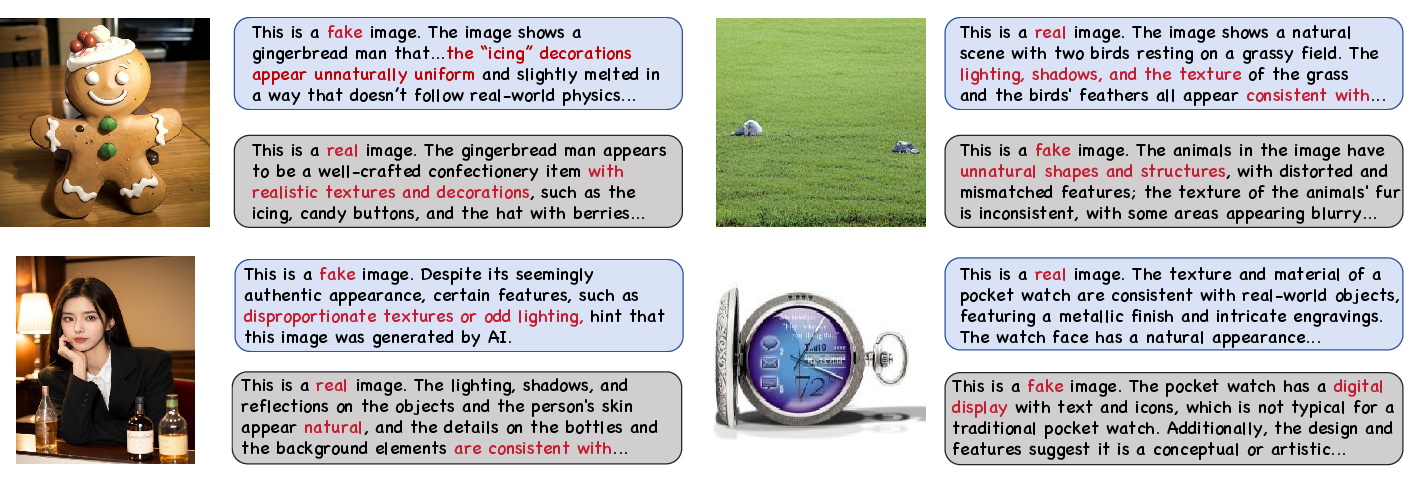
- The paper introduces a unified framework that co-evolves image generation and detection via a two-stage optimization, integrating generative cues with detection feedback.
- The methodology employs a novel symbiotic multi-modal self-attention module and detector-informed generative alignment to boost synthesis quality and detection accuracy.
- Experiments on multiple benchmarks demonstrate significant performance gains, robust cross-dataset generalization, and improved interpretability in authenticity judgments.
UniGenDet: Unified Generative-Discriminative Co-Evolution for Image Generation and Detection
Motivation and Overview
Advances in image generation have led to a rapid escalation in generative model capabilities, paralleled by growing challenges in detecting synthetic content. Existing paradigms have primarily evolved in isolation: generative models, such as GANs, VAEs, and diffusion transformers, optimize for perceptual quality, while detectors—often discriminative, task-specific, or vision-language-based frameworks—are reactive to ever-evolving forgeries. This architectural and methodological divergence creates a persistent arms race, with detectors prone to overfitting on obsolete artifacts and failing to generalize across domains and generative architectures.
The paper "UniGenDet: A Unified Generative-Discriminative Framework for Co-Evolutionary Image Generation and Generated Image Detection" (2604.21904) introduces a unified framework that tightly couples image generation and detection within a single multimodal architecture. The approach leverages a symbiotic learning process: generators inform detection modules about synthetic distributions, and detectors provide upstream feedback to generators for authenticity-aware synthesis, thereby closing the loop between production and authentication.
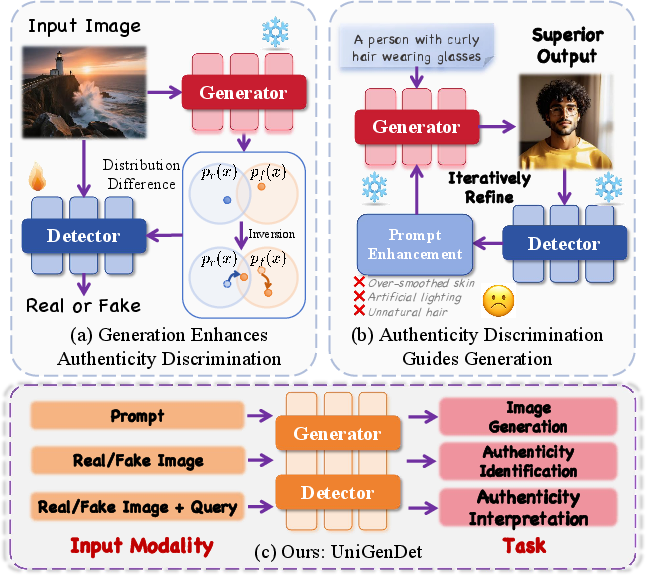
Figure 1: Illustration of the UniGenDet framework, showing the co-evolutionary synergy between generation and authenticity discrimination, with support for multi-modal and multi-task operations.
Framework and Methodology
Two-Stage Co-Evolutionary Optimization
UniGenDet implements a two-stage pipeline to bridge the gap between generative and discriminative objectives:
- Generation-Detection Unified Fine-tuning (GDUF):
- Both image generation and detection (with explanation) tasks are jointly fine-tuned atop a Mixture-of-Transformers generative-understanding base (BAGEL).
- A novel Symbiotic Multi-modal Self-Attention (SMSA) module orchestrates layer-wise interaction among generation latents, detection features, and textual representations, enabling detection heads to absorb distributional insights from the generation module.
- Detection is framed as a binary classification with explanation, where image and instruction inputs are fused and attended by SMSA to inform both label prediction and natural language rationale.
- Detector-Informed Generative Alignment (DIGA):
- After initial co-finetuning, the generator receives additional constraints by aligning its intermediate representations to those of a frozen, dedicated detector model.
- Feature alignment is enforced via cosine similarity in high-level embedding space, providing rich, reconstructive authenticity feedback over mere scalar adversarial losses.
- This alignment discourages the persistence of forensically exploitable artifacts during synthesis and steers generation toward the real image manifold as recognized by the detector.
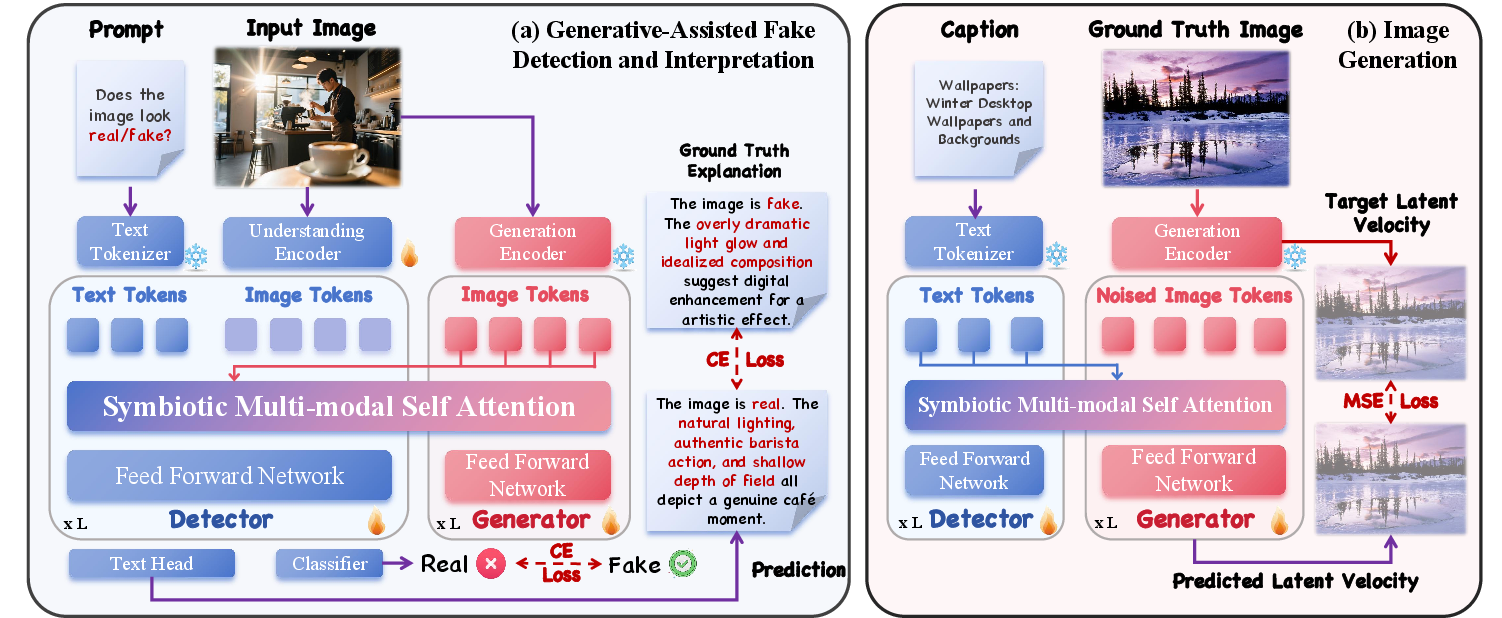
Figure 2: GDUF pipeline. (a) Detection with generator-informed analysis and textual rationale via SMSA. (b) Generation enhanced by discriminative cues from the detection branch.
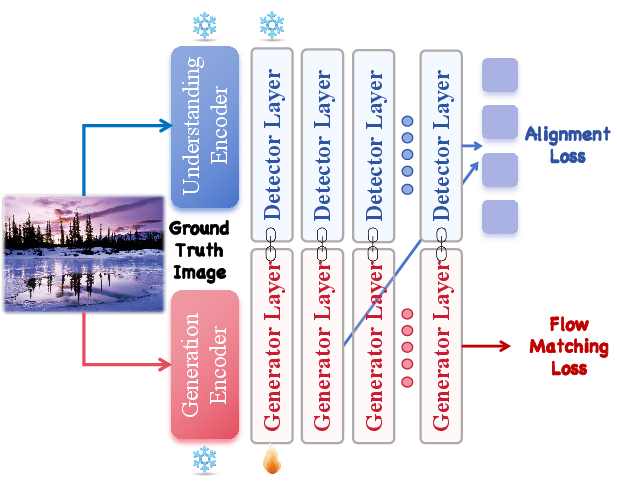
Figure 3: DIGA pipeline: Generator features are directly aligned to detector representations, infusing the generator with forensic knowledge for authenticity-aware synthesis.
Experimental Validation
UniGenDet demonstrates state-of-the-art detection efficacy across diverse and challenging benchmarks:
Image Generation Quality
- FID Benchmark: Achieves FID of 17.5 on LAION-derived evaluation, significantly outperforming the base model (BAGEL: 22.9; plus GDUF: 19.4). This indicates a closer match between generated and real image distributions, especially in high-level perceptual features, and fewer low-level artifacts.
- Text-Image Alignment: On the GenEval benchmark, UniGenDet attains 0.95 TO and 0.94 CL—comparable to dedicated T2I models and only marginally below the upper-bound established by the original multi-task backbone in niche facets (COUNT, ATTR).
- Qualitative Fidelity: Visualizations confirm improved structural coherence, lighting realism, and semantic consistency in generated scenes compared to the baseline, attributed to detection-guided synthesis.
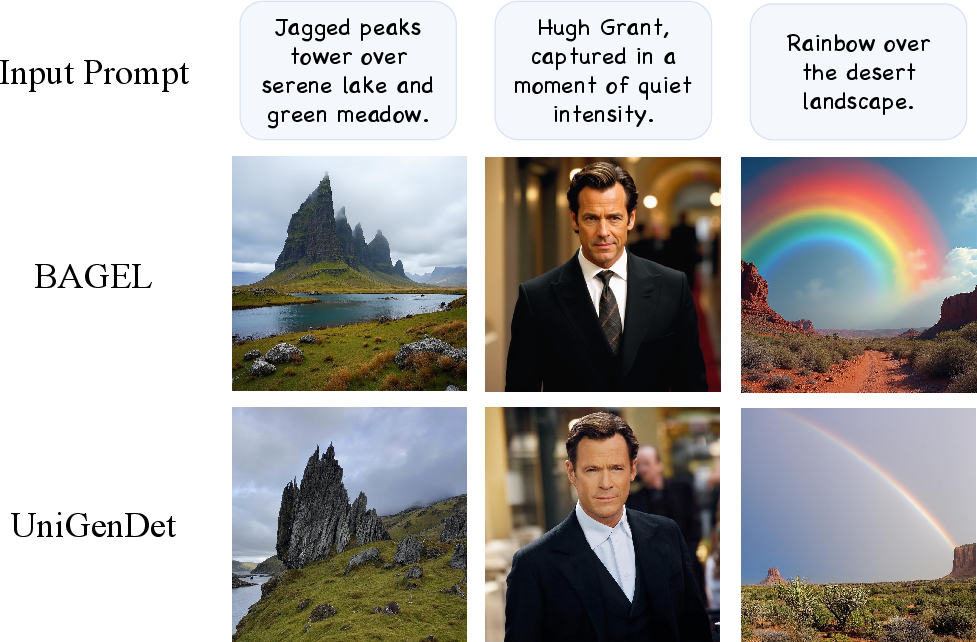
Figure 5: Qualitative generation comparison: BAGEL (middle) vs. UniGenDet (bottom). UniGenDet outputs landscapes with improved physical plausibility and artifact-free content.

Figure 6: Supplementary generation results corroborating the detection-driven optimization benefits.
Ablation, Robustness, and Failure Analysis
Ablation studies confirm the necessity of both the SMSA module and dual-stage fine-tuning. Removing cross-modal interaction or adversarial feature alignment reduces detection accuracy by up to 57.5 points (in extreme case, w/o GDUF) and FID increases by 5.4, demonstrating the synergy of discriminative and generative co-adaptation.
The robustness evaluation indicates that UniGenDet is resilient to common media corruptions, such as JPEG compression and cropping, outperforming FakeVLM by over 10% under severe degradation due to reliance on semantic (rather than fragile frequency) cues.
Failure cases remain in highly stylized forgeries or rare authentic images, underscoring the challenge of open-domain, edge-distribution synthesis and detection.
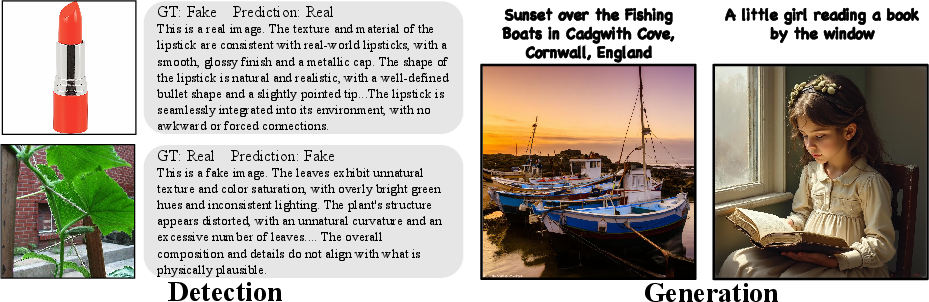
Figure 7: Example failure cases in detection and generation highlight the limitations under extreme distribution shifts and highly complex scenes.
Implications and Future Directions
UniGenDet operationalizes the principle that generation and detection are fundamentally entwined within the adversarial evolution of generative systems. By providing constructive, bidirectional integration at the architectural and training levels, the framework addresses chronic limitations in generative model evaluation and synthetic media authentication—domain adaptation lag, shallow forensic oversight, and brittle discriminators.
Practical Impact: The unified model streamlines deployment, reduces system complexity, and catalyzes rapid response to emerging generative paradigms, serving both creative and verification applications in digital media. Enhanced interpretability and cross-task learning boost reliability in high-stakes scenarios, such as journalism, law enforcement, and scientific publishing.
Theoretical Significance: The results suggest that information-theoretic feedback—beyond adversarial scalar loss—generalizes more robustly and fosters emergent representations aligned with authentic data manifolds. This approach transcends GAN-style binary adversarialism by exploiting richer cross-modal supervisory signals, potentially informing unified architectures for broader generative-understanding tasks (e.g., multimodal editing, video synthesis, and content attribution).
Directions for AI Evolution: The paradigm paves the way for future foundation models integrating generation, discrimination, and interpretability across modalities. Scaling co-evolutionary objectives, incorporating explicit spatial grounding, and leveraging continually updated adversarial feedback can further enhance resilience to distribution shift and model obsolescence.
Conclusion
UniGenDet constitutes a methodology shift for generative and discriminative vision AI: effectively coupling synthesis with forensic reasoning results in measurable gains in both generation quality and detection reliability. The closed-loop framework demonstrates superior performance in state-of-the-art benchmarks, indicating the prospective value of unified, symbiotic co-training strategies in forthcoming multimodal AI systems (2604.21904).