- The paper shows that signatures of critical brain dynamics vary systematically across anatomical hierarchies, particularly in visual and hippocampal regions.
- The study employs PRG and community detection methods to reveal contrasting static and dynamic scaling exponents along neural hierarchies.
- Findings suggest that behavioral context modulates these critical signatures, indicating dynamic tuning of brain computation near phase transitions.
Hierarchical Structure in Critical Brain Dynamics
Introduction
The concept of criticality in neural systems posits that brain dynamics operate near phase transitions, theoretically optimizing computational performance, information capacity, and sensitivity to inputs. Yet, the spatial organization of critical signatures across the brain, and their potential alignment with anatomical hierarchies, remains unclear and contested. The study "Hierarchical organization of critical brain dynamics" (2604.21832) rigorously investigates this issue using large-scale spiking data from mouse visual cortex and hippocampus, leveraging both phenomenological renormalization group (PRG) analyses and community detection methods.
Methodological Framework and Data Acquisition
The study employs PRG techniques—including momentum-space and real-space approaches—to mass neuronal spiking recordings in mice performing visual tasks. Coarse-graining procedures and statistical distances (notably the Jensen-Shannon distance, DJS) quantify deviations from Gaussianity in progressively aggregated activity, offering multi-scale estimates of proximity to criticality.
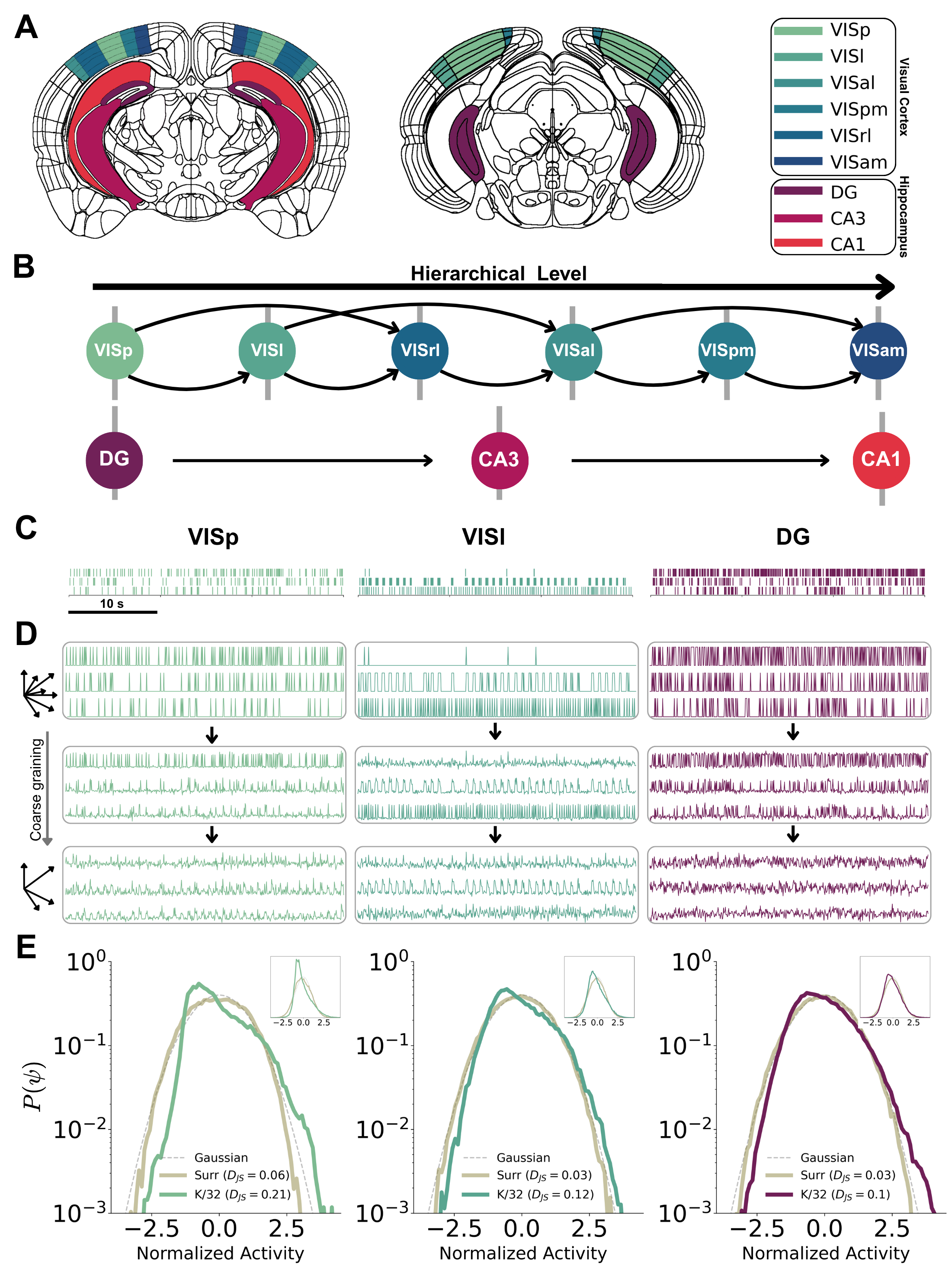
Figure 1: Anatomical localization and visual hierarchy of mouse brain regions subjected to PRG analysis.
Selection criteria required >128 simultaneously recorded units per region to ensure statistical stability, with regional analysis spanning the full depth of the visual hierarchy and hippocampus. Experimental phases included active, passive, and non-natural image (NNI) presentations.
Non-Gaussianity and Regional Gradients in Critical Signatures
A central finding is the observation that the distribution of DJS—which indexes distance from a trivial fixed point corresponding to Gaussian dynamics—varies systematically across the anatomical hierarchy. Visual areas display diverse, region-specific DJS distributions, with the primary visual cortex (VISp) exhibiting the largest deviations from Gaussianity, particularly during task engagement. In contrast, more integrative regions (e.g., VISam) demonstrate reduced DJS, closer to triviality.
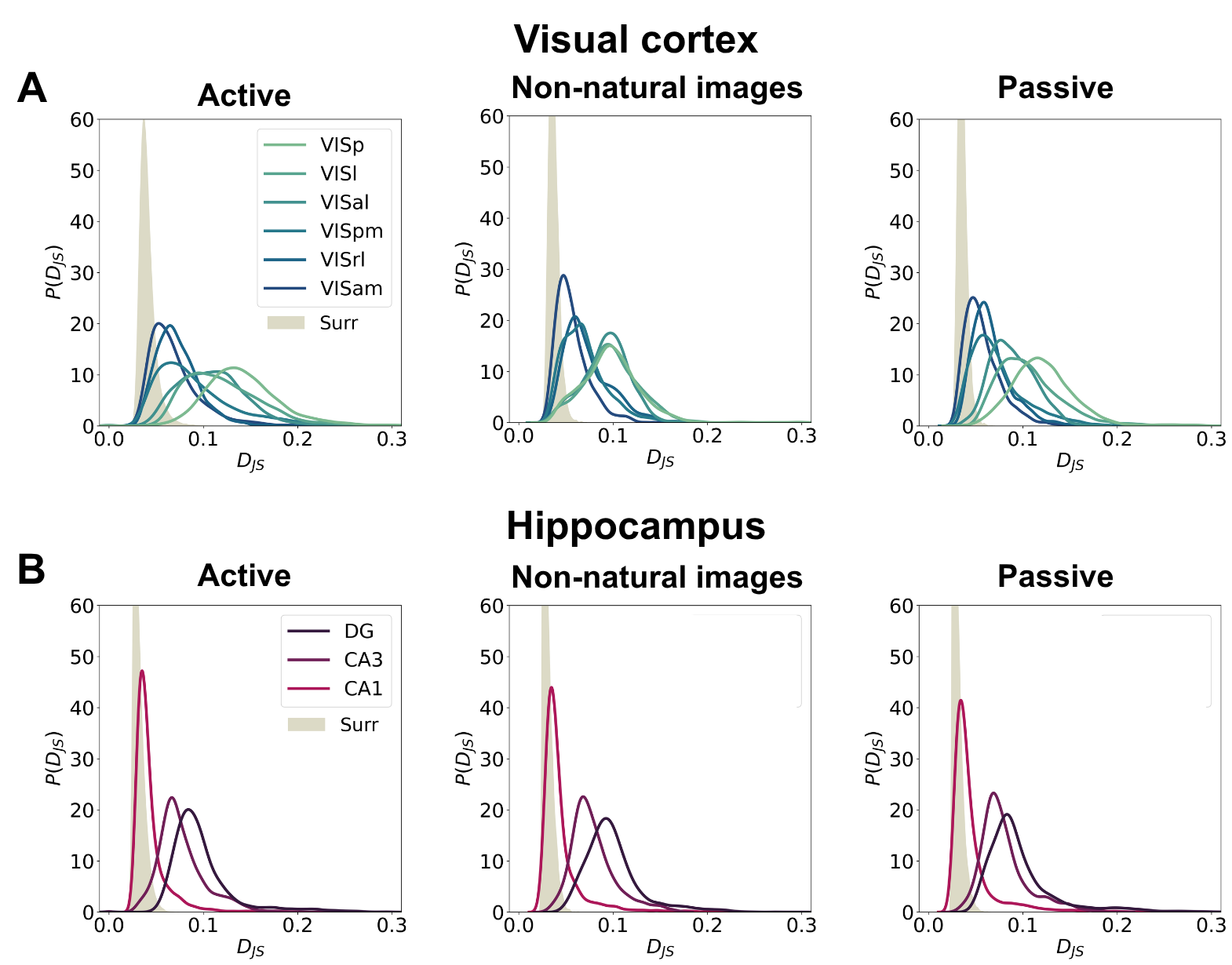
Figure 2: Distributions of Jensen-Shannon distance DJS for visual and hippocampal regions, illustrating region- and context-dependence.
The hippocampus presents a similar but less contextually modulated gradient, with the dentate gyrus (DG) manifesting pronounced critical deviations, unlike the more intermediate Cornu Ammonis areas.
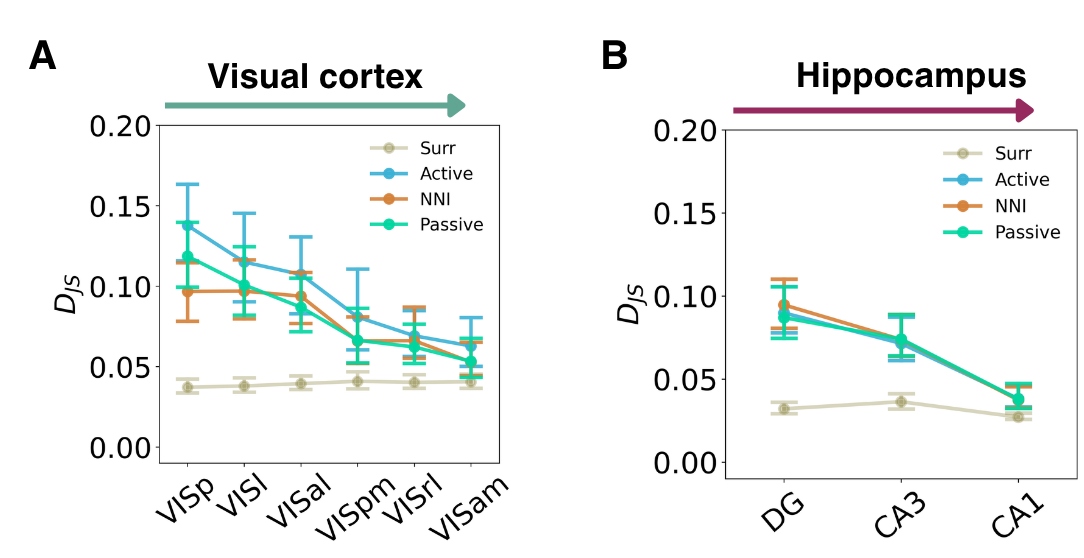
Figure 3: Median and quartile statistics of DJS across hierarchical axes for visual and hippocampal systems, with pronounced active task modulation in the visual hierarchy.
Extraction and Alignment of Functional and Anatomical Hierarchies
Temporal correlations in DJS across regions reveal modular community structure corresponding to established anatomical divisions. Functional connectivity derived from these criticality signatures robustly maps onto known hierarchies in both the visual system and hippocampus across behavioral contexts; functional integration is highest during natural image processing.
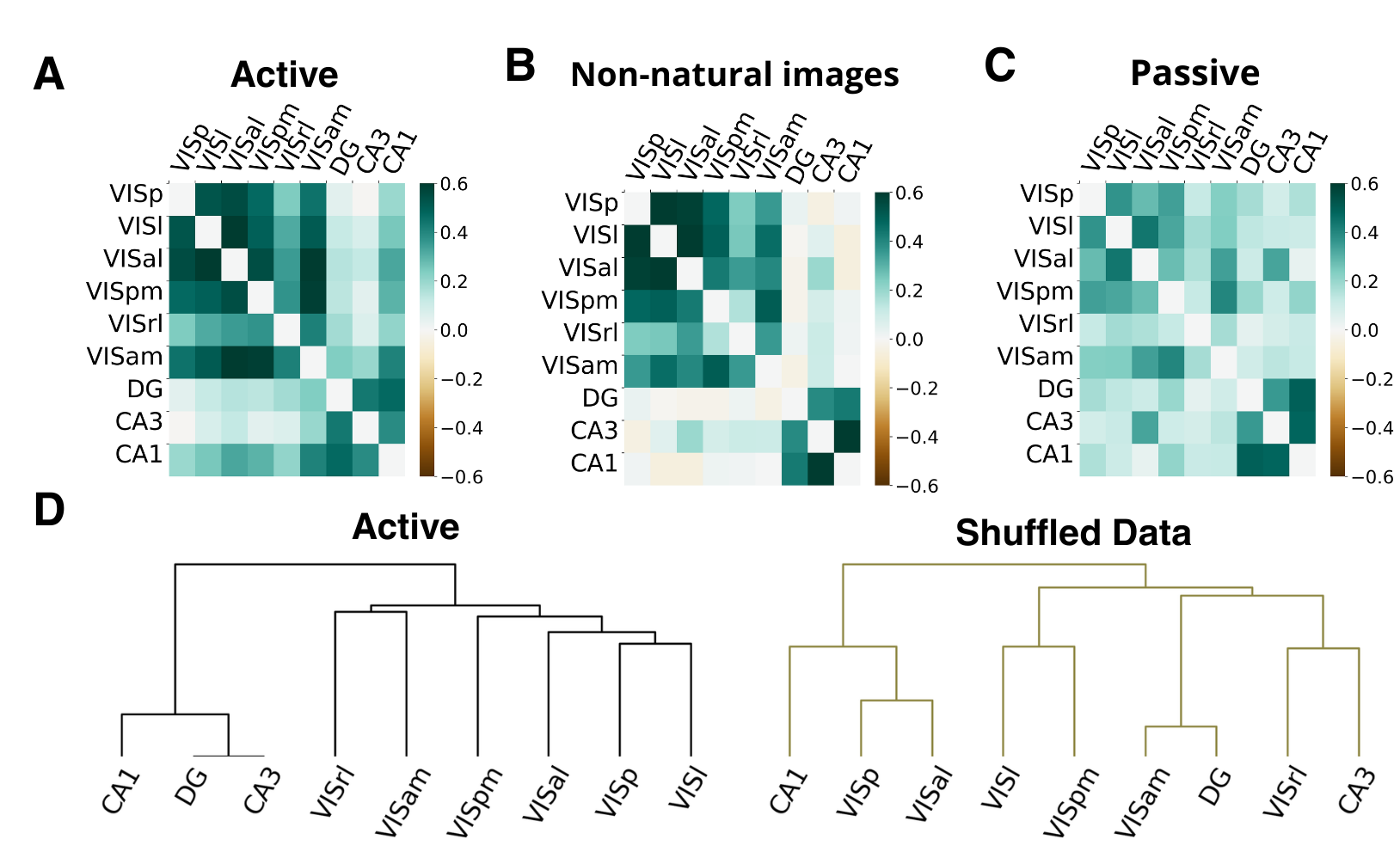
Figure 4: Inter-regional correlation matrices of DJS during various phases, with dendrograms depicting inferred functional hierarchies.
Community detection on these correlation matrices recapitulates the partition between visual cortical and hippocampal systems, and further refines the hierarchical gradient within each system based solely on dynamic critical signatures.
Scaling Exponents and Conflicting Criticality Gradients
The real-space PRG approach provides static scaling exponents (α from variance scaling, β from silence probability) and a dynamical exponent (DJS0 from autocorrelation scaling). The key findings are:
- Static exponents (DJS1, DJS2) exhibit decreasing trends along the anatomical hierarchy, i.e., regions closer to sensory input (VISp or DG) possess more pronounced critical scaling, with higher DJS3 and lower DJS4 values.
- In contrast, the dynamical exponent DJS5 increases along the hierarchy, indicating longer temporal correlations (critical slowing down) at higher integrative levels (e.g., VISam), directly conflicting with the static scaling trend.
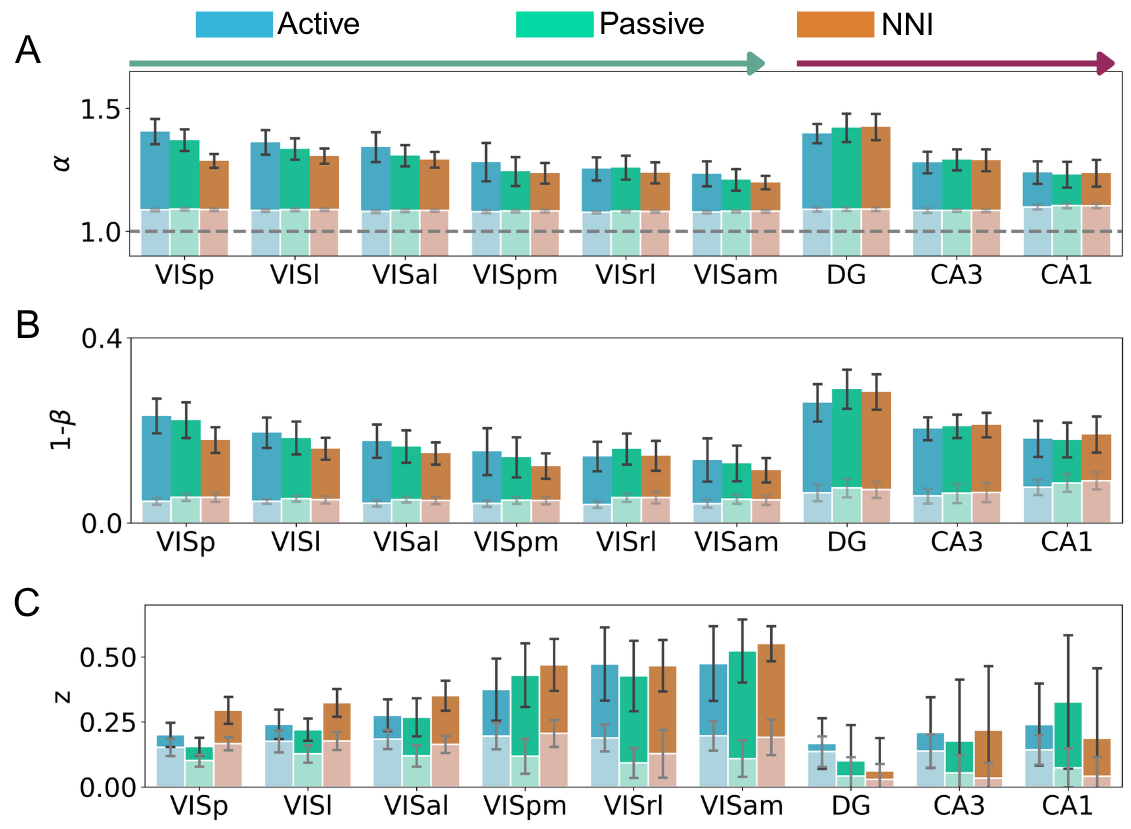
Figure 5: Region- and context-wise distributions of DJS6, DJS7, and DJS8 exponents, showing opposing gradients for static and dynamic measures across hierarchies.
The measured static exponents closely follow the theoretical scaling relation DJS9, indicating broad consistency of PRG theory across spatially disparate neural populations.
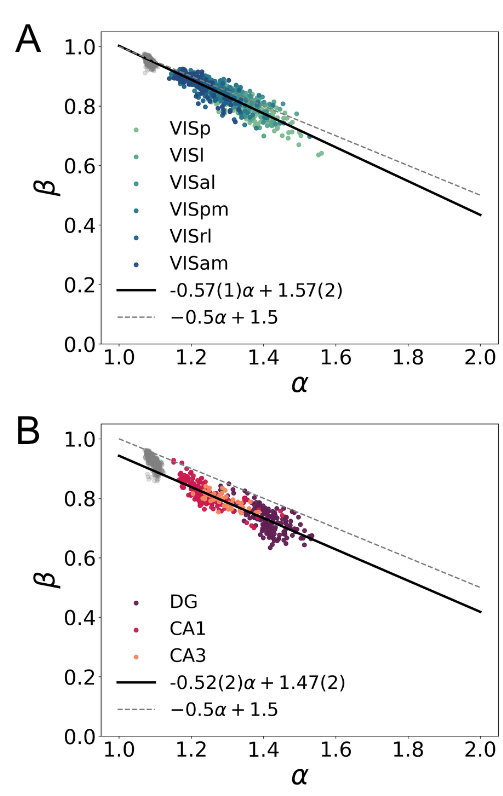
Figure 6: Interrelation of scaling exponents, showing the collapse of empirical static exponents along the theoretical scaling law for both visual cortex and hippocampus.
Discussion and Theoretical Implications
This work unambiguously demonstrates that signatures of critical brain dynamics are not spatially uniform but closely track anatomical hierarchies. The divergence in gradient direction between static and dynamic criticality markers challenges over-simplifications in the interpretation of brain criticality and indicates a measure-dependent organization. This has theoretical implications for understanding the optimization hypothesis—whether computation in the brain is maximized at a putative critical point and, crucially, whether different computational goals may select for distinct operational points along critical manifolds.
The functional connection matrices inferred from critical signatures outperform traditional approaches based on firing rates or naive correlation in recapitulating brain architecture. This advances methods for connectomics and offers new paradigms for the identification of mesoscale networks purely from collective dynamics and scaling deviations, potentially applicable to other neural recording modalities.
Prospects for Future Research in Systems Neuroscience and AI
The finding that criticality signatures reflecting different aspects of collective neural dynamics (static vs. dynamical) follow opposing anatomical gradients necessitates more nuanced models of how criticality interfaces with information processing and behavioral modulation. Specifically, the context-dependent gain in criticality signatures during task engagement suggests dynamic tuning of operational regimes, with implications for models of attention, consciousness, and state-dependent computation. The methodological toolkit—especially robust, distributional measures of non-Gaussianity under coarse-graining—can also enhance the study of emergent computation in artificial systems, toward building neuromorphic or brain-inspired AI architectures that leverage critical dynamics for flexible, efficient information processing.
Conclusion
This study rigorously links large-scale critical dynamics to the hierarchical architecture of the brain, with distinct, measure-dependent gradients revealed by PRG analyses. The ability to reconstruct anatomical hierarchies from dynamics alone, the divergence between static and dynamical critical scaling, and the modulation of criticality by behavioral context collectively challenge monolithic interpretations of brain criticality and advance both theoretical and practical methodologies for understanding collective computation in neural systems.

