- The paper introduces a framework that unifies U(1) gauge symmetry with stochastic neuroevolution to drive architecture search through drift-diffusion dynamics.
- It employs spectral agreement, Lyapunov exponent analysis, and a symmetry-constrained anchor to enforce marginal stability and match theoretical low-frequency spectral properties.
- Numerical experiments reveal that only the full symmetry-constrained model robustly achieves criticality, validating the effective field theory predictions.
Neuro-evolutionary Stochastic Architectures in Gauge-Covariant Neural Fields
The paper develops a framework that integrates gauge-covariant effective field theories with stochastic architecture evolution, yielding a formalism that unifies symmetry constraints and neuroevolution in deep neural networks. The underlying neural field model—previously introduced in [Terin, 2026]—formulates deep architectures in terms of classical commuting fields, where a complex field ϕ encodes coarse-grained features and a real Abelian field Wμ encodes effective connectivity. The essential structure leverages local U(1) symmetry, defining network propagation in terms of covariant derivatives and enforcing invariance under local reparametrizations that structurally parallel Abelian gauge theories.
To incorporate architecture search, the framework extends the effective theory by promoting architecture-level parameters Θ (e.g., weight variance σw2) to slow stochastic variables that evolve according to a Markovian process in function space. The evolution obeys drift-diffusion equations structurally analogous to Langevin and Fokker–Planck dynamics, with both the propagation and architecture search living on a symmetry-constrained manifold. The covariance condition imposed by the U(1) symmetry ensures that both layers—microscopic field evolution and macroscopic genotype evolution—are governed by the same structural principles.
Symmetry-Constrained Neuroevolution: Operators and Fitness
The architecture evolution is formally described by a density ρ(Θ,t) governed by a generator Levo that combines deterministic drift (selection based on a fitness functional F) and stochastic diffusion (mutation). The explicit covariance under local U(1) transformations is engineered by enforcing
Wμ0
ensuring admissible evolutionary directions remain in the symmetry-constrained set of architectures. In practice, selection utilizes Boltzmann weights over Wμ1, while mutations are implemented as Gaussian perturbations constrained to the admissible interval for Wμ2.
The fitness functional is a combination of three principled diagnostics:
- Spectral agreement: The relative mean-squared error between the simulated and theoretical low-frequency spectra, a probe of finite-width corrections.
- Marginality (Lyapunov exponent): Penalization for deviations from Wμ3, associated with the edge-of-chaos criterion.
- Symmetry-constrained anchor: Penalization for deviations from the critical value predicted by the effective theory, Wμ4.
This construction ensures that architecture evolution is steered both toward marginal stability and toward spectral regimes predicted by the underlying field theory.
Numerical Implementation and Regime Comparisons
The evolutionary process is tested in a minimal model where the genotype is solely Wμ5. The neural dynamics are linear, with the connectivity matrix Wμ6 sampled from a real Ginibre ensemble, optionally augmented with Wμ7 phase factors to preserve local symmetry analogs. Three models are compared:
- Model A (No critical anchor): Evolution is driven by spectral and Lyapunov criteria alone. The system drifts to a strongly ordered regime (Wμ8), with suppressed low-frequency power.
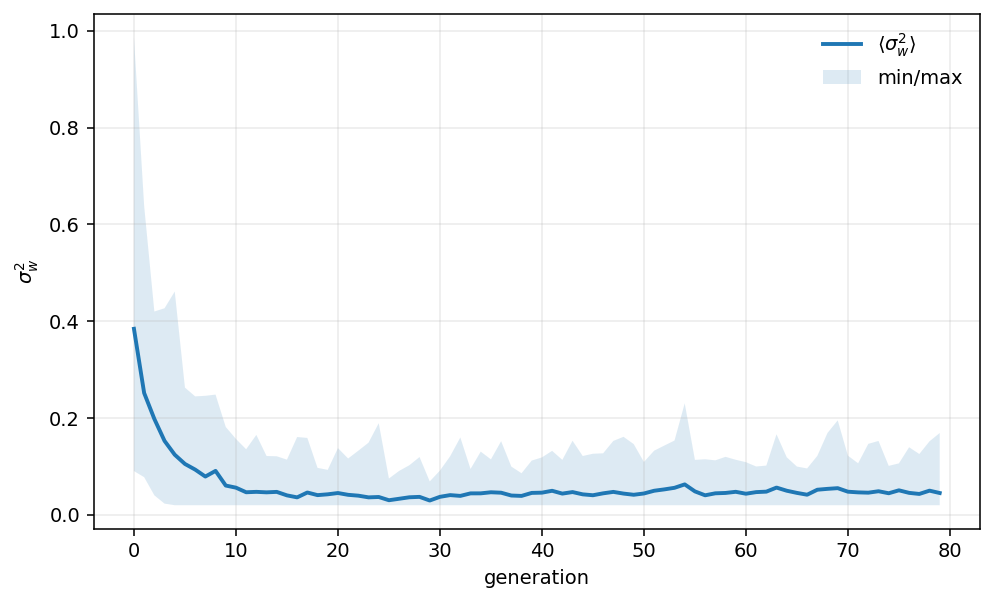
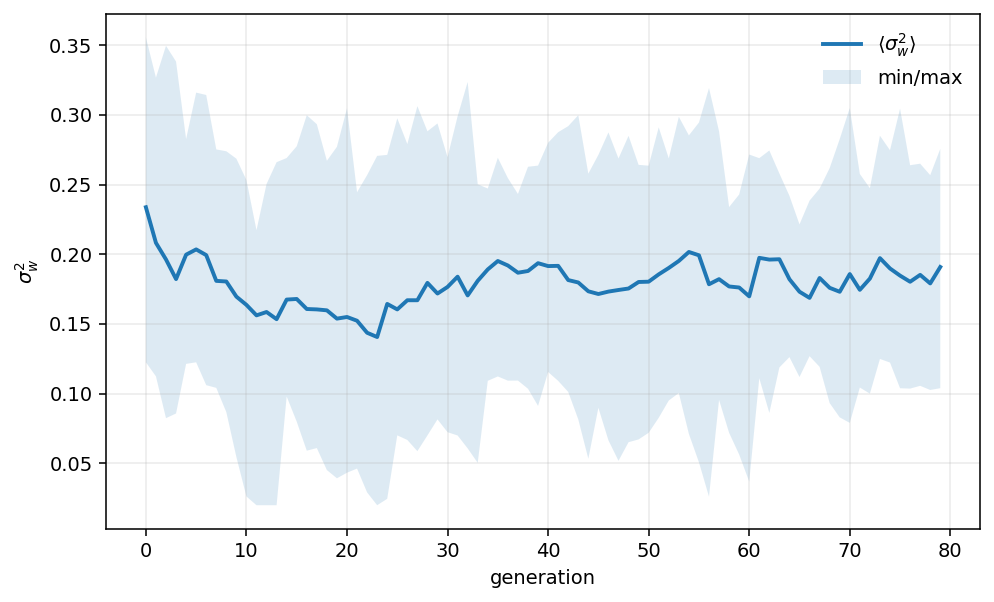
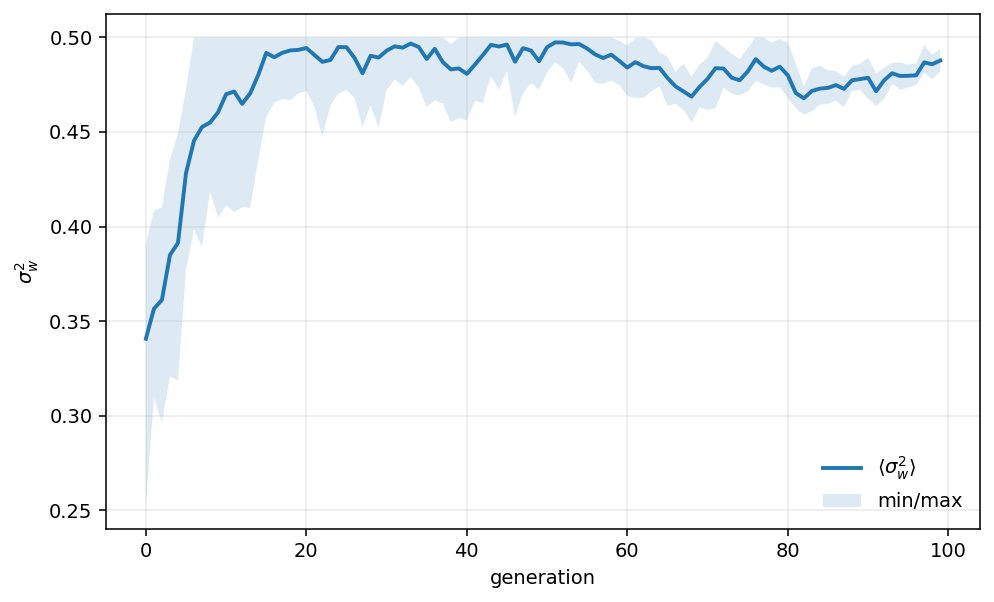
Figure 1: Model A: baseline without critical anchor.
- Model B (Real-symmetric anchor): The inclusion of a critical anchor improves marginality (Wμ9), but restricts exploration due to the limited symmetry group, which constrains spectral adaptation and flexibility.
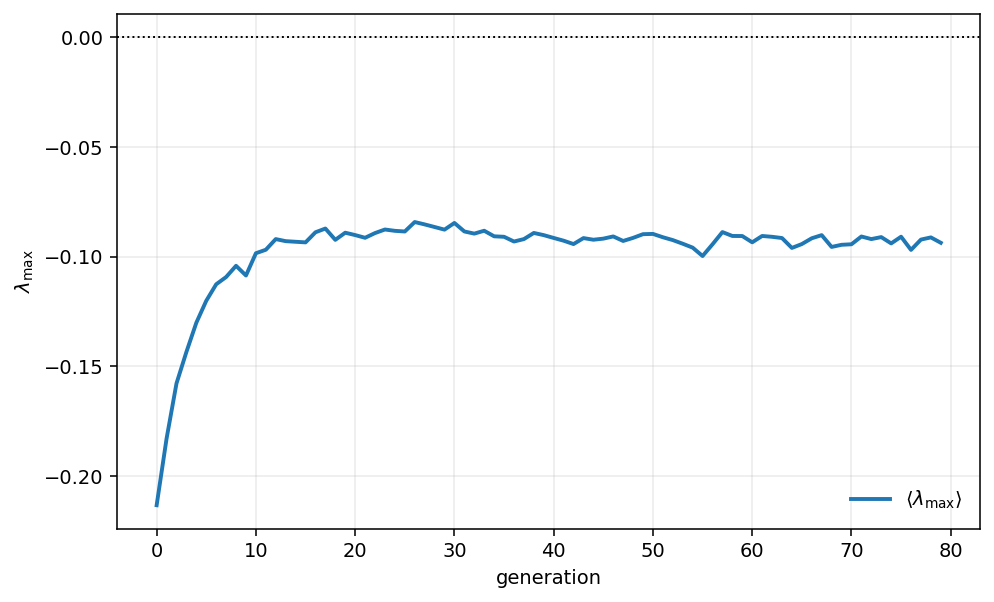
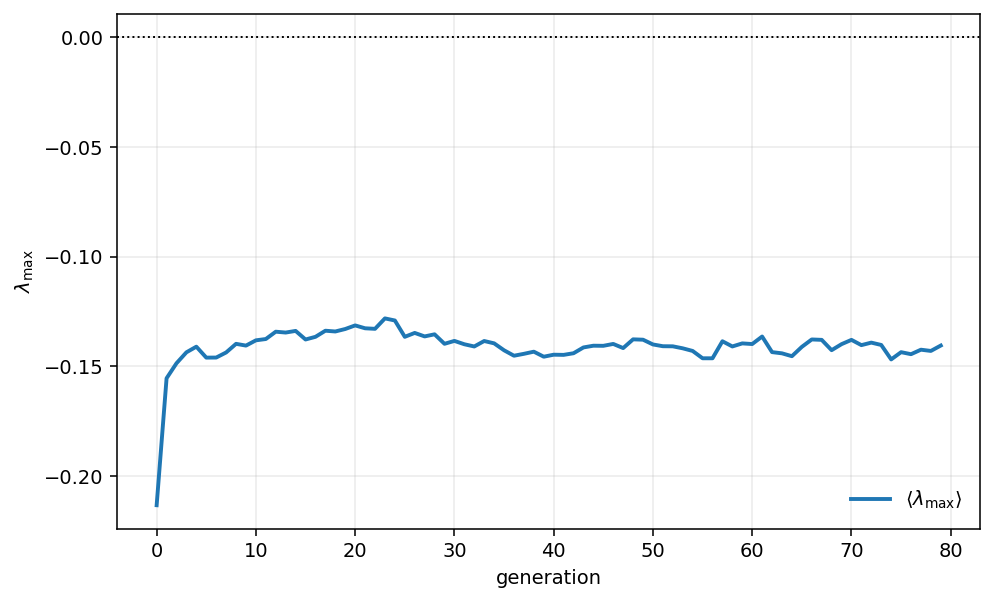
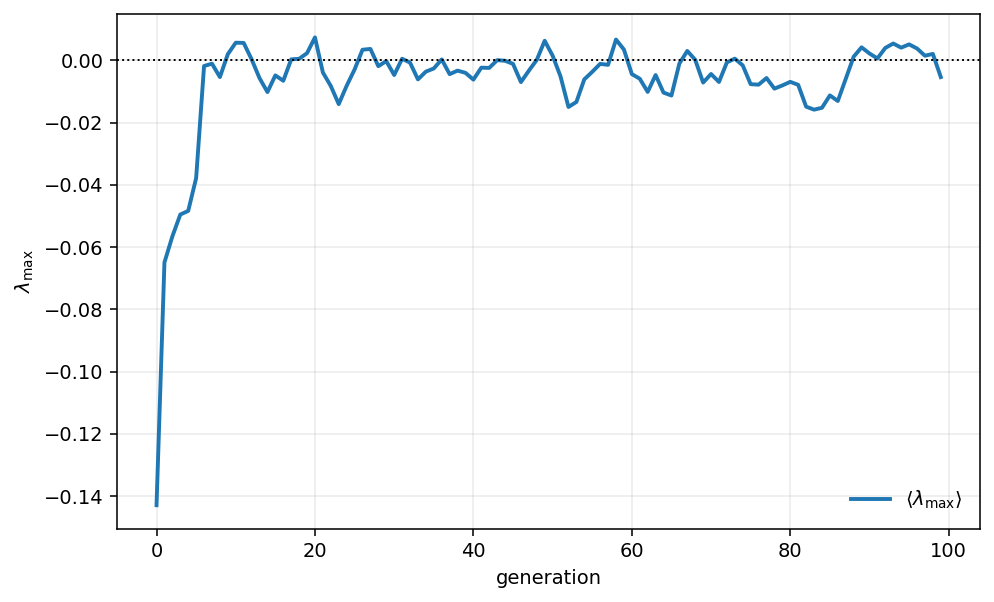
Figure 2: Model A: ordered regime.
- Model C (Symmetry-constrained Ginibre/U(1)0): Incorporation of the full symmetry-constrained kernel, combining the critical anchor, Ginibre connectivity, and local phases. This implementation yields robust self-organization into a narrow marginal regime with excellent agreement between simulated and theoretical low-frequency power spectra, including finite-width corrections.
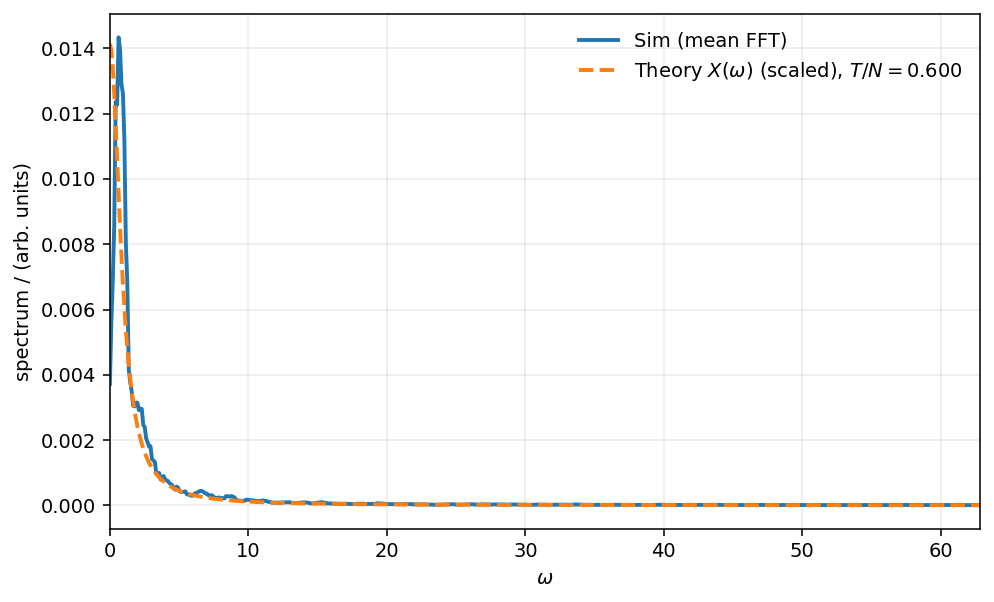
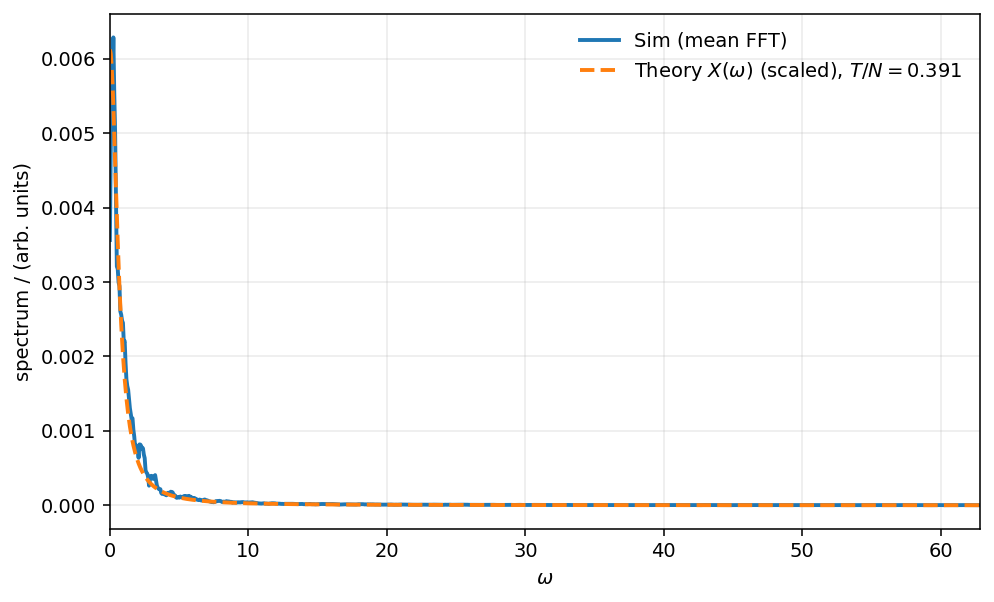
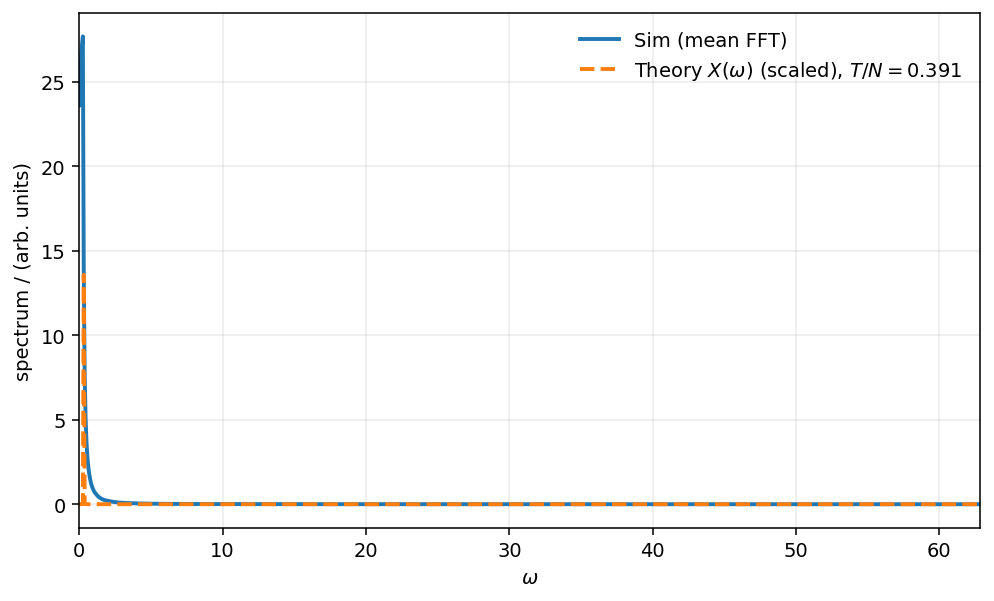
Figure 3: Model A.
Only Model C robustly stabilizes near the critical regime and aligns with the behavior predicted by the effective field-theoretic analysis. The simulations decisively show the necessity of symmetry-compatible evolution for reliable approach to marginality and low-frequency spectral characteristics.
Theoretical and Practical Implications
The presented formalism demonstrates that stability criteria derived from effective stochastic field theory can directly inform neuroevolution, yielding architecture search that is principled rather than heuristic. The enforced symmetry constraint does not simply regularize propagation—it organizes the architecture search trajectory itself, biasing the process toward criticality and expected spectral behaviors.
The theoretical implication is a two-level stochastic process controlled by the same symmetry: one layer governs state evolution (propagation of features); the second, orthogonal layer governs evolution of control parameters. This structure makes it possible to analytically characterize and manipulate the statistical and stability properties of networks through architectural evolution in symmetry-constrained spaces.
Practically, the approach provides an alternative to ad hoc initialization and regularization schemes often employed for criticality targeting in deep learning. The symmetry-constrained evolutionary process offers a template for generalized architecture search—extendable beyond the scalar case to multi-parameter genotypes and more complex architectures (e.g., convolutional, equivariant graphs).
Future Directions
While the present implementation focuses on a single scalar genotype in a linearized setting, the path-integral and operator formalism generalizes directly to richer architecture manifolds. Future work could explore:
- Multi-parameter genotypes, capturing architectures with structured connectivity, bias, or activation function parameters.
- Extension to nonlinear and non-Gaussian sectors, to investigate universality classes and higher-order critical phenomena.
- Systematic comparison of symmetry-constrained and conventional neuroevolution algorithms across diverse tasks (e.g., physical modeling, scientific ML).
Insights from mechanistic interpretability suggest that principled architectural constraints can enhance transparency; the present framework provides a symmetry-based alternative that could facilitate analytical scrutiny in complex architectures.
Conclusion
The paper provides a formally rigorous model that incorporates gauge-covariant effective field theory into the neuroevolution of neural architectures. By promoting architecture-level parameters to slow stochastic variables, and engineering their evolution to respect the underlying U(1)1 symmetry, the framework unifies stability diagnostics and architecture search in a single principled process. Empirical evidence indicates that only the full symmetry-constrained (“Ginibre/U(1)2”) scheme robustly achieves marginal stability and matches theoretically predicted finite-width spectral properties. This approach supplies a structural foundation for future advances in symmetry-aware architecture search, with implications for both theoretical analysis and practical tuning of deep networks.
Reference: "Neuro-evolutionary stochastic architectures in gauge-covariant neural fields" (2604.20373)