Chiral Lattice Gauge Theories from Symmetry Disentanglers
Abstract: We propose a Hamiltonian framework for constructing chiral gauge theories on the lattice based on symmetry disentanglers: constant-depth circuits of local unitaries that transform not-on-site symmetries into on-site ones. When chiral symmetry can be realized not-on-site and such a disentangler exists, the symmetry can be implemented in a strictly local Hamiltonian and gauged by standard lattice methods. Using lattice rotor models, we realize this idea in 1+1 and 3+1 spacetime dimensions for $U(1)$ symmetries with mixed 't Hooft anomalies, and show that symmetry disentanglers can be constructed when anomalies cancel. As an example, we present an exactly solvable Hamiltonian lattice model of the (1+1)-dimensional "3450" chiral gauge theory, and we argue that a related construction applies to the $U(1)$ hypercharge symmetry of the Standard Model fermions in 3+1 dimensions. Our results open a new route toward fully local, nonperturbative formulations of chiral gauge theories.
Paper Prompts
Sign up for free to create and run prompts on this paper using GPT-5.
Top Community Prompts
Explain it Like I'm 14
What is this paper about?
This paper shows a new way to build chiral gauge theories on a lattice using local, explicitly defined Hamiltonians. “Chiral” means left-moving and right-moving particles behave differently under a symmetry (like electric charge). These theories are important because the Standard Model of particle physics is chiral. But putting chiral theories on a lattice (a grid) without breaking important rules has been famously hard. The authors propose a tool called a symmetry disentangler, which turns a tricky, nonlocal symmetry into a local one so it can be gauged (made into a force) using standard lattice methods.
What questions are the authors trying to answer?
They focus on three big questions, stated simply:
- Can we realize chiral symmetries on a lattice without falling into the usual “fermion doubling” problem (which creates unwanted mirror particles)?
- If a symmetry is “not-on-site” (it acts in a nonlocal, tangled way across the lattice), can we convert it into an “on-site” symmetry (a clean, local action at each site) by a shallow, local quantum circuit?
- When known consistency checks in the continuum (like anomaly cancellation) say a chiral gauge theory should exist, can we actually build it with a local Hamiltonian on the lattice?
How do they approach the problem?
The authors combine ideas from condensed matter physics and quantum information to get a clean Hamiltonian construction.
Key idea: a symmetry disentangler
- Imagine a symmetry whose action is spread out and “entangled” over many sites, so you can’t write it as a simple product of local operations. That kind of symmetry can’t be gauged on a lattice in the usual way.
- A symmetry disentangler is a constant-depth circuit: a short sequence of local moves that “untangles” the symmetry so it becomes on-site (local) without changing the low-energy physics.
- Once the symmetry is on-site, you can gauge it by standard lattice techniques to get a chiral gauge theory.
Think of it like headphones with tangled wires: the music (the physics) is fine, but the controls (the symmetry) are hard to use. The disentangler untangles the cord so each button does something at its own spot.
A simple 1+1 dimensional playground
To make the idea concrete, they start in 1+1 dimensions (one space, one time), where math and models can be exactly solved.
- They use “rotor” variables—like little dials at each lattice site—to build a model with two U(1) symmetries:
- U(1)V (vector): acts like shifting all the dials by the same amount.
- U(1)A (axial): tied to how differences between nearby dials behave.
- These symmetries share a mixed ’t Hooft anomaly: a sign that you can’t make both perfectly local at once in a single copy. But if you take several copies whose anomalies cancel each other, the total symmetry should be realizable.
- They construct an explicit disentangler circuit (with a few extra helper rotors called ancillas) that makes the combined, anomaly-free U(1) symmetry on-site.
- With that in place, they present an exactly solvable Hamiltonian model of the “3450” chiral gauge theory (two left-movers with charges 3 and 4; two right-movers with charges 5 and 0). This is a classic test case, and their construction is fully local and solvable.
Moving to 3+1 dimensions and toward the Standard Model
In 3+1 dimensions (three space, one time), they follow a similar strategy:
- First, they build bosonic models (using rotor “dials” again) that realize U(1)V and U(1)A with a known mixed anomaly on the lattice. For stacks of such systems where the anomalies cancel, they construct a symmetry disentangler to make the desired U(1) on-site.
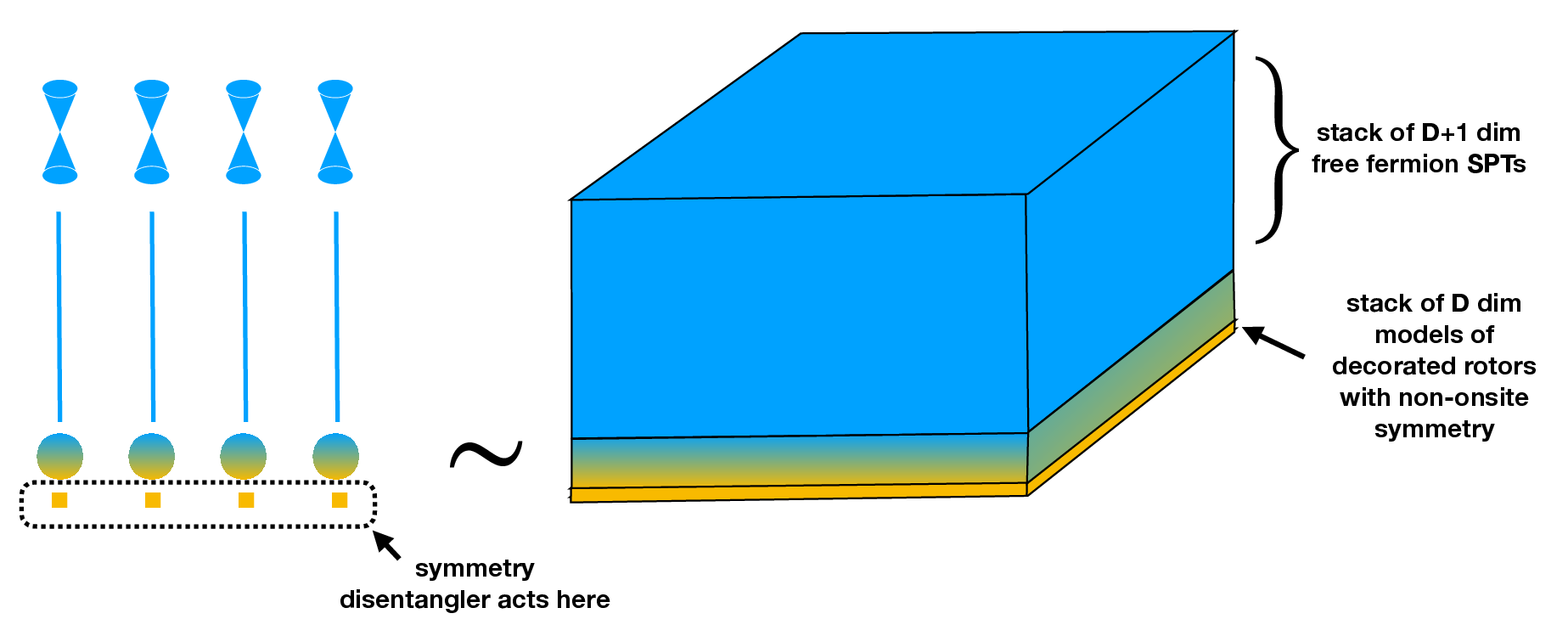
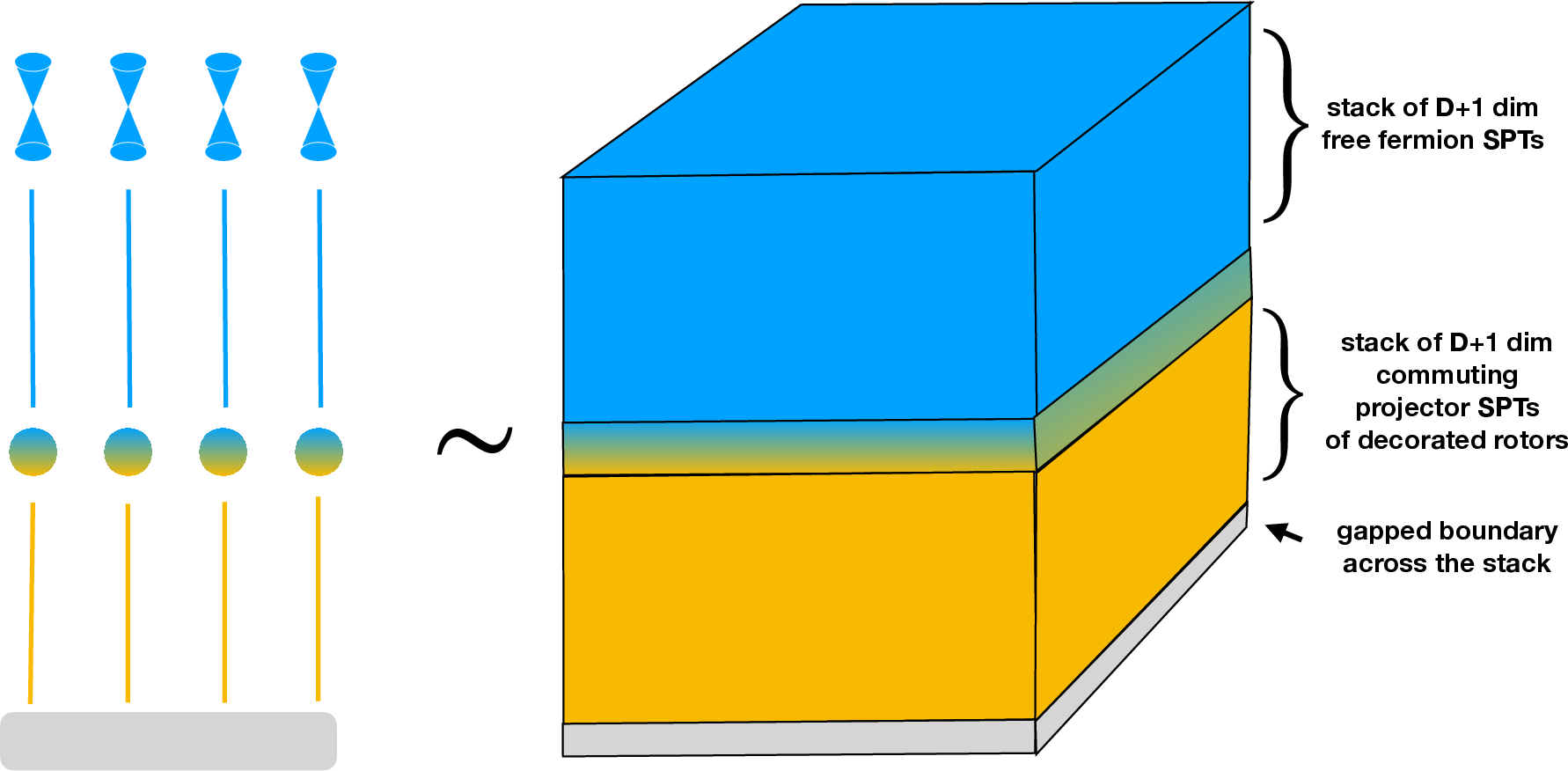
- For fermions (the kind of particles relevant to the Standard Model), the construction is more delicate. They combine their approach with “domain wall fermions”: you put a gapped system in one higher dimension whose boundary hosts chiral modes. This is like using a sandwich where the interesting physics lives on the bread’s surface.
- They couple each not-on-site model to the lower boundary of a higher-dimensional “SPT slab” (a short-range entangled, gapped phase with protected boundary behavior). The lower boundary and the original model can be gapped out together (so they disappear from low energies), leaving chiral modes on the upper boundary. Then a disentangler, supported near the lower boundary, makes the desired U(1) symmetry on-site at the microscopic level, allowing standard gauging.
- They argue this can match the U(1) hypercharge assignments of one generation of Standard Model fermions—provided you include a sterile (uncharged) neutrino. This is a significant step toward a fully local lattice Hamiltonian realization of (at least part of) the Standard Model.
What did they find?
- They constructed explicit symmetry disentanglers for several examples in 1+1D and 3+1D where anomalies cancel. This turns a nonlocal symmetry into a local one via a constant-depth circuit.
- They built an exactly solvable Hamiltonian lattice model for the 1+1D “3450” chiral gauge theory with a U(1) symmetry that can be gauged. This is, to their knowledge, the first solvable Hamiltonian model of this kind.
- In 3+1D, they showed how to realize bosonic U(1)V × U(1)A with its mixed anomaly on the lattice, and how to disentangle anomaly-free combinations. They then extended the method to include fermions so the anomaly matches that of four Weyl fermions in a minimal pattern relevant to particle physics.
- They outlined a practical route to the U(1) hypercharge sector of the Standard Model in 3+1D using their disentangler plus domain wall fermions, with the caveat that a sterile neutrino is included.
Why these results matter:
- A long-standing barrier to putting chiral gauge theories on a lattice has been making the symmetry local so it can be gauged. Their symmetry disentangler provides a concrete, constructive way to do that when anomalies cancel.
- The exactly solvable 1+1D model is a clean, testable demonstration that the approach works.
- The 3+1D pathway suggests real progress toward nonperturbative (beyond approximation) lattice definitions of chiral gauge theories—potentially including parts of the Standard Model.
Why is this important?
- It opens a new, Hamiltonian-based route to building chiral gauge theories on a lattice without relying on uncontrolled strong-coupling tricks.
- It sharpens the link between anomaly cancellation (a consistency check from field theory) and lattice gaugeability: in the settings they study, “anomaly-free” lines up with “there exists a constant-depth circuit that makes the symmetry on-site.”
- It provides tools that could be useful across quantum field theory, condensed matter, and quantum information—especially where symmetry, topology, and locality intersect.
A few key ideas in everyday language
Here are short, informal explanations of important terms used in the paper:
- Chiral: Left and right versions of a particle behave differently under a symmetry. In the Standard Model, this is essential to how the weak force works.
- On-site vs. not-on-site symmetry: On-site means the symmetry acts locally, site by site, like giving each lamp its own switch. Not-on-site means the “switch” depends on a complicated pattern over many sites—hard to gauge on a lattice.
- ’t Hooft anomaly: A warning sign that certain symmetries can’t coexist in a fully consistent, local, gauge-invariant way—unless anomalies cancel between different parts of the system.
- Symmetry-protected topological (SPT) phase: A gapped phase with special boundary behavior protected by symmetry (like a chocolate truffle with a special shell that can’t be peeled off without breaking a rule).
- Constant-depth circuit: A short sequence of local operations, the same small number of steps no matter how big the system is—good for preserving long-distance physics while changing the “basis” or “coordinates” of the description.
Limitations and next steps
- Full 3+1D, fully solvable Hamiltonians with chiral fermions are still challenging; the paper combines their method with domain wall fermions to make progress.
- Lattice-specific obstructions can appear even when anomalies cancel in the continuum; the authors show explicit success in several cases but not a universal solution.
- For Standard Model hypercharge, their route seems to require including a sterile neutrino, and a complete Hamiltonian for the full SU(3) × SU(2) × U(1) theory remains to be built.
- Future work will aim to extend these constructions, make more models exactly solvable, and assemble more pieces of the Standard Model on the lattice.
Bottom line
The authors introduce a practical, physical “untangling” method that converts tricky, nonlocal chiral symmetries into local ones on a lattice—precisely when anomaly cancellation says it should be possible. They demonstrate it in exactly solvable 1+1D models and construct strong evidence in 3+1D, charting a promising path toward fully local, nonperturbative constructions of chiral gauge theories and, ultimately, toward lattice versions of key parts of the Standard Model.
Knowledge Gaps
Below is a concise list of the paper’s unresolved knowledge gaps, limitations, and open questions. Each point highlights a concrete direction where further work is needed.
- General existence criteria: Develop necessary and sufficient conditions (and an algorithmic test) for when a lattice symmetry disentangler exists, beyond the specific U(1) examples; clarify the relationship to recently identified lattice obstructions and anomaly inflow.
- Exactly solvable 3+1D models: Construct explicit, strictly local 3+1D Hamiltonians that commute with the desired not-on-site symmetries without relying on SPT slabs or heuristic arguments; prove the existence of a spectral gap, absence of topological order, and symmetry preservation.
- Rigorous gapping mechanism in slab construction: Replace the “plausible”/heuristic gapping of the lower SPT boundary plus the D-dimensional model with explicit symmetric interactions and a proof of gapping (e.g., via commuting projectors or controlled limit).
- Operator-domain rigor for rotor circuits: Resolve the mathematical subtleties introduced by the discontinuous nearest-integer map in rotor-based disentanglers (self-adjointness, dense domains, stability under conjugation of unbounded Hamiltonians).
- Finite-dimensional truncations: Design and analyze qudit truncations that preserve locality, the anomaly structure, and on-site-ability post-disentangling; quantify truncation errors and convergence to the rotor limit.
- Explicit gauging and mirror decoupling: Provide full gauging procedures and resulting gauge-Hamiltonians for the 1+1D 3450 model and 3+1D constructions; nonperturbatively verify gauge invariance, absence of mirror modes, and exact enforcement of Gauss’s law.
- Continuum-limit control: Perform RG analyses showing that the gauged lattice models flow to the intended chiral gauge theories (compute anomalies, spectra, and long-distance correlators) and identify required fine-tuning of couplings.
- Non-Abelian extension: Generalize symmetry disentanglers and gauging to non-Abelian groups (e.g., SU(2), SU(3)), and characterize potential new lattice-specific obstructions.
- Sterile neutrino in U(1)Y: Determine whether the added sterile neutrino is strictly necessary for the hypercharge construction; either remove it via an alternative disentangler or explain its unavoidable role.
- Coverage of anomaly-free spectra: Extend the method beyond charge sets that can be grouped into 4-fermion U(1)V × U(1)A building blocks; either construct disentanglers for cases like five Weyls with charges {1,5,9,−7,−8} (anomaly-free) or prove a no-go theorem.
- Mixed gauge–gravitational anomalies: Address the apparent impossibility of realizing anomalies with in local lattice Hamiltonians; either construct such models or formalize a rigorous obstruction.
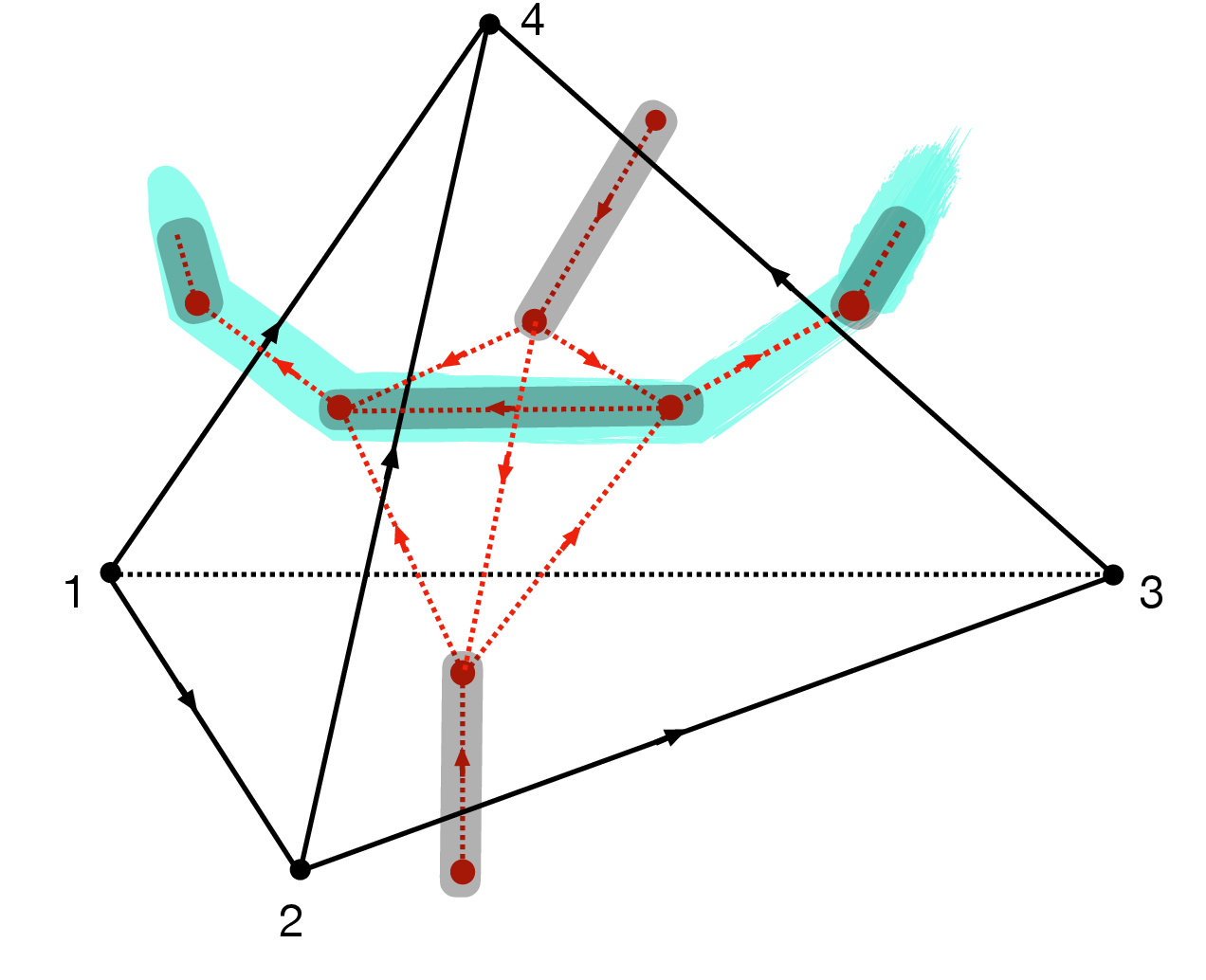
- Triangulation dependence: Prove invariance (up to finite-depth circuits) of the 3+1D cochain-based symmetry operators and disentanglers under local Pachner moves; or provide explicit conversion circuits and error bounds.
- Boundary SPT entanglers: Make the 2+1D U(1) SPT “entangler” induced by truncated axial rotations explicit, and reconcile it with known constraints on commuting-projector realizations of phases with nonzero Hall response (clarify what is and is not realized).
- Constructive recipe for W: Provide a general modular procedure (or software toolkit) to synthesize the finite-depth circuit W for arbitrary stacks and charge assignments satisfying the 1+1D condition and the 3+1D condition .
- Fate of ancillas: Analyze how ancilla degrees of freedom behave after gauging (e.g., how to gap, decouple, or eliminate them) without altering the intended IR chiral content or violating gauge invariance.
- Lattice/circuit translation: Translate cochain expressions into explicit circuits on standard lattices (e.g., cubic) with quantified locality and constant depth; detail gate sets and resource counts.
- Numerical validation and robustness: Support the constructions with simulations (ED, tensor networks, or classical Monte Carlo where applicable), measuring charge pumps, boundary SPTs, and stability of chiral modes under perturbations and disorder.
- Integration with overlap/domain-wall: Specify explicit couplings and demonstrate that constant-depth conjugation preserves locality and desired spectral properties in the domain-wall/overlap framework; compare to overlap Dirac operator locality bounds.
- Multiple U(1)’s and general anomalies: Extend disentanglers to multiple U(1)’s with mixed anomalies beyond the type; give a systematic treatment for general anomaly polynomials.
- Full U(1)Y construction: Upgrade the sketch of the U(1)Y sector to a complete Hamiltonian realization (explicit microscopic Hamiltonians, disentangler, gauging, diagnostics of IR spectrum), then couple to SU(2) × SU(3).
- Anomalies vs on-site-ability: Formalize the correspondence between continuum anomaly cancellation and lattice “on-site-ability” via constant-depth circuits in this framework; prove necessity/sufficiency and relate to lattice-homotopy classifications.
- Boundaries and counterterms after gauging: For open manifolds, specify boundary conditions and counterterms ensuring 2π periodicity and gauge invariance; analyze edge modes and anomaly inflow explicitly.
- Fully explicit fermionic 3+1D models: Present explicit fermionic lattice Hilbert spaces and local Hamiltonians implementing the proposed axial symmetry and disentangler (beyond rotor auxiliaries), and deliver the promised commuting-projector constructions where consistent.
Glossary
- Ancilla rotors: Additional auxiliary rotor degrees of freedom introduced to facilitate constructions (e.g., disentangling symmetries) without altering the primary system’s dynamics. "First, we introduce new ancilla rotors (), with all wavefunctions invariant under integer shifts of ."
- Anomaly cancellation: The condition that contributions to a symmetry’s anomaly from different fields or sectors sum to zero, allowing a consistent gauging. "Therefore, anomaly cancellation in quantum field theory does not, in general, guarantee the existence of a corresponding lattice construction or of a symmetry disentangler."
- Anomaly inflow: A mechanism where anomalies of boundary modes are accounted for by bulk topological terms, often realized via higher-dimensional SPT phases. "Strategies have been developed to evade fermion doubling, some of which can be understood from the perspective of anomaly inflow."
- Anomaly-free subgroup: A symmetry subgroup whose mixed or self anomalies vanish, enabling it to be realized on-site and gauged on the lattice. "we take a stack of such systems with canceling 't Hooft anomalies for some subgroup "
- Axial symmetry: A chiral symmetry (often denoted U(1)_A) under which left- and right-chiral fields transform with opposite phases; can exhibit mixed anomalies with vector symmetries. "In 3+1D, the axial symmetry for a single rotor is diagonal in the rotor basis"
- Branched simplicial decomposition: A triangulation of a manifold equipped with a branching structure used to define cochains and local lattice operators consistently. "we work on a branched simplicial decomposition of a spatial $3$-manifold ."
- Bounded-range interactions: Local Hamiltonian terms that act only within a finite spatial range, crucial for locality in lattice models. "a model in a tensor-product Hilbert space with bounded-range interactions"
- Charge pump: A process where a symmetry operation transports quantized charge across a system, often diagnosing mixed anomalies. "We think of this as a charge pump of a unit charge from one endpoint to the other"
- Chern insulator: A 2D topological insulator with quantized Hall conductance characterized by a non-zero first Chern number. "This produces at the boundary of the region a Chern insulator"
- Chern-Simons term: A topological term in odd-dimensional spacetime encoding responses like Hall conductance and anomalies. "corresponding to the 4+1D Chern-Simons term"
- Cochain notation: A discrete differential calculus on simplicial complexes using cochains, coboundary operators, and cup products to express lattice symmetries and anomalies. "We can make these formulae more compact with cochain notation"
- Compact boson: A scalar field with periodic identification, leading to quantized momentum and winding, often realizing Luttinger liquid physics. "It describes a compact boson CFT/Luttinger liquid"
- Constant-depth circuit: A sequence of local unitary gates organized in a fixed number of layers, independent of system size, used to implement locality-preserving transformations (e.g., symmetry disentanglers). "a constant-depth circuit of local unitaries"
- Dirac mass: A mass term coupling two Weyl fermions into a massive Dirac fermion, used to break axial symmetry to fermion parity in anomaly diagnostics. "Consider breaking the symmetry to while preserving by turning on a Dirac mass pairing the first and second Weyls"
- Domain wall fermion framework: A lattice approach where chiral fermions arise as boundary modes of higher-dimensional gapped systems. "we combine our construction with the domain wall fermion framework"
- Euclidean lattice models: Discrete-time (imaginary time) formulations used for constructive or numerical studies of quantum field theories. "Previous constructions include solvable Euclidean lattice models"
- Exactly solvable Hamiltonian: A model whose spectrum and eigenstates can be determined analytically, often due to quadratic or commuting-projector structures. "an exactly solvable Hamiltonian lattice model"
- Fermion doubling: The lattice artifact where naive discretizations produce extra fermion species in vector-like pairs, obstructing chiral theories. "This ``fermion doubling'' phenomenon blocks a straightforward lattice realization of chiral gauge theories."
- Fermion parity: A Z2 symmetry distinguishing even and odd fermion number, often identified with a π axial rotation. "Note a rotation in corresponds to fermion parity"
- Free-fermion SPT: A symmetry-protected topological phase constructed from noninteracting fermions whose boundary hosts anomalous modes. "a -dimensional slab hosting a free-fermion -SPT"
- Gauss’s law: A constraint enforcing gauge invariance, appearing as a condition on Villain variables in lattice formulations. "the Villain condition is Gauss's law."
- Gauge-gravitational anomalies: Mixed anomalies involving gauge fields and spacetime curvature that obstruct consistent coupling to gravity. "vanishing mixed gauge-gravitational anomalies"
- Hypercharge assignments: The U(1)_Y charge values attributed to Standard Model fermions, crucial for anomaly cancellation. "the hypercharge assignments for one generation of quarks and leptons"
- Jordan–Wigner transformations: Mappings between spin/boson and fermion variables in one dimension, enabling fermionization of bosonic models. "These models may be converted to models of Dirac fermions by familiar Jordan-Wigner transformations."
- Lattice regularization: Discretization of spacetime to define quantum field theories beyond perturbation theory in a controlled, local manner. "Lattice regularization provides a powerful framework"
- Locality-preserving unitary: A unitary transformation that maps local operators to operators with support bounded near the original region. "C is a locality-preserving unitary"
- Luttinger liquid: A gapless 1D phase of interacting particles characterized by bosonized fields with momentum and winding symmetries. "It describes a compact boson CFT/Luttinger liquid"
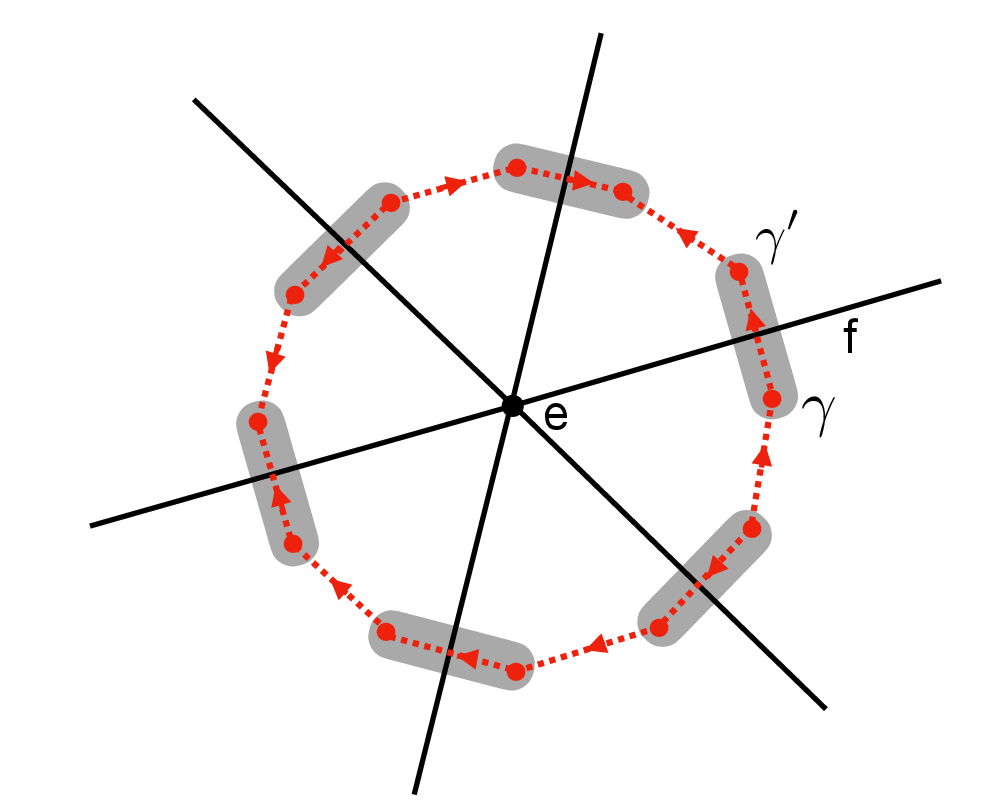
- Majorana fermions: Real fermionic degrees of freedom represented by operators that are their own antiparticles, often used to build lattice fermion models. "The red dots represent Majorana fermions."
- Mirror fermions: Additional fermion species of opposite chirality introduced on a separate boundary or sector, often gapped to achieve chiral spectra. "mirror fermions reside on the lower -dimensional boundary."
- Mixed ’t Hooft anomalies: Obstructions to gauging multiple symmetries simultaneously, encoded by topological terms linking their gauge fields. "for symmetries with mixed 't Hooft anomalies,"
- Non-perturbative formulation: A construction valid beyond small-coupling expansions, crucial for defining chiral gauge theories on the lattice. "a local non-perturbative formulation of chiral gauge theories in 3+1 dimensions remains elusive."
- Not-on-site symmetry: A global symmetry that cannot be represented as a product of operators acting independently on each local Hilbert space. "not-on-site symmetries"
- On-site symmetry: A global symmetry implemented as a tensor product of local unitary actions, making it straightforward to gauge on the lattice. "strictly on-site symmetries"
- Overlap fermion approach: A lattice method that integrates out bulk modes to realize chiral fermions with modified measures when anomalies cancel. "In the overlap fermion approach"
- Path-integral measure: The weighting of field configurations in the functional integral; its modification can encode anomalies or gauge consistency. "modifying the fermionic path-integral measure"
- Rotor Hilbert space: A lattice Hilbert space built from angular variables (rotors) with periodicity and integer shift invariance. "Working in the Hilbert space of a lattice model of rotors in $1$ spatial dimension"
- SPT entangler: A boundary operator generated by truncated symmetry actions that prepares or identifies an SPT state, signaling a mixed anomaly. "This boundary term is an SPT entangler"
- Spectral flow: The evolution of energy levels under parameter changes (e.g., flux insertion) that transports charge, diagnosing anomalies. "It is a lattice analogue of the familiar spectral flow"
- Symmetric mass generation (SMG): A mechanism to gap mirror fermions through strong interactions without breaking the protecting symmetry. "In the symmetric mass generation (SMG) approach"
- Symmetry disentangler: A locality-preserving, constant-depth circuit that converts a not-on-site symmetry into an on-site one. "a symmetry disentangler: a constant-depth circuit of local unitaries"
- Symmetry-protected topological (SPT) phase: A short-range entangled, gapped phase with nontrivial boundary states protected by global symmetries. "The bulk system, known as a symmetry-protected topological (SPT) phase in condensed matter language"
- Tensor-product Hilbert space: A microscopic Hilbert space factored into local subsystems, enabling strictly local operator definitions. "a tensor-product Hilbert space"
- Vector-like pairs: Fermion species appearing in pairs with opposite chiralities, typically produced by local lattice symmetries. "fermions in vector-like pairs"
- Villain formulation: A lattice discretization using integer-valued fields to encode periodic variables and gauge constraints. "we begin with a Villain formulation."
- Villain Hilbert space: The space of states satisfying Villain gauge constraints (e.g., integer shifts and Gauss’s law). "The Villain Hilbert space consists of wavefunctions invariant under the Villain transformations"
- Weyl fermions: Massless chiral fermions in relativistic field theory, central to chiral gauge constructions. "two left-moving Weyl fermions"
- Winding symmetries: Symmetries associated with topological winding numbers of compact bosons, often paired with momentum symmetries. "act as the momentum and winding symmetries respectively."
Practical Applications
Immediate Applications
Below are practical, near-term uses that can be deployed or prototyped now, leveraging the paper’s explicit constructions (rotor models, constant-depth symmetry disentanglers, and exactly solvable 1+1D models) and the associated workflows.
- Bold benchmark: exactly solvable 1+1D “3450” chiral gauge theory
- Sectors: software (HPC/LGT), quantum computing, academia (HEP/condensed matter)
- Description: Use the paper’s exactly solvable Hamiltonian model of the 1+1D 3450 chiral gauge theory as a gold-standard testbed to validate algorithms for chiral dynamics, anomaly diagnostics, and gauge-field coupling.
- Tools/products/workflows:
- Reference datasets and spectra for code verification
- Unit tests in LGT libraries (e.g., open-source suites for classical/quantum simulation)
- Side-by-side validations of tensor-network, MPS/DMRG, and quantum-circuit approaches
- Assumptions/dependencies: Requires truncation of rotor Hilbert spaces in practice; fidelity of anomaly behavior under truncation must be checked.
- Constant-depth symmetry disentangler circuits for U(1)
- Sectors: quantum computing (compilers, verification), software (circuit synthesis), academia
- Description: Integrate the paper’s constant-depth local circuits that turn not-on-site U(1) symmetries into on-site ones into quantum compilers and verification workflows.
- Tools/products/workflows:
- A compiler pass that: (i) takes anomaly-free charge assignments; (ii) generates a disentangler W; (iii) conjugates Hamiltonians; (iv) emits an on-site symmetry description ready for gauging
- Static “symmetry compliance” checks during circuit compilation
- Assumptions/dependencies: Proven for classes studied (continuous U(1) with mixed anomalies and their cancellation); not guaranteed for all groups and lattices due to lattice-only obstructions.
- Gauge-onset workflow for Hamiltonians (make symmetry on-site, then gauge)
- Sectors: software (LGT), quantum computing (digital LGT), academia
- Description: Operationalize the paper’s recipe: start from a model with not-on-site chiral symmetry, apply the symmetry disentangler to render an anomaly-free subgroup on-site, then gauge by standard lattice methods.
- Tools/products/workflows:
- “Disentangle-and-gauge” pipelines in simulators
- Automated generation of gauge couplings after disentangling
- Assumptions/dependencies: Requires explicit disentanglers and (where used) ancillas; accuracy depends on truncation and locality-preserving implementations.
- Educational modules and visual demonstrations of chiral anomalies
- Sectors: education (physics), outreach
- Description: Use the 1+1D rotor models and charge-pump diagnostics to teach anomaly inflow, boundary SPT pumping, and gauging on the lattice with concrete, solvable examples.
- Tools/products/workflows:
- Classroom notebooks (symbolic and numerical) showing endpoint charge pumping under axial rotations
- Visualization of cochain/cup-product constructions on 1D/3D simplicial complexes
- Assumptions/dependencies: Requires careful treatment of finite-size effects and truncations; emphasize conceptual alignment with anomaly inflow.
- Prototype analog experiments of 1D chiral pumping in synthetic quantum systems
- Sectors: quantum simulation (cold atoms, superconducting circuits), condensed matter
- Description: Realize truncated-rotor Hamiltonians to observe the mixed U(1)V–U(1)A anomaly as a quantized pump; benchmark disentangler action by local operations.
- Tools/products/workflows:
- Josephson-junction arrays (phase rotors), cold-atom rings with phase degrees of freedom, large-spin encodings
- Protocols implementing spatially truncated axial rotations and measuring endpoint charge transport
- Assumptions/dependencies: Rotor approximations via finite-level systems; stability of quantized response under truncation, disorder, and noise.
- Commuting-projector realization and benchmarks for a 2+1D U(1) SPT (Hall response 2)
- Sectors: quantum simulation, software, academia
- Description: Use the paper’s construction of a commuting-projector Hamiltonian for a 2+1D U(1) SPT (pumped by a π axial rotation) as a new benchmark for detecting SPT responses and edge phenomena.
- Tools/products/workflows:
- Spectroscopy and edge-transport probes in analog simulators
- Numerical checks of many-body invariants in commuting-projector models
- Assumptions/dependencies: Requires faithful implementation of boundary terms and careful handling of U(1) truncation; edge diagnostics must resolve finite-size gaps.
- Software libraries for cochain-based anomaly analysis and circuit generation
- Sectors: software (scientific computing), academia
- Description: Package cochain/cup-product lattice calculus to automatically compute mixed anomalies and synthesize symmetry disentanglers.
- Tools/products/workflows:
- Python/Julia/C++ libraries to: (i) discretize manifolds; (ii) compute d, cup, truncation maps; (iii) output depth-2 (or constant-depth) circuits W; (iv) emit Hamiltonians post-conjugation
- Assumptions/dependencies: Correct handling of branching structures and boundary counterterms; numerical stability for large complexes.
- Jordan–Wigner-enabled fermionizations in 1+1D for chiral models
- Sectors: quantum computing (fermionic encodings), software (TN/variational), academia
- Description: Use the boson-to-fermion mappings described to build and validate fermionic chiral models (e.g., 3450) in digital simulators and tensor networks.
- Tools/products/workflows:
- JW/BK encodings in quantum circuit frameworks
- TN ansatzes preconditioned by disentanglers to represent chiral sectors more efficiently
- Assumptions/dependencies: Boundary conditions and parity constraints must be consistent with the axial symmetry action; mapping overhead must be controlled.
- Training and standards: anomaly-aware benchmarks for quantum LGT
- Sectors: policy (R&D programs), academia, industry (quantum hardware/software)
- Description: Adopt the 1+1D solvable models and 3+1D bosonic stacks as standardized benchmarks for chiral gauge-simulation claims and hardware roadmaps.
- Tools/products/workflows:
- Community benchmark suites including spectra, correlation functions, and pumped-SPT diagnostics
- Round-robin comparisons across platforms (classical TN, trapped ions, superconducting qubits, cold atoms)
- Assumptions/dependencies: Community willingness to use cochain-based diagnostics and share reproducible pipelines.
Long-Term Applications
These opportunities require further research, scaling, or engineering, particularly for 3+1D fermionic models and Standard Model–relevant simulations.
- Hamiltonian, fully local, nonperturbative realizations of chiral gauge theories in 3+1D
- Sectors: high-energy physics, quantum computing (fault tolerant), software (HPC)
- Description: Use the symmetry-disentangler framework plus SPT-slabs/domain-wall fermion ideas to build scalable Hamiltonians with chiral fermions and gauge them on-site, enabling nonperturbative studies beyond vector-like theories.
- Tools/products/workflows:
- Fault-tolerant implementations of gauge-onset workflows
- Hybrid classical–quantum solvers for dynamical gauge fields with chiral matter
- Assumptions/dependencies: Existence and explicit construction of disentanglers for target charge assignments; reliable gapping of mirror sectors without uncontrolled strong dynamics.
- Toward a hypercharge sector of the Standard Model on a lattice
- Sectors: high-energy physics, quantum computing
- Description: Pursue the paper’s 3+1D U(1)Y program (including a sterile neutrino) using disentanglers to make anomaly-free hypercharge subgroups on-site and gaugeable, as a step toward full SM lattice Hamiltonians.
- Tools/products/workflows:
- Circuit/tooling to compose quark and lepton sectors and verify anomaly cancellation conditions
- Domain-wall SPT constructions where lower-boundary modes are gapped while upper-boundary chiral modes remain
- Assumptions/dependencies: Requires a consistent lattice realization of SU(3)×SU(2)×U(1)Y with all mixed anomalies properly canceled and lattice obstructions addressed; scalability to large volumes.
- Automated “from charges to circuits” design tools for chiral lattices
- Sectors: software (EDA for quantum), quantum computing
- Description: Given charge assignments and a lattice complex, automatically (i) check anomaly cancellation; (ii) synthesize constant-depth W; (iii) export gaugeable Hamiltonians; (iv) emit resource estimates for digital/analog platforms.
- Tools/products/workflows:
- Domain-specific languages for cochain-based symmetry specifications
- Integration with Qiskit/PennyLane/Cirq and analog-control stacks
- Assumptions/dependencies: Generalization of disentanglers beyond the classes treated; robust handling of finite truncation and boundary conditions.
- Tensor-network and variational ansatzes preconditioned by disentanglers
- Sectors: software (TN), academia
- Description: Build TN architectures that incorporate W as a fixed prelayer to “unwind” not-on-site actions, enabling efficient representations of chiral sectors and reducing variational overhead.
- Tools/products/workflows:
- PEPS/MERA variants with cochain-aware layers
- Benchmarks contrasting with standard TNs on chiral observables
- Assumptions/dependencies: Stability of TN optimization with non-on-site symmetry layers; scaling to 3+1D PEPS.
- Robust gauge-symmetry enforcement and error mitigation in quantum simulations
- Sectors: quantum computing (NISQ and FT)
- Description: Use constant-depth disentanglers to impose symmetry constraints at compile time and to construct local conserved quantities for error detection/mitigation in gauge simulations.
- Tools/products/workflows:
- Symmetry-preserving Trotterization templates
- Post-selection based on on-site symmetry checks
- Assumptions/dependencies: Hardware support for the required local unitaries and ancillas; overhead trade-offs vs. error rates.
- Synthetic quantum matter with engineered chiral edge transport via SPT-assisted design
- Sectors: quantum simulation (cold atoms/photonic/superconducting), condensed matter
- Description: Engineer stacks of SPT slabs coupled to tailored lower-boundary layers to produce robust chiral modes at upper boundaries, guided by anomaly inflow and disentangler design.
- Tools/products/workflows:
- Blueprint protocols for pumping SPTs by axial rotations
- Controlled gapping of mirror sectors through layer-local interactions
- Assumptions/dependencies: Experimental control of layer-specific interactions and boundary conditions; reliable realization of effective U(1) symmetries.
- Standardized benchmark suite for chiral gauge theory on quantum hardware
- Sectors: policy (program management), industry/academia consortia
- Description: Expand present benchmarks (1+1D 3450; 3+1D bosonic stacks; 2+1D U(1) SPT pumps) into a tiered suite for roadmap milestones in chiral-gauge quantum simulation.
- Tools/products/workflows:
- Open datasets, certification metrics (e.g., pumped-charge quantization, Hall response)
- Interoperable reference implementations across platforms
- Assumptions/dependencies: Community adoption; agreement on performance metrics and finite-size scalings.
- Exploratory crossovers to quantum error-correcting code design using symmetry disentanglers
- Sectors: quantum computing (QEC)
- Description: Investigate whether not-on-site-to-on-site transformations can inform new code constructions where global constraints are enforced by constant-depth circuits.
- Tools/products/workflows:
- Prototype codes with symmetry-enforcing prelayers
- Analytical studies of code distances vs. symmetry depth
- Assumptions/dependencies: Conceptual extension beyond physics symmetries to stabilizer/non-stabilizer code spaces; practical benefits yet to be demonstrated.
- Materials- and photonics-inspired platforms for anomaly-driven transport (far-term)
- Sectors: materials science, topological photonics
- Description: Long-term, use the anomaly-inflow-and-disentangler design logic to guide synthetic materials with robust chiral channels or quantized pumps.
- Tools/products/workflows:
- Design heuristics for metamaterials mimicking SPT slabs and boundary couplings
- Transport measurements tied to pumped-SPT diagnostics
- Assumptions/dependencies: Translating rotor/fermion lattice logic into realizable band-structure platforms; handling interactions/disorder.
Cross-cutting assumptions and dependencies
- Anomaly cancellation is necessary but not sufficient on the lattice: additional lattice-only obstructions can arise; the paper constructs disentanglers in specific U(1) settings but not universally.
- Rotor models are infinite-dimensional; practical implementations rely on truncations or encodings (large spins, oscillator modes, superconducting phases), and must validate anomaly and pump robustness under truncation.
- Disentanglers are constant-depth and locality-preserving, but some constructions involve unbounded operators (rotors) and require domain care and boundary counterterms.
- The 3+1D path toward SM hypercharge assumes adding a sterile neutrino and that lower-boundary modes can be gapped while preserving symmetry; full SU(3)×SU(2)×U(1)Y realization remains an open engineering and theoretical challenge.
Collections
Sign up for free to add this paper to one or more collections.