- The paper introduces a dual-agent system where co-evolving evaluation and planning eliminate denominator blindness and self-serving evaluation.
- The methodology employs isolated workspaces, audit separation, and an append-only, versioned knowledge base to ensure evaluation integrity and robust recovery.
- Empirical results show that transferring knowledge from higher-capability agents to weaker ones narrows performance gaps, reduces costs, and improves convergence.
Forage V2: Knowledge Evolution and Transfer in Autonomous Agent Organizations
Forage V2 addresses the structural challenge of denominator blindness in autonomous agents executing open-world tasks, where completion boundaries are unknown and agents systematically underestimate the breadth of the target space. Forage V1 established a dual-agent architecture with co-evolving evaluation (Evaluator discovers and refines task completeness criteria) and method isolation (mutual invisibility of Evaluator and Planner methods) to eliminate self-serving evaluation and mitigate denominator blindness. V2 extends this paradigm from single expeditions to persistent agent organizations where knowledge accumulates, transfers across agent capabilities, and institutional safeguards maintain evaluation integrity independent of model upgrades.
V2 differentiates itself from conventional harness-layer solutions by focusing on architectural, not algorithmic, innovation. Instead of fine-tuning or RL-based agent improvement, V2 implements structural constraints—audit separation, protocol contracts, and organizational knowledge—that provide reliability and transferability regardless of agent capability.
Extensions: Knowledge Evolution and Transfer Protocols
V2 introduces three extensions critical to organizational robustness:
Knowledge Evolution: Following each run, both agents independently extract transferable lessons without violating method isolation. These entries, versioned and advisory by design, accumulate in an append-only organizational knowledge base, maintaining full historical context and allowing for asynchronous curation.
Knowledge Transfer: The accumulated knowledge base from stronger agents (e.g., Opus, a higher-capability LLM) seeds weaker agents (e.g., Sonnet), facilitating cross-capability inheritance of pragmatic strategies, domain insights, and evaluation protocols. Crucially, transfer operates at the organizational document level (e.g., INDEX.md plus lesson files), not via weight- or fine-tuning-level transfer, preserving abstraction and enabling model-agnostic adoption.
Architectural Improvements: V2 hardens method isolation using separate physical workspaces, mitigating vulnerabilities discovered in V1's filename-convention isolation mechanisms. Persistent sessions and explicit recovery protocols bolster resilience against infrastructure failures and enable agents to retain trajectory context across rounds. Prompt-level self-audit and multi-round harness structure counter premature convergence even as knowledge accrues.
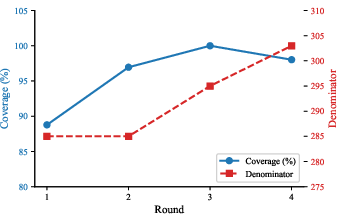
Figure 1: Coverage and denominator co-evolve across rounds, reflecting dynamic refinement of completeness criteria and product definition.
Empirical Results: Knowledge Accumulation and Transfer
Knowledge Accumulation: Across tasks (NVIDIA GPU scraping, UniProt API queries, mathematics reasoning), knowledge entries monotonically increased with post-mortem extraction reliably generating 6–14 new lessons per run (NVIDIA: 0→54 over six runs). Denominator stabilization demonstrates evolving domain understanding and evaluation precision, with Opus runs converging in minimal rounds and consistent final denominator estimates (variance: 265–303 for NVIDIA task, highly stable for UniProt).
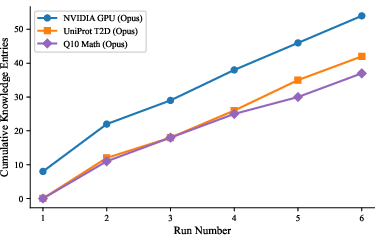
Figure 2: Cumulative knowledge entries illustrate reliable monotonic growth across domains and tasks.
Knowledge Transfer: The transfer protocol demonstrates that knowledge seeding allows weaker agents to approach strong-agent efficiency and coverage:
- Sonnet (seeded) narrows a 6.6pp coverage gap to 1.1pp relative to Opus, halves run cost (9.40→5.13), and converges in nearly half the rounds (mean 4.5 vs. 7.0).
- Denominator convergence is robust: three independent seeded Sonnet runs converge to exactly 266, inside Opus's range (265–303), demonstrating knowledge transfer calibrates both collection strategies and evaluation standards.
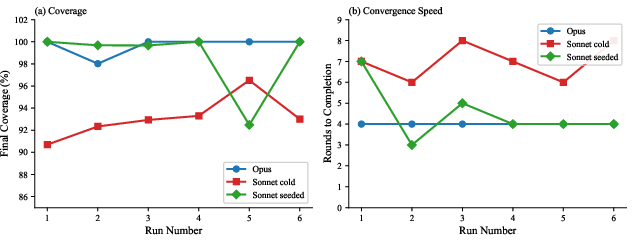
Figure 3: Seeded Sonnet significantly improves coverage and convergence efficiency, approaching Opus-level behavior.
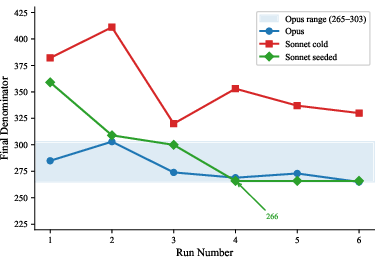
Figure 4: Denominator convergence in seeded Sonnet demonstrates robust calibration of evaluation itself via knowledge transfer.
On more challenging tasks (e.g., Q6, mathematical reasoning benchmarks), knowledge transfer improves survival rates of runs, though the bound shifts from agent reasoning quality to infrastructure resource constraints: knowledge improves operational efficiency but cannot overcome session context exhaustion in highly complex reasoning tasks.
Behavioral Analysis and Institutional Design Perspective
Structural self-deception modes (denominator blindness, self-serving evaluation, quality-as-completeness, knowledge contamination) are systematically eliminated through architectural mechanisms in V2. Hard isolation and append-only knowledge management prevent contamination and maintain epistemic honesty. Denominator variance, rather than measurement error, is treated as operational signal reflecting genuine definitional ambiguity in real-world tasks.
V2 leverages institutional analogs—audit separation, contract law, organizational memory—to ensure reliability and reproducibility. Method isolation, advisory knowledge delivery, and post-mortem extraction map directly to proven institutional practices in human organizations.
Practical and Theoretical Implications
Forage V2 highlights the centrality of organizational experience in agent system performance. It demonstrates that capability gaps between models (e.g., Sonnet vs Opus) can be primarily organizational—exploration inefficiencies—rather than cognitive. Architectural constraints enable rapid transfer of effective strategies, deepening evaluation rigor, and ensure calibration of both collection and evaluation even across heterogeneous model capabilities.
The results suggest best practices for agent systems in settings lacking pre-defined task boundaries: architecturally enforce evaluation separation, accumulate experience institutionally, and transfer knowledge at the organizational (not individual) level. Robustness is ensured by structural constraints, not personality-specific agent enhancements.
The findings open directions for future developments: dynamic supply allocation via orchestrator managers, knowledge curation for quality assurance, cross-task knowledge transfer, and crystallization of verified trajectories as novel training signals. The minimal two-agent architecture scales with task complexity, and its composability renders it compatible with harness-layer and swarm-based multi-agent orchestration.
Conclusion
Forage V2 provides evidence that architectural mechanisms—co-evolving evaluation, audit separation, advisory organizational memory—solve denominator blindness and enable reliable autonomous judgment in open-world tasks. Organizational experience accumulates, reliably transfers across agent capabilities and calibrates both execution and evaluation. Knowledge transfer closes capability gaps, resulting in efficient, credible task completion even for weaker agents. The system demonstrates that organizational design is a foundational axis of agent reliability and transferability, orthogonal to traditional model-centric improvement, and critical for real-world deployment where ground truth is undefined and tasks are inherently ambiguous.

