- The paper introduces quantum instruments that link measurement outcomes with outcome-conditioned quantum processes to model mid-circuit measurements.
- It employs the Pauli transfer matrix to clearly delineate error structures such as trace preservation, unitality, and coherent mixing.
- The analysis underscores practical implications for quantum error correction and adaptive circuit design, advocating detailed process tomography.
Quantum Instruments and Error Modeling in Mid-Circuit Measurements
Quantum instruments (QIs) extend the mathematical treatment of quantum measurements, bridging the gap between classical measurement outcomes and the post-measurement quantum state, which is essential for modeling mid-circuit measurements (MCMs). Unlike POVMs, which only describe probabilities for outcomes, QIs describe the complete quantum-classical transformation by associating a CPTP map to each measurement outcome. This makes QIs indispensable for adaptive circuits and quantum error correction schemes, where subsequent operations depend on the acquired measurement outcomes (2604.18884).
Formally, a QI I acts on a quantum state ρ as
I(ρ)=i∑Ei(ρ)⊗∣i⟩⟨i∣,
where each Ei is a CP quantum process conditional upon outcome i. Trace preservation is enforced as ∑iTr[Ei(ρ)]=1, but individual Ei are not necessarily TP. The joint quantum-classical output structure introduces outcome-dependent error models, complicating faithful representation and interpretation of errors in MCMs.
Pauli Transfer Matrix Representation and Error Structure
Errors in QIs are naturally represented as superoperators; the Pauli transfer matrix (PTM) is particularly instructive due to its real-valued, bounded entries and physically intuitive block structure. The PTM provides explicit insight into trace preservation, unitality, non-unitality, and polarization survival probabilities, facilitating direct inspection of the impact of stochastic errors and coherent processes.

Figure 1: The Pauli Transfer Matrix structure delineates trace preservation, unitality, non-unitality, and preservation of polarization, with explicit blocks identifying different physical error mechanisms.
The PTM for a quantum process Λ is given by Λij=d1Tr[PiE(Pj)], with Pi and ρ0 in the Pauli basis. Its composition is associative, allowing systematic modeling of sequential errors. The diagonal elements encode survival probabilities—e.g., for stochastic Pauli noise—and the off-diagonal elements measure coherent mixing. For unitary or stochastic Pauli errors, the process is unital, while non-unital entries directly signal processes such as ρ1 decay or leakage.
Outcome-Conditioned Error Model Interpretation
QIs decompose into ρ2 outcome-conditioned CP processes, each characterized by its own PTM. The sum across outcomes is TP, but individual components capture both quantum errors (e.g., state collapse, decoherence, relaxation) and classical effects (e.g., readout assignment errors):
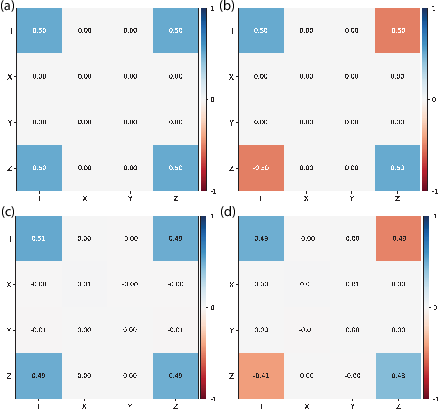
Figure 2: Ideal and experimental PTMs for single-qubit QIs, illustrating the impact of noise and readout infidelity in different conditional measurement channels.
For example, in the single-qubit case with outcomes 0 and 1, ideal PTMs have ρ3 and ρ4, while realistic implementations yield deviations (e.g., ρ5) reflecting physical noise sources such as ρ6 decay. The TP constraint is preserved globally, encoding the total probability conservation, but outcome-specific probabilities provide direct readout fidelity metrics.
Assignment fidelities, extracted from confusion matrices, quantify classical errors on the computational basis but fail to characterize errors affecting superposition states unless incoherent. PTMs enable a more comprehensive view, with quantum error metrics (entanglement infidelity, diamond distance) defined directly for QIs.
Measurement Axis and Post-Measurement State Analysis
The first row of the outcome PTMs encodes the effective measurement axis. Off-axis elements (e.g., non-zero ρ7 or ρ8) indicate measurement tilts from ρ9, either deliberately or due to apparatus imperfections. This is calculable from the PTM representation, equating directly with the Born rule for POVM effects.
The post-measurement state for each outcome is derivable from the PTM as I(ρ)=i∑Ei(ρ)⊗∣i⟩⟨i∣,0. When measuring maximally mixed or computational basis states, the conditional output approximates pure I(ρ)=i∑Ei(ρ)⊗∣i⟩⟨i∣,1 or I(ρ)=i∑Ei(ρ)⊗∣i⟩⟨i∣,2, but noise sources produce mixed output states (e.g., post-measurement shrinkage of the Bloch vector attributable to I(ρ)=i∑Ei(ρ)⊗∣i⟩⟨i∣,3 relaxation). Analysis of the unital block and survival probabilities shows rapid destruction of transverse (I(ρ)=i∑Ei(ρ)⊗∣i⟩⟨i∣,4, I(ρ)=i∑Ei(ρ)⊗∣i⟩⟨i∣,5) coherences for I(ρ)=i∑Ei(ρ)⊗∣i⟩⟨i∣,6-basis measurements, with residual coherent errors and asymmetries in polarization preservation further manifesting non-unitality.
Practical and Theoretical Implications
Accurate QI error modeling is critical for performance-limiting analysis in quantum circuits deploying MCMs. Classical assignment fidelities remain suboptimal; only a tomographic reconstruction of QIs can capture the full quantum-classical error structure and delineate quantum non-demolition behavior. This is especially vital for QEC, where repeated measurements' fidelity and coherence preservation directly impact logical error rates [stricker2022characterizing].
However, full QI process tomography scales poorly. Randomized benchmarking tailored to MCMs is being developed for practical characterization at scale [govia2023randomized, zhang2025generalized, hines2025pauli]. While these approaches obscure detailed error sources and report only aggregate metrics (fidelity, stochastic error rates), they may suffice for predominantly stochastic instruments (e.g., dispersive measurements on superconducting qubits). Nevertheless, the complexity of MCM dynamics—particularly their impact on neighboring spectator qubits—means that high-level metrics often fail to predict actual circuit performance, mirroring analogous findings in gate benchmarking.
Conclusion
Understanding and modeling quantum instruments is foundational for quantum computing architectures leveraging mid-circuit measurements, particularly for error correction and adaptive quantum control. The PTM framework offers a granular and interpretable lens into QI error structure, providing actionable insight into trace preservation, unitality, non-unitality, classical readout fidelity, measurement axis, and post-measurement state purity. While scalable benchmarking tools are under active development, full QI tomography remains essential for diagnostic accuracy and advancing quantum device performance. Future research should focus on reconciling scalable benchmarking with detailed error analysis, and on characterizing the impact of measurement dynamics on whole-system behavior, especially in the regime where stochastic and coherent errors coexist (2604.18884).