- The paper introduces an extension of the MeanFlow framework that leverages BLIP3o-NEXT for few-step, high-fidelity text-to-image synthesis.
- It addresses challenges from complex textual prompts by using adaptive time sampling and bidirectional temporal embeddings to stabilize the denoising process.
- Empirical results demonstrate superior semantic control, visual fidelity, and inference efficiency compared to existing distilled models.
Extending One-Step Image Generation from Class Labels to Text via Discriminative Text Representation
Introduction and Motivation
This work systematically extends the MeanFlow framework, previously effective for one-step image generation from discrete class labels, to the general text-to-image (T2I) paradigm by leveraging highly discriminative and disentangled text representations produced by large vision-LLMs (VLMs). The domain shift from class labels—discrete, well-separated, and low-entropy embeddings—to complex textual prompts introduces significant challenges for constructing semantically aligned velocity fields in continuous time generative flows. The authors analyze these limitations and propose a practical, scalable solution using state-of-the-art LLM-based text encoders, specifically BLIP3o-NEXT, showing the feasibility and superiority of text-conditioned MeanFlow in few-step and even one-step high-fidelity T2I generation.
Problem Statement and Background
The class-conditional MeanFlow approach exploits label sparsity to predict average velocity fields across the generative trajectory, enabling competitive one-step sampling in discrete settings. However, extending conditioning from classes to text fundamentally alters the geometry of the conditioning space: textual conditions are dense, compositional, and semantically entangled, causing velocity fields to become irregular and the denoising trajectory tortuous and more error-prone under few-step refinement.
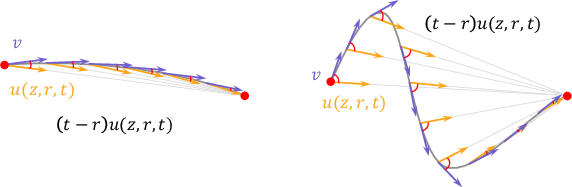
Figure 1: Denoising trajectories for class-condition (left, smooth) and text-condition (right, tortuous), emphasizing the increased difficulty of text-conditioned flow prediction.
Empirically, the authors observe that direct adaptation of class-label-trained MeanFlow models to text prompts fails, even with powerful backbone architectures and pretraining on standard datasets. Existing T2I text encoders (T5, CLIP, SANA-1.5, etc.) when used naively, yield poor semantic preservation and greater subject drift under aggressive step reduction, highlighting the importance of the encoder choice and its representation properties.
Discriminability and Disentanglement in Text Conditioning
A key insight from this work is that the quality of the text encoder is the core bottleneck for few-step T2I generation. The encoder should exhibit:
- High discriminability: Ensuring that even semantically nearby prompts yield distinct embeddings, improving semantic preservation with minimal denoising.
- Strong disentanglement: Attribute- and entity-level components of the text must be separately, linearly encoded, allowing the generative model to ground and bind complex descriptions faithfully even in one-shot or very few steps.
The authors provide empirical retrieval and ablation studies comparing SANA-1.5, CLIP, T5, Gemma, and BLIP3o-NEXT, with BLIP3o-NEXT dominating both theoretical desiderata and downstream generation performance.
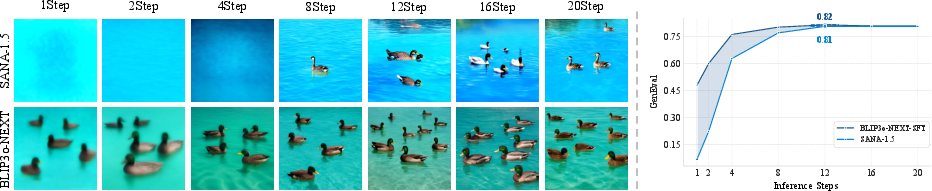
Figure 2: In few-step sampling, BLIP3o-NEXT preserves subject fidelity ("ducks") under 1-step generation, while SANA-1.5 loses core content; right, BLIP3o-NEXT outperforms SANA-1.5 across all GenEval submetrics in the few-step regime.
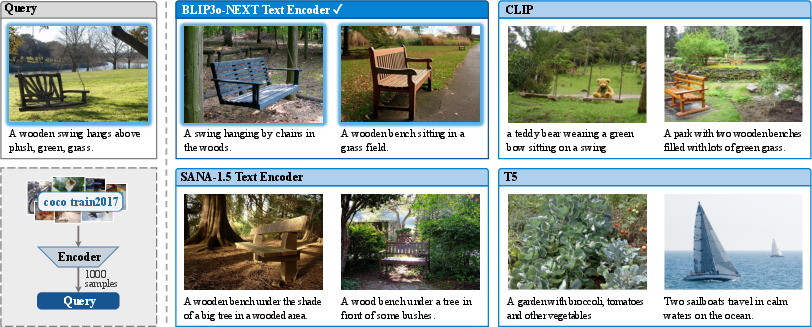
Figure 3: Retrieval on COCO2017 using different encoder architectures; BLIP3o-NEXT aligns text and visual representations most effectively, which correlates with improved semantic control.
Method: MeanFlow Extension and Training
The proposed extension modifies the MeanFlow conditional architecture for efficient text-driven generation:
- Bidirectional temporal embedding: Duplicating the usual noise level encoding to handle both interval length and segment end time, supporting precise interval-aware velocity prediction.
- Text condition injection: Using fixed, strong BLIP3o-NEXT embeddings for text, concatenated with temporal embeddings and image latents for conditioning the velocity predictor uθ.
- Adaptive time interval sampling: Timesteps (t,r) are adaptively drawn from distributions to provide balanced exposure to short- and long-range denoising, facilitating stable velocity field modeling.
The MeanFlow training loss remains a mean squared error between predicted and self-consistent velocity map targets, employing stop-gradient for stabilization, and Jacobian-vector products for computing necessary derivatives.
Experimental Results
Quantitative Benchmarks
The MeanFlow adaptation (EMF) is evaluated on GenEval, DPG-Bench, and HPS-v2, outperforming all distilled few-step models and even matching or surpassing larger teacher models on various sub-benchmarks. Notably, EMF with only 4 steps achieves GenEval 0.90, nearly identical to BLIP3o-NEXT's 30-step reference (0.91), and demonstrates significant robustness in highly compositional and long-form prompt evaluation.
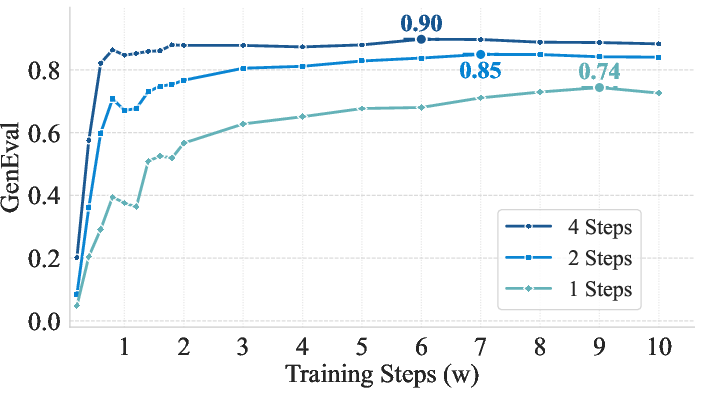
Figure 4: Ablation over training steps and number of inference steps for EMF; rapid convergence with only 4 steps and stable improvements for increased step counts.
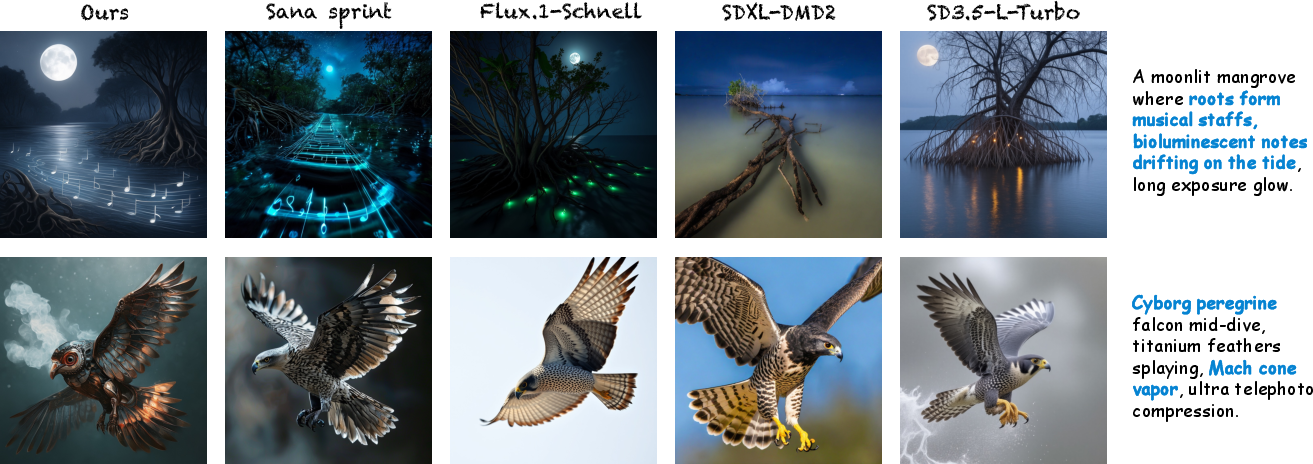
Figure 5: Against existing distilled models (e.g., SANA-Sprint, SDXL-Turbo), EMF achieves higher semantic and visual fidelity, particularly on complex textual instructions.
Visual and Perceptual Analysis
Comparison of generated samples under 4-step and 8-step sampling reveals sharper, more faithful adherence to prompts compared to both distilled and baseline flow matching models, especially evident on benchmarks with intricate object-attribute and relational binding requirements.
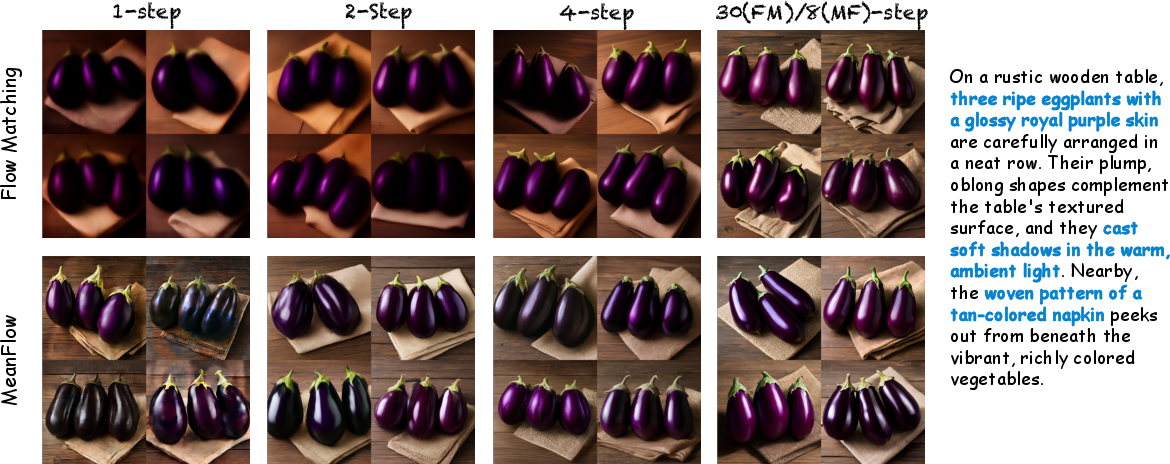
Figure 6: EMF yields visually sharp and semantically coherent images at 1 or 4 steps, matching or exceeding 30-step flow matching approaches in both speed and quality.
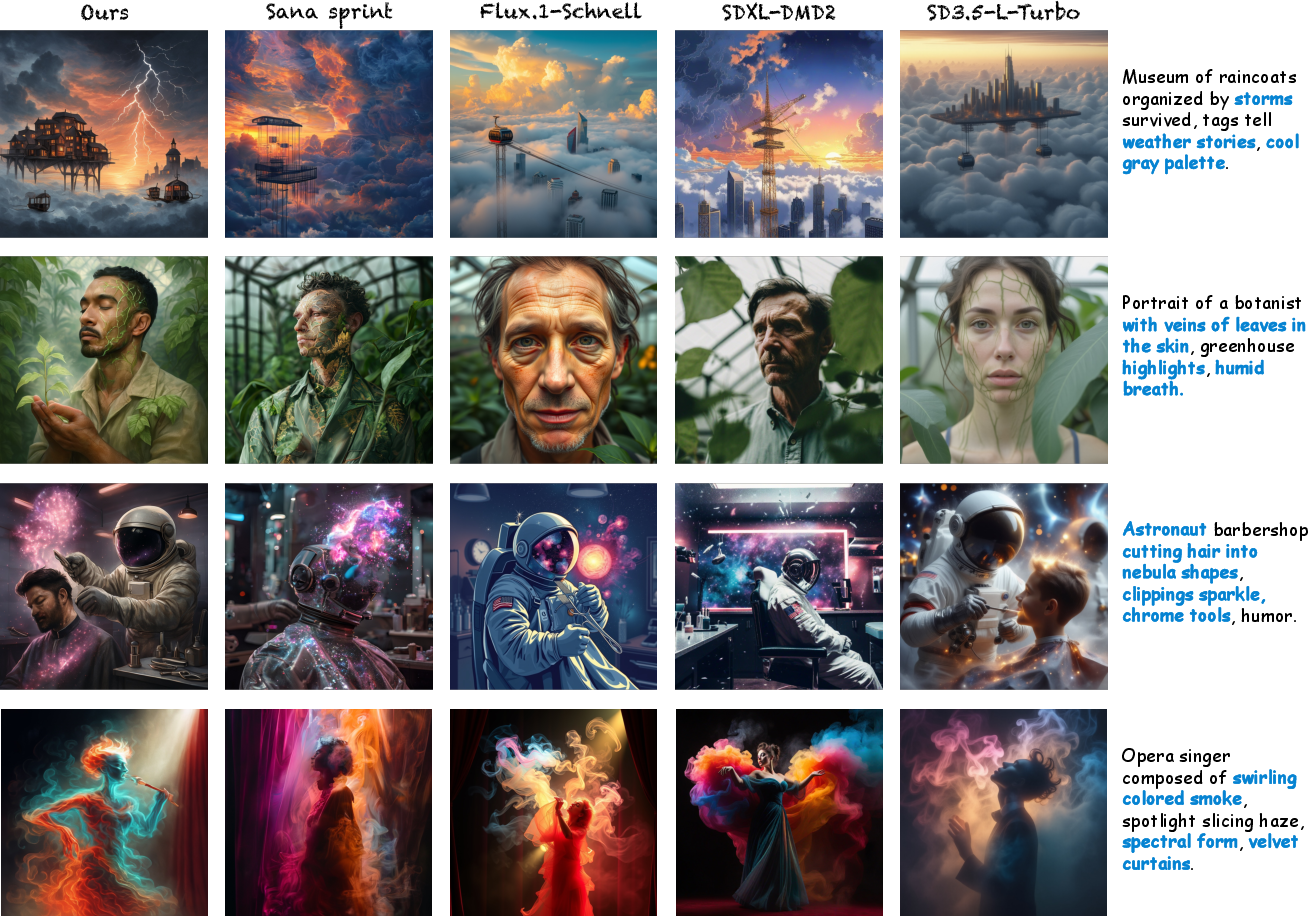
Figure 7: Additional 4-step generation results where distilled models fail attribute binding, while EMF preserves linguistic nuance and compositional detail.
Encoder and Model Design Analysis
Ablation on text encoder swap-in and further experiments on SANA-1.5 and OpenUni validate that only text representations trained for discriminability and disentanglement (as in BLIP3o-NEXT's joint vision-language pretraining regime) enable effective MeanFlow extension to complex T2I settings.
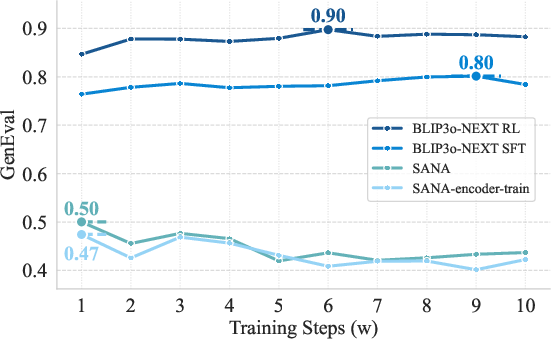
Figure 8: GenEval evolution under MeanFlow training for various encoders; only BLIP3o-NEXT achieves stable, monotonic improvement in the few-step context.
Inference Efficiency
EMF drastically reduces wall-clock inference time (1-step: 0.08s, 4-step: 0.22s) versus 30-step flow matching (1.24s), demonstrating practical viability for latency-critical applications.
Implications and Future Work
This work re-anchors the bottleneck of generative acceleration and text control in the representation geometry and vision-language alignment of the conditioning encoder, not merely in improved ODE solvers or loss functions. The findings indicate that further progress in few-/one-step T2I relies less on architectural scale of the generator itself and more on joint contrastive or language-vision pretraining objectives that improve semantic localization, compositional disentanglement, and intra-text discriminability.
The results suggest the research direction of exploring more tailored discriminative loss functions, specialized pretraining for instruction-space density, or cross-modal alignment strategies, potentially generalizing to multimodal settings beyond T2I (e.g. text-driven video, 3D generation, or multimodal editing).
Furthermore, the MeanFlow framework, thanks to its stable discretization of continuous generative dynamics, does not exhibit the quality plateau or degradation as step count grows—a limitation observed in prior consistency/distillation-based acceleration approaches—thus supporting scalable deployment with better trade-off selection for inference speed and quality.
Conclusion
This work presents the first successful extension of MeanFlow one-step and few-step generation to continuous, high-entropy text conditions by employing discriminative and disentangled VLM text representations. The empirical results cement BLIP3o-NEXT's text encoder as the superior backbone for modern T2I acceleration, and the architectural and analytical contributions provide a practical and general foundation for efficient, high-fidelity text-driven synthesis. This study establishes a compelling procedural guidance for the community on how to condition fast generative models on complex linguistic inputs for reliable content creation.
(2604.18168)

