Magnetic-fluctuation-driven suppression of spin-orbit hybridization in the surface ferromagnet GdAg2/Ag(111)
Published 20 Apr 2026 in cond-mat.str-el | (2604.18009v1)
Abstract: Magnetic materials hosting topological band structures have attracted intense interest due to the interplay between magnetism and spin-orbit coupling (SOC). Here, using temperature- and polarization-dependent angle-resolved photoemission spectroscopy, we investigate the surface ferromagnet GdAg2/Ag(111), a two-dimensional system with Weyl-nodal-line-like band crossings. We find that spin fluctuations preserve the nodal-line-derived band crossings even above the Curie temperature, while SOC-induced hybridization develops only at low temperatures, as evidenced by spectral-weight redistribution. The suppression of the hybridization at high temperature is attributed to spin decoherence and band-dependent scattering, captured by an effective non-Hermitian framework. Our results establish magnetic fluctuations as a control knob for SOC-induced hybridization and associated Berry curvature, and highlight magnetic systems as a platform for exploring non-Hermitian band physics.
The paper demonstrates that magnetic fluctuations suppress SOC-induced hybridization, stabilizing nodal-line features even above the Curie temperature.
It employs ARPES measurements and DFT calculations to reveal temperature-dependent spectral broadening and persistent spin-mixing exchange splitting.
The effective non-Hermitian framework links SOC and quasiparticle lifetimes, offering tunable control over Berry curvature and anomalous Hall transport.
Magnetic-Fluctuation-Induced Suppression of Spin-Orbit Hybridization in GdAg2/Ag(111)
Introduction
The study addresses the relationship between magnetic fluctuations, spin-orbit coupling (SOC), and topological band structures in the two-dimensional surface ferromagnet GdAg2/Ag(111). This system is characterized by Weyl-nodal-line-like band crossings and strong local moment magnetism originating from Gd 4f7 electrons. The research provides detailed experimental and theoretical evidence that spin fluctuations stabilize nodal-line features even above TC, while SOC-induced band hybridization is suppressed in the absence of long-range magnetic order. A unified non-Hermitian framework is adopted to interpret the temperature-dependent suppression of the hybridization gap, identifying lifetimes and decoherence as critical parameters. This insight enables linkages between tunable Berry curvature and anomalous Hall transport in correlated magnetic systems.
Band Structure Evolution and Topological Crossings
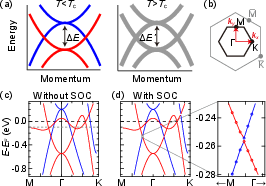
The surface alloy GdAg2/Ag(111) undergoes a (3×3)R30∘ surface reconstruction with moiré patterns, confirmed by LEED and previous studies. DFT calculations for a monolayer without SOC exhibit spin-split electron and hole bands mainly from hybridized Ag and Gd orbitals, forming multiple topological crossings near the Fermi level. Incorporating SOC into the calculations reveals hybridization gaps at these crossings, directly associated with finite Berry curvature and intrinsically large anomalous Hall responses. The exchange splitting ΔE persists above TC due to localized moments and spin mixing, unlike standard itinerant ferromagnetic behavior.
Figure 1: Schematic and DFT data showing spin-mixing exchange splitting, surface Brillouin zones, spin-polarized band structure, and SOC-induced hybridization gap at nodal crossings in GdAg2/Ag(111).
ARPES Measurements and Band Crossing Characterization
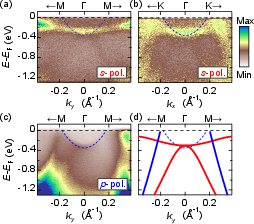
Polarization- and temperature-dependent ARPES measurements reveal robust electron-like and hole-like features around the Γ point at both 100 K and 10 K, indicating temperature-independent exchange splitting consistent with spin-mixing phenomena. Differences in intensity and dispersion along high-symmetry directions are highlighted by polarization selection; 20-polarized light resolves electron bands, whereas 21-polarized light distinguishes hole-like bands and projected substrate features. The nodal-line-derived band crossing at 22 is confirmed, although certain crossings predicted by DFT near the Fermi level are not resolved experimentally due to substrate hybridization or vertical Gd displacement effects.
Figure 2: ARPES maps along 23 and 24; polarization selectivity enables identification of majority and minority spin bands and key band crossings.
Temperature Dependence and Magnetic Fluctuation Effects
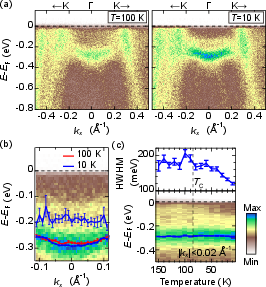
Temperature variation across the ferromagnetic transition reveals that, while the main bands remain at constant energy positions near 25, spectral broadening increases significantly at high temperatures. This broadening is attributed to enhanced quasiparticle scattering and reduced coherence, but the persistence of band splitting at high 26 confirms that localized moments provoke spin-mixing splitting above 27, enabling the survival of nodal-line-derived topological features.
At low temperature, a subband-like feature with reduced dispersion gains intensity near 28, possibly connected to magnetic effects beyond DFT. Lorentzian fits quantify these changes, with spectral width (FWHM) increasing monotonically from 10 K to 150 K. The electron-like band's width increases by approximately 29 meV between 20 K and 60 K, while the hole band remains relatively unchanged.
Figure 3: ARPES maps, energy position fits, and temperature-dependent spectral widths, demonstrating constant band positions but pronounced broadening at elevated temperature.
Suppression of SOC-Induced Hybridization via Spin Fluctuations and Non-Hermitian Effects
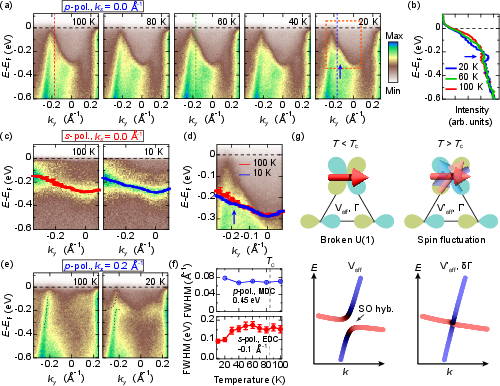
The SOC-induced hybridization gap only emerges below 4f70, evidenced by the redistribution of spectral weight and bending of hole-band dispersions around the band crossing. ARPES cuts at 4f71 show clear temperature-dependent gap formation and intensity transfer. At high temperature, the gap is suppressed, attributed to two cooperative mechanisms: (1) spin fluctuation-induced decoherence reducing the effective hybridization matrix element (4f72), and (2) band-dependent quasiparticle scattering producing non-Hermitian lifetime effects.
The effective Hamiltonian is defined as
4f73
where 4f74 captures SOC-induced hybridization, and 4f75 denote band-dependent scattering rates.
At the crossing (4f76), the gap becomes
4f77
with 4f78. Thus, if 4f79, the gap is effectively closed despite finite SOC coupling. Experimentally, TC0 is measured to be TC1 meV, which is significant relative to the SOC gap scale.
Figure 4: Temperature-dependent ARPES maps, spectral redistributions, gap position fits, band broadening analysis, and schematic diagrams linking suppressed SOC hybridization to spin fluctuations and lifetime effects.
Implications and Prospects
The results underscore that SOC-induced band hybridization is not static but highly tunable with magnetic fluctuations. Control over the Berry curvature distribution and related transport phenomena such as the anomalous Hall effect can be achieved through temperature or magnetic field manipulation. Spin decoherence and band scattering allow continuous modulation of hybridization, offering degrees of freedom not accessible via simple spin orientation control.
Notably, the data and the non-Hermitian framework position magnetic systems—especially those with strong band-dependent scattering such as GdAgTC2—as promising platforms for non-Hermitian band physics. The regime where SOC matrix elements and lifetime differences are comparable is accessible, enabling observation and tuning of non-Hermitian band crossings and their affiliated topological phenomena.
Conclusion
This study systematically demonstrates that magnetic fluctuations induce persistent spin-mixing band splitting and stabilize nodal-line-derived topological crossings above TC3 in GdAgTC4/Ag(111). SOC-induced hybridization develops only with long-range order and is suppressed through spin decoherence and band-dependent scattering at elevated temperatures, as captured by an effective non-Hermitian Hamiltonian. Magnetic fluctuations serve as a control knob for engineering SOC-driven hybridization, Berry curvature, and non-Hermitian band crossings, with direct implications for tunable transport behaviors and new band topology regimes in correlated electron systems.