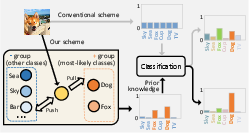
- The paper presents a two-stage DIFO++ framework that integrates prompt learning with gap region-driven uncertainty reduction for improved source-free domain adaptation.
- It customizes a frozen vision-language model using class-conditioned prompts and mutual information maximization to align with unlabeled target data.
- Empirical results demonstrate 2.1%–13.2% accuracy gains over benchmarks, with enhanced feature separation and temporal prediction stability.
Source-Free Domain Adaptation with Vision-Language Prior: A Technical Analysis
Introduction and Motivation
Source-Free Domain Adaptation (SFDA) addresses the transfer of a pre-trained source model to a target domain where only unlabeled data are available. Classical SFDA paradigms predominantly depend on pseudo-labeling or mining auxiliary supervision from the source model, strategies that are highly susceptible to domain shift and consequently induce error accumulation during adaptation. The paper "Source-Free Domain Adaptation with Vision-Language Prior" (2604.17748) systematically navigates beyond these limitations by leveraging external, pre-trained multimodal foundation models such as CLIP as a source of heterogeneous and general-purpose semantic knowledge.
A central claim of this work is that neither direct zero-shot application of vision-language (ViL) models nor conventional self-training is sufficient for effective, target-specialized adaptation. To overcome this inadequacy, the authors propose a two-stage methodology, termed DIFO++, which alternately customizes ViL models to the target domain and distills their knowledge into the target model with uncertainty-aware mechanisms, explicitly focusing on "gap regions"—feature-space zones of class ambiguity.
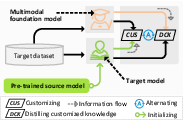
Figure 1: The framework leverages both a pretrained source model and a multimodal foundation model (e.g., CLIP) for unsupervised SFDA.
DIFO++ Framework and Methodological Advancements
The DIFO++ architecture is defined by the iterative alternation of two core processes: task-specific ViL customization and gap region-driven knowledge adaptation.
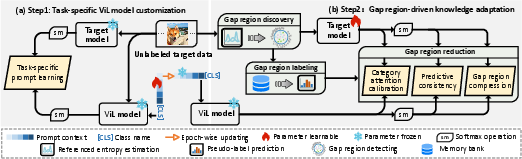
Figure 2: High-level overview of DIFO++ adaptation pipeline, including ViL customization and uncertainty-guided knowledge transfer via gap region reduction.
Task-Specific Customization of ViL Models
Given a frozen ViL model (e.g., CLIP) and its lack of task specialization, the first stage focuses on adapting the ViL model to the target domain via prompt learning. The only learnable parameters are class-conditioned prompts while all ViL weights are frozen. To address the absence of reliable supervision signals in the target domain, DIFO++ employs mutual information maximization between the evolving target model and the tailored ViL model. This mutual information-driven alignment is theoretically justified by its unbiased nature—unlike the asymmetric bias induced by KL divergence—rendering it a superior choice for co-regularizing unsupervised adaptation when both teacher and student predictions are noisy.
Gap Region-Driven Knowledge Adaptation
The second stage introduces a disciplined curriculum-style adaptation centered on "gap regions"—compact, high-entropy feature-space areas where domain shift induces significant class ambiguity. The identification of these gap regions utilizes a proposed "referenced entropy" metric, which tracks the evolving uncertainty of each target sample relative to an adaptation-aware entropy reference via an EMA update scheme. This mitigates the noisy behavior exhibited by traditional entropy, energy scores, or margin metrics in SFDA.
Within the gap region, pseudo-labels are constructed via an exponential-weighted fusion of the target and customized ViL predictions, with historical prediction banks ensuring temporal stability. The knowledge transfer is regularized by three synergistic mechanisms:
This pipeline synthesizes the strengths of both domain-specific inductive biases (source model priors) and multimodal generalization (ViL priors), enabling robust and curriculum-informed transfer.
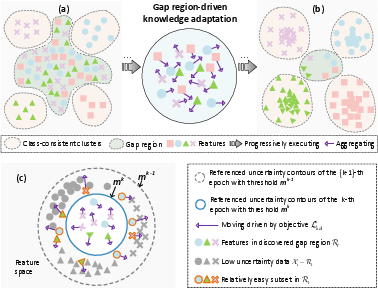
Figure 3: Schematic of gap region identification (a), reduction via regularized adaptation (b), and epoch-wise feature redistribution (c).
Empirical Results
Experimental evaluation was conducted across standard SFDA benchmarks: Office-31, Office-Home, VisDA, and DomainNet-126, spanning closed-set, partial-set, open-set, continual, and multi-target settings.
Main findings include:
- DIFO++ produces consistent gains over prior SFDA methods (e.g., SHOT, NRC, SiLAN, DIFO), attaining up to 2.1%–13.2% higher average accuracy across considered benchmarks.
- The proposed referenced entropy metric outperforms conventional entropy, energy, and margin-based uncertainty models, yielding more stable convergence and reduced error amplification, particularly in high-class-count scenarios.
- Task-specific customization of CLIP via prompt learning followed by disciplined fusion and distillation aligns the learned representation closer to the "oracle" model trained on labeled target domain data, as shown both numerically and in MMD-driven feature space analysis.
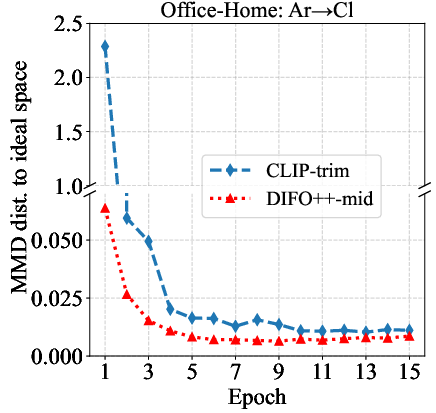
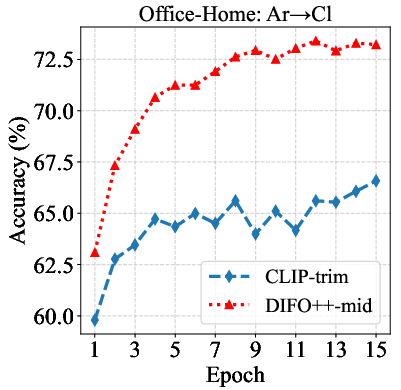
Figure 6: MMD distance and target accuracy vs. epochs during adaptation, revealing synchronized task specialization of both student and customized ViL models.
Visualization analyses (e.g., t-SNE, Grad-CAM) demonstrate that DIFO++ significantly reduces class overlap in ambiguous feature regions, yielding feature distributions comparable to the supervised target oracle.
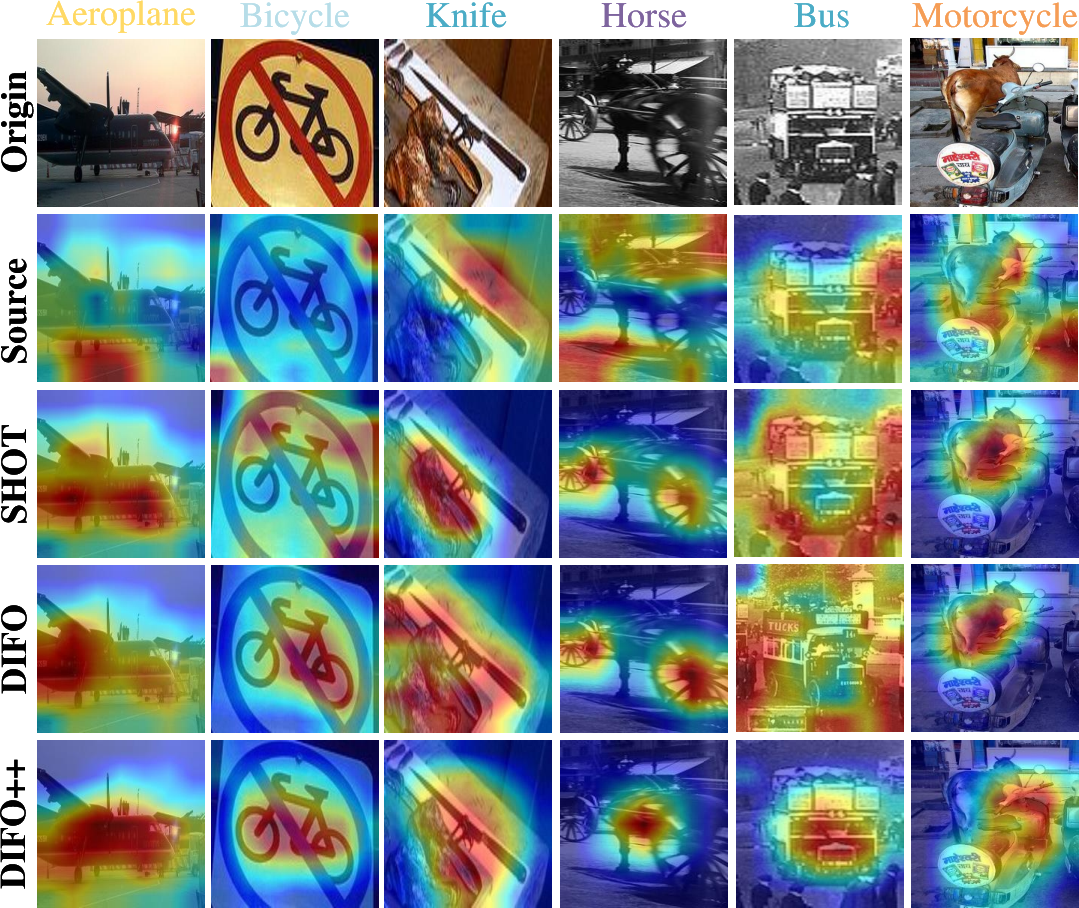
Figure 5: Grad-CAM maps for VisDA illustrate DIFO++'s improved spatial focus and semantic grounding compared to SFDA baselines.
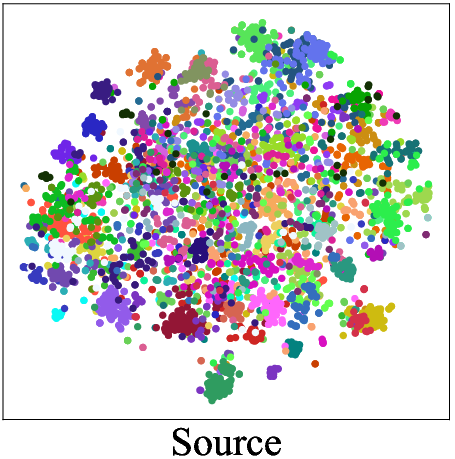
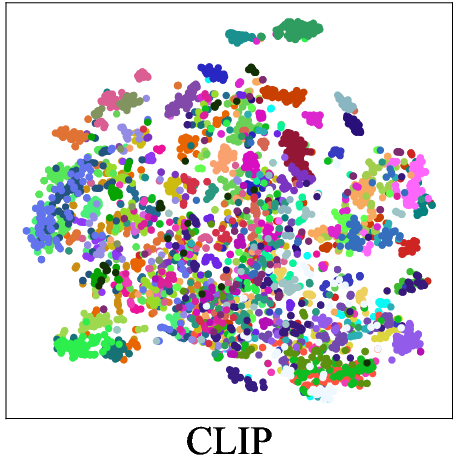
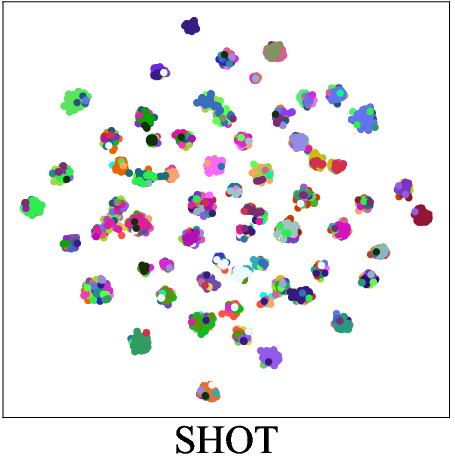
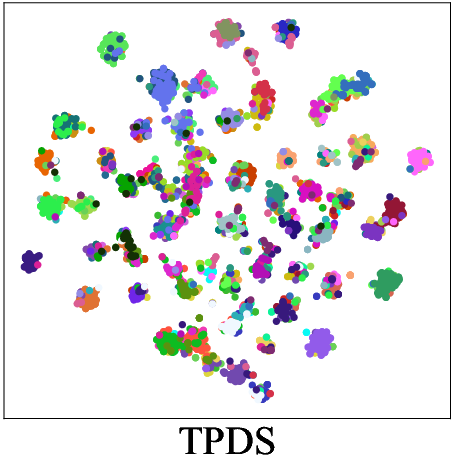
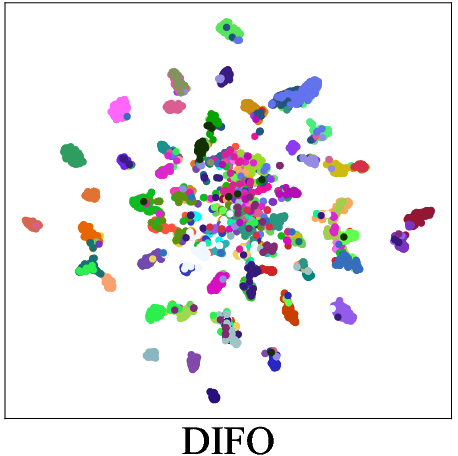
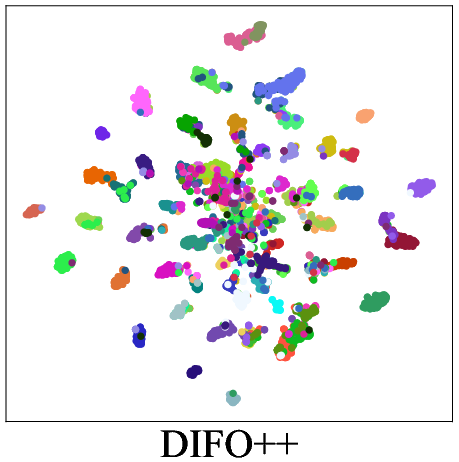
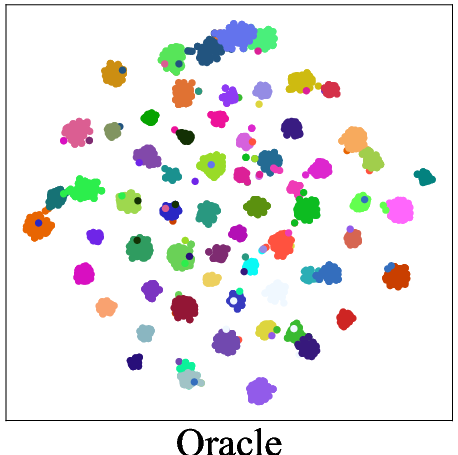
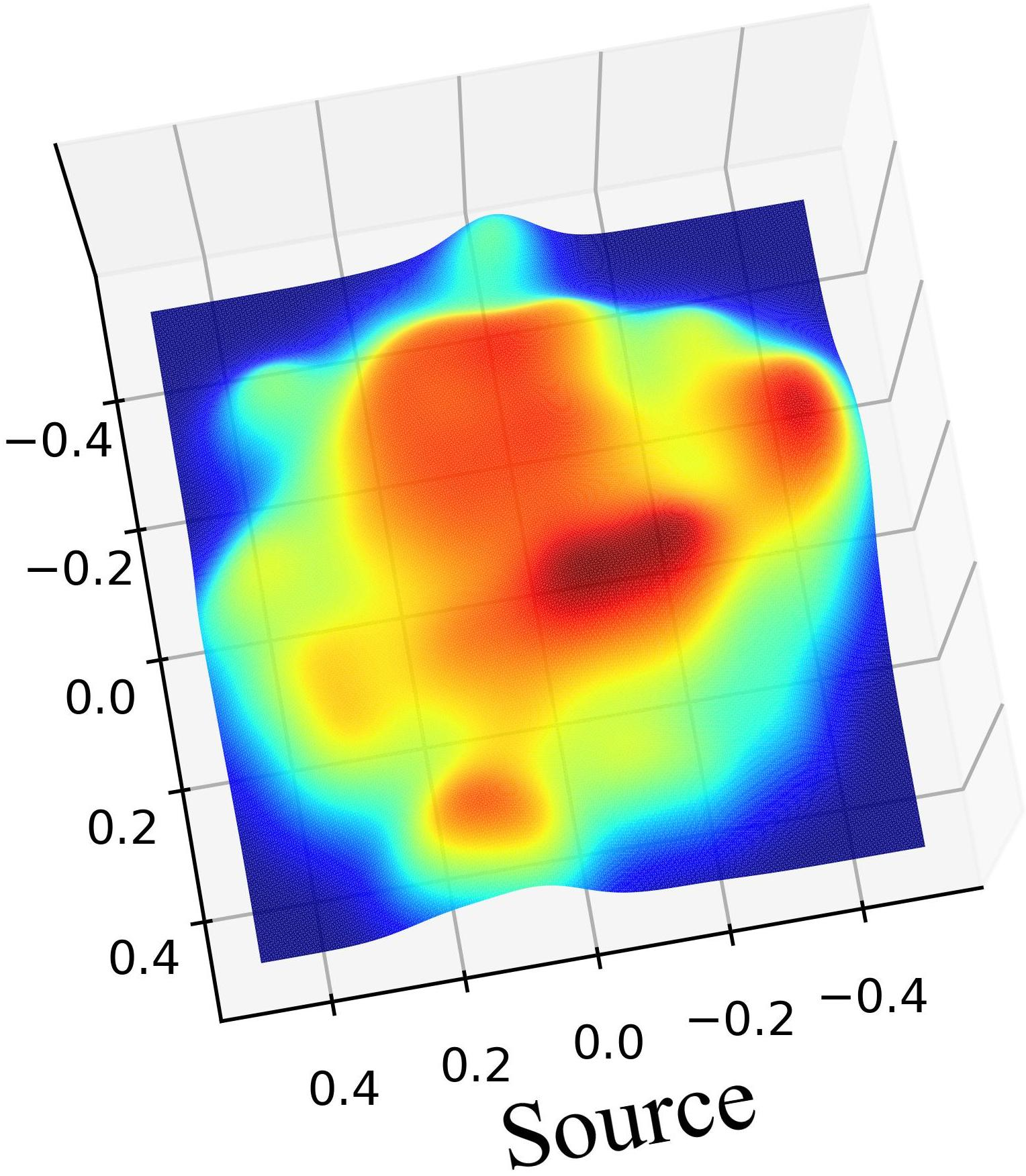
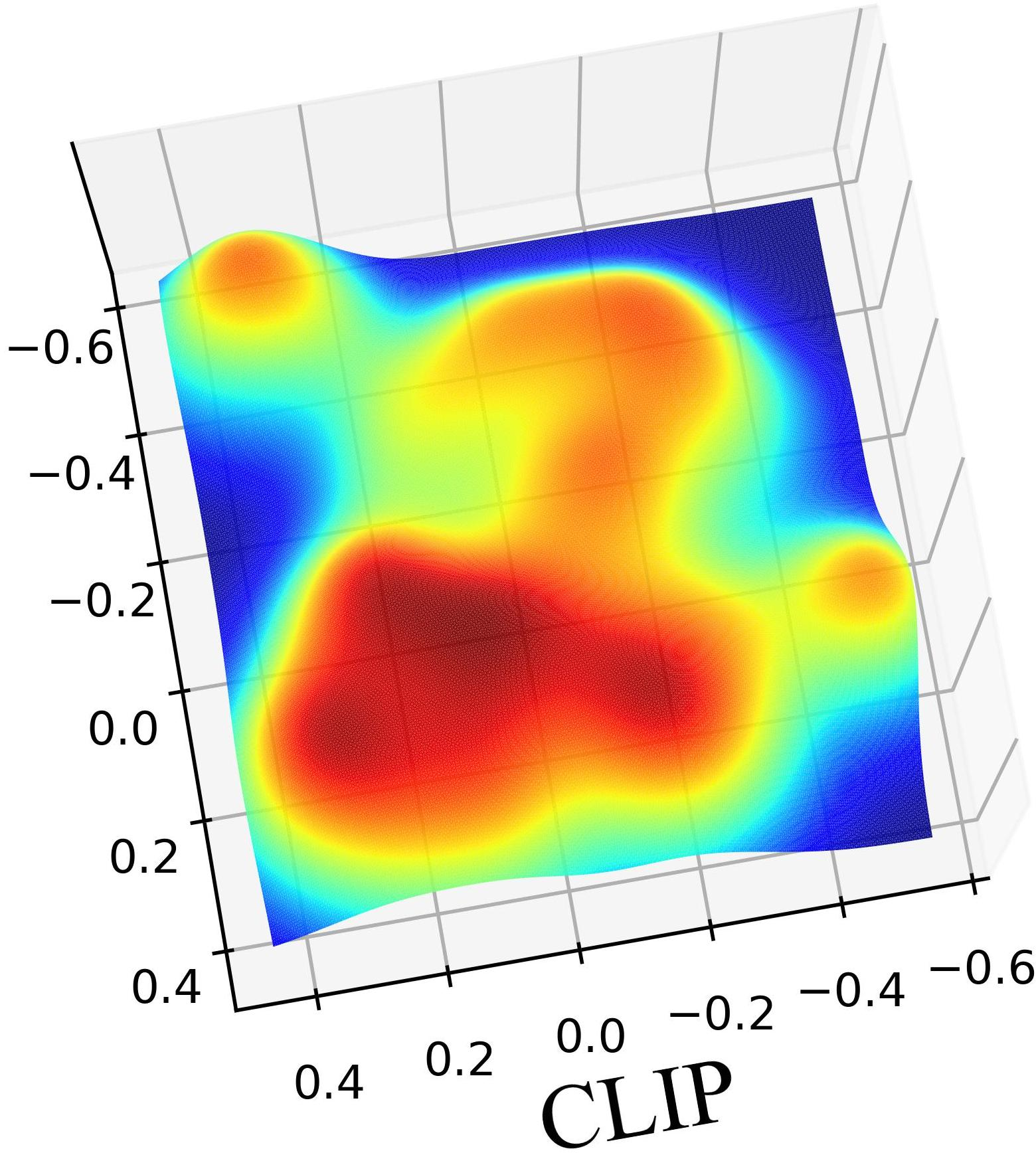
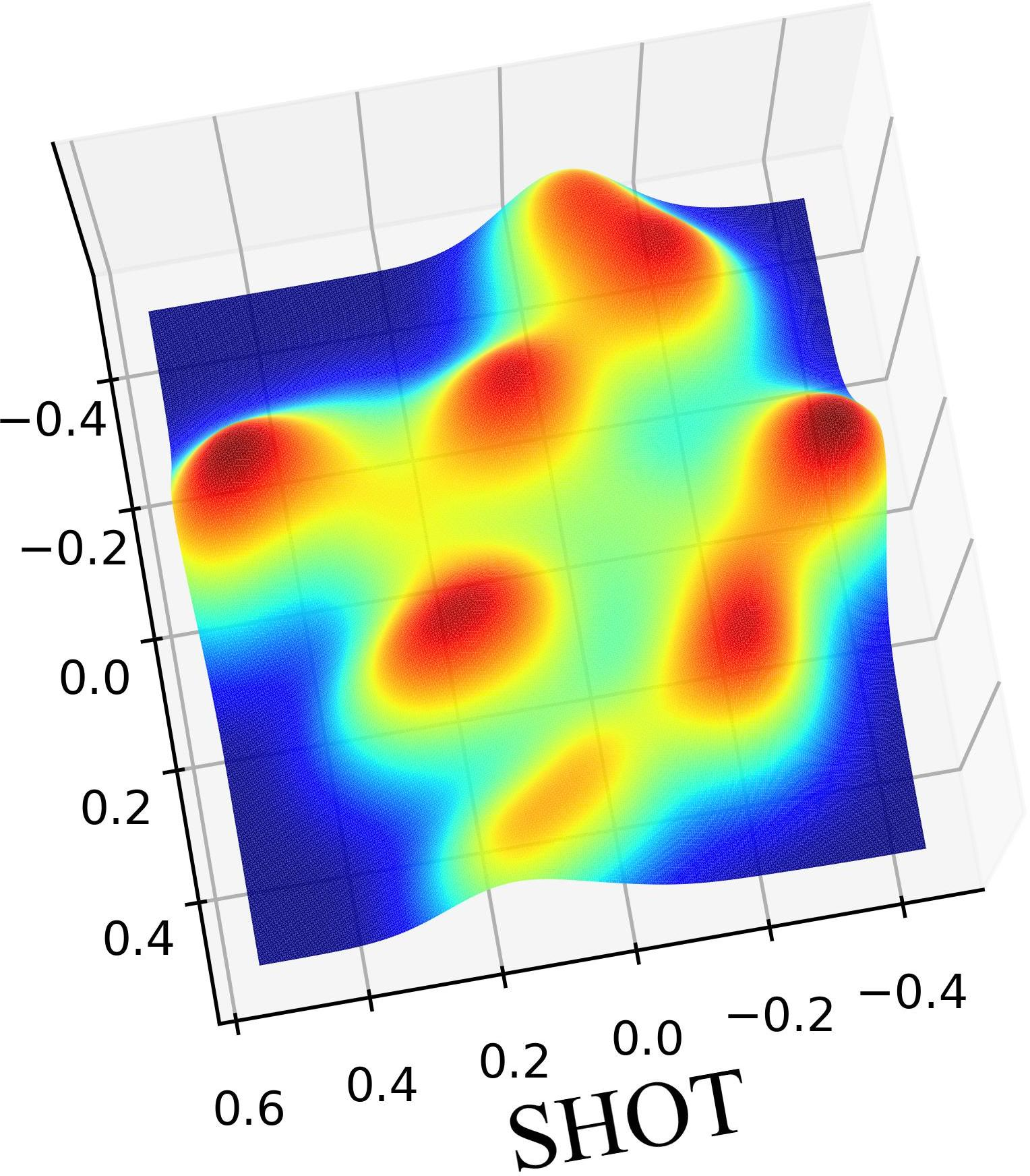
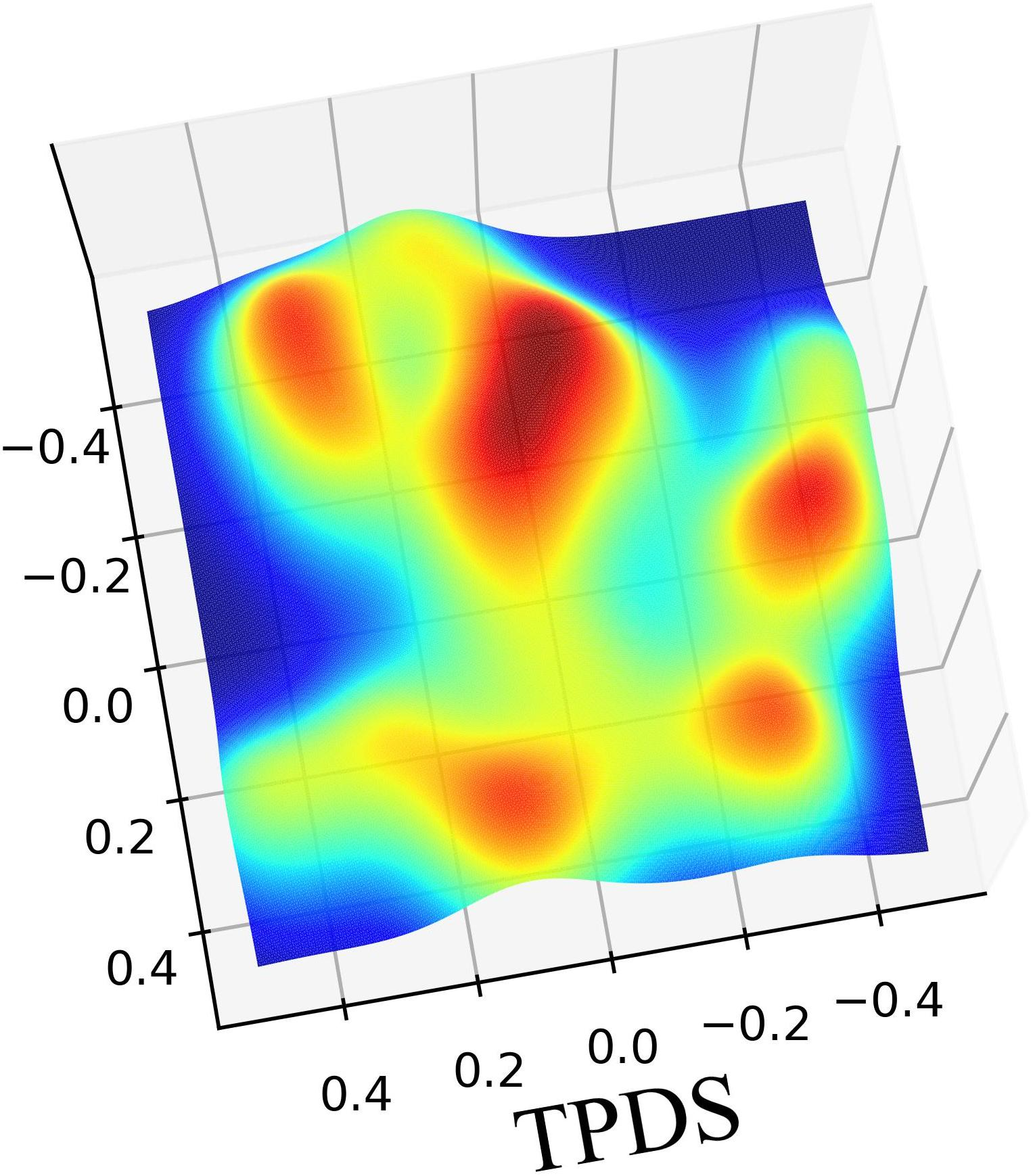
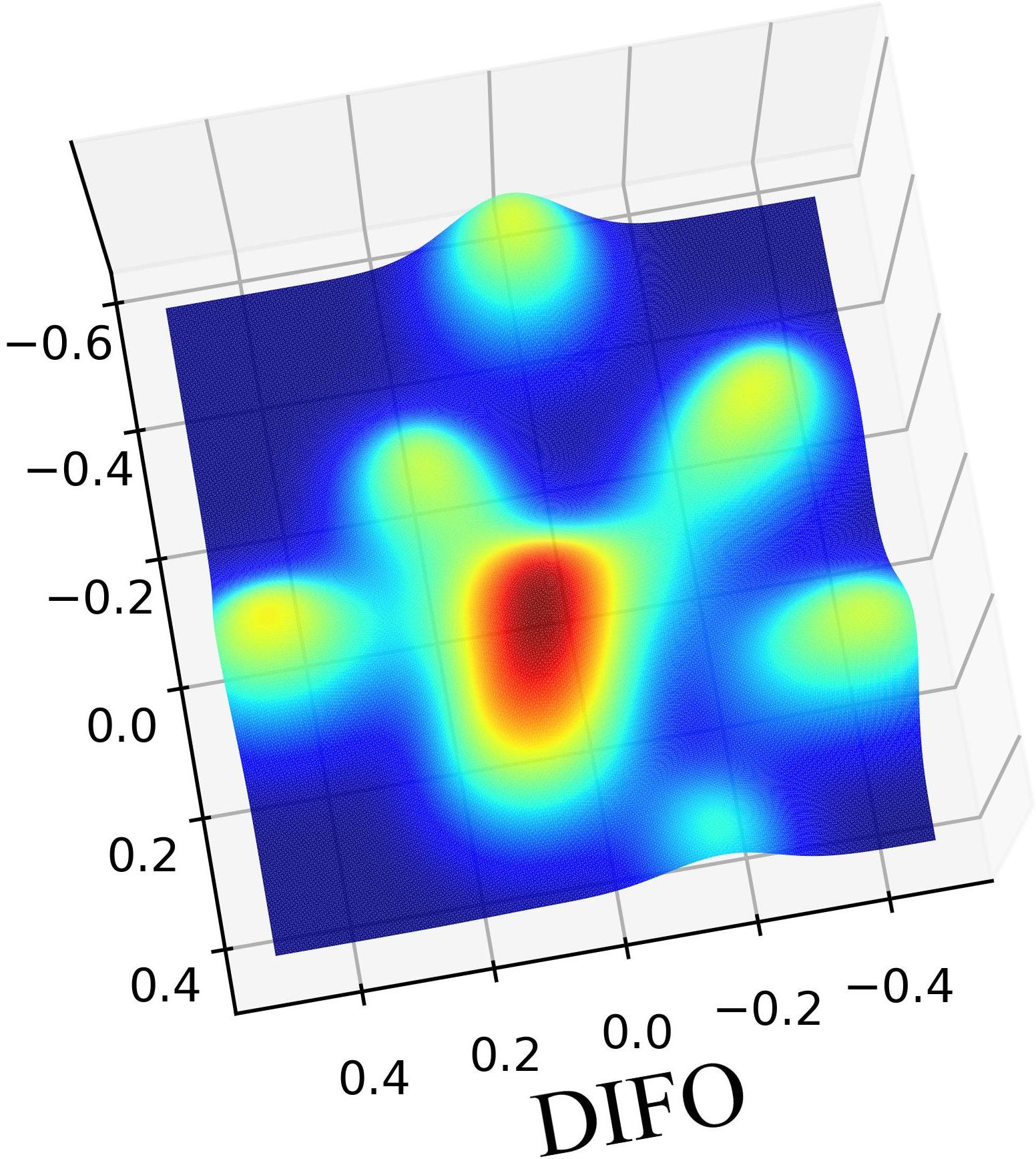
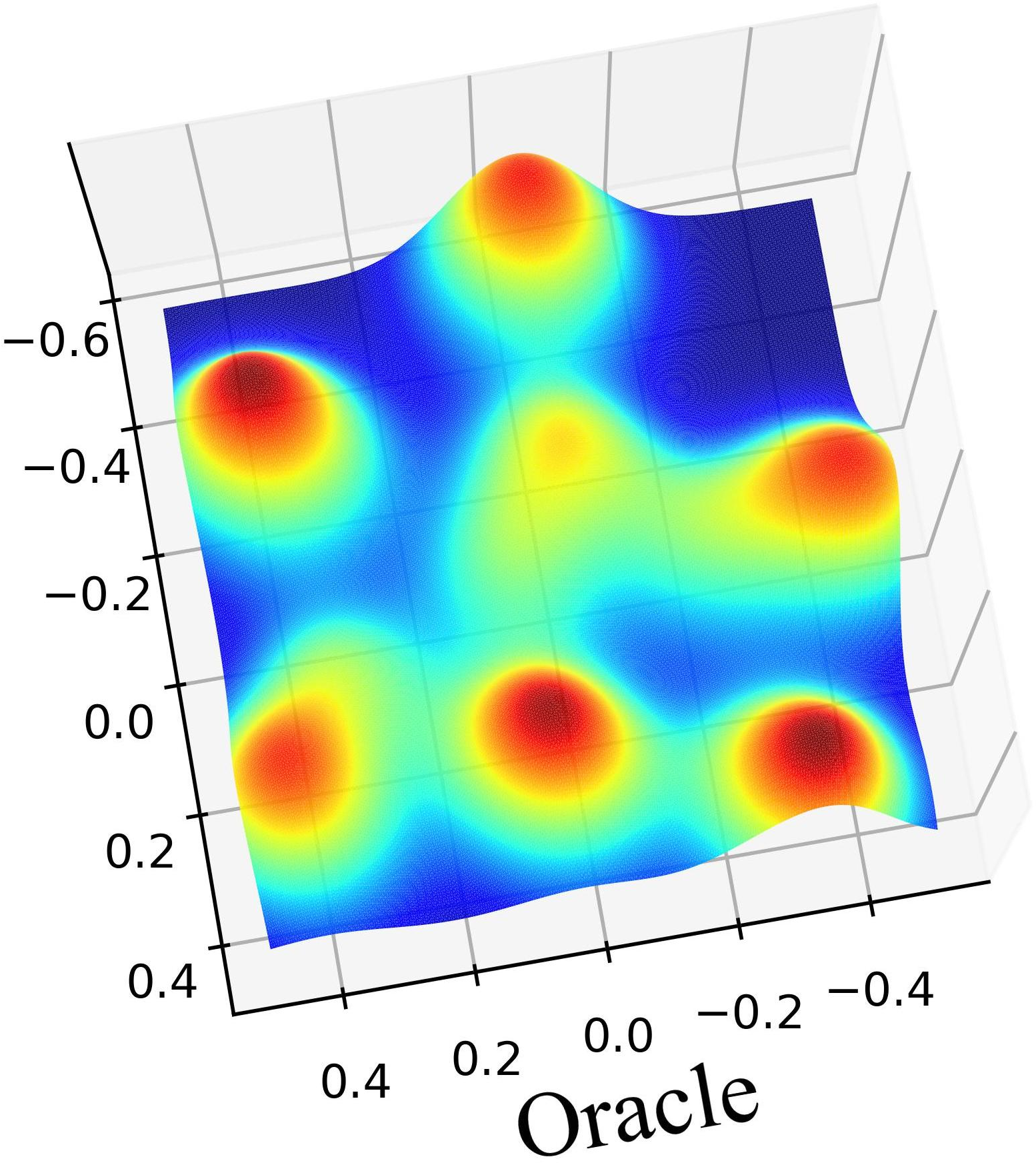
Figure 9: t-SNE and 3D density visualization of the feature space after adaptation exposes enhanced class separation and cluster integrity for DIFO++.
Theoretical and Practical Implications
Theoretically, DIFO++ exemplifies a new paradigm in SFDA: rather than relying exclusively on error-prone self-training or distribution matching between source and target latent spaces, it exploits the semantic diversity of multimodal priors in a noise-robust, curriculum-informed manner. This both softens the restrictive bounds of source-limited inductive transfer and advances a blueprint for more data-efficient, annotation-free domain adaptation.
Practically, the approach enables robust adaptation in privacy- or bandwidth-constrained deployment scenarios, where source data transmission is infeasible and only model weights can be provided. Moreover, the algorithmic design (based on prompt-level adaptation rather than end-to-end ViL fine-tuning) matches typical SFDA compute/memory constraints, as resource analysis shows only moderate additional requirements over strong baselines.
DIFO++'s approach to handling "gap regions" may inspire similar uncertainty-guided curricula in other challenging distribution shift settings, including generalized OOD detection, continual learning, and federated model personalization, especially where labeled adaptation data are strictly unavailable.
Limitations and Future Directions
- The prompt-based customization assumes full access to the ViL model internals, which may be infeasible in black-box or API-only settings.
- The absence of explicit anti-forgetting mechanisms leaves DIFO++ susceptible to catastrophic forgetting under continual adaptation regimes.
- Referenced entropy computation requires maintenance of historical sample uncertainty, complicating applications in real-time or TTA settings.
Future research could probe prompt-freeways to leverage ViL priors, memory-efficient uncertainty tracking, and online curriculum designs responsive to non-stationary domains.
Conclusion
DIFO++ represents a methodologically rigorous advance in source-free domain adaptation, uniting prompt-customized ViL priors and uncertainty-aware curriculum distillation to systematically overcome the inherent pitfalls of pseudo-label-driven self-training. Its empirical superiority across multiple SFDA settings and theoretical underpinning through mutual information maximization and referenced uncertainty modeling set new standards in annotation-free domain adaptation. The work opens new avenues for multimodal prior utilization in unsupervised adaptation and, by its explicit modeling of uncertainty and semantic focus, establishes general principles valuable for future OOD and transfer learning research.