- The paper presents a simulation framework for detecting market power arising from cross-market gas-electric bidding.
- It couples DC OPF and nonlinear OGF models with an iterative heuristic to optimize generator bids across both markets.
- Numerical experiments show that strategic gas bids can significantly boost generator profits and raise LMPs while evading current monitoring methods.
Simulation-Based Market Power Detection in Coupled Gas and Electricity Transmission
Overview and Motivation
The integration of gas-fired generators into modern energy systems has amplified the interdependence of natural gas and electricity networks. As these generators act as both electricity producers and gas consumers, strategic bidding across these two interrelated markets introduces complex opportunities for market manipulation and arbitrage. "Simulating Arbitrage Optimization for Market Monitoring in Gas and Electricity Transmission Networks" (2604.16229) presents a formal framework for modeling and detecting such cross-market market power, and demonstrates with interpretable examples how exploitation of gas market positions can bypass traditional electricity market monitoring mechanisms.
Market Monitoring and Mitigation
The paper analyzes current regulatory mechanisms governing electricity markets, focusing primarily on Independent System Operators (ISOs) in the U.S. Standard practice involves the detection and mitigation of market power via conduct and impact tests. These are triggered when submitted bids deviate too far from reference cost levels, either in percentage or absolute terms. If these bounds are exceeded and corresponding market clearing prices are significantly affected, market mitigation is enforced by substituting submitted offers with precomputed reference levels.
The efficacy of such a system is conditioned on the assumption that bidding strategies are endogenous to the electricity market alone. However, the deployment of gas-fired generation introduces new cross-market arbitrage possibilities that existing monitoring frameworks often overlook, due to the administrative and regulatory separation of gas and electricity markets.
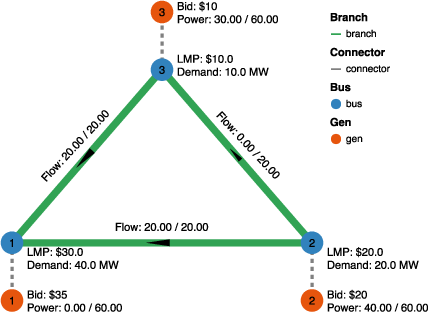
Figure 1: Visualization of a power grid under congestion; LMPs are determined by local generator bids, but not all congested nodes possess actionable market power.
Optimization Models: OPF, OGF, and Arbitrage
The core technical contribution is the construction of joint modeling for electricity and gas markets based on the following components:
- DC Optimal Power Flow (OPF): Standard linearized problem formulation where electricity generators submit bids and the system is cleared to provide supply at minimum cost, subject to network and production constraints.
- Optimal Gas Flow (OGF): Nonlinear steady-state network flow problem representing the gas market. Generator loads compete with other participants for pipeline capacity, subject to physical (Weymouth equation) and contractual constraints.
The dual-market arbitrage model, termed Generator Price Arbitrage (GPA), frames the decision problem for a gas-fired generator seeking to maximize profit by optimizing price and quantity bids across both markets, while ensuring actions remain within the permissible boundaries of the electricity market monitoring system.
LP-Based Market Power Testing
An important theoretical result is the formalization of a market power detection certificate within the DC OPF model. The approach tests whether a specific generator or group of generators can unilaterally set their bid prices to arbitrarily high levels without losing market clearing, indicating the presence of actionable market power. This is implemented as a primal-dual linear programming feasibility check, providing a computationally efficient, provable detection method for electricity-only systems.
However, the nonconvexity and regulatory separation of the gas market preclude analogous direct tests, motivating the design of simulation-based iterative bidding algorithms for evaluating cross-market arbitrage in practice.
Bidding Interaction and Iterative Heuristic
Given the natural gas and electricity markets are cleared at different times under incomplete information, the paper proposes an iterative approach for strategic bid adjustment:
- Initialize generator electricity market bids.
- Solve the OPF for cleared prices and quantities.
- Determine gas market bids so as to cover the generator's feasible production and maximize profit.
- Solve the OGF for feasible gas allocations and prices.
- Update electricity market bids in response to the new gas-cleared quantities and repeat.
This method approximates a local optimum of the generator profit, constrained by the need not to trigger power market mitigation.
Numerical Scenarios and Anticompetitive Outcomes
The authors illustrate the mechanism of market manipulation using interpretable test cases. Even under binding transmission constraints in electricity networks, a generator within a congested region may not always possess market power.
Crucially, when coupled with a constrained gas network, coordinated bidding in the gas market allows gas-fired generators to artificially restrict or reroute gas supply, indirectly inducing congestion and higher Locational Marginal Prices (LMPs) in the power market—while the direct evidence of excessive pricing remains within permitted bounds.
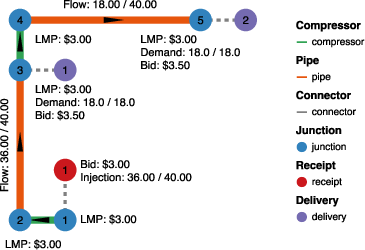
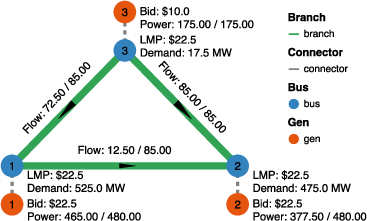
Figure 2: Gas (top) and electricity (bottom) networks; marginal supply constraints in gas impact generation and market clearing downstream.
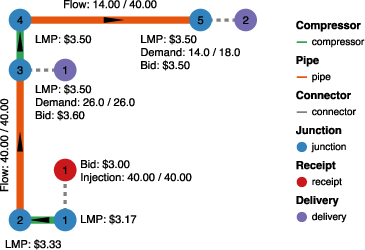
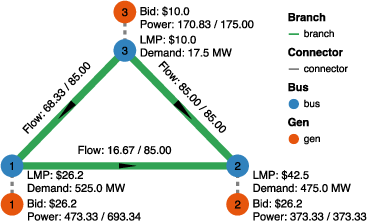
Figure 3: Manipulative gas market bids by Generator 1 limit Generator 2’s electric output, raising LMPs without explicit electricity market rule violations.
This manipulation can significantly amplify generator profits, as shown through numerical experiments in both small networks and larger coupled IEEE-14/GasLib-11 test cases.
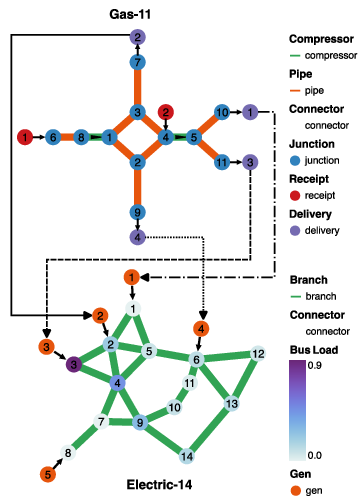
Figure 4: Schematic coupling of IEEE-14 (electric) and GasLib-11 (gas) networks. Arrows show generator sites interlinking the two domains.
Numerical Results and Claims
Empirical findings demonstrate:
- Generators can substantially increase profit—orders of magnitude higher compared to non-strategic bidding—by marginal adjustments in their gas market positions without exceeding electricity market conduct or impact thresholds.
- Collusive or coordinated bidding by multiple gas-fired generators can further amplify these effects, directly manipulating LMPs through indirect physical constraints.
- With only modest bid changes in the gas market, LMPs in the power network can be raised beyond standard mitigation thresholds, while evading detection by current market monitoring schemes.
These results robustly support the claim that monitoring restricted to a single market domain is insufficient in coupled gas-electricity systems.
Practical and Theoretical Implications
The findings highlight the urgent necessity to update current market monitoring frameworks to address cross-market strategies. Regulatory authorities must integrate gas market data and physical models into electricity market oversight, specifically focusing on:
- Joint conduct and impact tests spanning both markets to identify indirect congestion-driven price manipulation.
- Dynamic reference level recalibration accounting for coordinated arbitrage across energy domains.
- Algorithmic certification tools for market power in nonconvex multi-commodity transmission networks, extending LP-based detection where possible.
Future research directions include the development of tractable, possibly convex, optimization-based certificates for market power in the gas market, and data-driven detection of collusive cross-market bidding in large-scale, real-world networks.
Conclusion
The research meticulously exposes key vulnerabilities in market monitoring in the era of deeply coupled gas and electricity networks. By formalizing the arbitrage problem, presenting solution heuristics, and quantifying the resulting profit incentives and price distortions, the paper provides a rigorous foundation for the redesign of anti-competitive monitoring and mitigation systems in modern energy markets. These results emphasize the criticality of integrated oversight and the design of robust, multi-market detection algorithms in order to sustain competition and efficiency in future energy systems.