- The paper introduces MAPLE, a meta-learning framework that uses prototypical networks to rapidly adapt to unseen essay prompts and scoring traits.
- It adopts flexible task formulations with both binary and multiclass strategies, significantly improving performance on heterogeneous English and Arabic datasets.
- By integrating prompts, rubrics, and engineered features with deep text representations, MAPLE achieves state-of-the-art gains in Quadratic Weighted Kappa scores.
Introduction
Automated Essay Scoring (AES) poses persistent challenges, especially under cross-prompt conditions where the model must generalize to essays written in response to previously unseen prompts. Traditional AES models often suffer performance degradation due to prompt specificity, trait intricacies, and score-sequence heterogeneity. "MAPLE: A Meta-learning Framework for Cross-Prompt Essay Scoring" (2604.17569) addresses these issues by integrating prototypical networks with a flexible meta-task formulation. The framework is validated on both English (ELLIPSE, ASAP) and Arabic (LAILA) datasets, providing an extensive evaluation across heterogeneous scoring distributions and languages.
Methodology
The MAPLE framework formalizes cross-prompt AES as a meta-learning problem, leveraging prototypical networks for rapid adaptation. Key technical differentiators are as follows:
- Task Formulation: Unlike prior approaches that treat each prompt as a homogeneous meta-task (thereby limiting diversity), MAPLE employs both binary and multiclass meta-task generation strategies. Tasks are defined as combinations of prompts, traits, and score levels, thus maximizing heterogeneity and enabling robust generalization. During meta-training, support and query sets are always constructed from different prompts, enforcing the cross-prompt condition.
- Meta-Learner Architecture: The architecture is non-parametric and contextual. Input representations consist of the essay text, corresponding prompt, trait-specific rubrics, and a set of engineered features previously demonstrated to benefit cross-prompt evaluation. Components are concatenated and merged via a learned gating mechanism, allowing for adaptive weighting of prompt, rubric, and feature context for each scoring task.
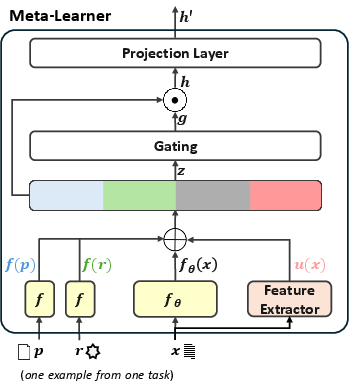
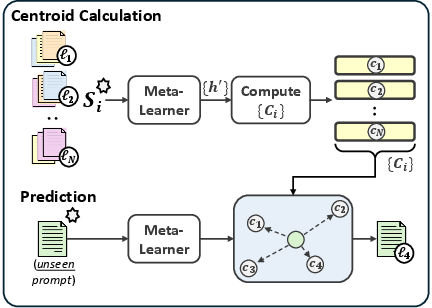
Figure 1: The meta-learner encodes essays, prompts, and rubrics with engineered features using a contextual gating mechanism; prototypes are computed for each scoring class and used for essay prediction.
- Prototypical Inference: Essay representations are projected, and prototypes for each scoring class are formed as centroid embeddings of support set examples. Query essays from unseen prompts are scored according to proximity to these prototypes in embedding space, supporting few-shot and zero-shot scenarios without reliance on target-specific data for adaptation.
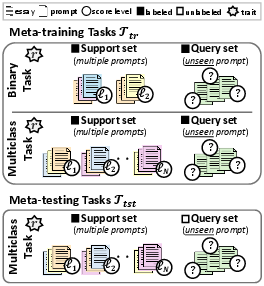
Figure 2: Meta-training involves support and query set sampling over prompt, trait, and score combinations, with meta-testing evaluating generalization to unseen prompts and unified multiclass target tasks.
Experimental Setup
The paper conducts systematic experiments across three datasets: ELLIPSE (English, 44 prompts), ASAP (English, 8 prompts, heterogeneous scoring), and LAILA (Arabic, 8 prompts). The evaluation metric is Quadratic Weighted Kappa (QWK), the standard for AES agreement assessment. Encoder selection is dataset- and language-tailored: RoBERTa-base for English and AraBERTv2 for Arabic, constrained by transformer model size (<200M parameters). Extensive ablation studies investigate the impact of meta-task formulation (binary, multiclass, single-prompt, multi-prompt), context incorporation (prompt, rubric), and engineered feature sets.
Results and Analysis
Empirical results demonstrate that multiclass meta-training outperforms binary on datasets with fine-grained scoring and a larger set of prompts (ELLIPSE), while binary setups are preferable where prompts are few and score granularity is coarse (LAILA). On ASAP, score-range heterogeneity demands single-prompt support sets to avoid unrepresentative prototypes. Task construction diversity, driven by trait and label variation, is critical for effective meta-learning in cross-prompt AES.
Context and Feature Integration
Incorporating prompt and rubric context yields statistically significant improvements in QWK, complementing essay representations by clarifying trait targets and prompting conditions. Feature engineering boosts performance further; syntactic, structural, and surface-level features contribute especially to traits such as grammar and organization, yielding relative QWK gains of up to 0.7 for ASAP and 0.5 for ELLIPSE.
Comparison to SOTA Baselines
MAPLE achieves SOTA average gains of 8.5 and 3 QWK points on ELLIPSE and LAILA, respectively, compared to previously published neural and feature-based models. Notably, trait-level performance for holistic and stylistic dimensions consistently surpasses baselines. On ASAP, MAPLE excels on traits with unified score ranges (Prompt Adherence, Language, Narrativity), though it is less competitive on other traits due to cross-prompt score incompatibility, highlighting an inherent limitation of classification-based frameworks in this context.
Implications and Future Directions
MAPLE's results substantiate the hypothesis that meta-learning, particularly under non-parametric prototypical constraints, provides a robust path for generalization in cross-prompt AES. The demonstration of effectiveness on both English and Arabic corpora confirms cross-linguistic applicability. Integrating task context and engineered features with deep essay representations resolves challenges associated with trait nuance and prompt variability.
However, several theoretical and practical challenges remain. Current classification-based meta-learning frameworks struggle with heterogeneous score distributions, limiting their adoption on datasets where prompt-level scoring ranges diverge. Future work must address label range normalization and class imbalance in meta-learning, possibly by hybridizing regression and classification approaches. Further, extending MAPLE to fully multilingual regimes, as well as integrating auxiliary tasks or self-supervision for further enhancement of prompt/trait representations, remains a promising research avenue.
Conclusion
MAPLE demonstrates that flexible, context-aware meta-learning, leveraging prototypical networks, delivers SOTA performance on cross-prompt AES in both English and Arabic. Its ability to generalize across prompts, scoring traits, and even languages is contingent upon careful task construction and rich context integration. The framework provides a replicable, transparent benchmark for future AES research and sets a foundation for the development of robust, prompt-agnostic educational NLP systems.