Coevolving Representations in Joint Image-Feature Diffusion
Abstract: Joint image-feature generative modeling has recently emerged as an effective strategy for improving diffusion training by coupling low-level VAE latents with high-level semantic features extracted from pre-trained visual encoders. However, existing approaches rely on a fixed representation space, constructed independently of the generative objective and kept unchanged during training. We argue that the representation space guiding diffusion should itself adapt to the generative task. To this end, we propose Coevolving Representation Diffusion (CoReDi), a framework in which the semantic representation space evolves during training by learning a lightweight linear projection jointly with the diffusion model. While naively optimizing this projection leads to degenerate solutions, we show that stable coevolution can be achieved through a combination of stop-gradient targets, normalization, and targeted regularization that prevents feature collapse. This formulation enables the semantic space to progressively specialize to the needs of image synthesis, improving its complementarity with image latents. We apply CoReDi to both VAE latent diffusion and pixel-space diffusion, demonstrating that adaptive semantic representations improve generative modeling across both settings. Experiments show that CoReDi achieves faster convergence and higher sample quality compared to joint diffusion models operating in fixed representation spaces.
















































Paper Prompts
Sign up for free to create and run prompts on this paper using GPT-5.
Top Community Prompts
Explain it Like I'm 14
Overview
This paper is about teaching an image‑making AI to learn not just from pixels, but also from high‑level clues about what’s in a picture—like “this patch looks like fur” or “this region is sky.” The new idea, called CoReDi (Coevolving Representation Diffusion), lets the AI and these high‑level clues learn and improve together during training, instead of keeping those clues fixed from the start. This makes training faster and the generated images better.
Key Objectives
The researchers wanted to find out:
- If the extra “semantic” feature space (the high‑level clues) should be fixed ahead of time or should adapt while the image generator learns.
- How to let these features adapt without breaking training (which can happen if the model takes shortcuts).
- Whether this idea works both when generating from compressed images (fast but slightly lossy) and from full pixels (slower but potentially sharper).
How They Did It (in simple terms)
First, a quick picture of the problem:
- A diffusion model makes images by starting from noisy static and gradually denoising it into a picture—like sculpting a statue out of a block covered in dust, brushing away the dust step by step.
- Many modern systems work on a compressed version of images (called VAE latents), which is like working from a high‑quality thumbnail to make training faster.
- Separately, a “visual encoder” (like DINOv2 or MOCOv3) looks at images and produces high‑level features—think of them as notes saying “edge here,” “fur texture there,” “round shape here.” These are called semantic representations.
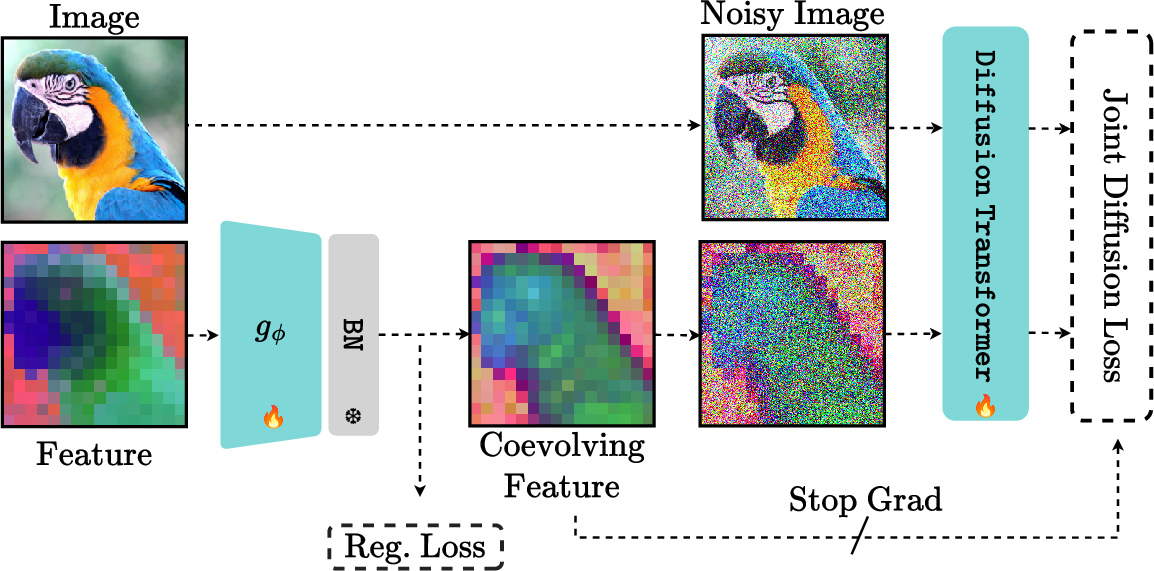
Earlier methods often took those semantic features, compressed them once using a fixed tool (like PCA, which is a simple prebuilt compressor), and kept them frozen during training. CoReDi instead learns the compressor (a small linear layer) at the same time as the image generator trains, letting both “co‑evolve.”
What can go wrong? If both the input features and the training target move at once, the model can cheat—by changing the target to make the loss look small without learning anything useful. To avoid that, the authors introduced three simple but important stabilizers:
- Stop‑gradient on the target: like giving the student an answer key that cannot be edited. The model learns to reach the target but can’t secretly change the target itself.
- Batch normalization after the projection: like setting the volume to a steady level so signals don’t get too loud or too quiet. This keeps the noise schedule stable and avoids channels dying out.
- Regularization to prevent feature collapse: feature collapse is when all channels carry the same info—like a band where everyone plays the same note. They used lightweight rules to keep channels diverse:
- Feature variance regularization (encourages each channel to stay active),
- Orthogonality (pushes channels to focus on different directions),
- Covariance penalties (discourage channels from mirroring each other).
They tested this in two settings:
- Latent‑space diffusion (using compressed images): faster and common in practice.
- Pixel‑space diffusion (directly on raw pixels): avoids compression limits; they build on a method called DeCo to keep it efficient.
Under the hood they use “flow matching,” a diffusion‑style training that teaches the model to predict the best direction to move from noise toward the clean image at each step. You can think of it like a GPS that tells you which direction to go to reach your destination from your current spot.
Main Findings and Why They Matter
- Faster training with better or equal quality:
- In latent space, CoReDi reached the same high image quality as a strong baseline with about half the training steps, and compared to an earlier representation‑guided model (REPA), it converged up to about 13× faster.
- In pixel space, CoReDi cut the time to a given quality roughly in half compared to a strong pixel method (DeCo).
- Better image quality:
- They measured quality using FID (a popular score where lower is better). CoReDi consistently got lower FID than versions that used fixed, non‑adaptive features.
- Stable training needs all three ingredients:
- Without stop‑gradient, the model drifted into bad solutions.
- Without batch normalization, training collapsed.
- Without regularization, channels became redundant and quality dropped.
- Works across different feature encoders:
- Whether the high‑level features came from DINOv2, MOCOv3, SigLIP, or MAE, learning the projection jointly still helped.
- Representations become more organized:
- Over training, the learned feature maps showed clearer spatial structure—like parts of the image that belong together lighting up together—helping the generator make more coherent scenes.
What This Could Lead To
- Faster, cheaper training for high‑quality image generators by letting feature spaces adapt to the task.
- Better images even when working directly with pixels, which can remove limits caused by compression.
- A general lesson for AI: instead of freezing helper features from other models, let them co‑evolve with the main task—this idea could extend to video, audio, or 3D generation.
- Simpler add‑on: the adaptive part is just a small learnable projection layer with basic normalization and regularization, so it’s easy to plug into existing systems.
In short, CoReDi shows that when the image generator and its guiding features learn together—with the right safety rails—the result is faster training and better pictures.
Knowledge Gaps
Knowledge gaps, limitations, and open questions
Below is a single, focused list of concrete gaps that remain unresolved and could guide future research:
- Dataset and resolution scope: Results are limited to ImageNet at 256×256; the approach is untested on higher resolutions (e.g., 512–1024), other domains (e.g., COCO, LSUN, FFHQ), or distribution shifts, leaving generalization unclear.
- Compute accounting: “Faster convergence” is reported in iterations, not wall‑clock time, FLOPs, or memory; actual efficiency gains and training stability across seeds and hardware are not quantified.
- Projection capacity: Only a linear projection is explored; the impact of modestly higher-capacity projections (e.g., MLPs, low-rank adapters, gated/mixture projections) on performance and collapse risk is unknown.
- Projection dimensionality: The number of projected channels (e.g., 8 for latents, 16 for pixels) is fixed without a systematic study of the quality–compute trade-off or scaling to larger channel counts.
- Initialization strategy: The effect of initializing the learnable projection with PCA or other data-aware initializations versus random orthogonal is not assessed.
- Encoder adaptation: The frozen visual encoder is never adapted; whether partial fine-tuning (e.g., LoRA, last blocks) or joint EMA targets improves coevolution versus destabilizing training is untested.
- Layer and feature choice: Only one encoder layer/feature type appears used; the impact of multi-layer feature fusion, different layers’ spatial granularity, or alternative tokenizations (e.g., hierarchical backbones) is not explored.
- Fusion mechanism: Representation–image fusion uses “merged tokens”; alternatives (cross-attention, FiLM/gating, late fusion, multi-stage fusion, layer-wise insertion) and their cost–benefit are not compared.
- Normalization reliance: BatchNorm (without affine) is critical for stability; sensitivity to batch size, distributed training (sync-BN vs. local BN), and alternatives (LayerNorm, GroupNorm, whitening) is not investigated.
- Stop-gradient design: The stop-gradient is introduced heuristically; alternative asymmetry mechanisms (e.g., EMA targets, predictor heads, BYOL/SimSiam-style asymmetry) and a principled justification are not provided.
- Regularizer choice and scaling: Three regularizers are tried, but there is no guidance on how to choose or combine them, their sensitivity to hyperparameters (e.g., γ in variance loss), or behavior as projection dimensionality grows.
- Complementarity quantification: The claim that coevolving features better complement image latents is qualitative; no quantitative analyses (e.g., mutual information, redundancy/unique-info decomposition) show what each modality contributes.
- Precision–recall trade-off: CoReDi often increases recall and sometimes lowers precision; methods to control or tune this trade-off (e.g., via λz, regularizer strengths, guidance schedules) are not studied.
- Guidance interactions: Effects of classifier-free guidance (CFG) strength on CoReDi are limited; FID/IS/precision–recall curves vs. CFG scale and interactions with the coevolving representation are not reported, especially in pixel space.
- Samplers and objectives: The approach is shown with flow matching and specific samplers; generality across score-matching (DDPM/EDM), alternative noise schedules, and diverse samplers is untested.
- Pixel-space breadth: Pixel-space results are demonstrated only on DeCo-L/16 at 256×256; applicability to other pixel-space architectures, higher resolutions, and stronger decoders is unknown.
- λz sensitivity beyond pixels: While λz is ablated in pixel space, its role and optimal setting in latent-space CoReDi across scales/datasets is not systematically examined.
- Robustness at small batch sizes: Since BN is central, stability under small-batch regimes and potential remedies (e.g., GN, BN with ghost-batch statistics) are not explored.
- Stability across scales: Benefits are shown for B/2 and XL/2; whether gains persist for larger/smaller models, and how projection/regularization should scale with model size, remain open.
- Controllability and conditioning: The coevolving representation is sampled jointly but not used for controllable generation (e.g., editing/fixing z, class/text conditions); how to steer or condition via the learned space is unaddressed.
- Representation interpretability and transfer: Whether the learned projection preserves or improves semantic utility (e.g., linear probes, segmentation performance) and if it transfers across tasks/models is not evaluated.
- Encoder diversity: Experiments cover DINOv2, MOCOv3, SigLIPv2, and MAE; text-aligned encoders (e.g., CLIP/ALIGN), multi-modal encoders, or task-specific encoders and their compatibility with coevolution are not assessed.
- Failure modes and collapse: Despite regularization, residual risks (e.g., channel collapse at larger d, spatial collapse, over-smoothing) and diagnostics/early warnings are not characterized.
- Information bottlenecks: The interplay between VAE compression levels (for latent CoReDi) and representation dimension is not analyzed; whether coevolving reps can compensate for more aggressive VAE compression is unknown.
- Theoretical footing: There is no formal analysis of why stop-gradient + BN + regularization should avoid degenerate minima or how convergence depends on projection/model capacity and data distribution.
- Security and memorization: Coevolving representations may increase memorization risks; privacy, membership inference, and content safety implications are not examined.
- Inference-time efficiency: Whether coevolving reps enable fewer sampling steps or improved distillation/compression is not explored.
- Extensibility: Application beyond images (video, audio, 3D) and to multi-modal generative tasks remains untested.
Practical Applications
Below are practical, real-world applications that follow directly from the paper’s findings and innovations in Coevolving Representation Diffusion (CoReDi). Each item is linked to sectors and includes assumptions or dependencies that affect feasibility.
Immediate Applications
The following can be deployed now with current tooling and compute resources, leveraging the released codebase and standard diffusion training pipelines.
- Improved training efficiency for production diffusion models
- Sector: software, media/creative, cloud AI platforms
- What: Integrate the learnable projection with stop-gradient, batch normalization, and collapse-prevention regularizers into existing latent or pixel-space diffusion pipelines to reduce training iterations and time-to-quality (e.g., CoReDi’s ~2× speed-up over DeCo in pixel space and ~13× vs. REPA in latent space at comparable quality).
- Potential tools/products/workflows: A “CoReDi plugin” for DiT/SiT/U-Net training loops; adapters for popular frameworks (PyTorch Lightning, Accelerate); preconfigured configs for ImageNet-256 and common encoders (DINOv2, SigLIP).
- Assumptions/dependencies: Availability of a frozen visual encoder; correct implementation of stop-gradients and BN; appropriate regularization choice and tuning; compute budget similar to standard diffusion training.
- Higher quality image synthesis in creative applications
- Sector: media/design, advertising, digital content platforms
- What: Use CoReDi’s adaptive semantic space to improve sample quality and spatial coherence for photorealistic image generation, concept art, textures, and marketing assets; apply pixel-space CoReDi to minimize VAE reconstruction artifacts in high-fidelity imagery.
- Potential tools/products/workflows: Asset generation pipelines in design suites; “Adaptive Representation Layer” in commercial diffusion backends; improved presets for photorealistic and layout-consistent generations.
- Assumptions/dependencies: Latency and cost constraints for pixel-space inference; quality measured on domain-specific datasets (beyond ImageNet-256).
- Synthetic data generation for computer vision
- Sector: robotics, autonomous systems, retail/e-commerce CV, industrial inspection
- What: Produce semantically structured, diverse synthetic images (thanks to improved spatial organization in coevolving features) to augment detector/segmenter training and domain randomization pipelines.
- Potential tools/products/workflows: Synthetic dataset builders with CoReDi backends; label transfer workflows (e.g., rendering masks from semantic channels or using pretrained segmentation for pseudo-labels).
- Assumptions/dependencies: Task-aligned labeling; evaluation for domain gap; IP/licensing compliance for training data.
- Production monitoring and quality assurance for generative training
- Sector: MLOps, ML platform engineering
- What: Add feature variance, orthogonality, and covariance metrics to monitor representation collapse during training; trigger regularization schedules or early warnings when collapse is detected.
- Potential tools/products/workflows: “Representation Collapse Dashboard” with variance/covariance heatmaps; auto-tuning of regularization weights λreg; batch-normalization health checks.
- Assumptions/dependencies: Instrumentation for feature logging; standardized metrics thresholds per domain.
- Curriculum and research teaching modules
- Sector: education, academia
- What: Course labs demonstrating why stop-gradient and batch normalization are necessary in joint image–feature diffusion, and how explicit regularization prevents feature collapse; reproducible experiments with DINOv2/MOCOv3/SigLIP encoders.
- Potential tools/products/workflows: Jupyter notebooks; classroom assignments; small-scale datasets (CIFAR, mini-ImageNet); didactic ablations (w/o SG, w/o BN).
- Assumptions/dependencies: GPU access; simplified configs for classroom constraints.
- Greener AI reporting
- Sector: policy, sustainability offices in tech
- What: Quantify and report energy/emissions savings from faster convergence using CoReDi relative to fixed-space baselines; incorporate into internal sustainability KPIs.
- Potential tools/products/workflows: Training carbon calculators; efficiency benchmarks; internal guidance memos on representation-guided training.
- Assumptions/dependencies: Accurate energy metering; organizational buy-in for reporting frameworks.
- E-commerce product visualization and rapid A/B creative testing
- Sector: retail/e-commerce, marketing tech
- What: Generate clean, layout-coherent product shots and variants with improved spatial structure for listing pages, ads, and email campaigns.
- Potential tools/products/workflows: “CoReDi-enabled product shot generator”; automated creative A/B pipelines.
- Assumptions/dependencies: Domain-specific fine-tuning data; approval processes for brand consistency.
Long-Term Applications
These require further research, scaling, domain adaptation, or new engineering to mature into products or standardized practices.
- Domain-specific medical and geospatial synthesis
- Sector: healthcare, earth observation
- What: Coevolve projection layers using specialized encoders (e.g., medical image encoders, satellite encoders) to generate synthetic DICOM scans or satellite tiles for data augmentation and privacy-preserving research.
- Potential tools/products/workflows: “CoReDi-Med” for radiology augmentation; “CoReDi-Geo” for rare class synthesis (e.g., disaster imagery).
- Assumptions/dependencies: Rigorous clinical validation; regulatory compliance (HIPAA, GDPR); bias and safety audits; high-quality domain encoders and datasets.
- Multi-modal coevolving diffusion (image–text–audio–video)
- Sector: generative AI platforms, media
- What: Extend coevolution to jointly learn projections for multiple modalities (e.g., CLIP text embeddings + visual features + audio features), improving alignment and sample quality across modalities.
- Potential tools/products/workflows: Unified multi-modal “Adaptive Representation Stack”; multimodal regularization suites.
- Assumptions/dependencies: Stability across modalities (new collapse modes); large-scale multi-modal datasets; inference complexity and latency management.
- Personalized and on-device coevolving generators
- Sector: mobile, consumer apps
- What: Lightweight linear projection fine-tuned per user to adapt style, preferences, or camera characteristics; privacy-preserving on-device coevolution for personalization without cloud data sharing.
- Potential tools/products/workflows: Mobile SDKs with a tunable projection head; federated learning updates for projection parameters.
- Assumptions/dependencies: Edge acceleration (NNAPI, Apple Neural Engine); memory/power constraints; private fine-tuning datasets.
- Interactive controllability via semantic channels
- Sector: creative tools, UX research
- What: Expose coevolved channels in UI sliders to influence layout, texture, or object emphasis (leveraging the improved spatial organization); support composition presets tied to channels.
- Potential tools/products/workflows: “Semantic Channel Panel” for artists; channel–concept mapping dashboards; guided sampling workflows.
- Assumptions/dependencies: Interpretability research to associate channels with human-meaningful concepts; safeguards against unintended artifacts.
- 3D scene and simulation content for robotics
- Sector: robotics, simulation, digital twins
- What: Generalize CoReDi to 3D encoders (e.g., point-cloud or NeRF features), coevolving representation spaces for scene synthesis to train policies with better semantic structure and diversity.
- Potential tools/products/workflows: “CoReDi-3D” for sim asset generation; domain randomization with semantic structure metrics.
- Assumptions/dependencies: Suitable 3D encoders; training stability in higher-dimensional spaces; metrics for 3D spatial coherence.
- AutoML for representation-space design
- Sector: ML tooling, MLOps
- What: Automated selection of regularizer type (variance, orthogonality, covariance), λz and λreg schedules, and BN configurations based on live collapse/similarity metrics to maximize training speed and quality.
- Potential tools/products/workflows: “Auto-CoReDi” hyperparameter tuner; metric-driven training controllers.
- Assumptions/dependencies: Reliable online metrics; search costs; generalization across datasets/tasks.
- Safety, fairness, and bias auditing of coevolving representations
- Sector: policy, responsible AI
- What: Use spatial self-similarity and covariance diagnostics to detect representation biases (e.g., overemphasis on certain regions/attributes), and guide mitigation via regularization or data curation.
- Potential tools/products/workflows: Bias dashboards for coevolving tokens; fairness-aware regularization schedules; governance playbooks.
- Assumptions/dependencies: Diverse, representative datasets; accepted fairness metrics; organizational mandates for responsible AI.
- Standards and best practices for energy-efficient generative training
- Sector: policy, industry consortia
- What: Publish guidelines recommending adaptive, coevolving semantic spaces over fixed projections to reduce compute and emissions; propose standardized reporting of convergence gains.
- Potential tools/products/workflows: Industry whitepapers; benchmark suites; sustainability certifications for training practices.
- Assumptions/dependencies: Broad industry participation; reproducibility across architectures and datasets.
- Enterprise-grade libraries for adaptive representation layers
- Sector: enterprise software, ML platforms
- What: Hardened, audited implementations of the projection+BN+regularization stack with telemetry, rollback, and compliance features; support for multiple encoders (DINOv2, SigLIP, MAE).
- Potential tools/products/workflows: “Adaptive Representation Layer” enterprise library; CI/CD-integrated training pipelines; observability hooks.
- Assumptions/dependencies: Security and compliance reviews; long-term maintenance; cross-framework support.
- Edge inference enhancements (conditional generation)
- Sector: mobile/AR, embedded
- What: Deploy the lightweight, learnable linear projection as a conditioning module for generative models to adapt to sensor or environment characteristics (e.g., AR scene adaptation), while keeping the main generator fixed.
- Potential tools/products/workflows: On-device conditioning heads; adaptive sampling policies.
- Assumptions/dependencies: Real-time constraints; compatibility with compact generative backbones; careful tuning to avoid instability.
Glossary
- Barlow Twins: A self-supervised learning method that reduces redundancy between feature channels to prevent representational collapse by decorrelating embeddings. "Redundancy-reduction methods such as Barlow Twins~\cite{zbontar2021barlow}, VICReg~\cite{bardes2021vicreg}, and W-MSE~\cite{ermolov2021whitening} decorrelate features to avoid degenerate solutions, with VICRegL~\cite{bardes2022vicregl} extending this to local features."
- Batch normalization: A technique that normalizes activations across a batch to stabilize training dynamics and control feature scale. "Batch normalization after the projection, which stabilizes feature scale, preserves the intended noise schedule, and avoids per-channel sample collapse."
- BYOL: A self-supervised learning algorithm that uses an online and a target network with a stop-gradient mechanism to learn representations without negative pairs. "Architectural approaches, BYOL~\cite{grill2020bootstrap}, SimSiam~\cite{chen2021exploring}, and DINO~\cite{Caron2021EmergingPI, oquab2023dinov2} instead break gradient symmetry via stop-gradients, momentum encoders, or output centering."
- CDS: A spatial self-similarity metric that measures how quickly patch similarity decays with spatial distance in feature maps. "CDS~\cite{singh2025matters}, which captures how quickly patch similarity decays with spatial distance,"
- Classifier-Free Guidance (CFG): A sampling technique that mixes conditional and unconditional predictions at inference to improve sample quality. "Quantitative evaluation on ImageNet$256$ with Classifier-Free Guidance."
- Coevolving Representation Diffusion (CoReDi): The proposed framework where the semantic representation space is learned jointly with the diffusion model so that both co-adapt. "We introduce Coevolving Representation Diffusion (CoReDi), a framework in which the projection of pretrained visual features is learned jointly with the diffusion model."
- Cosine decay scheduler: A learning-rate schedule that smoothly decreases the rate following a cosine function over training. "for the XL experiments, which are trained for more iterations, we optimize the projection using a cosine decay scheduler; see the appendix for additional details."
- Covariance regularization: A regularizer that penalizes off-diagonal entries of the feature covariance matrix to decorrelate channels and prevent redundancy. "we penalize the off-diagonal entries of the channel covariance matrix of the projected representations $\tilde{\mathbf{z}_0$."
- DeCo: A pixel-space diffusion approach that separates high- and low-frequency generation and uses a lightweight pixel decoder. "DeCo~\cite{ma2025deco} decouples the generation of high and low frequency components, leveraging a lightweight pixel decoder to reduce the complexity of direct pixel synthesis."
- Diffusion Transformer (DiT): A transformer-based backbone for diffusion models that replaces the traditional U-Net architecture. "The Diffusion Transformer (DiT)~\cite{peebles2023scalable} marked a significant architectural shift by replacing the U-Net \cite{ronneberger2015u} backbone with a transformer,"
- Euler–Maruyama sampler (SDE): A numerical method for simulating stochastic differential equations used to sample from diffusion processes. "we employ the SDE EulerâMaruyama sampler."
- Feature collapse: A degeneracy where multiple channels carry redundant or near-constant information, reducing representational expressiveness. "Even with stop-gradient and batch normalization, we observe feature collapse, where multiple channels encode redundant information or fail to capture meaningful variation."
- Feature variance regularization: A constraint that enforces sufficient per-channel variation to avoid collapse and encourage diversity in the learned representation. "feature-variance regularization, orthogonality constraints on the projection weights, and covariance regularization to discourage feature collapse."
- FID (Fréchet Inception Distance): A metric that measures the distance between real and generated image distributions using features from a pretrained network. "To benchmark generative performance, we report Frechet Inception Distance (FID)~\cite{fid}, sFID\cite{sfid}, Inception Score~\cite{is}, Precision (Pre.) and Recall (Rec.)~\cite{kynkaanniemi2019improved} using 50k samples and the ADMâs TensorFlow evaluation suite \cite{dhariwal2021diffusion}."
- Flow matching: A training objective that learns velocity fields to transport noise to data (or vice versa), aligning model predictions with target flows. "The joint imageâfeature generation framework of \cite{kouzelis2025boosting} trains a single flow matching model~\cite{albergo2025stochastic, esser2024scaling, lipman2022flow} to jointly capture low-level image structure and high-level semantic information."
- Heun sampler: A second-order numerical solver used for sampling in diffusion models, offering improved accuracy over Euler steps. "we follow DeCo and use the Heun sampler and 50 sampling steps."
- Inception Score: An evaluation metric for generative models that assesses both the confidence and diversity of generated images. "To benchmark generative performance, we report Frechet Inception Distance (FID)~\cite{fid}, sFID\cite{sfid}, Inception Score~\cite{is}, Precision (Pre.) and Recall (Rec.)~\cite{kynkaanniemi2019improved} using 50k samples and the ADMâs TensorFlow evaluation suite \cite{dhariwal2021diffusion}."
- Joint flow-matching objective: A combined loss that trains the model to predict velocities for both image and representation modalities in a unified framework. "Training minimizes the joint flow-matching objective:"
- Latent Diffusion Models (LDM): Diffusion models that operate in a compressed latent space (typically from a VAE) for computational efficiency. "Latent Diffusion Models~\cite{rombach2022high, ma2024sit, peebles2023scalable, zheng2024masked, wang2025ddt} operate in the compressed latent space of a variational autoencoder (VAE)~\cite{rombach2022high, yao2025reconstruction, kouzelis2025eqvae},"
- LDS: A spatial metric that contrasts similarities of nearby versus distant patches to assess spatial structure in representations. "LDS~\cite{lds}, which measures the contrast between the average similarity of nearby versus distant patch pairs,"
- Merged tokens strategy: A fusion approach that embeds image and representation tokens separately and sums them before transformer processing. "We adopt the merged tokens strategy \cite{kouzelis2025boosting} to fuse image and representation."
- Normalizing flows: Generative models built from invertible transformations with tractable likelihoods, sometimes used as alternatives in pixel-space modeling. "including transformer-based normalizing flows~\cite{zhai2024normalizing},"
- Orthogonality regularization: A constraint that encourages projection weights to have orthonormal columns to reduce feature redundancy. "we penalize the deviation of from the identity matrix:"
- PCA projection: A dimensionality reduction method that projects high-dimensional features onto principal components. "In practice, PCA or lightweight autoencoders are used to project the typically high-dimensional semantic features into a more compact space (i.e., with fewer channels)"
- Pixel-space diffusion: Diffusion models that operate directly on pixel values rather than compressed latents. "Recently, there has been a surge of interest in pixel diffusion models, since they avoid the reconstruction bottleneck imposed by the VAE."
- Precision–Recall (for generative models): Metrics that quantify fidelity and diversity (coverage) of generated samples relative to real data. "To benchmark generative performance, we report Frechet Inception Distance (FID)~\cite{fid}, sFID\cite{sfid}, Inception Score~\cite{is}, Precision (Pre.) and Recall (Rec.)~\cite{kynkaanniemi2019improved} using 50k samples and the ADMâs TensorFlow evaluation suite \cite{dhariwal2021diffusion}."
- RMSC: A spatial diversity metric assessing variety of patch features across the image. "RMSC~\cite{singh2025matters}, which measures the overall spatial diversity of patch features."
- sFID: A variant of FID that emphasizes local and spatially-aware differences between real and generated images. "To benchmark generative performance, we report Frechet Inception Distance (FID)~\cite{fid}, sFID\cite{sfid}, Inception Score~\cite{is}, Precision (Pre.) and Recall (Rec.)~\cite{kynkaanniemi2019improved} using 50k samples and the ADMâs TensorFlow evaluation suite \cite{dhariwal2021diffusion}."
- Stop-gradient: An operation that blocks gradient flow through a tensor to prevent degenerate optimization. "Stop-gradient in the representation diffusion target, preventing trivial minimization of the representation diffusion loss."
- U-Net: A convolutional encoder–decoder architecture commonly used in diffusion models for image synthesis. "The Diffusion Transformer (DiT)~\cite{peebles2023scalable} marked a significant architectural shift by replacing the U-Net \cite{ronneberger2015u} backbone with a transformer,"
- Variational Autoencoder (VAE): A latent-variable generative model that learns a compressed representation of images via variational inference. "operate in the compressed latent space of a variational autoencoder (VAE)~\cite{rombach2022high, yao2025reconstruction, kouzelis2025eqvae},"
- Visual encoder (VE): A pretrained feature extractor used to obtain high-level semantic representations from images. "extracted by a frozen pretrained encoder where is the number of spatial tokens and is the feature dimension."
Collections
Sign up for free to add this paper to one or more collections.