- The paper introduces a dual BiLSTM framework that adaptively configures RIS using environmental sensing to enhance localization accuracy in dynamic rich scattering environments.
- It employs a two-stage architecture combining Bi-SEN and Bi-ARULN, optimized via Bayesian methods to minimize RMSE between estimated and actual user positions.
- Simulation results demonstrate up to a 79% reduction in localization RMSE with increased RIS elements and robust performance under low-SNR, fast-fading conditions.
Adaptive RIS Configuration for User Localization in Dynamic Rich Scattering Environments
Introduction and Problem Statement
Accurate user localization in indoor wireless networks is critical for autonomous systems, smart environments, and next-generation radio access networks. The complexity of this problem is heightened in dynamic rich scattering environments (RSEs), where electromagnetic waves interact nonlinearly with mobile scattering objects (SOs) and reconfigurable intelligent surfaces (RISs), producing volatile multipath channels that invalidate simplistic propagation models. In such scenarios, static fingerprinting or deterministic angle-of-arrival (AoA) based techniques are insufficient to provide reliable positioning.
This paper introduces a novel, context-aware approach to user localization leveraging distributed, adaptive RIS configuration integrated with environmental sensing. Unlike static or codebook-based RIS schemes, the method actively estimates the state of dynamic SOs and customizes the RIS phase profile to optimize localization accuracy at every time instance. The solution is realized by a dual-module deep learning architecture—comprising a BiLSTM-based Scattering Estimation Network (Bi-SEN) and an Adaptive RIS-Assisted User Localization Network (Bi-ARULN)—jointly trained with hyperparameters tuned via Bayesian Optimization.
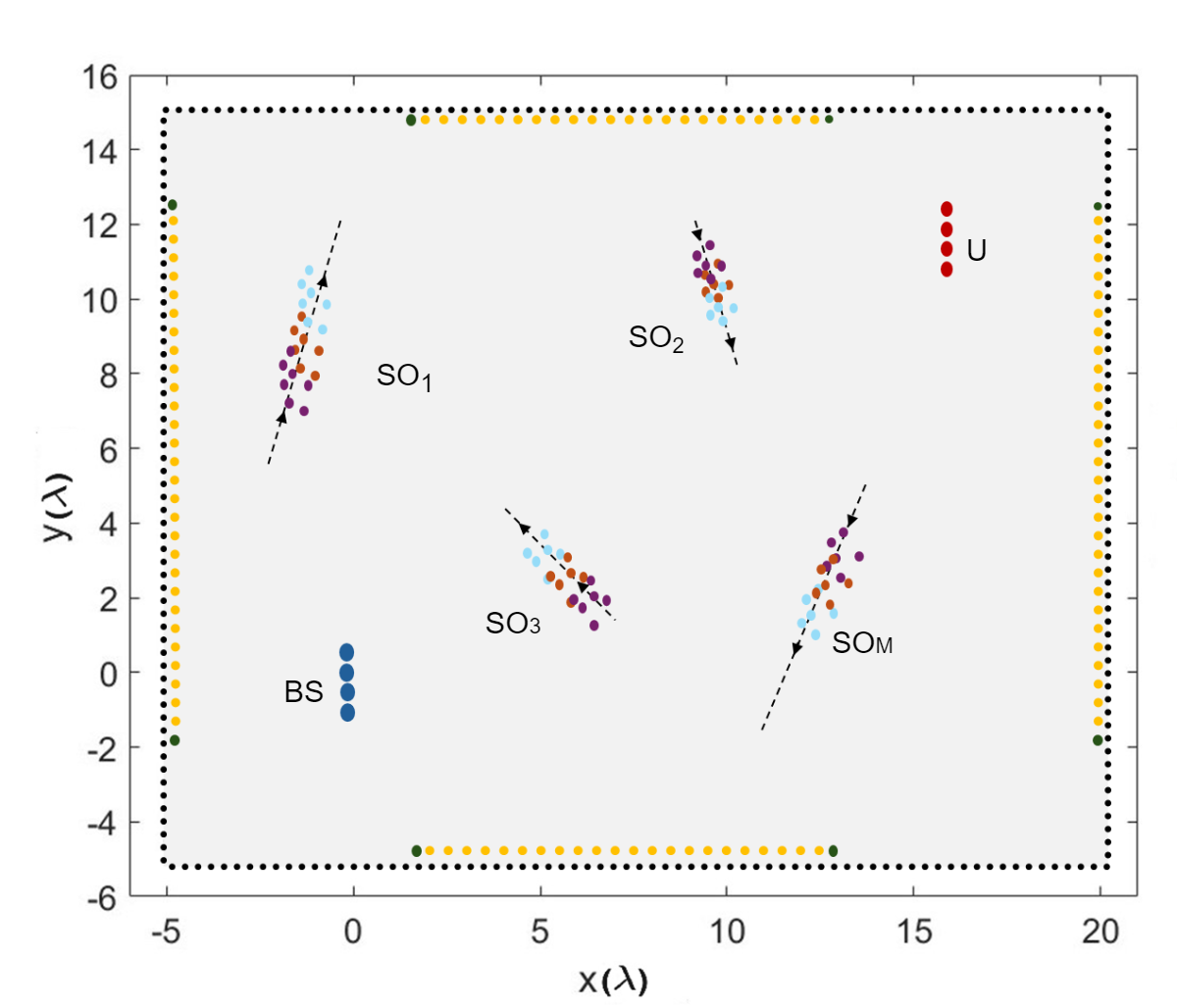
Figure 1: Physics-based simulation environment illustrating RIS elements, BS/user positions, dynamic SOs, and spatial configuration.
System Model and Channel Representation
The physical model is a two-dimensional enclosed “room” equipped with distributed RIS elements, a base station (BS), and a user equipment (UE), with multiple independently moving SOs. The wireless channel is governed by both deterministic LOS and stochastic multipath components, where each element (BS, RIS, wall, SO, UE) is modeled as a dipole, enabling high-fidelity emulation of mutual coupling, phase-amplitude interactions, and frequency- and location-dependent fading [9856592].
End-to-end channel response construction employs coupled-dipole formalism, producing a transfer matrix from the BS to UE that encapsulates all propagation phenomena, including:
- Multipath superposition (spatial and temporal),
- Nonlinear interaction between RIS phase profiles and environmental scatterers,
- Fast fading due to SO movement,
- Mode diversity provided by distributed RIS and antenna arrays.
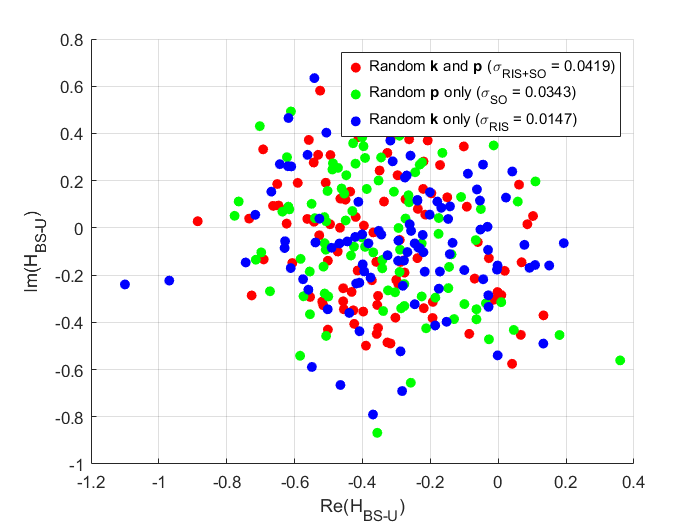
Figure 2: Distribution of the complex BS-UE channel for variations in RIS and SO configurations.
Deep Learning-based Adaptive Sensing and Configuration
Two-Stage BiLSTM Architecture
The core of the framework is a dual-recurrent architecture:
- Scattering Estimation (Bi-SEN): Receives sequential pilot measurements gathered via a specialized sensing subset of the RIS. Bi-SEN iteratively refines the hidden state that encodes the spatiotemporal status of SOs by fusing phase and magnitude of received signals. The output is a real-time estimate of the environmental scatterers’ states.
- RIS Configuration & User Localization (Bi-ARULN): For each time step, Bi-ARULN predicts the next RIS configuration by integrating sequential UE pilot signals and context vectors from Bi-SEN. This predicted phase profile steers the channel into an observability-maximizing regime for localization. Ultimately, after T rounds, the hidden state is mapped to the UE's estimated position.
The complete system minimizes the expected RMSE between estimated and actual user locations, with regularization on intermediate SO state estimation. BiLSTM’s ability to capture long-term dependencies and bi-directional sequence context is critical to robust operation under environmental volatility and measurement noise.
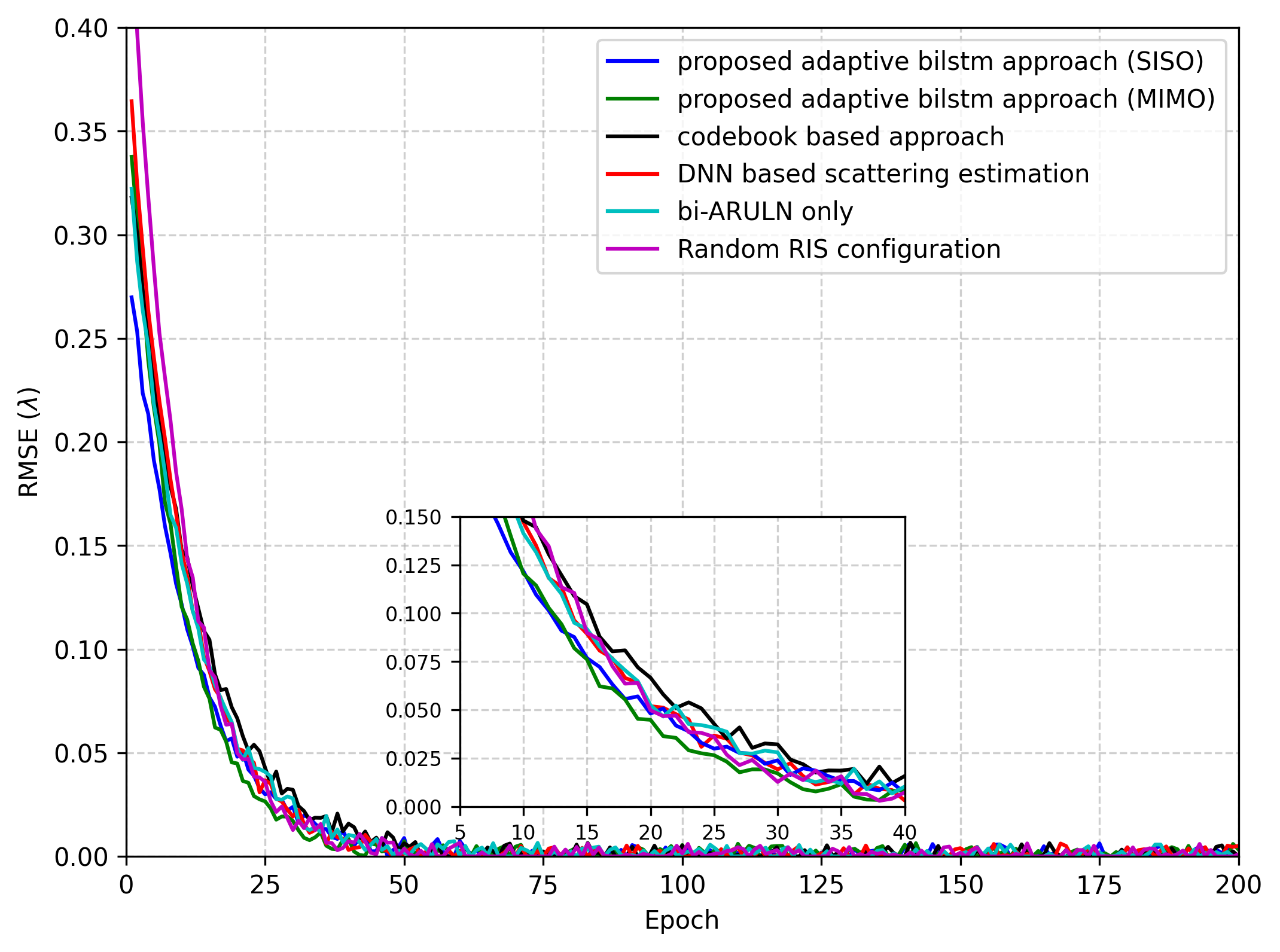
Figure 4: RMSE loss curves during training for the proposed BiLSTM and competing baselines.
Experimental Evaluation and Baseline Comparisons
Simulation and Baselines
The experiments consider both SISO and MIMO setups, varying number of RIS elements (NRIS), time frames (T), and SNR, with parameters optimized by Bayesian methods. Models are trained and tested on comprehensive synthetic channel realizations constructed using a physics-based simulator.
Key evaluation baselines:
- Random RIS Configuration: RIS phase profiles are randomly selected at every round.
- Codebook-based Approach: Precomputed optimal configurations for quantized environmental states.
- DNN-based Scattering Estimation: Classical feedforward DNN replaces sequence modeling.
- BiARULN-only: Only user-side pilots are used for RIS adaptation, omitting explicit scattering awareness.
Numerical Results
RIS Scaling: Localization RMSE decreases monotonically with increasing RIS size for all approaches. The proposed method consistently yields the lowest errors, e.g., a 79% reduction as RIS size grows from NRIS=20 to $100$ in MIMO settings, outperforming all alternatives.
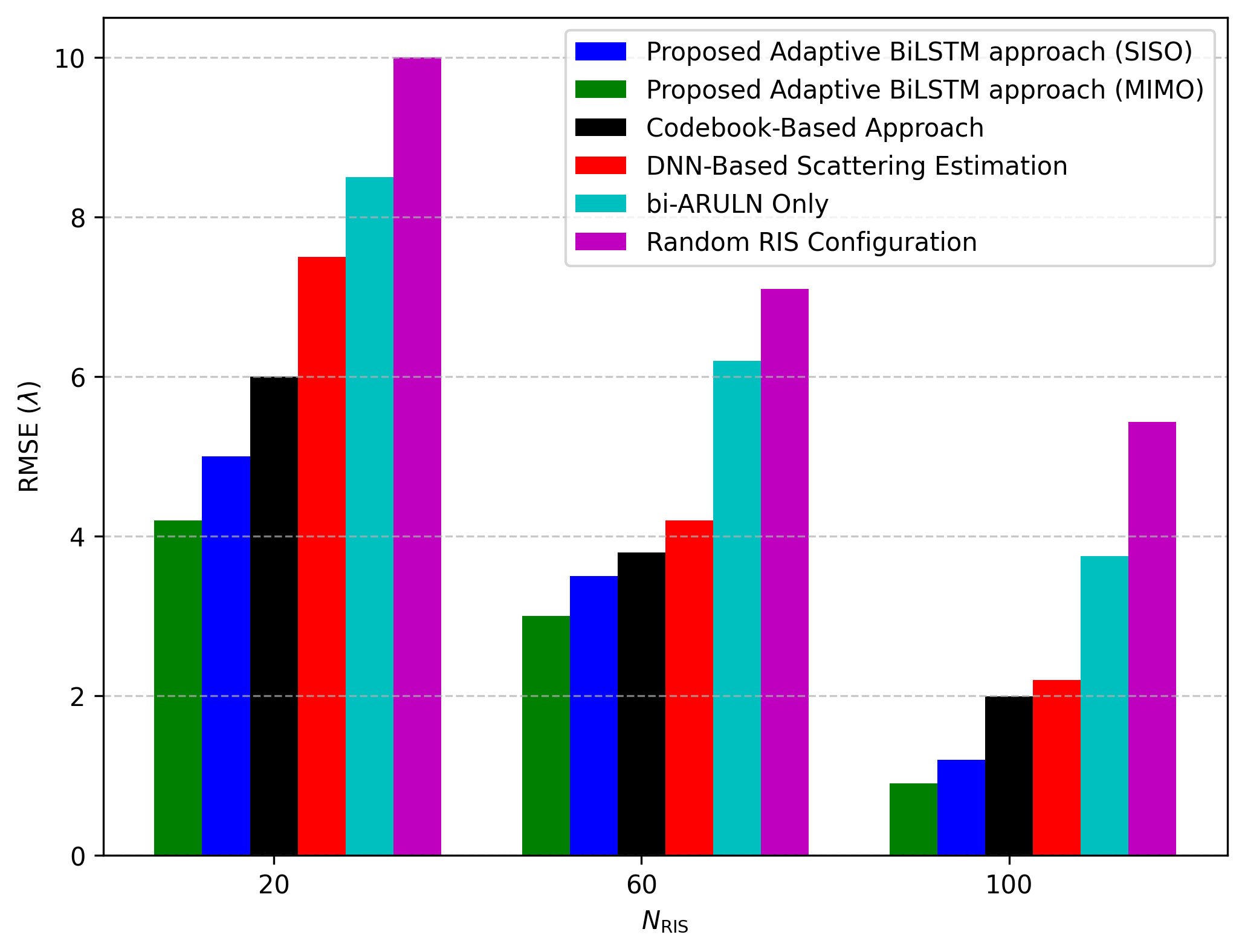
Figure 3: RMSE as a function of RIS size, showing the scalability benefits of adaptive learning-based configuration.
CDF Analysis: The CDF of localization error shows that the majority of inferences with the BiLSTM model land below top error deciles, supporting high reliability requirements.
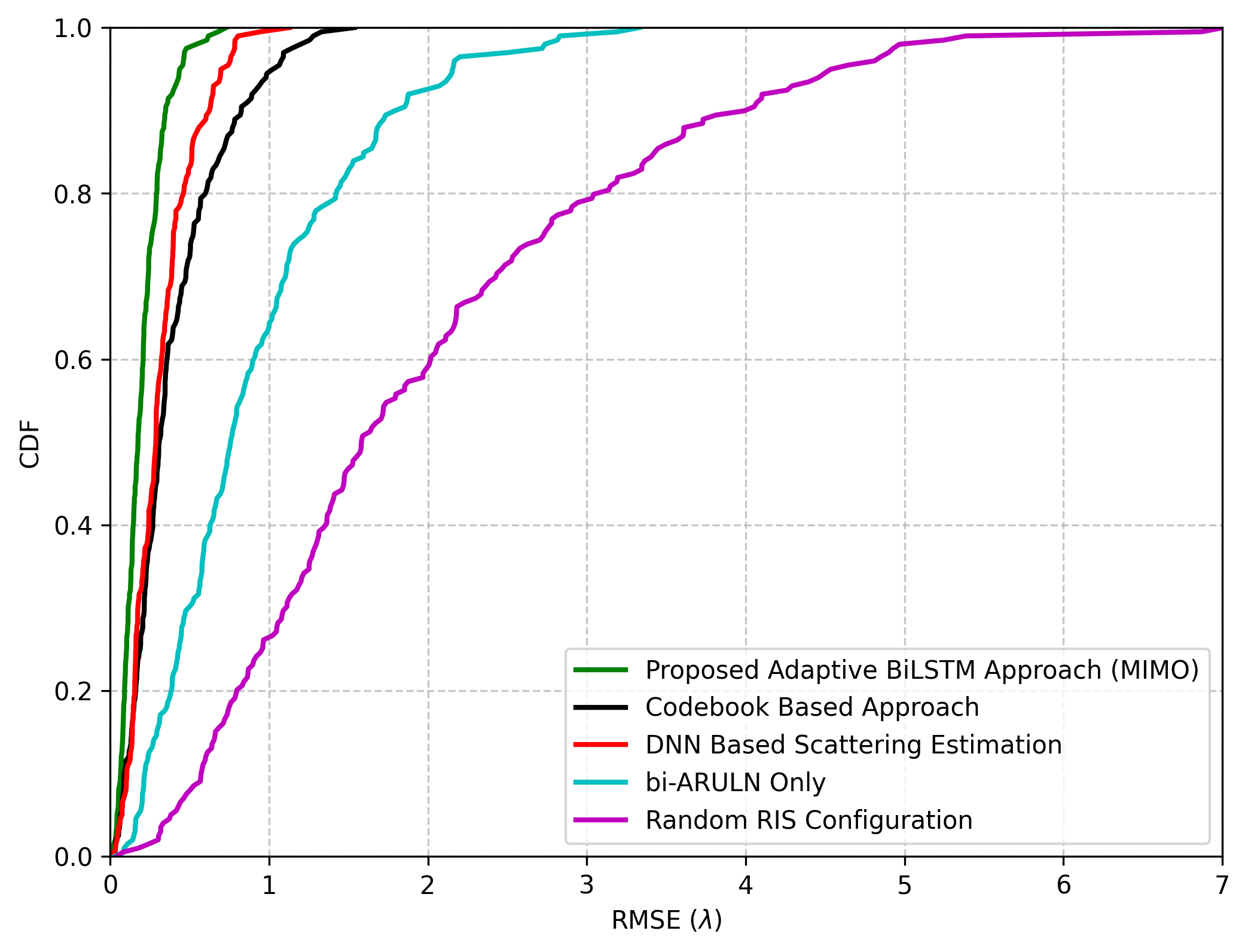
Figure 5: CDF of RMSE for different methods, highlighting the concentrated low-error distribution of the proposed approach.
SNR Sensitivity: When SNR is decreased, absolute localization performance degrades for all baselines, but the adaptive BiLSTM maintains a pronounced margin across the range. The MIMO extension provides further robustness in low-SNR and fast-fading regimes.
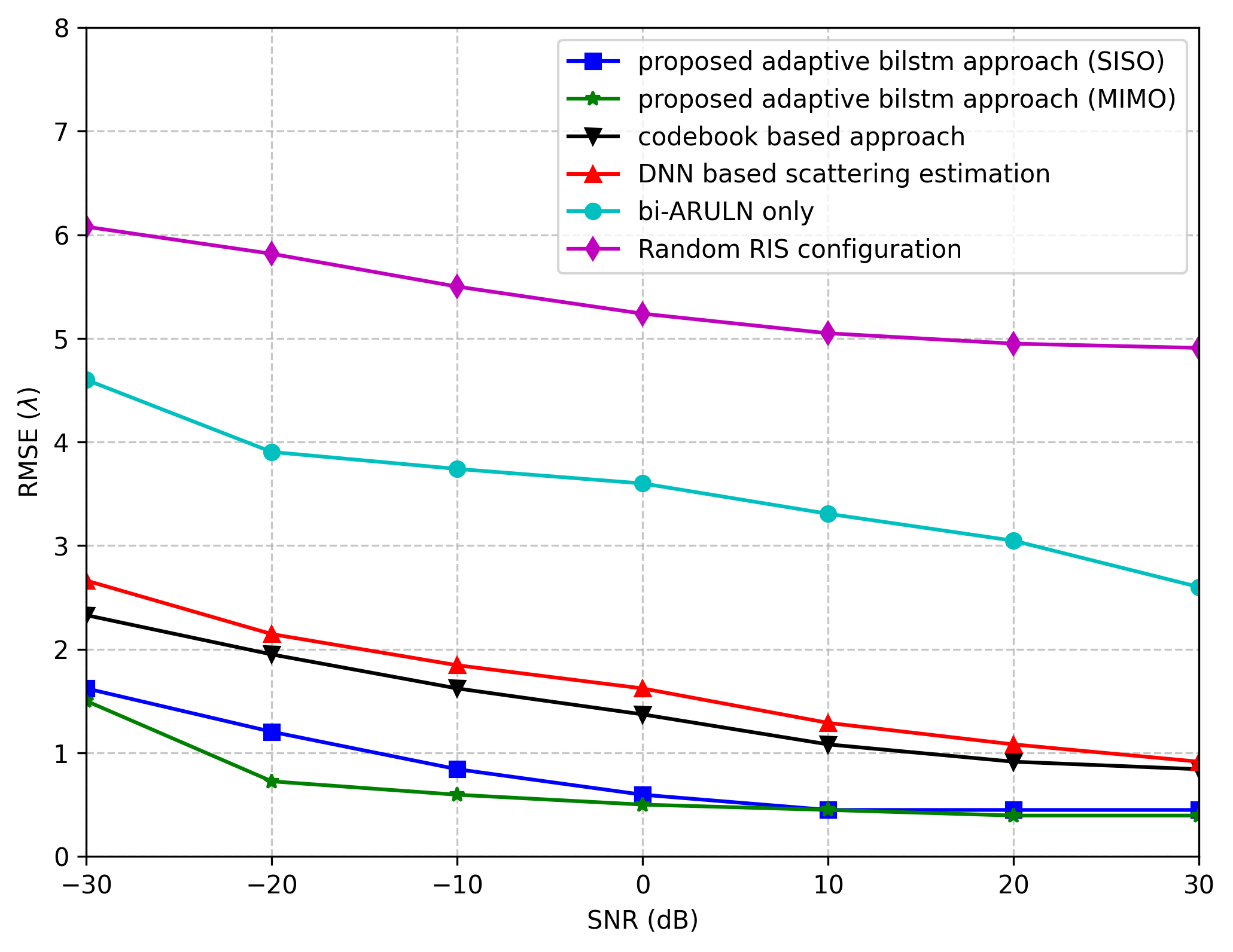
Figure 6: RMSE versus SNR for user localization across model classes.
Temporal Dynamics: As additional time frames are incorporated, both SO state estimation (for context) and localization accuracy improve, with BiLSTM architectures converging faster and to lower errors than DNNs. Notably, accurate localization can be achieved with fewer measurement rounds, highlighting the system’s potential for low-latency applications.
(Figure 8, Figure 9, Figure 10)
Figure 7: Scattering estimation RMSE reduces with more sensing frames (Fig. 8).
Figure 8: Localization RMSE versus total frames T (Fig. 9).
Figure 9: Stagewise RMSE evolution, indicating rapid error decay in BiLSTM-based designs (Fig. 10).
Theoretical and Practical Implications
The results establish several important points:
- Environmental Awareness: Explicit modeling and estimation of scattering state (beyond user-only pilot adaptation) are necessary for high-precision localization in RSEs. Neglecting these effects (e.g., in bi-ARULN-only or random methods) yields markedly higher errors.
- End-to-End Training: Realistic, differentiable channel representations enable effective joint training of sensing, configuration, and positioning modules, vital for integrated sensing-communication tasks.
- Latency and Scalability: Rapid convergence to low RMSE with few time frames implies feasibility for real-time, high-update-rate applications in dense or mobile scenarios. The method’s scalability with both RIS size and MIMO array dimensions makes it suitable for next-generation (6G) deployments.
- Generalizability: Unlike codebook-based systems, the approach interpolates across unseen environmental states and supports varying numbers of RIS elements and network geometries with minimal retraining.
Conclusion
This work proposes a layered recurrent deep learning framework that adaptively configures RIS elements for localization in highly dynamic, nonlinear scattering environments. By coupling BiLSTM-based environmental context extraction with sequential RIS adaptation, the system achieves strong improvement over static, codebook, and user-only adaptive designs—demonstrably lowering localization error and reducing required latency. The approach operationalizes context-aware sensing and communication, addresses the inherent nonlinearity of RSEs, and generalizes to different hardware and scenario scales. Future directions include generalizing to unstructured dynamic RSEs, incorporating orientation inference, enabling distributed/federated learning for scalability, and quantized configuration optimization for practical bandwidth and energy constraints.
References:
- "Adaptive RIS Configuration Design with Environmental Sensing for User Localization in Dynamic Rich Scattering Environment" (2604.17485).
- Physics-based channel modeling in RIS-parameterized environments [9856592].
- RIS-aided localization theory and design [10453467] [10858311].