Observation of a cross-section enhancement near the $t\bar{t}$ production threshold in $\sqrt{s}=13$ TeV $pp$ collisions with the ATLAS detector
Published 18 Apr 2026 in hep-ex | (2604.17138v1)
Abstract: A significant excess of $t\bar{t}$ events near the production threshold was observed in LHC Run-2 data by the ATLAS Collaboration. It is consistent with the formation of $t\bar{t}$ quasi-bound states, which were first hypothesised almost 40 years ago. This contribution summarises the experimental results and outlines a path toward further characterisation of the excess.
The paper provides the first strong evidence of a cross-section enhancement near the t-tbar threshold, supporting the existence of toponium states.
It employs advanced MC models, including NRQCD corrections, to robustly differentiate threshold phenomena from standard pQCD predictions.
Observed results at 8σ significance call for refined theoretical models and improved simulations addressing non-perturbative QCD effects in top production.
Observation of a Cross-Section Enhancement Near the ttˉ Production Threshold at s=13 TeV with ATLAS
Introduction
This work presents the observation of a statistically significant cross-section enhancement near the top–antitop (ttˉ) pair production threshold in proton–proton collisions at s=13 TeV employing the ATLAS detector. The study is based on LHC Run-2 data with integrated luminosity of 140 fb−1. The observed excess is consistent with the long-hypothesized formation of ttˉ quasi-bound states, or “toponia,” predicted within the non-relativistic QCD (NRQCD) framework almost four decades ago. Owing to the very short lifetime of the top quark, such effects were previously thought to be inaccessible at hadron colliders. The results deliver strong constraints on QCD dynamics in the ttˉ threshold region and motivate further refinement of theoretical and simulation tools.
Theoretical Framework and Simulation Models
Top quark pairs near the production kinematic threshold, where mttˉ≈2mtop, are characterized by small relative velocities and dictated by non-relativistic QCD. In this regime, the color-singlet ttˉ pair experiences a Coulombic attraction and can form quasi-bound toponium states, notably in the 1S0 channel. Standard MC implementations for s=130 production, based on fixed-order perturbative QCD (pQCD) and parton showers (POWHEG+Pythia8), do not model such genuine threshold phenomena.
The analysis employs two major MC models:
Baseline pQCD Model: Uses POWHEG-Box v2 with Pythia8.2, normalized to the NNLO+NNLL inclusive cross-section. Two-dimensional NNLO-QCD+NLO-EW reweighting is performed in s=131 and s=132 to improve kinematic accuracy.
Extended Model (with NRQCD Bound-State Effects): Incorporates threshold resummation following [Fuks et al., (Fuks et al., 2024)], which models the formation of color-singlet s=133 bound states through Coulomb Green’s function reweighting in MadGraph-generated samples. This effect is strictly applied for s=134 GeV and low top momentum in the s=135 rest frame, ensuring minimal overlap with standard pQCD.
Alternative samples using the bb4l model in PowhegBoxRes were produced to account for spin correlations and off-shell effects at NLO.
Event Selection and Analysis Strategy
Candidate events are required to contain two oppositely charged leptons (s=136) and at least two jets (s=137 GeV), with at least one s=138-tagged jet. Numerous kinematic selections efficiently suppress s=139+jets and non-prompt backgrounds; residual backgrounds are confined to ttˉ0 and constrained through control regions.
Full four-vector reconstruction of the top quarks utilizes a constrained kinematic fit (Ellipse Method) leveraging ttˉ1-tagged jets, lepton momenta, and ttˉ2, yielding an ttˉ3 resolution of approximately 18–22%.
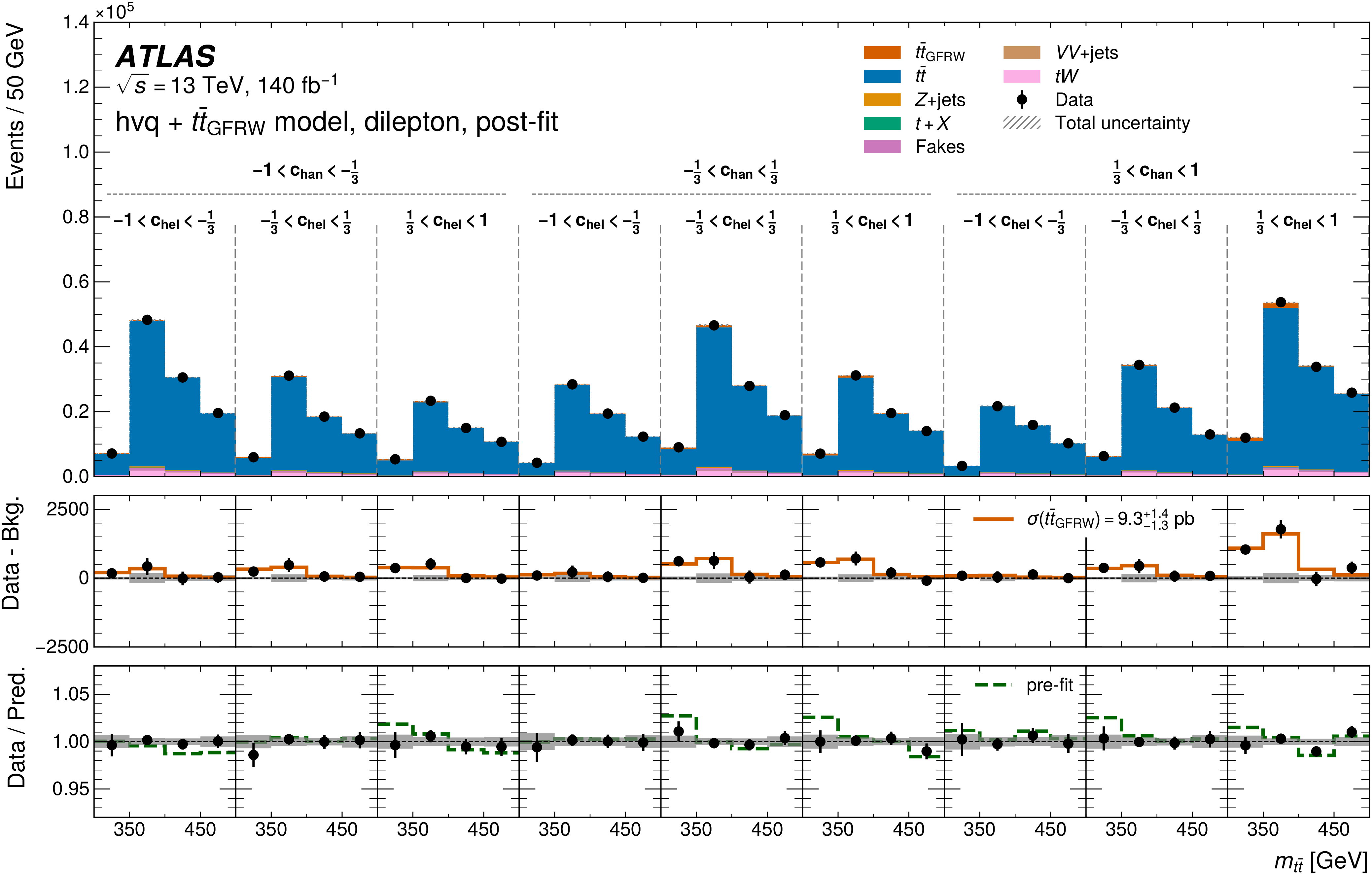
Events with ttˉ4 GeV are subsequently categorized into nine signal regions defined on angular observables (ttˉ5, ttˉ6), which are sensitive to the spin structure of the ttˉ7 system and enable discrimination between bound-state and continuum pQCD production.
Results
A binned likelihood fit of the ttˉ8 distribution in the signal regions quantifies the compatibility of the data with the baseline and extended models. Figure 1 displays the salient features of the observed and predicted ttˉ9 spectra, as well as the data/MC ratios after profiling systematics.
Figure 1: Observed and expected s=130 distributions and the ratio of data to the extended model with statistical and systematic uncertainties.
The baseline pQCD-only model is rejected with a significance exceeding s=131 (expected s=132), indicating unambiguous evidence for threshold enhancements not modeled in standard pQCD. Introducing the NRQCD-motivated “s=133” component yields a fitted cross-section
s=134
which is s=135 higher than the 6.43 pb analytical calculation, reflecting a corresponding excess at low s=136.
The systematic uncertainty on s=137 is dominated by modeling uncertainties in both the pQCD and NRQCD regions, in particular final-/initial-state radiation modeling and the QCD scale choices.
The alternative bb4l baseline increases robustness with respect to off-shell and spin effects; the measured enhancement and statistical significance persist.
As an additional cross-check, a simplified NRQCD model using a pure pseudoscalar resonance approximation yields an even larger cross-section, s=138 pb, further supporting the excess but underscoring the need for a more consistent treatment of threshold effects.
Implications and Outlook
These results provide unambiguous evidence of strong threshold enhancements in s=139 production at hadron colliders, consistent with toponium formation and long-standing NRQCD predictions [Fadin et al., 1987]. Such effects have significant implications:
They confirm non-perturbative QCD dynamics in a regime previously thought inaccessible at the LHC due to the top’s large decay width.
The observed normalization is in tension with current theoretical implementations, indicating missing ingredients or higher-order effects in NRQCD threshold modeling.
These results strongly motivate new MC tools with improved NRQCD–pQCD matching, inclusion of P-wave and color-octet toponia, and the implementation of off-shell and higher-order EW corrections.
Precise modeling is crucial for LHC Run 3 and future colliders, where these states could impact both SM measurements and BSM searches, including CP properties and potential new particle mediators in the −10 resonance region.
Conclusion
The ATLAS measurement of a pronounced cross-section enhancement near the −11 threshold constitutes strong evidence for short-lived top–antitop quasi-bound states, opening a new avenue for probing QCD in the top sector. The observed excess substantially disfavors pure pQCD modeling and requires an improved theoretical treatment of NRQCD corrections. Continued efforts in both experimental analysis and MC model development are essential for quantitatively understanding top-threshold dynamics and their impact on precision SM and BSM physics at high-energy colliders.