- The paper establishes a rigorous analytic framework linking vector-valued Hardy spaces to operator-valued Kramers-Kronig relations for non-Markovian memory kernels.
- It demonstrates that the Nakajima-Zwanzig memory kernel, the reduced-state Laplace transform, and the effective kernel satisfy Hardy-space criteria, ensuring causality when initial correlations are correctly treated.
- The work provides detailed numerical validation and experimental diagnostics, including moment-based criteria, to identify and remedy Kramers-Kronig violations in quantum master equations.
Kramers-Kronig Relations for Vector-Valued Hardy Spaces in Non-Markovian Open Quantum Dynamics
Introduction
This paper provides a rigorous analytic framework for the Kramers-Kronig (KK) relations in the context of non-Markovian open quantum systems, addressing the analyticity, causality, and complete positivity of the Nakajima-Zwanzig (NZ) memory kernel in frequency space. The central technical advancement is the establishment of conditions under which the NZ memory kernel, its associated reduced-state Laplace transform, and the effective kernel (resulting from force-fitting correlated initial states into a homogeneous equation) belong to vector-valued Hardy spaces and obey the operator-valued KK relations. The work bridges classical linear-response dispersion theory with non-Markovian open quantum system dynamics, providing both fundamental theorems and computational/experimental diagnostics.
Analyticity and Hardy-Space Structure
The analysis is organized around three operator-valued objects with distinct sensitivity to system-bath correlations:
- Memory kernel K~(z): Under standard physical assumptions (thermodynamic limit and local Lp coupling-weighted spectral density), K~(z) is shown to belong to a vector-valued Hardy space Hp(B) for p>1. This ensures analyticity in the upper half-plane and the validity of the KK relations in operator form.
- Reduced-state Laplace transform σ~(z): Proven to be analytic in the upper half-plane for any initial state (factorized or correlated) due to the norm contractivity induced by the unitarity of the underlying dynamics.
- Effective kernel K~eff(z): When initial correlations are force-fit into a homogeneous equation, the correction term I~(z)σ~(z)−1 can introduce poles in the upper half-plane if the reduced state's Laplace transform has zeros there, resulting in a violation of the KK relations and complete positivity.
A crucial technical result is the CPTP-Hardy consistency criterion: any approximate or phenomenological kernel with upper-half-plane poles cannot be the result of any underlying unitary, causal microscopic evolution.
KK Relations and Operator-Valued Dispersion Theory
The main theorems establish:
- Standard KK relations for the NZ memory kernel as an operator-valued analytic function when it belongs to H1(B);
- Subtracted KK relations for the case of algebraic long-time tails (e.g., sub-Ohmic spectral densities) where the standard KK integral diverges;
- Passivity-analyticity link: for passive bosonic baths at thermal equilibrium, operator dissipativity (imaginary part seminegative) ensures Hardy and Nevanlinna structure, and thus KK analyticity.
This formalizes the analytic structure for the kernel that was typically assumed or treated heuristically in earlier non-Markovian quantum master equation work.
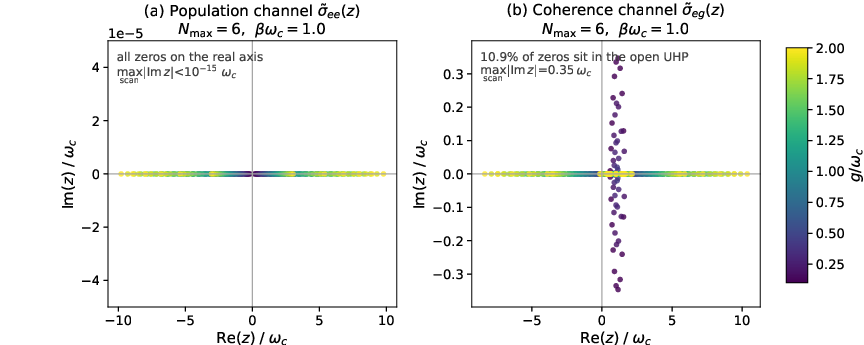
Figure 1: Zeros of the reduced-state Laplace transform σ~(z) for a finite Jaynes-Cummings model showing that coherence-channel zeros can enter the open upper half-plane, preconditioning KK violation.
Robustness and Breakdown Under Initial Correlations
The reduced-state Laplace transform Lp0 retains full Hardy analyticity for arbitrary initial correlations due to unitary contractivity. However, when one force-fits a homogeneous memory-kernel equation (ignoring the inhomogeneous or initial-correlation term), the effective kernel typically fails Hardy analyticity if Lp1 has zeros in the upper half-plane—a scenario shown to generically occur in near-resonant, structured systems such as truncated Jaynes-Cummings models.
Strong numerical evidence is presented: for the Jaynes-Cummings model, approximately Lp2 of the scanned coherence-channel zeros of Lp3 lie in the open upper half-plane (Lp4), explicitly demonstrating the precondition for observable KK violation in realistic quantum-optics settings.
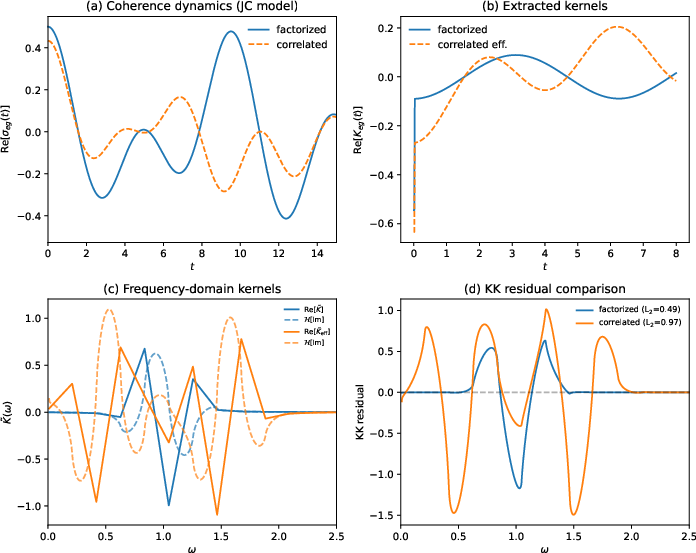
Figure 2: Direct numerical demonstration of KK violation in the force-fit effective kernel for the Jaynes-Cummings model; under correlated initialization, the KK residual roughly doubles.
The paper demonstrates that direct extraction of the effective kernel under correlated initial conditions in the Jaynes-Cummings model yields a twofold increase in the KK residual (Lp5 vs.\ Lp6).
Moment-Based Criteria and Finite-Dimensional Reconstructions
The analysis incorporates a moment-based Carleman criterion: for finite-dimensional system Liouville space, if the projected moments satisfy an operator Carleman divergence condition, the matrix-Padé-constructed kernel converges in Lp7 norm and thus strictly satisfies KK. This justifies moment-based extraction procedures used in Non-Markovian Kernel Construction Techniques (MKCT) and distinguishes genuine physical instabilities from numerical artifacts (Froissart doublets).
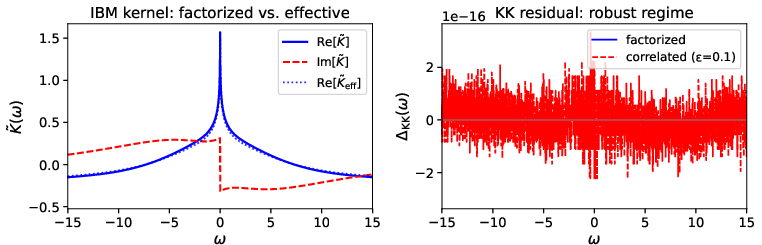
Figure 3: Analytic self-consistency check for the independent boson model: both Born and correlated cases yield machine-precision KK residuals, confirming the theoretical diagnostics in the robust regime.
First-Principles Validation and Counterexamples
The framework is validated using:
- HEOM and exact diagonalization for the spin-boson model with Ohmic and sub-Ohmic baths, showcasing the boundary between analytic and non-analytic kernel behaviour; recurrences and slower relaxation are observed for discrete or anomalous spectral densities.
- A counterexample simulation: for a spin-boson model initialized in a correlated (thermal) state, the inhomogeneous term Lp8 does not vanish and the extracted (force-fit) kernel fails causality and KK analyticity. This illustrates the quantum analogue of Gavassino's "stadium wave" causality paradox for coarse-grained effective equations.
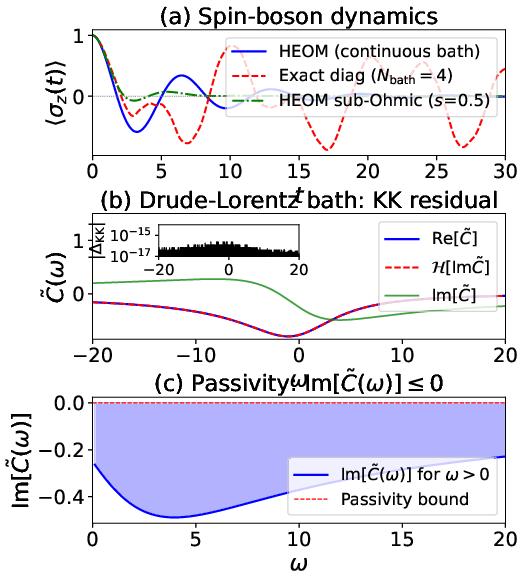
Figure 4: First-principles validation at Born order: HEOM (Ohmic bath) yields causal relaxation, while finite-mode diagonalization exhibits Poincaré recurrences and deviation from strict causality; bath correlator satisfies KK at machine precision.
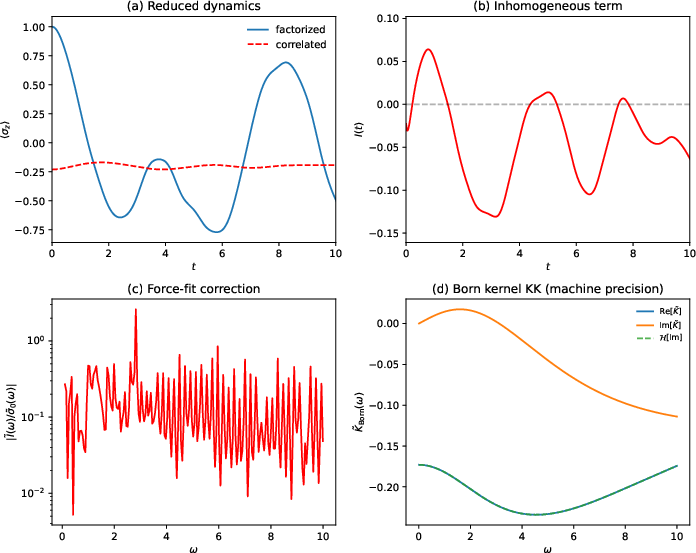
Figure 5: Counterexample—correlated initial state; direct computation of the inhomogeneous term Lp9 and the frequency-domain correction demonstrates large force-fit effects and explicit KK violation.
Physical and Experimental Implications
The framework provides experimentally accessible diagnostics (e.g., THz or 2D-IR spectroscopy) for detecting non-Markovian effects induced by system-bath correlations in the frequency domain. In the "fragile" regime (coherence-channel zeros of K~(z)0 in the upper half-plane), the effective kernel displays observable KK-violating Lorentzian peaks—offering a concrete signature of reductionism breakdown due to initialization or model mis-specification.
The results clarify that the apparent acausality signaled by KK violation is an artifact of improperly force-fitting a causal, multi-variable correlated dynamics into a single-variable kernel master equation framework. The underlying quantum dynamics remains strictly causal and CPTP whenever all terms (including the inhomogeneous one) are properly included.
Theoretical and Future Directions
Outstanding theoretical questions include the full operator-valued converse to the Titchmarsh theorem, sharper analytic criteria for infinite-dimensional systems, and exact topological classification of robust/fragile parameter regimes (e.g., via winding numbers of Laplace-domain zeros as coupling is varied). Extensions to non-Hermitian and active baths (Blaschke-Nevanlinna decomposition), multitime dispersion relations, and Floquet/structured environments remain open for further research.
Conclusion
This work provides a mathematically rigorous foundation for the analyticity and causality of the memory kernel in open quantum systems, explicitly connecting physical constraints (passivity, complete positivity, and spectral support) to KK relations in the operator Hardy space framework. The introduced criteria and diagnostics are both theoretically robust and practically accessible, supplying essential tools for the extraction, validation, and interpretation of non-Markovian quantum master equations in simulation and experiment. The framework also decisively links violations of KK and CPTP constraints not to fundamental breakdowns of causality in quantum dynamics, but rather to inappropriate model reduction in the presence of initial correlations.