- The paper presents a phenomenological spectral function that captures sub-Ohmic behavior and memory effects in optomechanical resonators.
- It employs a nonlocal quantum Langevin equation to model system–bath interactions while ensuring finite renormalizations of mechanical parameters.
- The framework facilitates experimental reconstruction of the complex mechanical susceptibility, aiding in precise dissipation control and system characterization.
Modeling Non-Markovian Brownian Motion in Optomechanical Resonators: A Globally-Consistent Bath Spectral Approach
Introduction and Context
This work presents a comprehensive theoretical framework for modeling the non-Markovian quantum Brownian motion of optomechanical resonators, motivated by observed non-Ohmic environmental spectral densities near mechanical resonances. The Markovian assumption, prevalent in standard weak-damping treatments of system-bath interactions, is demonstrably inadequate for structured solid-state environments such as those encountered in micro- and nanomechanical systems. Coupling mechanisms including phonon tunneling and interaction with two-level systems introduce non-locality and spectral features absent in the Ohmic paradigm. Recent optomechanical experiments have reported sub-Ohmic spectral slopes around the resonance, emphasizing the need for globally-admissible spectral models that extend beyond local frequency-domain fits.
The main innovation is the construction of a phenomenological bath spectral function Jk(ω) that (i) reproduces the observed non-Ohmic slope in a narrow window near resonance, (ii) regulates infrared and ultraviolet divergences to ensure finite bath-induced renormalization of mechanical parameters, and (iii) provides an analytic handle on temporal non-Markovianity. The implications for both fundamental quantum open system theory and experimental spectroscopy in cavity optomechanics are significant, enabling precise characterization and control of memory effects, dissipation, and the underlying structured environment.
Theoretical Model for System–Bath Interaction
The system is modeled as a linear coordinate-coupled quantum oscillator bath, with the mechanical resonator coupled to a continuum of harmonic bath modes. The total Hamiltonian is
H=2MP2+21MΩ02Q2+j∑[2mjpj2+21mjωj2xj2]−Qj∑cjxj,
leading, via the Heisenberg equations, to a nonlocal quantum Langevin equation (QLE) for Q(t): MQ¨+∫−∞tμ(t−t′)Q˙(t′)dt′+(MΩ02−δK)Q(t)=F(t),
where μ(t), derived from the bath spectral function J(ω), encapsulates non-Markovian dissipation, and F(t) is the thermal noise operator. This formalism ensures a direct link between experimental observables (e.g., susceptibility, linewidth) and the underlying microscopic environment.
The crucial spectral function is defined as
J(ω)=2πj∑mjωjcj2δ(ω−ωj)
and, in the continuum, as a function of bath parameters and density of states.
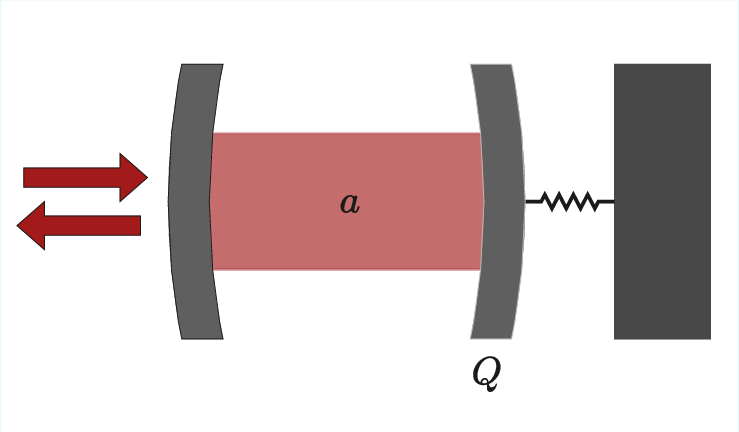
Figure 1: Schematic of an optomechanical platform with cavity mode a coupled to the motion (Q) of a micro-mechanical mirror, illustrating the canonical setup relevant for the system-environment modeling.
Construction of the Phenomenological Bath Spectral Density
Experimental reconstructions of H=2MP2+21MΩ02Q2+j∑[2mjpj2+21mjωj2xj2]−Qj∑cjxj,0 near the resonance (Nat. Commun. 6, 7606) show sub-Ohmic scaling H=2MP2+21MΩ02Q2+j∑[2mjpj2+21mjωj2xj2]−Qj∑cjxj,1 with H=2MP2+21MΩ02Q2+j∑[2mjpj2+21mjωj2xj2]−Qj∑cjxj,2. Extending such power-law fits globally leads to divergences in mass and stiffness renormalizations: H=2MP2+21MΩ02Q2+j∑[2mjpj2+21mjωj2xj2]−Qj∑cjxj,3
To suppress these pathologies while retaining local empirical accuracy, the authors construct a globally-admissible family: H=2MP2+21MΩ02Q2+j∑[2mjpj2+21mjωj2xj2]−Qj∑cjxj,4
where H=2MP2+21MΩ02Q2+j∑[2mjpj2+21mjωj2xj2]−Qj∑cjxj,5 ensures super-Ohmic low-H=2MP2+21MΩ02Q2+j∑[2mjpj2+21mjωj2xj2]−Qj∑cjxj,6 scaling for infrared convergence, and the crossover term recovers the measured local power-law near H=2MP2+21MΩ02Q2+j∑[2mjpj2+21mjωj2xj2]−Qj∑cjxj,7. The approach is flexible, as the precise form of the crossover can be adapted subject to physical constraints—positivity, finiteness of H=2MP2+21MΩ02Q2+j∑[2mjpj2+21mjωj2xj2]−Qj∑cjxj,8, H=2MP2+21MΩ02Q2+j∑[2mjpj2+21mjωj2xj2]−Qj∑cjxj,9, and non-divergent quadrature fluctuations.
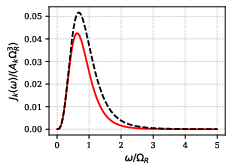
Figure 2: Normalized bath spectral function for representative Q(t)0, exhibiting super-Ohmic infrared behavior (guaranteeing regular renormalizations) and non-monotonic structure characteristic of engineered or naturally-structured environments.
The spectral function is non-monotonic, with its maximum below Q(t)1, and generically encodes a redistribution of dissipation in frequency, matching the signatures of a structured reservoir.
Time-Domain Non-Markovian Signatures
The non-Markovian character emerges explicitly in the temporal structure of the dissipation kernel Q(t)2, which, after analytic evaluation, exhibits power-law-modulated exponential decay and negative lobes: Q(t)3
This transient negativity is a hallmark of memory effects in structured baths and distinguishes the dynamics from purely Markovian, exponentially decaying kernels.
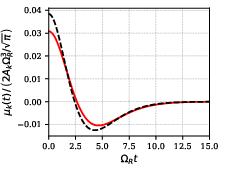
Figure 3: Temporal profile of the normalized dissipation kernel for two spectral exponents, demonstrating power-law decay and transient negativity, indicative of pronounced memory effects atypical of Ohmic baths.
The resulting position and momentum correlation functions inherit these features, displaying leading sharp-damped harmonic contributions from the resonance and subleading, memory-sensitive corrections controlled by the nonlocal bath. Importantly, the correlation envelopes show nontrivial temporal structure beyond simple exponential relaxation.
Spectroscopic Reconstruction and Experimental Implications
A major practical outcome is the demonstration that homodyne detection of the cavity output, with and without calibrated coherent mechanical drives, enables, in principle, full reconstruction of both the dissipative and dispersive components of the complex mechanical susceptibility Q(t)4. In the weak-coupling limit (probe regime), the homodyne photocurrent quadrature spectrum is governed by
Q(t)5
permitting direct inference of the mechanical response near resonance. With additional calibration, the full frequency dependence of Q(t)6 can be reconstructed, supporting separation and identification of bath-induced renormalizations, complex self-energy, and measurement of the structured bath spectrum itself.
This formalism sharply refines previous approaches by emphasizing global consistency, systematic extrapolation of local spectroscopic data, and strict physical admissibility with respect to divergences or instabilities.
Implications and Future Directions
The framework outlined provides a rigorous path to embedding locally-observed non-Ohmic and non-Markovian behavior into analytically tractable, globally-well-behaved bath models. Theoretical control over the bath spectral density and its analytic structure enables several significant advances:
- Practical Engineering: Experimental protocols for structured reservoir probing, optimal design of long-coherence mechanical modes (via Q(t)7-factor engineering), and possible reservoir engineering for dissipation control.
- Fundamental Open System Physics: Refined understanding of quantum Brownian motion in realistic, memoryful environments, including non-Markovian correlations, anomalous renormalizations, and thermalization rates.
- Extension to Strong Coupling and Nonlinear Regimes: While the current focus is weak-coupling/linear response, the analytic apparatus can be adapted to explore regimes with strong probe backaction or hybrid nonlinearities, supporting studies of decoherence, quantum thermodynamics, and macroscopic quantum phenomena.
- Metrological Applications: The approach supports precision measurements of environmental spectral properties, relevant to noise-limited mechanical sensing and quantum control experiments.
Conclusion
This work addresses the challenge of extending local experimental information on system-bath coupling into a fully consistent, globally-admissible theoretical description, particularly for non-Markovian, structured environments typical of solid-state optomechanics. The resulting framework provides formal and practical tools to model dissipative dynamics, predict temporal correlation features, and design experiments for the precise inference of environmental properties. The phenomenological construction and analytic tractability bridge open system theory with cavity optomechanical spectroscopy, opening avenues for systematic exploration and engineering of non-Markovian dynamics in quantum nanomechanics.