- The paper introduces Workstream, a developer dashboard that aggregates diverse engineering tools and AI services into a unified local-first interface.
- It presents a 120-point AI readiness scoring algorithm and automated artifact generation that improve code review and operational efficiency.
- Evaluation shows significant AI readiness score improvements and reduced developer context switching, highlighting the tool’s practical impact.
Workstream: A Local-First Developer Command Center for AI-Augmented Engineering Workflows
Introduction and Problem Statement
"Workstream: A Local-First Developer Command Center for the AI-Augmented Engineering Workflow" (2604.17055) addresses the profound fragmentation experienced by modern software developers. The proliferation of tools—ranging from repository forges (GitHub/GitLab) and task trackers (Jira) to communication suites (Slack), calendar apps, CI dashboards, and now multiple AI providers and agents—has led to significant cognitive overhead and context switching. Existing dashboards and orchestration tools target narrow subdomains or management personas, failing to provide a holistic, personalized aggregation with first-class AI integration. The emergence of AI code assistants introduces new requirements for repository readiness, agent management, secret handling, and team-specific review context that today's multi-tool workflow exacerbates.
System Architecture and Design Principles
Workstream is presented as an open-source, single-developer dashboard integrating all facets of engineering workflow into a cohesive interface, adhering to five design principles: local-first data residency, zero-configuration setup, no build step, personal instance model, and AI-native feature centrality. The backend is composed of a FastAPI service interfacing with a local SQLite instance, with persistent polling on GitHub, GitLab, Jira, Google Calendar, and AI providers and normalization into a unified schema. The frontend is delivered as a single vanilla JS SPA with direct REST fetches, CSS theming, and tab-based navigation.
A notable architectural decision is the exclusive local-first model which ensures no data leaves the developer's system, addressing organizational mandates on data privacy and reducing attack surface. Each dashboard instance operates with the user's own tokens, with no shared tenancy or state propagation.
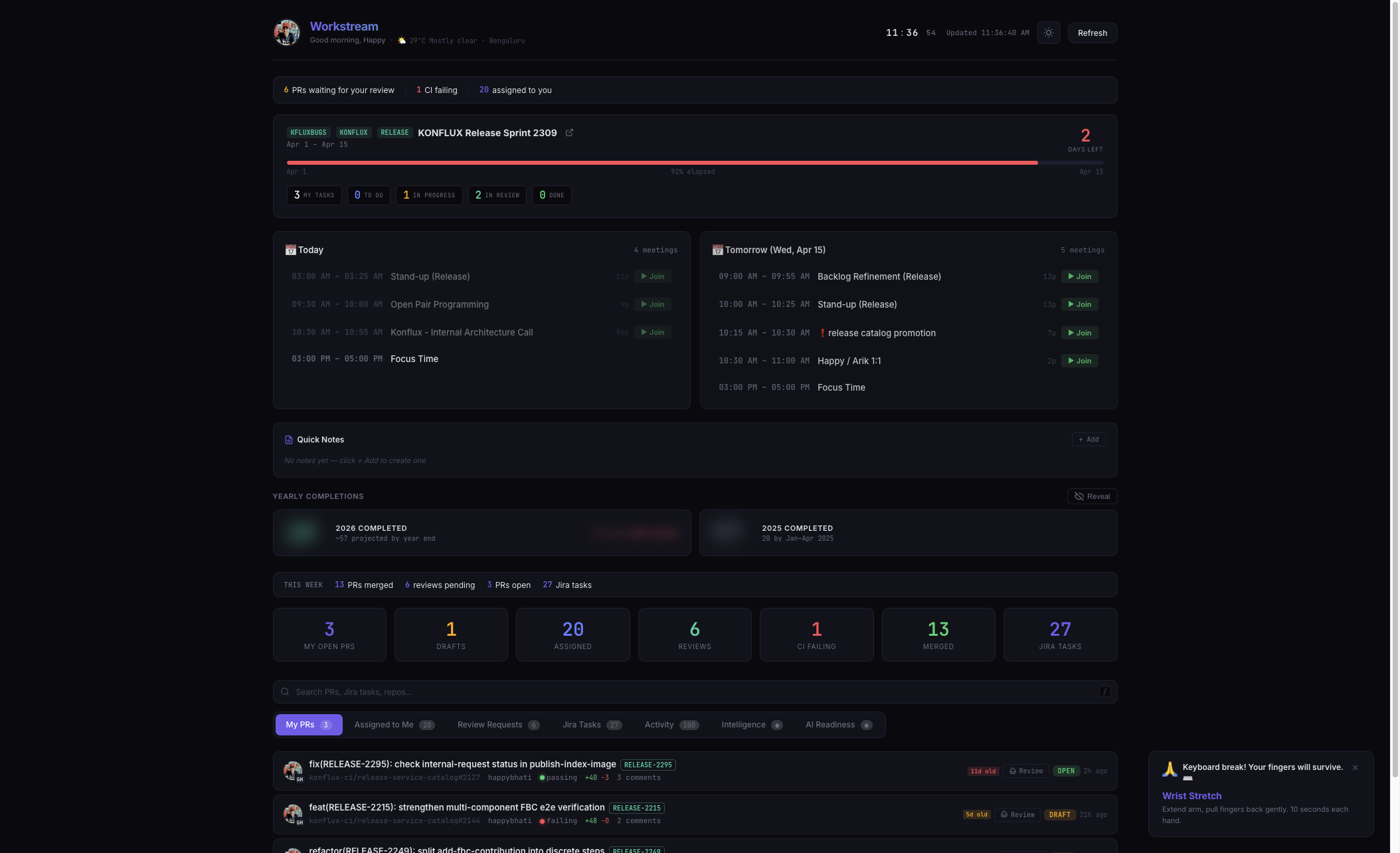
Figure 2: Workstream dashboard in dark mode displaying aggregated PRs, calendar, sprint tracking, and status cards on a single interface.
AI-Native Integrations
Multi-Provider Code Review and Review Intelligence
The system supports code review via Anthropic Claude, Google Gemini, and Ollama, with end-to-end prompt engineering, secret redaction (comprehensive regex for source code tokens and credentials), and structured JSON-based result ingestion. Of note, every review is enriched with repository- and team-specific context extracted from a custom review intelligence pipeline. This pipeline incrementally mines year-long historical PRs, filters bots, and classifies comments into a pragmatic taxonomy (bug, security, error handling, testing, performance, concurrency, API design, documentation, architecture) using ordered pattern matching. Intelligence is used to augment either direct automated review or copy-paste prompt workflows, empirically favored by developers for provider flexibility.
A central innovation in Workstream is the 120-point AI readiness scoring algorithm operationalized across five axes: agent config, documentation, CI/CD quality, code structure, and security. Each criterion is checked both heuristically (file presence, content heuristics) and by API inspection (repo tree, workflows). The outcome includes a normalized 0–100 score, a letter grade, and prioritized recommendations for criticality.
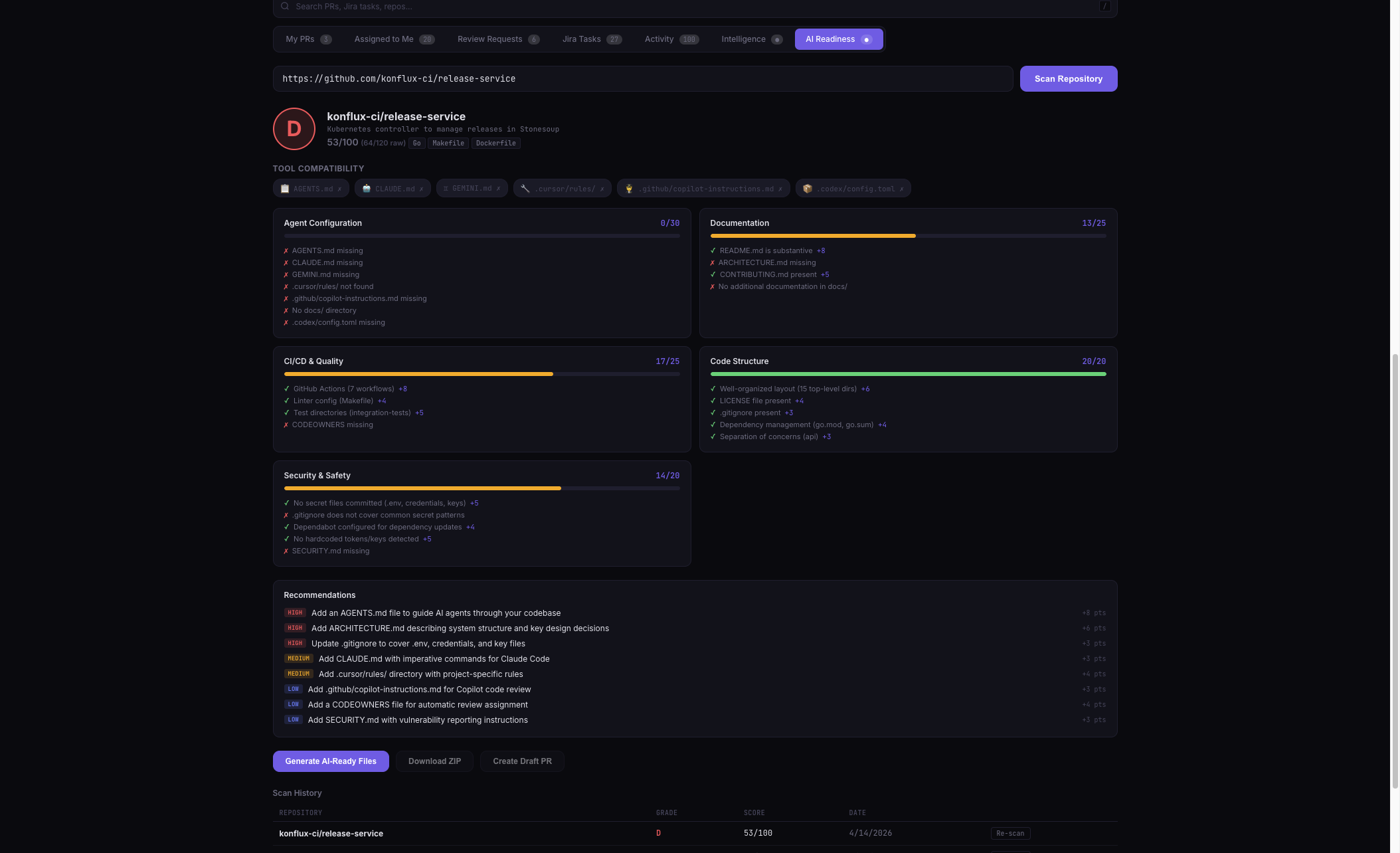
Figure 1: AI Readiness scan results, with a categorical score breakdown, grade, and automated prioritized improvement recommendations.
An agentic file generator is included: If a repository lacks essential context artifacts (e.g., AGENTS.md, CLAUDE.md), Workstream drafts and proposes these with gap analysis, incorporating both static code analysis and extracted organizational review intelligence. Drafts are committed as PRs via API for review and integration into the canonical repository.
Agent Observability: MCP, A2A, and AOP
Workstream operationalizes observability protocols for AI agents—the Model Context Protocol (MCP), Agent-to-Agent (A2A), and Agent Observability Protocol (AOP). Agents are auto-discovered from local IDE config, health-checked via local/remote probes, and their session, cognition, and operation events are streamed in real time via SSE. Cumulative agent statistics (token usage, cost, latency, success/failure) are displayed per-agent and in aggregate, affording visibility previously unavailable in individualized developer workflows.
Implementation Details
The backend comprises 8,411 lines of Python with asynchronous architectures and strong typing. No external build or transpilation is required; the frontend is delivered in ∼4,900 lines of vanilla JS with direct DOM manipulation and native CSS theming. Persistent integrations span seven external APIs, with polling intervals and local persistence abstracted from the user. Cross-platform support is provided for macOS (LaunchAgent), Linux (systemd), containers (Podman), and Kubernetes/OpenShift deployments, with defensive coding practices around API token management, secret scrubbing, and database encapsulation.
The CI/CD pipeline encompasses static typing, linting, matrix testing (Python 3.11–3.13), security auditing, container health checks, and end-to-end smoke tests with real external API tokens.
Evaluation: Quantitative and Qualitative Results
AI Readiness Score Gains
An internal case study ("dogfooding") was performed by applying the readiness scanner to Workstream's own repository, implementing all generated improvement recommendations. The scanner initially rated the project at 48/100; after iterative adoption of suggested artifacts and configurations, the score improved to 98/100 (+104%). An independent agentready CLI, using a separate scoring rubric, measured an increase from 41.6/100 to 73.7/100 (+77%). The remaining discrepancy is attributed to differences in scoring emphasis—Workstream prioritizes context files for agent compliance whereas agentready emphasizes CI and testing rigor.
Observed Workflow Gains
Daily use indicated substantive qualitative reductions in context switching, as measured by minimized navigation between tool silos and the adoption of focus banners and consolidated event feeds. PR handling latency dropped due to direct notifications and single-click navigability. The "copy prompt" feature for AI code review was inherently more utilized than automated reviews, suggesting developer preference for flexible LLM invocation. Review intelligence enrichment led to reviews that aligned more closely with established team conventions.
Limitations and Open Issues
The evaluation is limited by a single-user, self-assessed case study, and observed qualitative discontinuities are not presently measured against time-tracking or cross-user baselines. The tool's heavy dependency on third-party APIs and polling introduces potential for staleness and breakage. Current design is strictly single-user; extension to team-wide dashboards may challenge the "local-first" axiom. The validity of the AI readiness score as a predictor of actual AI agent efficiency remains an open empirical question.
Implications and Future Directions
Workstream highlights the shifting locus of developer cognitive load from code production per se to orchestration of complex agentic, information, and tool flows. The approach of local, privacy-preserving, AI-integrated dashboards offers an alternative to cloud-federated, management-centric platforms. Future directions include validation of readiness scores against agent performance metrics, development of plugin ecosystems for expanded tool integration, and potential architectural extensions for multi-user collaboration without compromising local-first constraints. The agent observability stack anticipates a future where developer workflows are heavily mediated by and dependent on autonomous agent behavior, requiring rigorous monitoring and cost control.
Conclusion
Workstream delivers a comprehensive, local-first aggregation point for the AI-augmented engineering workflow, coupling traditional workflow data (PRs, issues, sprints, calendars) with AI-native functionalities (multi-provider review, automated readiness scoring, real-time agent observability). Quantitative evaluation shows dramatic improvements in AI readiness scores (48→98 and 41.6→73.7), while qualitative observations document reduced context switching, faster incident response, and improved review congruity with team standards. The platform is open-sourced and available for adoption and extension, offering a robust reference for the next generation of developer command centers in the AI era.