- The paper implements the exact O(λ^(5/2)) coefficient to collapse the broad LSTP Padé ensemble into a unique interpolant.
- It rigorously combines weak- and strong-coupling data using a [4/4] rational function and strict admissibility filters.
- The unique interpolant reduces systematic uncertainties in N=4 SYM thermodynamics, though route dependence remains a source of ambiguity.
Constrained Padé Ensembles for Thermal N=4 SYM: Collapse to a Unique Interpolant at O(λ5/2)
Introduction
This work rigorously examines interpolation uncertainties in the thermodynamic analysis of planar N=4 supersymmetric Yang–Mills theory at finite temperature by implementing the exact O(λ5/2) coefficient in the weak-coupling expansion for the normalized entropy density. The study extends the constrained log-subtracted two-point Padé (LSTP) interpolant methodology and provides an explicit comparison to the previously admissible Padé ensemble built with only lower-order weak-coupling data. The main result is the complete collapse of the admissible LSTP band to a unique curve, with remaining ambiguity attributed solely to the choice of interpolation ansatz.
Theoretical Framework: Padé Interpolation and Series Expansions
The observable of interest, f(λ)≡S/S0, admits an asymptotic expansion for small 't Hooft coupling λ via finite-temperature perturbation theory and for large λ via the AdS/CFT correspondence. Both expansions fail in the intermediate-coupling regime, necessitating rigorous interpolation frameworks. The LSTP construction leverages known terms from both asymptotic regions with a rational ansatz performed on a conformally mapped variable and utilizes physical admissibility filters.
A significant theoretical advance is the determination of the exact A5/2 coefficient [Carrington et al., (Carrington et al., 7 Apr 2026)], allowing for a high-fidelity weak-coupling constraint. The updated expansion up to O(λ5/2) introduces a nontrivial positive term, markedly distinct in sign and magnitude from prior Hermite-Padé predictions.
Numerical Construction and Admissibility Criteria
Across both the previous O(λ2) and the new O(λ5/2)0 Padé ensembles, the same rational ansatz, conformal mapping, matching protocol, and admissibility filters are enforced. The updated analysis shifts weak-side matching points to higher O(λ5/2)1 values where O(λ5/2)2 yields significant numerical impact. A O(λ5/2)3 Padé rational function is pinned to fixed matching conditions at five weak- and four strong-coupling points, with further constraints of physical monotonicity (O(λ5/2)4), Stefan-Boltzmann normalization, and absence of positive real poles. The only allowed variable region in parameter space is the O(λ5/2)5 grid, with degeneracy in O(λ5/2)6 values due to the construction.
Results: Collapse of the Admissible LSTP Band
The imposition of the exact O(λ5/2)7 coefficient yields a radical transformation of the admissible ensemble:
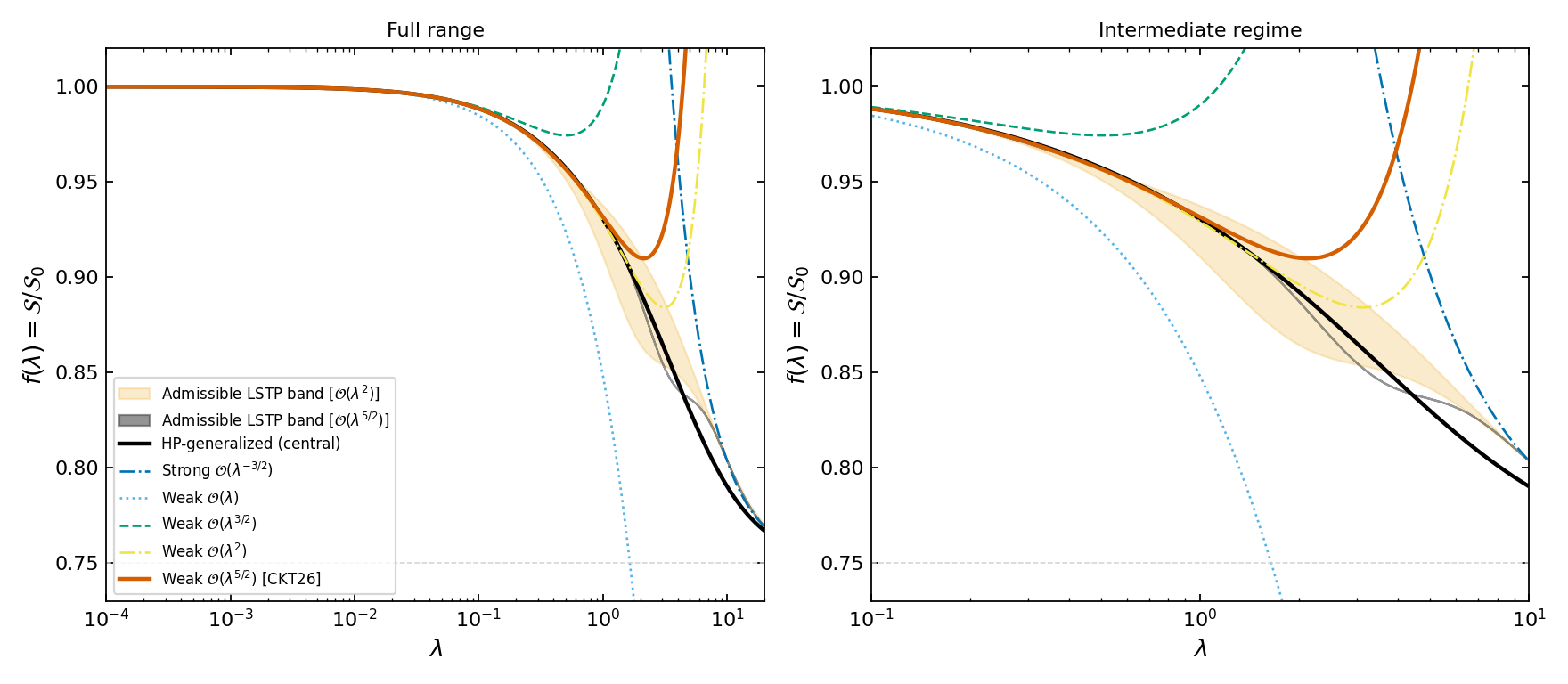
Figure 1: The broad O(λ5/2)8 LSTP admissible band shrinks to a unique curve when the exact O(λ5/2)9 coefficient is imposed.
With the N=40 truncation, the scan produces nine nominal survivors—three numerically distinct curves corresponding to different N=41 values—in a wide crossover region, N=42. After the inclusion of N=43, only the N=44 curves survive across all N=45, and these collapse numerically into a single distinct interpolant with N=46 and N=47. All other parameter combinations are excluded by the admissibility filters due to unphysical behavior.
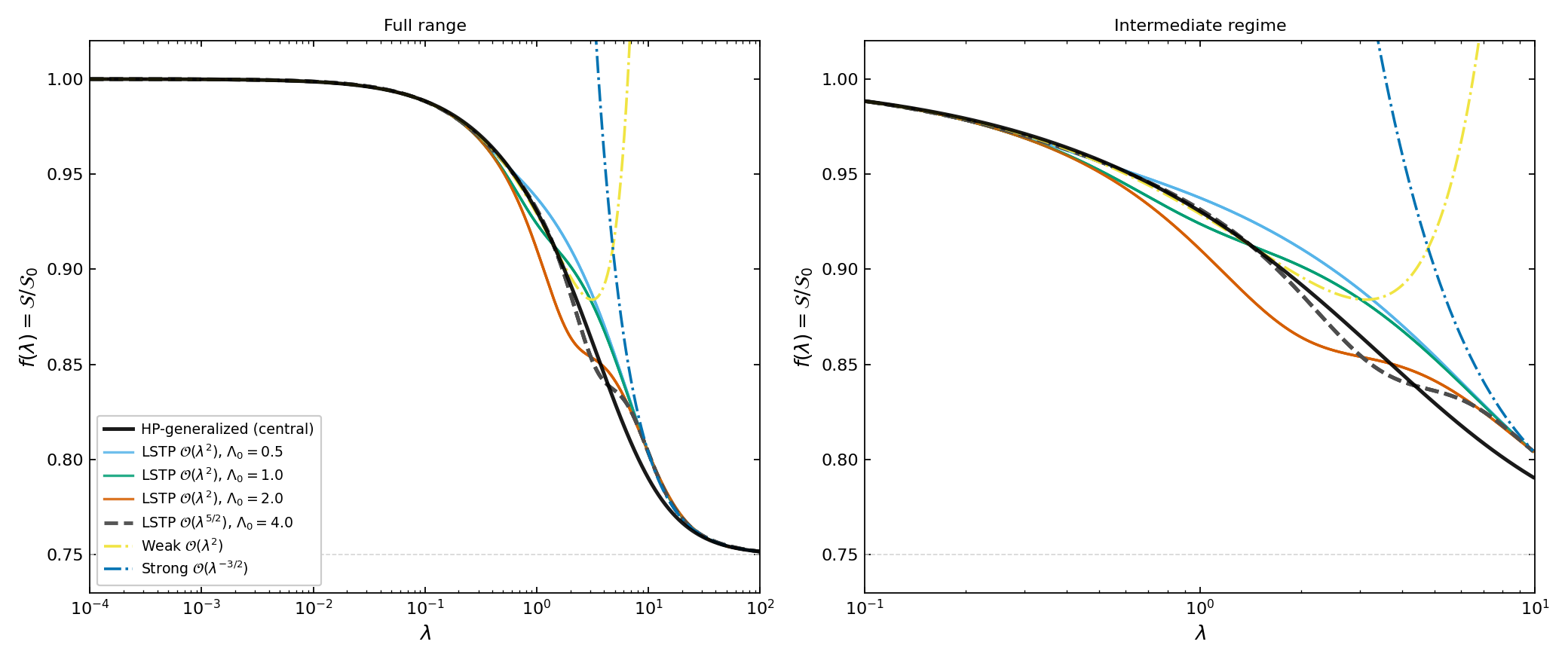
Figure 2: The spread of individual LSTP survivors at N=48 collapses to a single unique curve with the N=49 upgrade, illustrating the strength of the new constraint.
Diagnostic Indicators: Strong-Coupling Residual and Curvature
For an estimator of the next unknown strong-coupling term, one considers
O(λ5/2)0
evaluated at off-grid points (here O(λ5/2)1). In the previous band, this quantity ranged over O(λ5/2)2 at O(λ5/2)3, while the unique LSTP curve at O(λ5/2)4 pins it to O(λ5/2)5. By contrast, the reference Hermite-Padé (HP) curve yields O(λ5/2)6, demonstrating a robust and sign-changing route dependence not resolved by weak-coupling data alone.
Evaluation of the second derivative with respect to O(λ5/2)7 further highlights the contrast between the ensemble collapse and the persistent ansatz dependence.
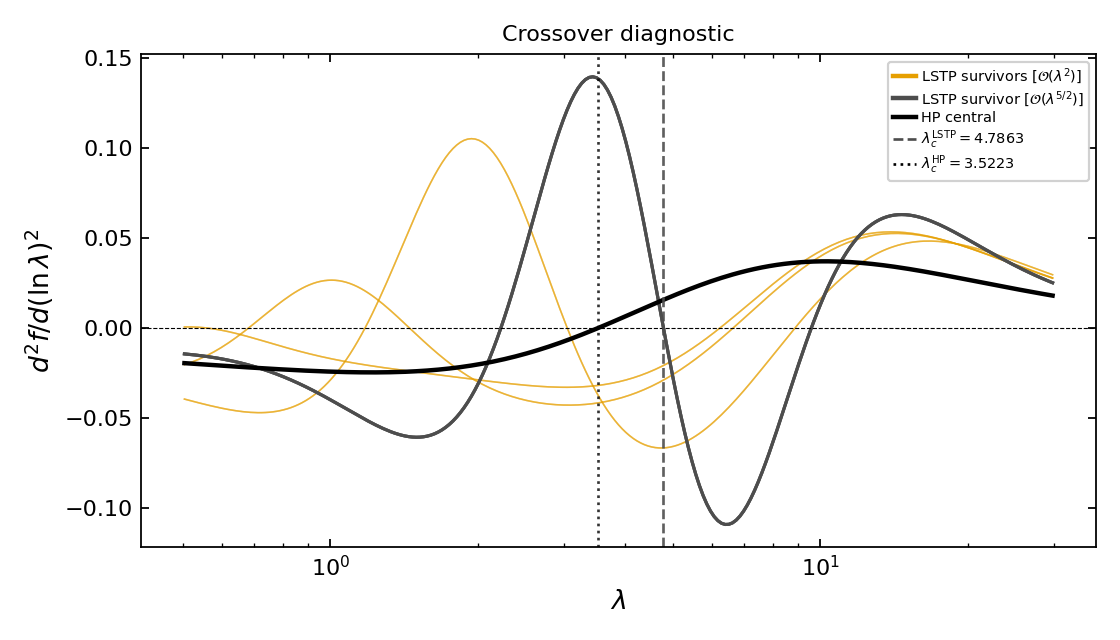
Figure 3: The curvature diagnostic O(λ5/2)8 showcases the spread in inflection points at O(λ5/2)9 (thin orange) and the unique optimized LSTP curve at f(λ)≡S/S00 (solid gray), compared to the HP curve (black).
Route Dependence and Limitations
Despite the collapse of the LSTP ensemble, the central HP curve remains offset both in absolute value and in the predicted location of the crossover and strong-coupling residual. The disagreement is both quantitative and qualitative (sign difference). The HP construction cannot be updated by simply plugging in f(λ)≡S/S01; its rational ansatz structure must be fundamentally extended due to pre-existing spurious terms and the absence of free parameters. As a result, route dependence remains the dominant source of theoretical uncertainty, given the present knowledge of asymptotic coefficients.
Practical and Theoretical Implications
The collapse of the Padé admissible set to a unique interpolant under the addition of a single higher-order weak-coupling term demonstrates the severe constraining power such coefficients can provide, beyond their usual role as mere checks on extrapolation. This significantly reduces systematic uncertainties from ensemble construction. However, residual ambiguity—marked by the difference between LSTP and HP/Hermite-Padé curves—highlights the need for additional constraints, notably the determination of the next strong-coupling coefficient (f(λ)≡S/S02), or a symmetric extension of the HP route including f(λ)≡S/S03.
On the practical side, the unique LSTP curve with the f(λ)≡S/S04 constraint provides the most robust available interpolant for f(λ)≡S/S05 SYM thermodynamics over all couplings, but theoretical advances are required to further reduce route dependence.
Conclusion
Incorporating the exact f(λ)≡S/S06 weak-coupling coefficient into the LSTP interpolation for planar f(λ)≡S/S07 SYM rigidly selects a unique admissible interpolant, collapsing the previous uncertainty band and providing sharp predictions for the entropy density and residual strong-coupling corrections. Nevertheless, structural ambiguity persists across interpolation routes, quantifiable via the strong-coupling estimator and inflection diagnostics, and will remain until corresponding advancements are made either in strong-coupling expansion or ansatz extension. Future developments in analytic strong-coupling calculations or a rebuilt Hermite-Padé framework will be necessary to fully resolve this theoretical indeterminacy (2604.16109).