- The paper achieves a complete weak-coupling computation of the N=4 SYM free energy density to order λ⁵ᐟ², highlighting precise cancellation of infrared divergences.
- The analysis employs static resummation over ring diagrams and an automated symbolic computation framework to manage complex three-loop contributions.
- The results demonstrate superior convergence relative to QCD, providing a robust benchmark for future analytical and lattice studies in supersymmetric thermodynamics.
Thermodynamics of N=4 Supersymmetric Yang-Mills to Order λ5/2
Overview and Motivation
This work presents a complete computation of the weak-coupling thermodynamics of N=4 supersymmetric Yang-Mills theory (SYM44) in four spacetime dimensions, calculated up to the perturbative order λ5/2 in the 't Hooft coupling. The analysis is performed at finite temperature and vanishing chemical potential. The result stands as the highest possible perturbative order attainable, since beyond λ5/2, nonperturbative magnetic mass effects (arising at O(λ3)) become relevant and obviate strict perturbative calculations.
The infrared finiteness of the results is ensured by an infrared resummation—static resummation—over SYM44 ring diagrams. The calculation is ultraviolet finite due to the conformal and supersymmetric nature of N=4 SYM. Theoretical innovations include systematic amplitude simplification, explicit treatment of hard and soft momentum regions using resummed propagators, and an automated symbolic computation framework that enables the control and verification of this highly nontrivial multi-loop calculation.
Theoretical Structure and Computational Method
The analysis leverages several technical advantages of SYM44: the absence of a running coupling (λ5/20 in all orders), resulting UV finiteness and simple scale dependence (λ5/21 scaling of the ideal gas term), and exact field content. All fields reside in the adjoint of λ5/22, including gauge fields, four Majorana fermions, and six real scalar degrees.
A static resummation approach, as an application of the Braaten-Pisarski reorganization, classifies contributions according to hard (λ5/23) and soft (λ5/24) momentum modes. Bosonic Matsubara zero modes are responsible for soft contributions; ring diagrams encode the resummation needed for IR finiteness.
Symbolic manipulation of amplitudes, facilitated by Mathematica, ensures reproducibility and handles the enormous combinatorics of three-loop diagrams. Variable transformations and symmetrizations reduce complex integrands into linear combinations of known sum-integrals, with careful decoupling of soft/hard contributions and a precise tallying of thermal counterterms. The calculation is systematically verified by cross-checks against lower-order known results and QCD analogues.
Main Results
The central result is the explicit expression for the free energy density, normalized to the ideal gas result: λ5/25
with all coefficients λ5/26 given analytically.
Key properties and findings:
- All IR divergences cancel among three-loop contributions and ring diagrams, leading to a manifestly finite final result.
- No λ5/27 term appears, consistent with effective field theory expectations where no coupling or mass renormalization arises in SYMλ5/28.
- The RDR (regularization by dimensional reduction) and DR (canonical dimensional regularization) schemes yield very similar results for physically relevant couplings, with only minor numerical differences at order λ5/29, affirming the insensitivity to regularization specifics due to exact supersymmetry.
The ordered weak-coupling expansion is valid and convergent up to N=40, with improved convergence relative to QCD. This is illustrated by direct comparison of the perturbative series and the enhancement of convergence attributes in SYMN=41 over QCD Figure 1.
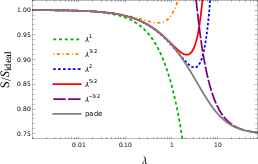
Figure 2: The scaled entropy as a function of coupling at different orders in perturbation theory; the Padé approximant interpolates between weak and strong coupling.
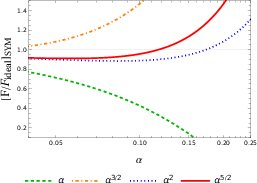
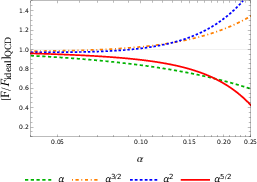
Figure 1: The SYMN=42 and QCD free energies as a function of N=43; convergence of the SYMN=44 series is superior to that of QCD.
The analysis is extended by comparing perturbative results with a generalized Padé approximant, constructed to interpolate between the weak-coupling expansion (to N=45) and the known strong-coupling AdS/CFT result (N=46). The Padé approximant, however, does not closely track the direct N=47 result in the weak coupling regime, indicating limitations of such interpolations when higher-order perturbative data becomes available.
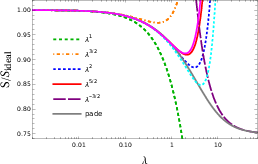
Figure 3: Free energy obtained with RDR (supersymmetric regularization) and DR (conventional dimensional regularization), showing marginal differences at N=48.
Technical and Numerical Checks
The calculation is substantiated by several internal and external consistency checks:
- All IR/UV singularities cancel in the sum, with no poles appearing.
- To N=49, the analytic result coincides with independent previous computations performed by different methods.
- For QCD, the methodology reproduces the known result through 440, including all required fundamental sum-integrals.
- Factorization of overlapping sum-integrals and cancellation of subleading logarithmic terms are confirmed as required by effective field theory structure.
Implications and Outlook
The demonstration that weak-coupling expansions in SYM441 are better behaved than those in QCD has implications for analytic studies of strongly correlated gauge theories. The conformal and supersymmetric structure ensures clean IR/UV separation and mitigates the breakdown of perturbative expansions at moderate coupling.
At a theoretical level, this result establishes the ultimate boundary for what can be computed perturbatively in the finite-temperature equilibrium thermodynamics for a four-dimensional gauge theory with a UV finite, highly symmetric field content. Any extension to higher order or lower temperature would necessitate nonperturbative information about the magnetic scale.
This calculation provides an anchor for future, more ambitious EFT and lattice approaches. The accuracy and automation of the symbolic computation pipeline developed here can immediately be retrofitted to studies of other supersymmetric gauge theories, their deformations, or to QCD with extended field content. Interpolating functions between weak and strong coupling require careful assessment with any additional higher-loop perturbative data.
Conclusion
The explicit computation of the SYM442 free energy to order 443 in perturbation theory confirms the improved convergence and analytic tractability of thermodynamics in this maximally supersymmetric and conformal setting. The finite, scheme-insensitive result constitutes a precise benchmark for studies of gauge theory thermodynamics, both perturbative and nonperturbative. The calculation structure and checks also demonstrate the reliability of robust algebraic automation for high-order gauge theory computations, paving the way for further developments in analytic and numerical studies of supersymmetric thermal field theories.