- The paper presents a DAE-aware Bayesian framework for joint estimation of generator and network parameters by leveraging advanced MCMC strategies and structured reparameterization.
- It rigorously analyzes parameter identifiability via forward DAE sensitivity and co-identifiability indices, ensuring accurate recovery under nonlinear dynamics.
- Numerical experiments on IEEE 9-bus and 39-bus systems validate the framework’s ability to reduce DAE solves while delivering robust, uncertainty-aware calibration.
DAE-Aware Bayesian Inference for Joint Generator-Network Parameter Estimation
Introduction and Problem Motivation
This paper addresses the parameter estimation (PE) problem for multi-machine electric power grids modeled as nonlinear differential-algebraic equations (DAEs), specifically targeting joint estimation of generator (inertia, damping) and network (branch resistance, reactance) parameters from phasor measurement unit (PMU) data. The central motivation is the inherent coupling of generator and network parameters through the DAE structure—physically, generator frequency dynamics are mediated by network admittances, while network voltage responses depend on generator parameters. Ignoring this interplay leads to parameter bias and a lack of robustness under varying system conditions. Existing literature falls short by generally treating either generator or network parameters as fixed, not performing simultaneous Bayesian calibration under the DAE model.
DAE-based PE presents a formidable computational challenge: the inverse problem is ill-conditioned, features strong parameter correlations, and requires repeated forward DAE solves under stiff dynamics and potentially infeasible parameter proposals. The novelty of this work lies in developing a DAE-aware Bayesian framework that enables scalable, credible joint inference while enforcing physical constraints, accommodating modeling error via noise inflation, and efficiently exploring high-dimensional posteriors with advanced Markov Chain Monte Carlo (MCMC) strategies.
Parameter Identifiability and Structured Reparameterization
The paper provides a rigorous analysis of which parameter combinations are locally identifiable from PMU measurements in DAE-structured power system models. A forward DAE sensitivity framework is derived, quantifying the impact of generator and network parameters on measured channels via time-varying Jacobians and Schur complement terms. Importantly, a co-identifiability diagnostic is introduced: the Gauss-Newton curvature matrix is block-partitioned to quantify cross-influence, and a normalized co-identifiability index IXY is defined to assess the coupling strength between parameter groups (generator inertias, dampings; resistances, reactances).
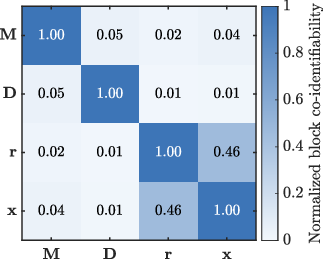
Figure 2: Normalized co-identifiability matrix IXY quantifies the local coupling among inertia, damping, resistance, and reactance parameter groups.
Figure 2 demonstrates, for the IEEE 9-bus case, that generator dynamic parameters are weakly coupled to network parameters (IM,r,IM,x≪1), confirming the time-scale separation between frequency response and network voltage settling. However, network resistances and reactances exhibit significant co-identifiability, motivating blocked update strategies in subsequent MCMC sampling.
The parameter space is reparameterized to log-normal latent coordinates, ensuring strict positivity, natural accommodation of multiplicative uncertainty, and unit-variance standardization—a choice that facilitates adaptive proposal design and robust mixing in high-dimensional MCMC.
Bayesian PE is formulated by constructing a joint posterior on standardized parameters, combining (i) a channel- and time-segmented Gaussian likelihood, (ii) physics-informed log-normal priors, and (iii) hard constraints enforcing physical plausibility and DAE power-flow feasibility. Crucially, the likelihood model is not naively derived from measurement noise alone; a channel-specific model discrepancy inflation term accounts for forward-model uncertainty (e.g., unmodeled dynamics, solver error), preventing overconfident, unrealistic posteriors. Time segmentation further emphasizes periods in which specific parameter classes (inertia, damping, network) are most identifiable.
The prior design reflects realistic engineering uncertainty: e.g., 95% prior widths of ±30% for inertias, ±60% for dampings, and ±25% for branch parameters, with hard box constraints. All proposals are checked for DAE power-flow feasibility—a nonnegotiable physical constraint—prior to likelihood evaluation.
Multifidelity Delayed-Acceptance MCMC Sampler
Efficient posterior exploration is realized using a multifidelity delayed-acceptance MCMC framework, essential given the cost of DAE solves and high-dimensional parameter vector. The sampler design includes:
- Blocked Gibbs Proposals: Generator, resistance, and reactance parameters are updated in physically informed blocks, reducing proposal dimension, improving acceptance rates, and leveraging the co-identifiability structure.
- Adaptive Covariance Estimation: Proposal covariances are initialized using local curvature and adaptively learned during burn-in, targeting optimal acceptance rates.
- Three-Stage Multifidelity Filtering: Each candidate proposal is (i) first screened for DAE initialization feasibility (power-flow solve), (ii) then evaluated using a cheap DAE integration surrogate (coarse time grid, relaxed solver), and (iii) only candidates passing these are evaluated using the full, high-fidelity likelihood. The Metropolis correction ensures detailed balance and unbiased posterior exploration, while reducing expensive DAE evaluations by up to 70%.
Numerical Results: Joint Estimation, Ablation, and Scalability
Extensive validation is conducted on the IEEE 9-bus and preliminary 39-bus systems. On the 9-bus case (21 parameters, 4 experiments), the framework accurately recovers all generator and network parameters. Posterior marginals contract sharply relative to priors, with true values always contained within 95% credible intervals. Mean posterior-mean errors are sub-2% for all parameter classes, and all strong, critical parameters are well-centred.
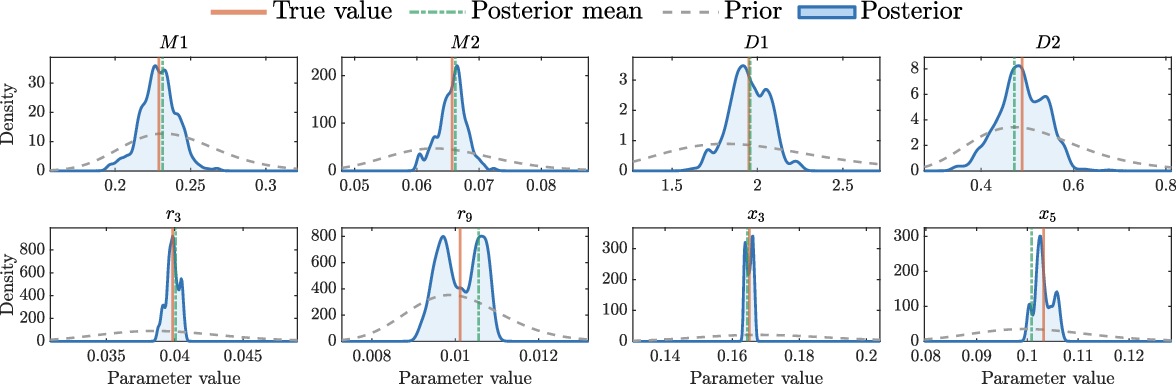
Figure 1: Prior-to-posterior marginal contraction for representative inertias, dampings, resistances, and reactances under the full joint Bayesian model.
Ablation studies confirm key algorithmic choices:
- Blocked proposals outperform full-block proposals in both accuracy and posterior calibration.
- Multifidelity delayed acceptance reduces the number of exact DAE solves by 50–70% with negligible distortion in the posterior.
- Joint estimation correctly attributes measurement variation to underlying physical causes, while decoupled estimation (fixing either generator or network parameters) introduces systematic bias as demonstrated by significant errors and shifted posteriors.
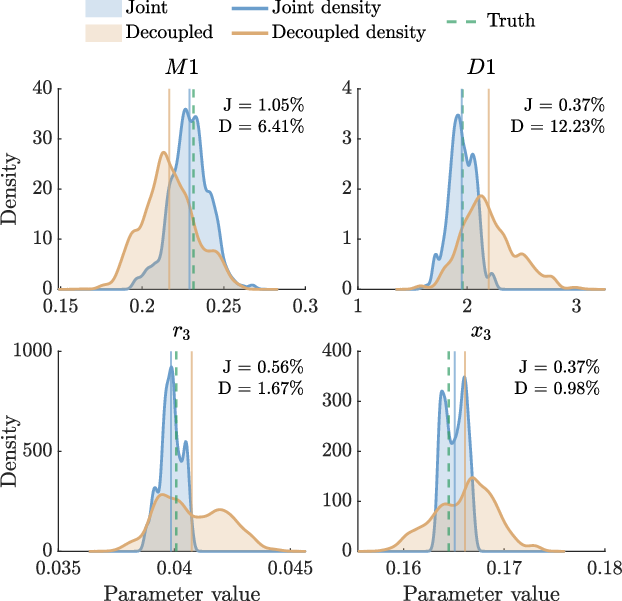
Figure 3: Comparison of posterior marginals for joint versus decoupled estimation; decoupled estimation introduces significant bias due to the unmodeled DAE coupling.
Scalability experiments on the 39-bus system (108 parameters) achieve low point-estimation errors but exhibit under-dispersed credible intervals, indicating the need for further calibration and tuning in larger, less informative settings.
Implications, Limitations, and Future Directions
The proposed DAE-aware Bayesian framework represents a principled approach for uncertainty-aware, physics-consistent joint calibration of power system parameters directly from PMU data, addressing both theoretical identifiability and practical computational challenges. Key takeaways include:
- Robust parameter recovery is possible without conservative priors or ODE-based model reductions, provided DAE coupling is addressed.
- Ignoring coupling between generator and network parameters causes misattribution of measurement variation, leading to biased and unreliable models that may fail under topology or loading change.
- The computational expense makes the approach currently suitable for offline calibration or small-to-medium systems; further acceleration (e.g., with surrogates, parallelization, or reduced-order modeling) is needed for real-time or large-scale deployments.
For the power systems community, this work underlines the necessity of joint estimation when constructing credible system models in the face of increasing renewable penetration and dynamic uncertainty. Future work should prioritize model mismatch robustness, real PMU data validation, and algorithmic advances for scalability and real-time implementation. The methodology is conceptually extensible to broader DAE-structured inference challenges in complex engineered systems.
Conclusion
This study provides a technically sound Bayesian framework for joint inference of dynamic and network parameters in DAE-modeled power systems. Key contributions include the DAE-aware identifiability analysis, channel- and time-segmented uncertainty modeling, and an efficient MCMC strategy tailored to the computational and structural complexities of power system models. The results underscore both the feasibility and necessity of joint inference and provide a foundation for robust, uncertainty-aware power system modeling under increasing complexity and uncertainty.

