- The paper reveals that integrating static heterogeneity into energy landscape models yields near-unity first-passage bursty dynamics.
- Combining STM monitoring with kinetic Monte Carlo simulations, it quantifies residence and interpeak time distributions with precise power-law behavior.
- The findings question universality claims by demonstrating that simple stochastic processes, influenced solely by static disorder, can mimic heavy-tailed burstiness.
Static Heterogeneity Drives Apparent Universality in First-Passage Bursty Dynamics
Introduction and Motivation
The statistical physics of complex systems frequently invokes concepts of universality, where macroscopic observables are presumed to exhibit system-independent scaling behaviors arising from underlying microscopic dynamics. The emergence of "bursty" dynamics—intermittent activity with heavy-tailed inter-event time distributions—across disciplines as disparate as human communication, ion channel gating, gene expression, seismicity, and surface diffusion has led to conjectures regarding universal mechanisms and scaling exponents, often emphasizing underlying decision-making processes or sophisticated queueing models.
This paper executes a reductionist approach, leveraging the direct real-time monitoring of single-molecule diffusion on Ag(110) using atom-tracking scanning tunneling microscopy (STM) to interrogate the microscopic origins of bursty dynamics (2604.15084). The study highlights that the widely reported near-unity power-law exponents (α≈1) for inter-event times can arise generically in simple stochastic processes due to spatial heterogeneity in the energy landscape, without recourse to non-Markovianity, priority-queueing, or temporal inhomogeneity. It consequently challenges strong universality claims and the presumed specialness of power-law scaling in such systems.
Experimental System and Extraction of First-Passage Statistics
High-mobility perylene-3,4,9,10-tetracarboxylic acid dianhydride (PTCDA) molecules on Ag(110) serve as a model system for two-dimensional biased diffusion. STM images show self-assembled islands of PTCDA and a dilute 2D molecular gas phase. Owing to rapid molecular motion, the latter manifests as strong noise in STM topographs; controlled tip positioning (atom tracking) enables monitoring of time-resolved tunnel current fluctuations, each corresponding to single-molecule crossing events (Fig. 1).
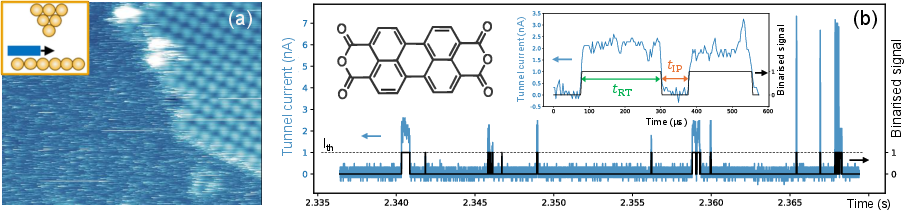
Figure 1: (a) STM image of PTCDA/Ag(110) with noisy region indicating molecular diffusion. (b) Tunnel current as a function of time with annotated residence (tRT) and interpeak (tIP) times.
Binarization of the recorded tunnel current, using a statistically robust threshold, yields sequences from which distributions of residence times (RTDs) and interpeak times (ITDs, i.e., first-passage return times) are directly computed.
Universal vs Apparent Scaling in Residence and Interpeak Time Distributions
The measured RTDs consistently exhibit a truncated power-law form over multiple decades in time, with exponents clustered around αRTD≈1.53±0.03 (across setpoint currents), followed by exponential cut-off. This value is in direct agreement with unbiased two-dimensional first-passage theory, where the survival probability S(t)∼t−1/2 and the first-passage (or return-time) density follows t−3/2 scaling. The extent of the power-law regime is sensitive to the effective detection cross-section.
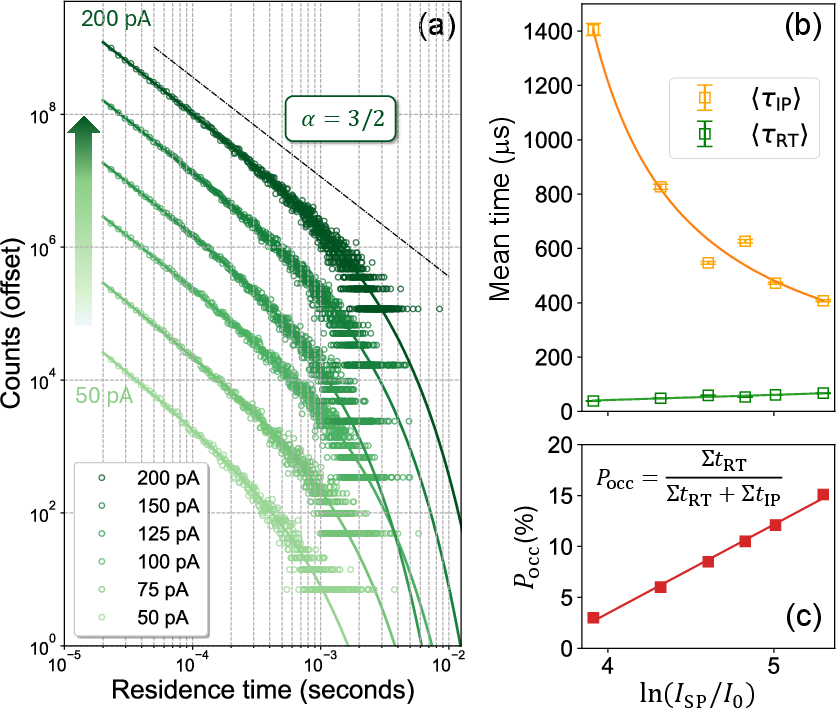
Figure 2: Unbinned RTDs for varying tip setpoints and dependencies of mean residence/interpeak times and occupation probability on tip-sample separation.
In marked contrast, interpeak time distributions show an apparent α∼1 power-law regime at short times, with a transition to exponential or compressed-exponential cutoff at longer tIP (Fig. 3). The dependence of ITDs on experimentally tunable parameters (tip-sample distance) is nontrivial: the mean interpeak time decreases sharply with smaller tip-sample separations, directly evidencing tip-induced bias fields.
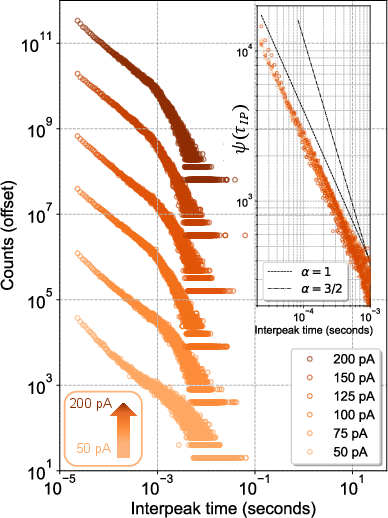
Figure 3: Measured interpeak time distributions and normalized probability densities over a fixed time window; dotted/dash-dotted lines correspond to −1 and −3/2 slopes.
Statistical Model Selection and Maximum Likelihood Results
Visual power-law assessment via log-log plots is known to be unreliable. The analysis applies discrete-time maximum likelihood techniques, comparing candidate models: pure power-law, exponentially truncated power-law, lognormal, Weibull, two-exponential mixtures, and a Kohlrausch-Williams-Watts (KWW) tempered power-law:
tRT0
For all but the largest tip-sample separations, the KWW form offers decisive Akaike and Bayesian information criterion preference (for example, for tRT1 pA, tRT2AIC and tRT3BIC for KWW vs alternatives are tRT4 vs tRT5 for other heavy-tailed models). The best-fit exponents cluster tightly around tRT6, tRT7, and with a tip-height-dependent cutoff scale tRT8.
Kinetic Monte Carlo Modeling and Mechanistic Analysis
Kinetic Monte Carlo (KMC) simulations (parameterized by DFT calculations of PTCDA-tip and molecule-tip interactions) recapitulate the experimental ITDs only if they implement a spatial energy landscape incorporating realistic amplitude heterogeneity on the nanometer scale.
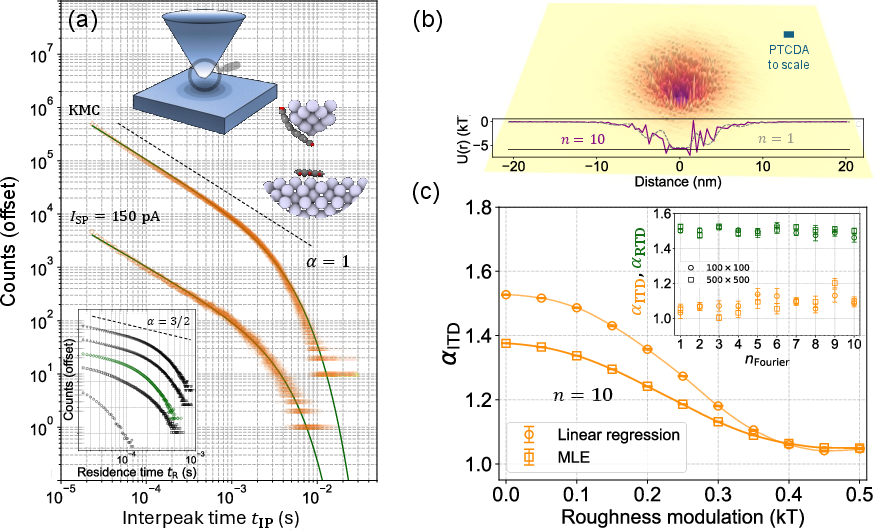
Figure 4: (a) Overlay of experimental and KMC-simulated ITDs, both fit to KWW-tempered power law. (b) Energy landscape with roughness; examples for different numbers of spatial Fourier modes. (c) Dependence of ITD scaling exponent tRT9 on roughness magnitude tIP0 and insensitivity to mode number; tIP1 as tIP2 increases.
The central claim, contradicting claims of process universality tied to queueing or agent memory, is that the simple addition of spatial heterogeneity (random roughness in the energy landscape) generically transitions first-return statistics from the Markovian random walk exponent (tIP3) to apparent tIP4 scaling over experimentally accessible time windows. This crossover arises solely from static disorder and is robust to changes in Fourier mode count, characteristic wavelength, and moderate anisotropy.
Control simulations confirm that neither increased molecular density nor anisotropic diffusion yield the observed scaling. The spatial disorder maps to a static ensemble of local Boltzmann-weighted hopping rates, equivalent to a broad distribution of temporal inhomogeneity—directly analogized to external circadian or weekly cycle modulation in social burstiness models, but with a spatial, time-independent origin.
Implications for Universality and Complex Systems
By demonstrating that static heterogeneity alone generically produces “bursty” ITDs with tIP5 over finite windows—without queueing, priority, memory, or explicit temporal inhomogeneity—this study undermines strong universality claims linking such exponents to specific psychological or biological mechanisms. The statistical spread of fitted tIP6 values across random landscape realizations closely matches that found in extensive human activity records, supporting the interpretation that static, agent-independent disorder is sufficient to explain the observed diversity in many empirical systems.
The KWW-tempered power law also establishes a direct connection to stretched-exponential and compressed-exponential relaxation phenomena in glassy and disordered systems, where the role of the heterogeneity parameter tIP7 links empirically observed dynamics to underlying energy landscape roughness. This cross-disciplinary connection has significant implications for the interpretation of relaxation and waiting time statistics in both condensed matter and networked systems.
Theoretical and Practical Implications
The results advise caution regarding attribution of mechanism in empirical bursty datasets and highlight the necessity of rigorous model selection approaches. For nanoscale surface science, the findings address the interpretation of STM-based diffusion studies and demonstrate that local tip-induced static disorder critically determines statistical observables. More broadly, the data pose challenges for the identification of genuine universal classes in complex systems.
Given the completeness and reproducibility of the STM and KMC methodology (including open access to experimental data and codes), the results set a stringent benchmark for future modeling of heavy-tailed, bursty dynamics in both the physical and social sciences. Analogous mechanisms may underlie similar apparent universality in stochastic processes ranging from trafficking and transport in cells to spreading dynamics on temporal networks.
Conclusion
The systematic comparison of experiment, KMC simulation, and rigorous statistical modeling shows that static heterogeneity in the underlying energy landscape generically produces inter-event time distributions with near-unity exponents and heavy tails, mimicking the hallmarks of canonical bursty dynamics.
This work provides a critical reference framework for the interpretation of scaling in empirical inter-event time statistics, advocates for skepticism regarding unwarranted universality claims, and underscores the centrality of static disorder in driving apparent universal behaviors—both in nanoscale transport and across complex systems.