- The paper establishes that extreme first passage times decay logarithmically with increasing searchers across various anomalous diffusion models.
- It utilizes theoretical analysis and numerical simulations to show that, counterintuitively, subdiffusion can yield faster extreme search times than normal diffusion.
- The study delineates the crossover from diffusive to ballistic regimes by considering physical constraints like finite particle speeds.
Universality and Ambiguity in Extremes of Anomalous Diffusion
Overview
The paper "Universality and ambiguity in extremes of anomalous diffusion" (2604.10004) rigorously investigates extreme first passage times (fFPTs) for a broad class of anomalous and normal diffusion processes, focusing on the statistical behavior of the minimum time required by a population of independent stochastic searchers to reach a target. This analysis is central to applications in biophysics, where the timing of the fastest searcher among many is determinative, and more generally to problems in extreme value statistics in stochastic processes.
The study covers both unbounded and bounded speed dynamics, encompassing classical Brownian motion, scaled Brownian motion (sBm), Riemann-Liouville fractional Brownian motion (RLfBm), and fractional Brownian motion (fBm). The authors derive general asymptotic expressions for the statistics of the fFPT as the number of searchers N becomes large, clarify when previously observed paradoxical features are genuinely universal, and delineate the parameter regimes where artefactual results—such as fFPTs vanishing for large N—cease to be physically relevant. Throughout, they complement theoretical analysis with numerical simulations.
Extreme First Passage Times in Anomalous Diffusion
The fFPT, denoted TN=min{τ1,…,τN} for N independent first passage times, is investigated in diffusion settings where the underlying particle trajectories can be subdiffusive (α<1), normal (α=1), or superdiffusive (α>1). Anomalous diffusion is characterized by the mean-squared displacement scaling E[(X(t))2]=2D(t/τ0)α.
Two notable features are at the heart of the inquiry:
- Vanishing fFPT with Increasing N: In classical (unbounded speed) Brownian motion, the mean fFPT decays asymptotically as E[TN]∼L2/(4DlnN). Thus, the fastest searcher can theoretically reach the target in arbitrarily short times as N0.
- Subdiffusion Can Be Faster: The asymptotics suggest that, paradoxically, subdiffusive processes (lower N1) may yield smaller fFPTs than normal and even superdiffusive dynamics in the large N2 limit.
These results are surprising given that subdiffusion is typically associated with hindered transport, and are, prima facie, concerning for physical modeling since true physical processes cannot permit infinite speeds.
Asymptotic Results: Universality and Its Limits
The main technical advance lies in showing that for broad classes of self-similar, mean-zero Gaussian processes with power-law mean-squared displacement, the moments of the fFPT obey:
N3
where N4 is a process-dependent constant and N5 is the anomalous diffusion exponent (subdiffusive: N6, superdiffusive: N7).
Notably, this result holds for sBm, RLfBm, and fBm, each a canonical model for anomalous diffusion, and shows a logarithmic decay with N8, confirming the universality of features (i) and (ii) within this broad class.
Numerically, the results are substantiated across diffusion regimes, and the nontrivial prediction that subdiffusion may, in some parameter ranges, lead to shorter fFPTs than normal or superdiffusion is strongly supported (see Figure 1 and Figure 2).
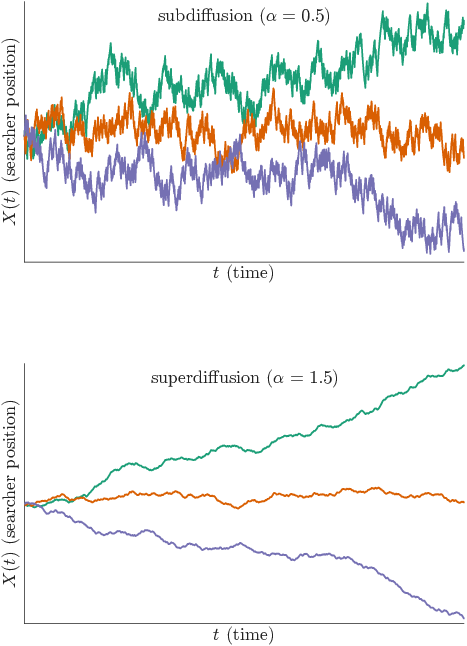
Figure 1: Example trajectories of a bounded speed anomalous diffusion, required to analyze the physically admissible regime.
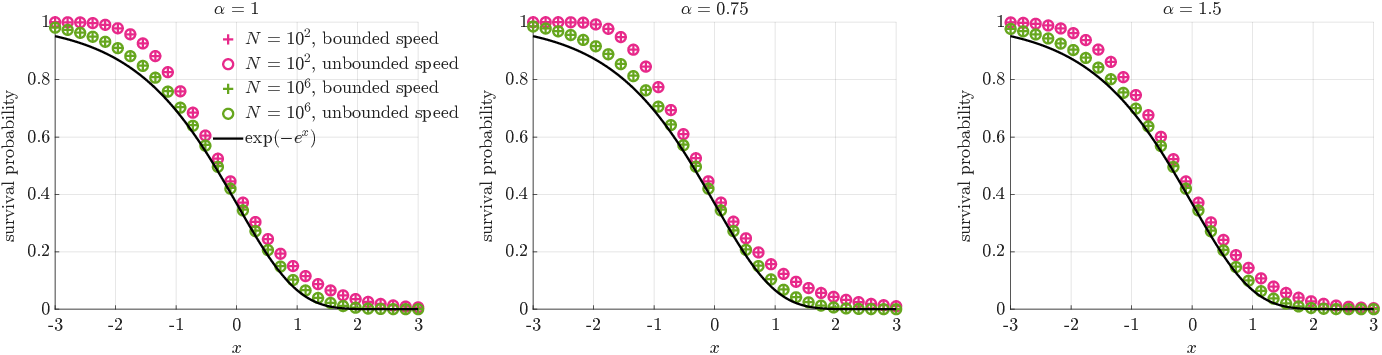
Figure 2: Convergence in distribution of fFPTs of the unbounded speed sBm and the corresponding bounded speed analog.
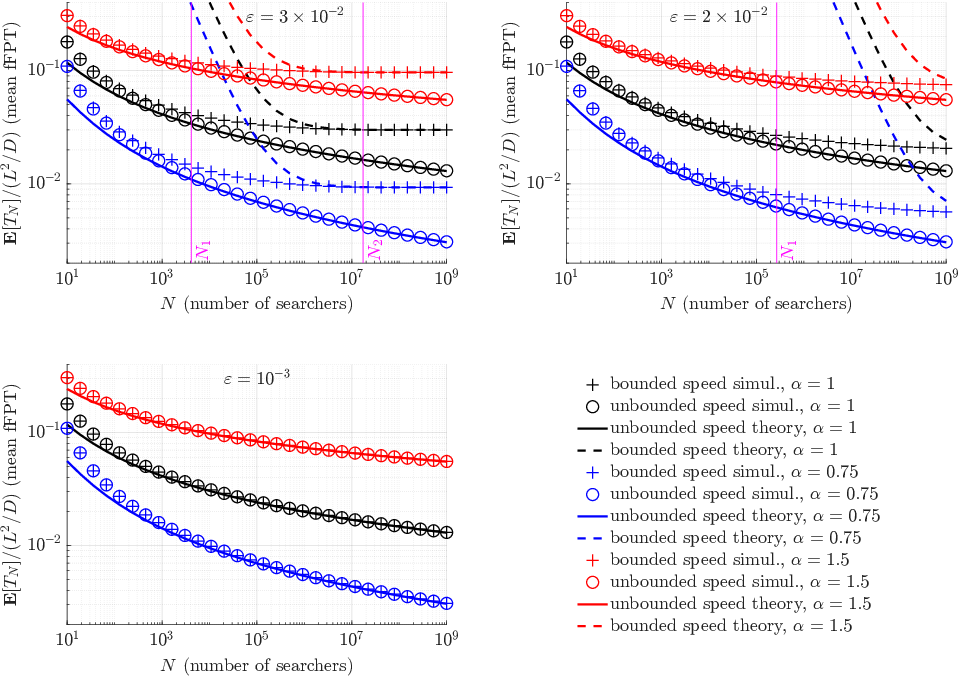
Figure 3: Decay of the mean fFPT as N9 increases for the unbounded speed sBm, demonstrating the logarithmic scaling and the ordering of subdiffusion, normal diffusion, and superdiffusion.
However, the universality has important caveats. When the stochastic processes are constrained to bounded speed—reflecting physical realities of finite particle velocities—the decay of the fFPT cannot continue indefinitely. Instead, the fFPT converges exponentially rapidly to a strictly positive minimum search time as TN=min{τ1,…,τN}0, determined by the process's maximal velocity and the geometry of the search region.
Bounded vs. Unbounded Speed: Physical Consistency
The logarithmic scaling and subdiffusion-faster-than-normal effect persist for a wide range of TN=min{τ1,…,τN}1 even in physically consistent (bounded speed) models, but only below certain model-dependent thresholds. Beyond these, the statistics of the fFPT are dominated by ballistic constraints, and the minimal time required to traverse the search region at maximum speed becomes the limiting factor.
The authors rigorously analyze the crossover between the diffusive (logarithmic) and ballistic (exponential) regimes, providing explicit formulas for the relevant scales (TN=min{τ1,…,τN}2), and clarify that the anomalous regime is observed only when TN=min{τ1,…,τN}3 is neither too small nor too large for given physical parameters.
This transition is evident in simulation and is well captured by the theoretical approximations presented (Figure 4).
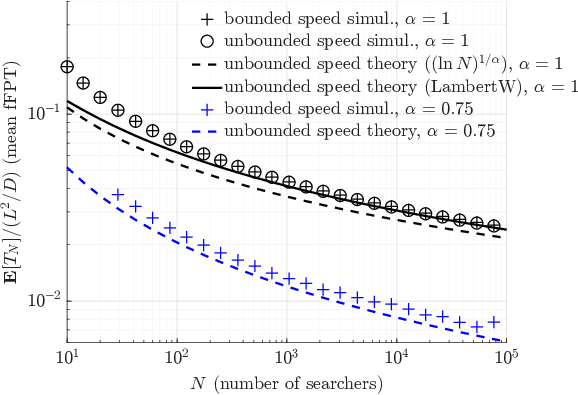
Figure 4: Finite speed RLfBm simulations overlaid with unbounded theory, demonstrating their agreement and the eventual saturation at the minimum feasible fFPT.
Analysis of Probability Distributions
Beyond first moments, the full probability distribution of the fFPT is derived in the large TN=min{τ1,…,τN}4 limit, where Gumbel or Weibull statistics emerge depending on the specifics of the process and the boundedness of speed. The asymptotic distributional convergence is substantiated both analytically and via simulation for various scenarios (as illustrated in additional figures in the paper).
Implications and Extensions
Biological and Physical Relevance
The observation that, under certain conditions, subdiffusion yields faster extreme search times than normal diffusion challenges naive intuitions and suggests possible biological utility—such as in intracellular transport where large ensembles of searching molecules operate in crowded, subdiffusive environments. However, given the strong constraints arising from bounded speed, such effects are only present for specific parameter regimes, and caution must be used when interpreting these results in biological contexts.
Theoretical Extensions
The methodology is broadly extensible:
- To higher-order extremal statistics (e.g., TN=min{τ1,…,τN}5-th fastest).
- To higher spatial dimensions and diverse geometries.
- To other classes of anomalous transport, including Lévy flights, for which the decay can be faster (TN=min{τ1,…,τN}6) than in the Gaussian/self-similar processes considered here.
Future Directions
Clarifying the full range of processes for which subdiffusive fFPT minima are observed, characterizing higher-dimensional and heterogeneous environments, and connecting these predictions to empirical measurables in living cells and experimental systems remain promising directions. Further, systematic exploration of how combinatorial factors (process type, speed constraint, domain geometry) mediate the crossover from anomalous-diffusive to ballistic regimes will refine our understanding of universal vs. model-specific features in extreme statistics.
Conclusion
This work establishes that logarithmic decay of extreme first passage times with the number of searchers and the ordering of fFPTs across anomalous exponent regimes are robust features among a wide class of anomalous diffusion models, even when accounting for realistic physical constraints. However, these features are only relevant within particular parameter regimes, limited by speed constraints and process specifics. Consequently, while subdiffusion can yield faster extreme search times theoretically, this is not a universal effect and must be interpreted in the context of the modeled physical system.
The paper offers a rigorous framework for understanding the universality and limitations of extreme statistics in anomalous diffusion, providing both practical tools for calculation and theoretical insight into the subtleties and ambiguities inherent in applying stochastic process models to real-world search problems.

