- The paper shows that heavy-tailed cluster deposition breaks the FV dynamic scaling, leading to non-universal behavior in kinetic roughening.
- It uses a one-dimensional interface model to reveal a continuous, τ-dependent drift in roughness (α) and dynamic (z) exponents, diverging from KPZ predictions.
- The study identifies a competing rare-event-driven length scale that, alongside the standard correlation length, disrupts the traditional collapse of growth curves.
Breakdown of Universality in Surface Growth Driven by Rare Event Clusters
Introduction
The study titled "Beyond dynamic scaling: rare events break universality" (2604.01820) systematically challenges the established universality paradigm in kinetic roughening and surface growth by demonstrating that the dynamic scaling ansatz, particularly the Family–Vicsek (FV) form, fails in the presence of large, rare cluster deposition governed by power-law size distributions. The study departs from canonical models (Edwards–Wilkinson, KPZ) by considering surface dynamics where extended aggregates with power-law distributed sizes drive the interface evolution, rather than monomeric or compact local growth.
Model and Regimes
The framework is a one-dimensional interface (h(x,t) on a band of length L) that starts flat and undergoes deposition of rigid Eden clusters, with their sizes sampled from a power-law: P(s)∼s−τ, 1≤s≤L. Clusters attach irreversibly by a next-to-nearest-neighbor rule (see Fig. 6 in the appendix), and no local relaxation occurs.
The exponent τ critically controls the deposition statistics:
- For τ>3 the size distribution has finite variance.
- For 2<τ<3, the mean size is finite but the variance diverges, leading to fat-tailed fluctuations.
- For τ≤2, the mean size diverges, representing an extreme heavy-tailed regime (main focus: 2≤τ≤3.5).
Snapshots of the surface (Figure 1) immediately reveal the dramatic morphological differences as τ decreases, with larger isolated jumps for low L0 values.
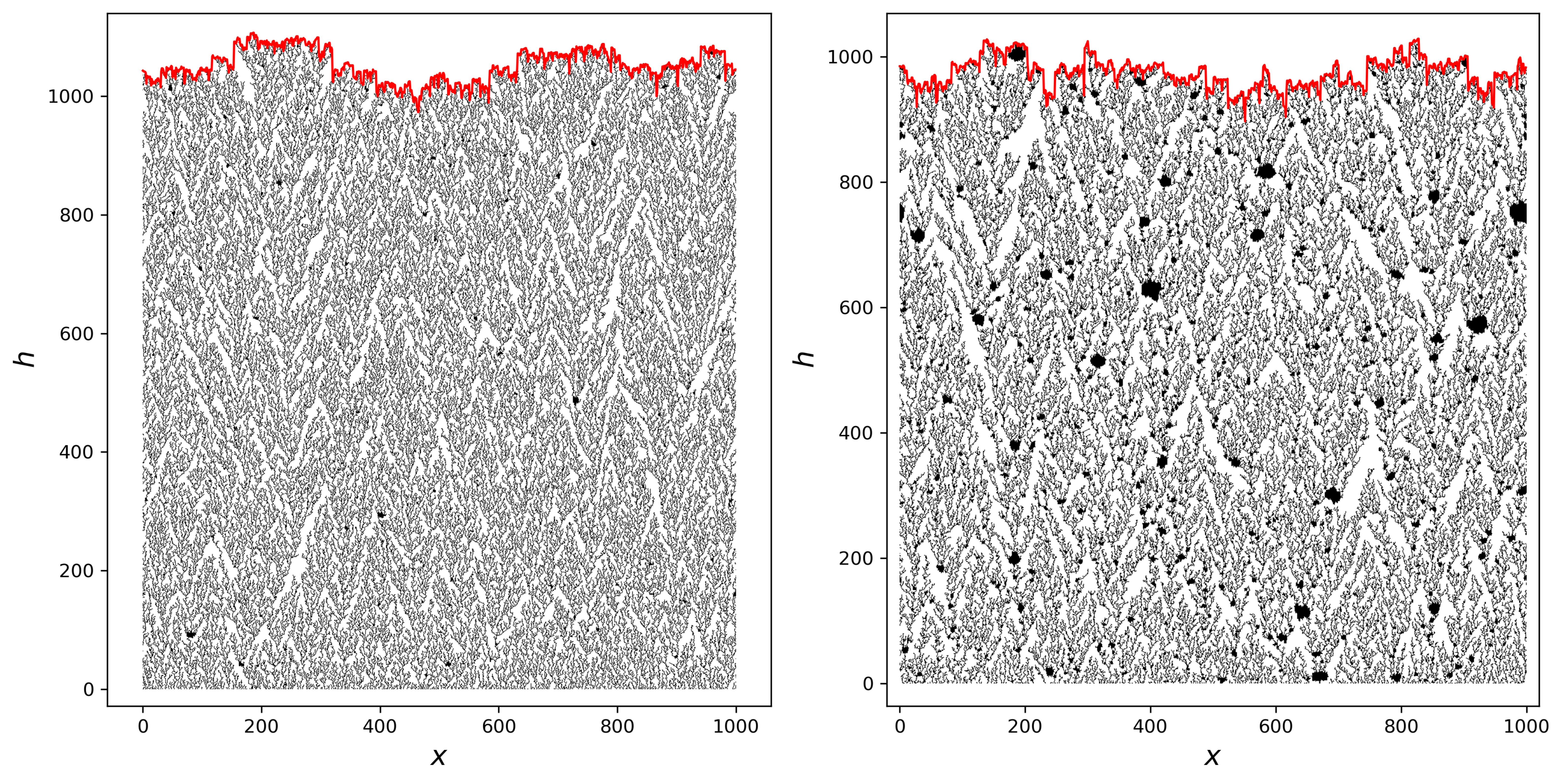
Figure 1: Surface morphology for L1 (left, standard roughening) and L2 (right, strong rare-event-driven protrusions).
Critical Exponents and Universality Breaking
For classical kinetic roughening, universality is encoded in the exponents L3 characterizing width scaling L4: roughness exponent L5, dynamic exponent L6, and growth exponent L7 (L8).
Figure 2 shows systematic measurements of L9 and P(s)∼s−τ0 versus P(s)∼s−τ1. The main findings are:
- For P(s)∼s−τ2 (finite variance), the exponents converge to the KPZ values: P(s)∼s−τ3, P(s)∼s−τ4 for 1+1D.
- For P(s)∼s−τ5, there is a continuous, P(s)∼s−τ6-dependent drift in the exponents, with violation of the KPZ Galilean-invariance (P(s)∼s−τ7) and breakdown of the central universality concept.
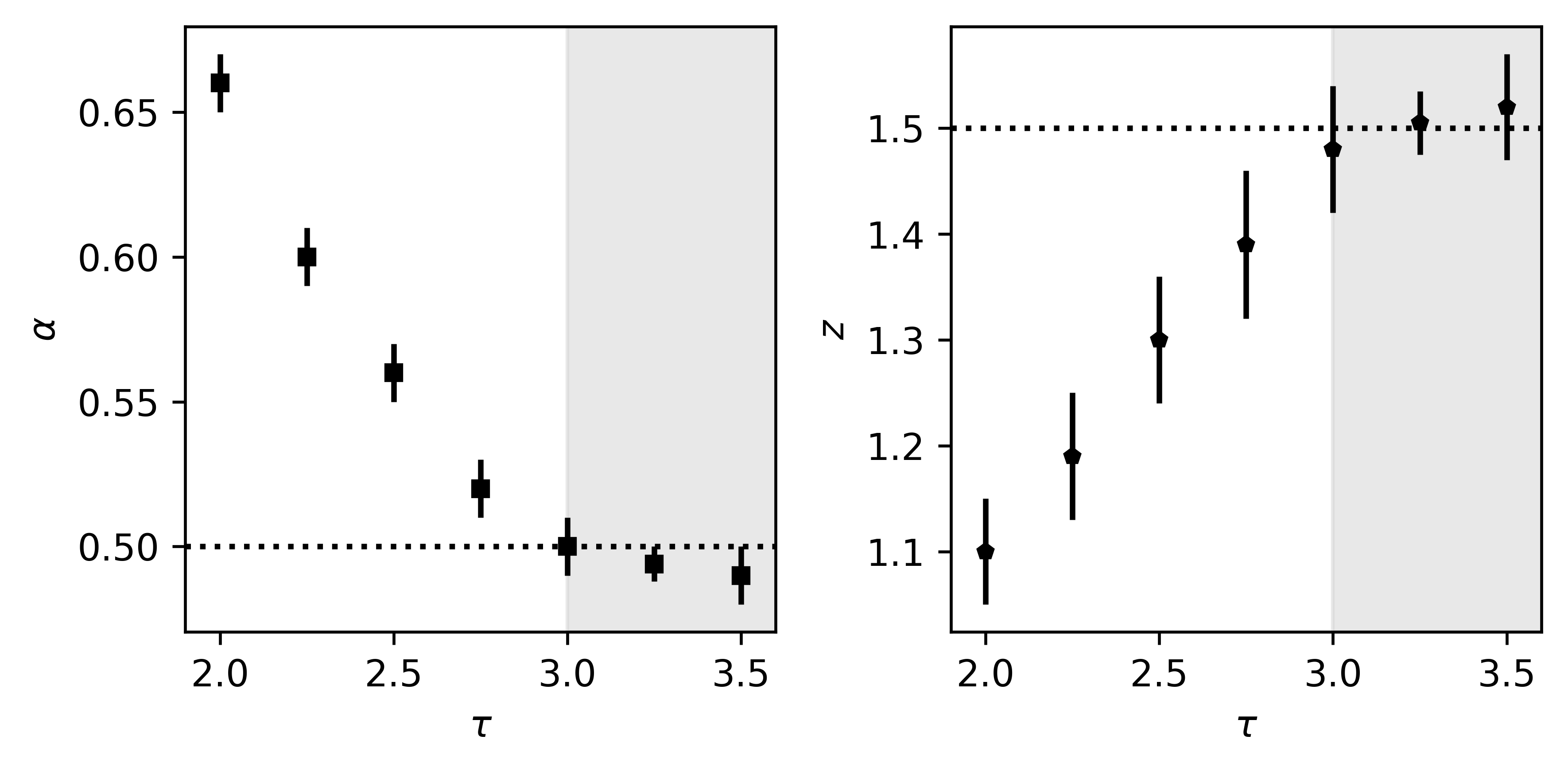
Figure 2: Evolution of roughness (P(s)∼s−τ8) and dynamic (P(s)∼s−τ9) exponents with 1≤s≤L0. KPZ exponents (dotted) are recovered for 1≤s≤L1, but critical exponents drift continuously for 1≤s≤L2.
This non-universal scaling is further emphasized by the failure of standard dynamic scaling collapse for 1≤s≤L3. The dynamic scaling breakdown is evident in Figure 3.
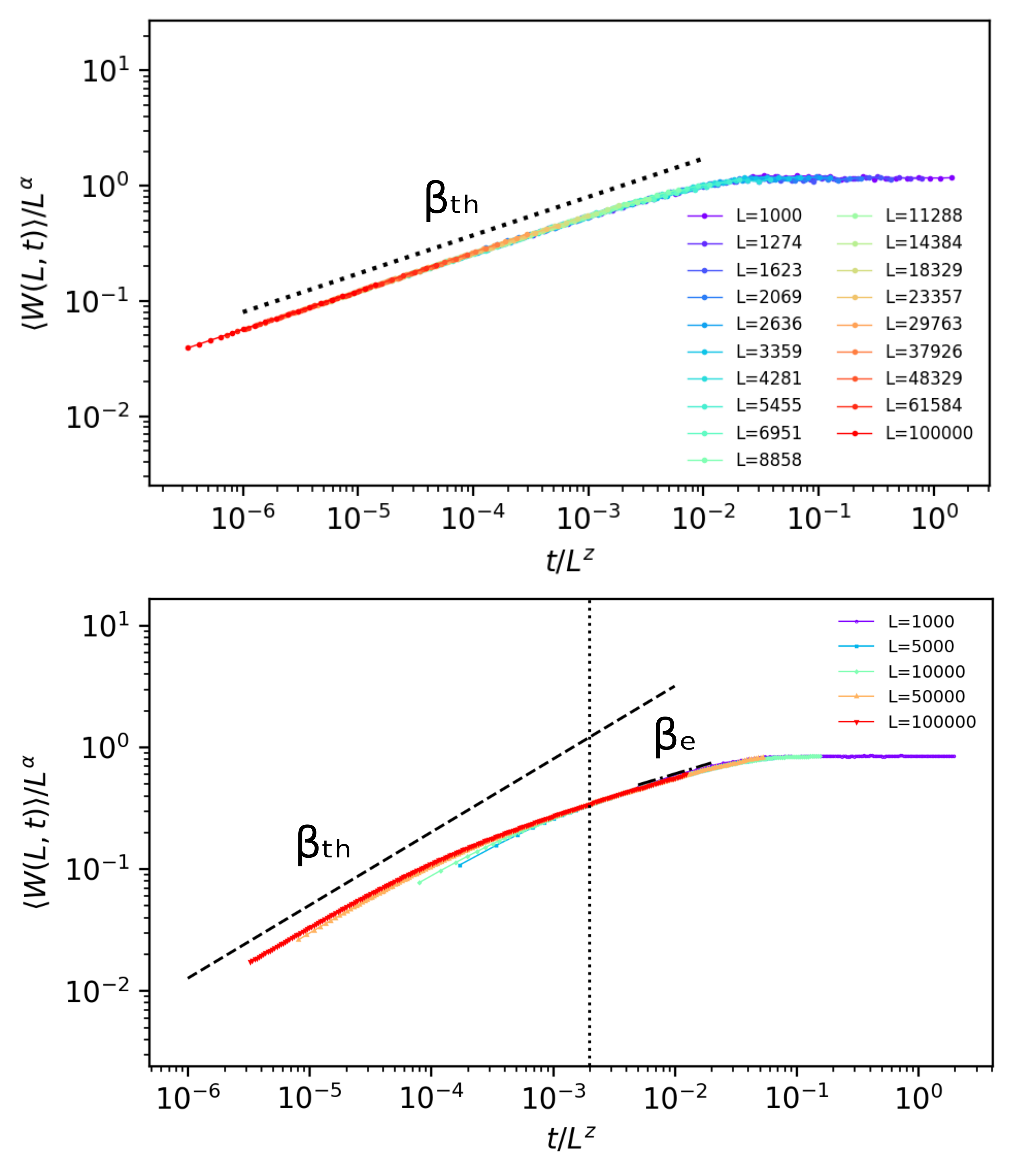
Figure 3: Failure of the Family–Vicsek collapse for 1≤s≤L4, with roughness curves not collapsing onto a single master curve across system sizes, in contrast to the well-defined behavior for 1≤s≤L5.
Effective Growth Exponent and Dynamical Scaling Failure
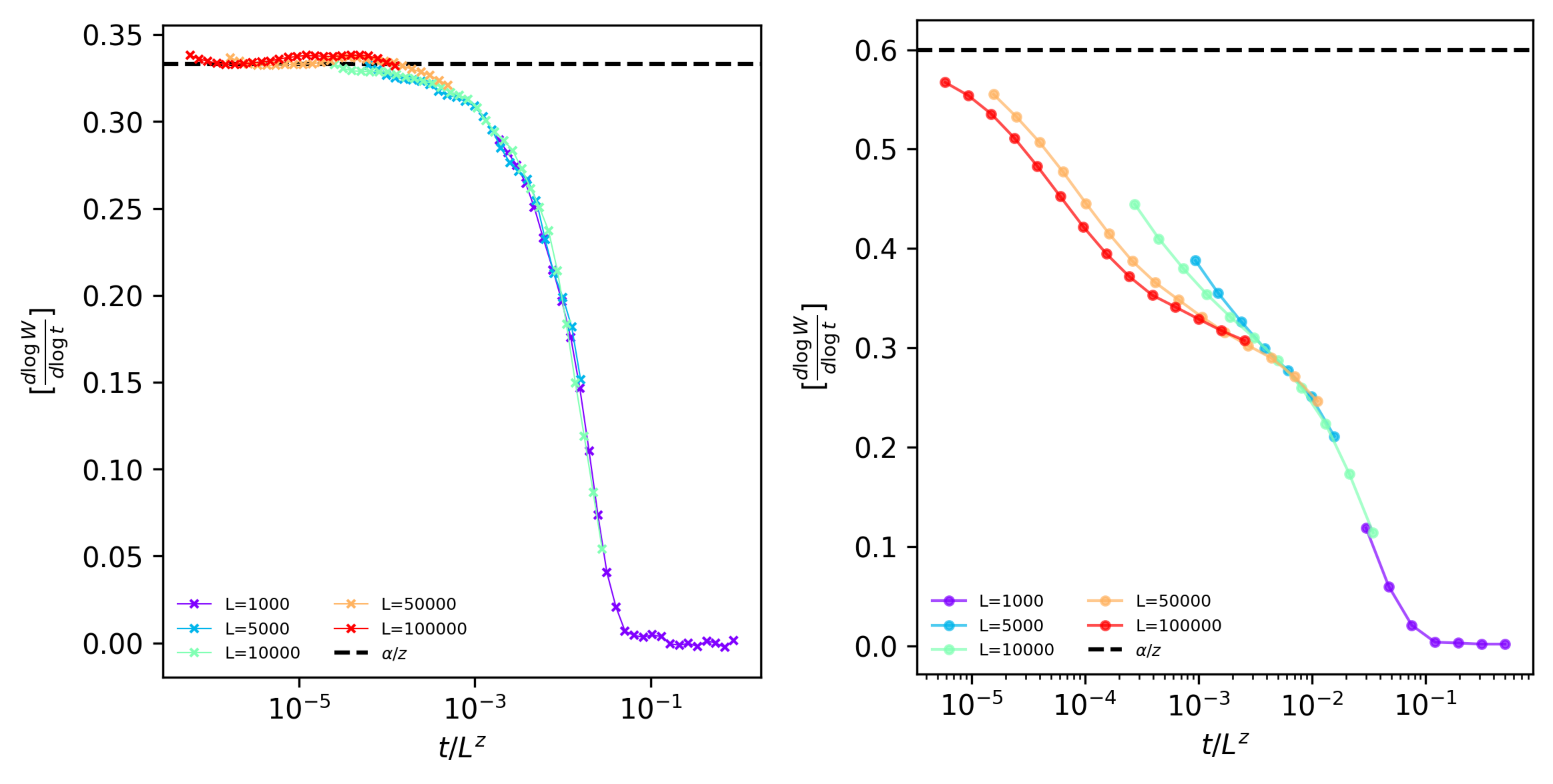
Further quantification of scaling breakdown is provided by considering the effective growth exponent 1≤s≤L6.
Mechanism: Competition of Two Dynamical Length Scales
The violation of dynamic scaling is shown to originate from the presence of a second, rare-event-driven dynamical length scale τ4—the spatial height jump associated with the largest deposited blob up to time τ5. In contrast to standard roughening (governed by a single correlation length τ6), the width now depends on both τ7 and τ8, leading to nontrivial, non-universal scaling functions:
τ9
The interplay of these scales is depicted in Figure 5, illustrating how the timescales for the emergence of rare events compared to correlation-growth times lead to intermediate and late-time crossover regimes.
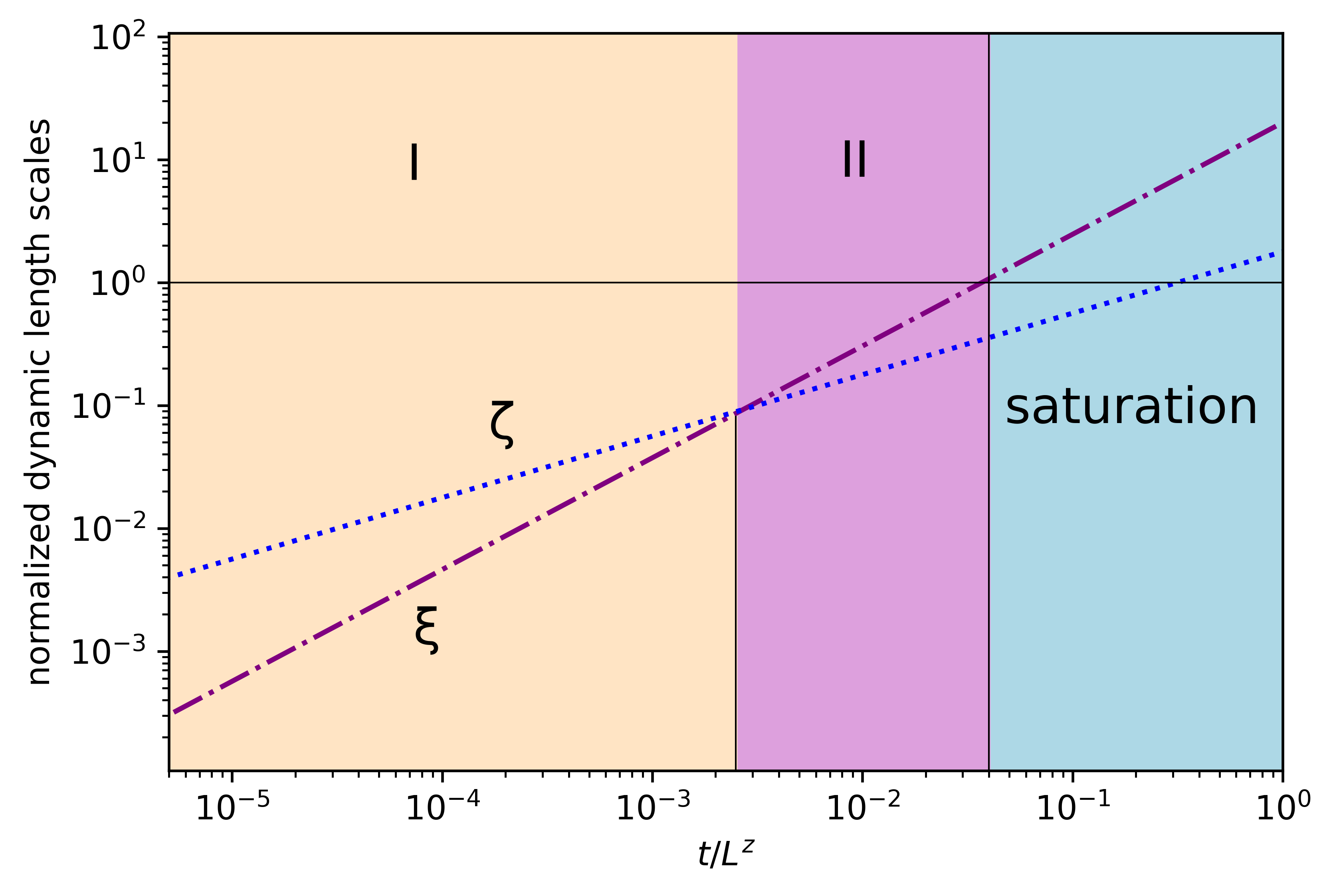
Figure 5: Schematic showing crossover of correlation length τ>30 and rare event scale τ>31 for τ>32. Multiple regimes appear as time and system size are varied, explaining the observed scaling breakdown.
Comparative Reference Models
The robustness of KPZ universality under deposition of extended objects is cross-validated using a random deposition model of finite-sized rods (Appendix), and a Tetris-like deposition model using fixed tetrominoes. Both confirm that only sufficiently heavy-tailed distributions (τ>33) break KPZ scaling. For fixed rods or tetrominoes, KPZ exponents are retained regardless of local morphological complexity.
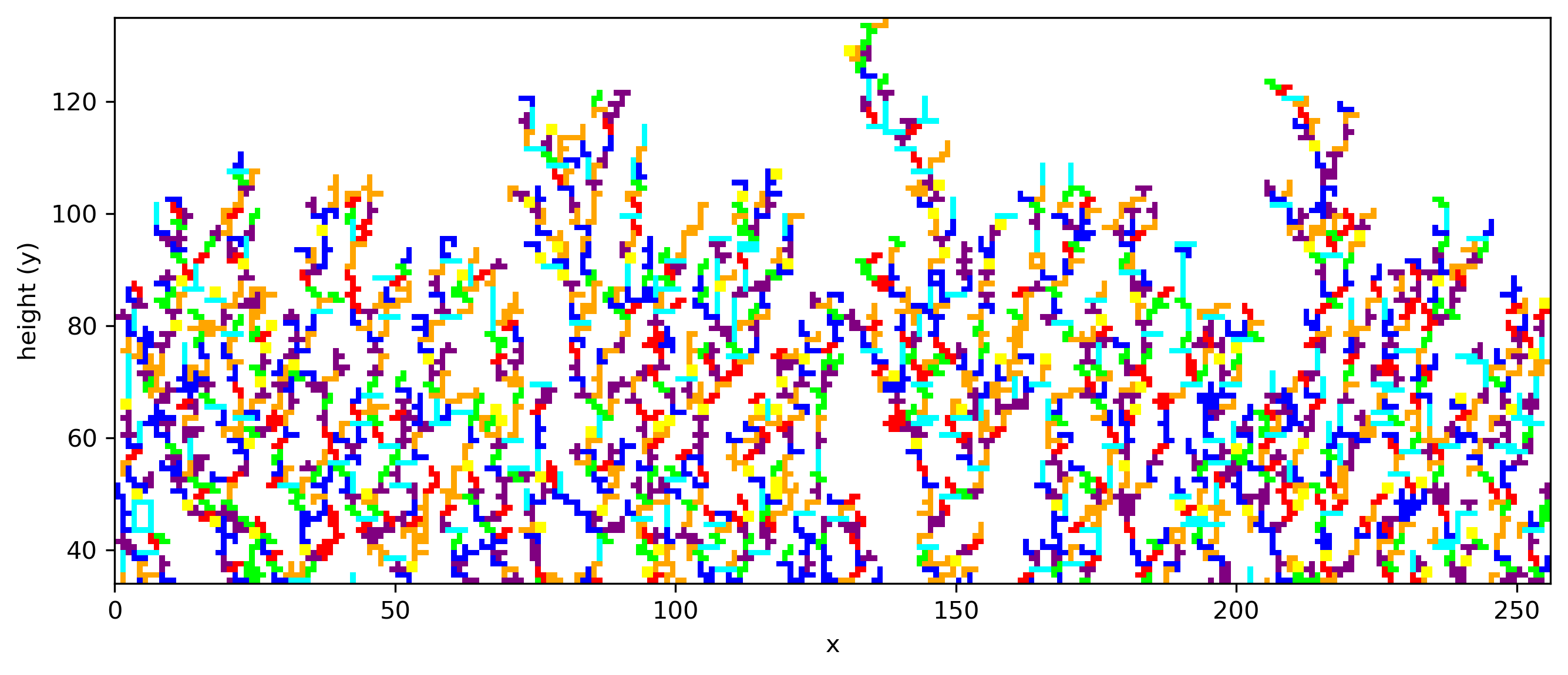
Figure 6: Example of a Tetris-like ballistic deposition interface, exhibiting KPZ scaling even with highly nontrivial, shape-anisotropic building blocks.
Implications and Perspectives
This study demonstrates, with high numerical precision, that scale invariance and universality in interface growth are only robust to noise with finite variance. Heavy-tailed, rare-event-driven dynamics, as found in many natural aggregation processes (aerosol deposition, sedimentation, urban growth), fundamentally violate the FV ansatz. This is not primarily a breakdown of self-affinity, but a competition of relevant dynamical length scales arising from extremal statistics.
These findings force a reconsideration of the theoretical toolkit for surface roughening:
- In physical and biological systems where non-monomeric growth with heavy-tailed size distributions occurs, universality and simple scaling classifications are not legitimate.
- Theoretical efforts for extreme-event driven stochastic growth must routinely account for late-time, multi-scale, non-universal behavior.
- For simulation and analysis of experimental data (e.g., porous media, city growth, sedimentation), careful attention to rare-event statistics and their implications for observed exponents is essential.
Future work will need to clarify higher-dimensional behaviors, generalizations to off-lattice and correlated aggregation, and potential connections to other nonequilibrium phenomena where rare events dominate statistical properties.
Conclusion
The work provides a comprehensive demonstration that universality in kinetic roughening is fragile in the presence of strong rare events. Surface growth processes governed by the deposition of extended clusters with diverging variance in the size distribution do not obey the Family–Vicsek dynamic scaling collapse; instead, they exhibit a new dynamic phenomenology with exponents that drift continuously with microscopic noise parameters. The stability of the KPZ class is now precisely delimited: finite variance of deposition events is a strict lower bound for its protection.
These results establish a technical benchmark for interpreting anomalous roughening exponents in experimental and natural interfaces, and they suggest new theoretical directions for modeling growth processes where extremal noise sources are dominant.