- The paper introduces a robust OED framework that integrates probabilistic and scenario-based methods to optimize sensor placement under failure conditions.
- It applies relaxation techniques and a double-well penalty to efficiently derive binary sensor layouts in high-dimensional design spaces.
- Computational results demonstrate enhanced information gain and reduced estimation errors under dropout and clipping scenarios.
Robust Optimal Experimental Design for Sensor Failure in Structural Dynamics
Problem Context and Motivation
The paper "Robust Optimal Experimental Design Accounting for Sensor Failure" (2604.14497) presents a comprehensive framework for optimal experimental design (OED) in the context of sensor reliability and failures during vibration-based structural dynamics experiments. Conventional OED approaches are effective for maximizing information gain within sensor budget constraints, typically prioritizing sensor locations and orientations based on the D-optimality criterion (minimizing the determinant of the parameter covariance). However, these approaches are inherently fragile when confronted with sensor failures—either due to dropout (physical detachment, loss of communication) or clipping (measured amplitudes exceeding sensor ranges resulting in corrupted or unusable data)—that frequently occur in high-acceleration regimes.
This paper addresses the scarcity of robust OED formulations applicable to high-dimensional design spaces typical of structural health monitoring, where forward models (e.g., finite element analysis of vibrational response) are computationally expensive and sensor failures are not negligible. The authors develop generic robust OED objectives that allow for efficient optimization using gradient-based methods with a relaxation-based approach and introduce a binary-inducing double-well penalty to obtain final binary sensor layouts.
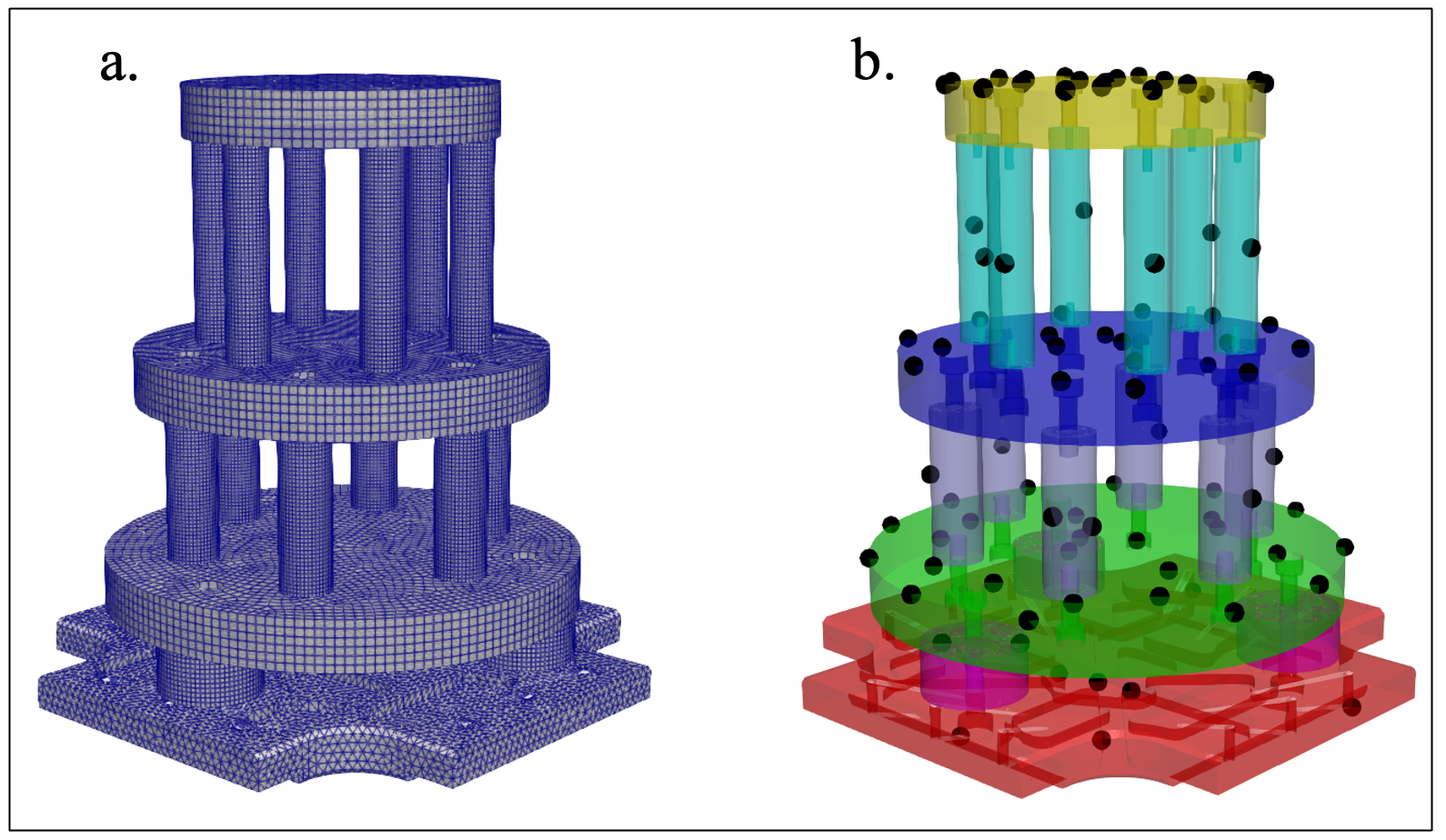
Figure 1: Finite element model of the "wedding cake" test structure and candidate sensor locations across multiple levels, illustrating spatial distribution and orientations for vibration sensing.
Methodological Framework
Structural Model and Inverse Problem Setup
The structural response is modeled via spatially discretized linear systems (Helmholtz equation) for vibrational acceleration, with unknown point loads as parameters to be inferred from observed sensor data. Sensor placement is parameterized as a binary vector indicating which degrees of freedom (locations/orientations) are measured, subject to a sensor budget constraint.
The inverse problem is formulated as optimal estimation via least squares, with the sensor placement entering the statistical model both in data acquisition and through the observation operator. The information content of a design is captured in the covariance of the estimated model parameters.
The classical OED objective optimizes sensor locations to minimize the log determinant of the parameter covariance ($\Psi := \log \det({\bm C}(\des))$) under a budget constraint. When sensor failures are possible, robust variants are needed. Two formulations are developed:
- Probabilistic Robust OED: Assuming known or predicted probabilities of failure for each sensor, the criterion is modified by introducing Bernoulli random variables (dropout indicators), deriving an asymptotic covariance estimator weighted by expected sensor availability.
- Scenario-Based Robust OED: When failure probabilities are unknown, robustness is achieved by explicitly considering all or sampled failure scenarios ("dropout matrices") in the optimization objective, averaging the performance criterion over these cases.
To handle the computational complexity of binary optimization in high-dimensional spaces, sensor selection weights are relaxed to fractional values, permitting gradient-based optimization. Binary sensor designs are obtained either via post-optimization rounding or, more efficiently, by embedding the binary-inducing double-well penalty ($P(\des) = \sum_i w_i (1 - w_i)$) into the objective, which penalizes non-binary solutions.
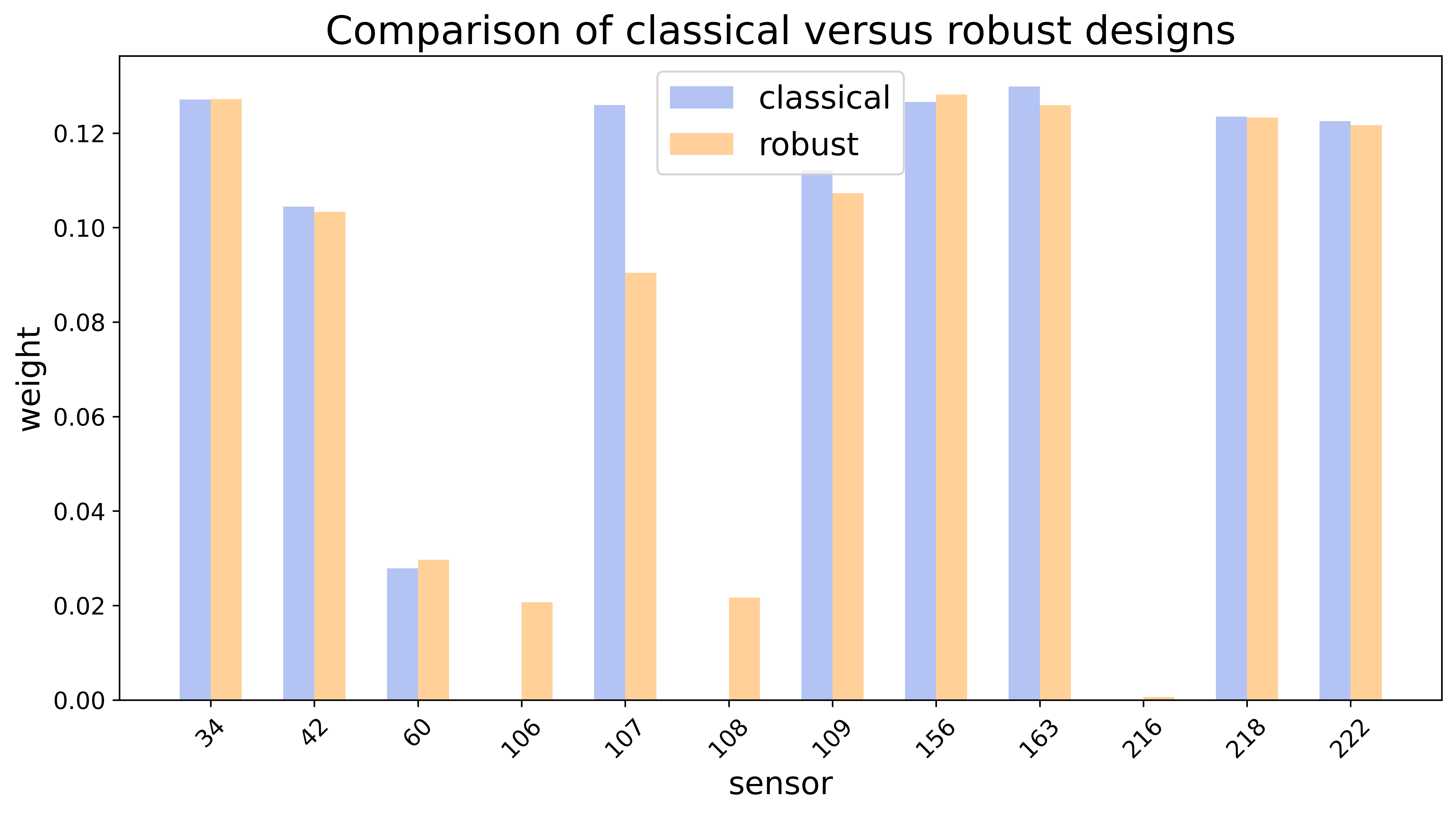
Figure 2: Fractional classical and robust optimal sensor designs in the "wedding cake" structure, showing the effect of robust formulation on weight distribution.
Computational Results
Robustness to Single Sensor Failure
Robust OED formulations accounting for single sensor failure scenarios yield sensor placements practically indistinguishable from classical designs when restricted to binary layouts. However, in fractional design space (allowing repeat experiments or weighted placements), robust designs exhibit increased nonzero weights, yielding improved information gain under sensor dropout.
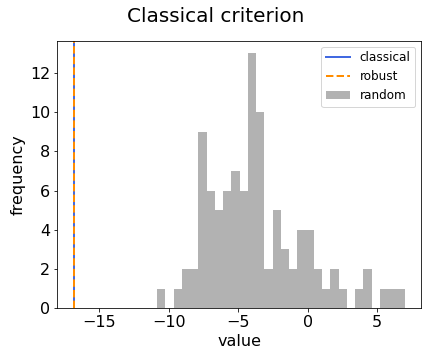
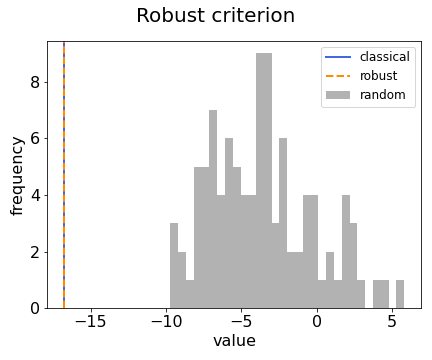
Figure 3: Performance comparison of classical and robust fractional designs versus random designs, evaluated by classical and robust OED criteria.
Performance evaluation via log-determinant histograms reveals robust designs maintain higher average information content when one or two sensors fail, outperforming classical layouts under these conditions and exhibiting further resilience as dropout scenarios become more severe.
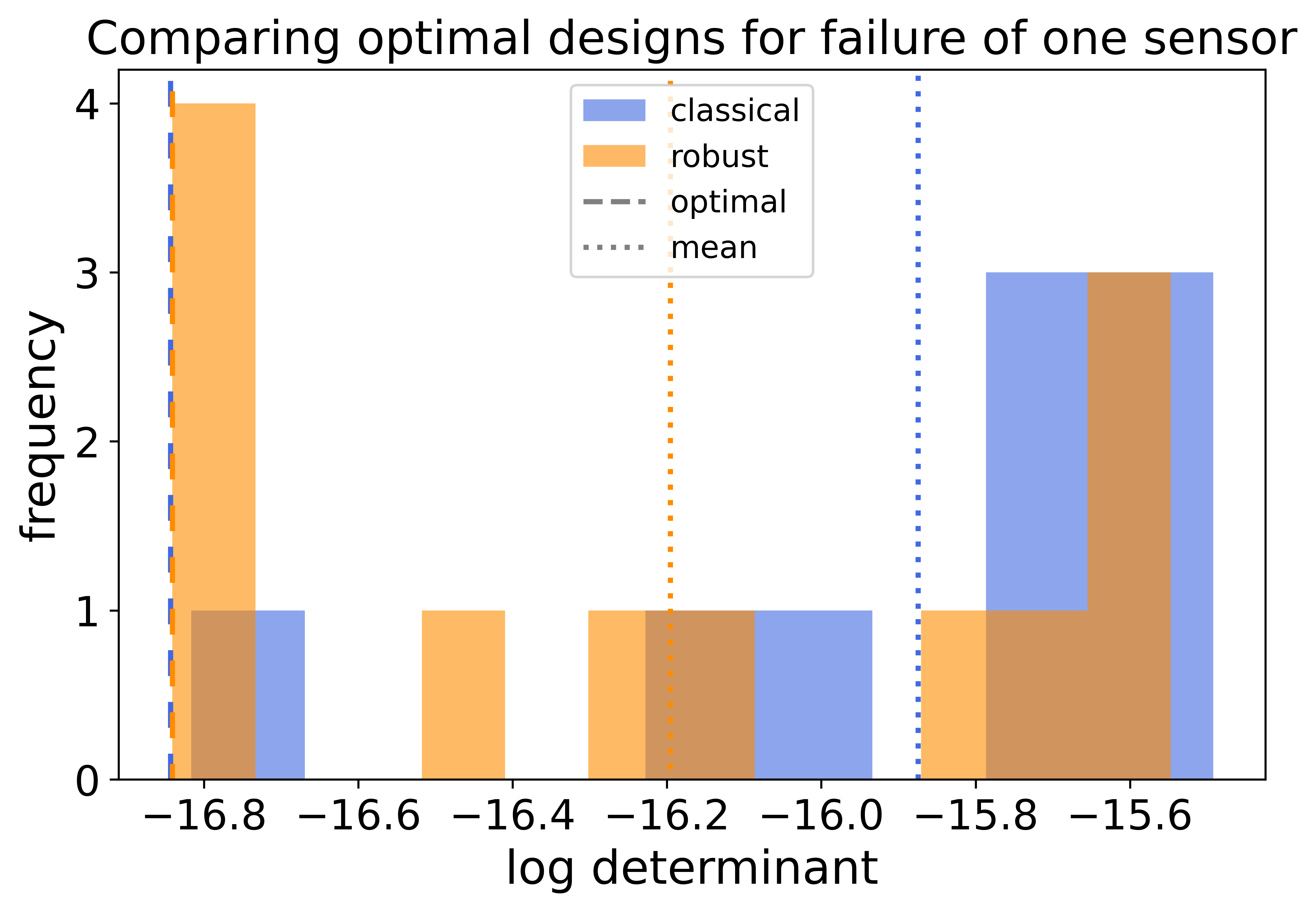
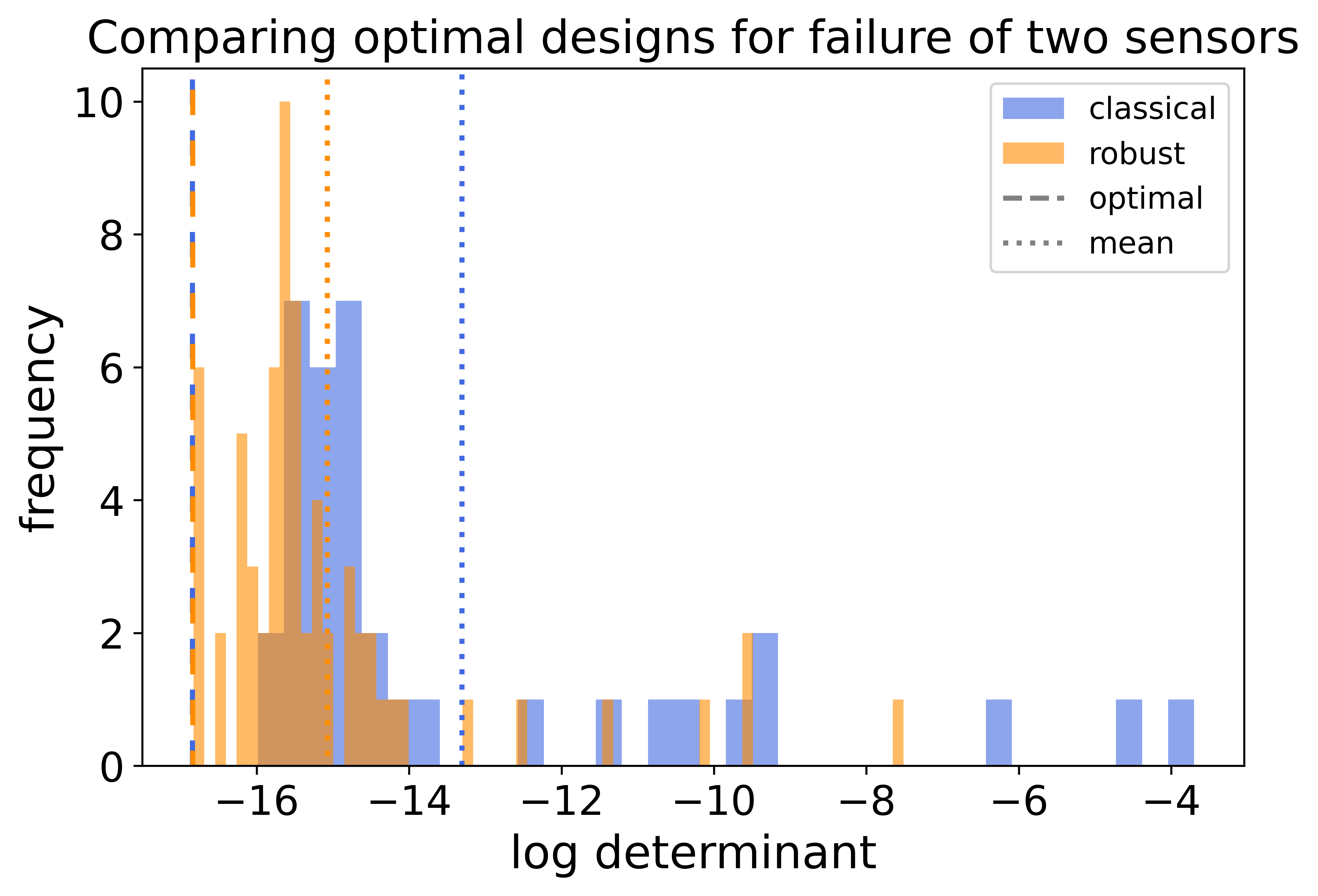
Figure 4: Histogram comparison of robust versus classical fractional designs, showing enhanced average and worst-case D-optimality with sensor failures.
Robustness to Known Probabilities of Failure
When prior knowledge on sensor reliability is available, robust OED solutions incorporate spatially-varying probability of failure, yielding sensor allocations that avoid high-risk regions. The double-well penalty ensures binary feasible designs. Evaluation over 105 Bernoulli-sampled failure scenarios demonstrates robust designs outperform classical ones in mean log-determinant and mean squared errors (MSE for both parameters and predictions), particularly by avoiding rare but catastrophic information loss cases.
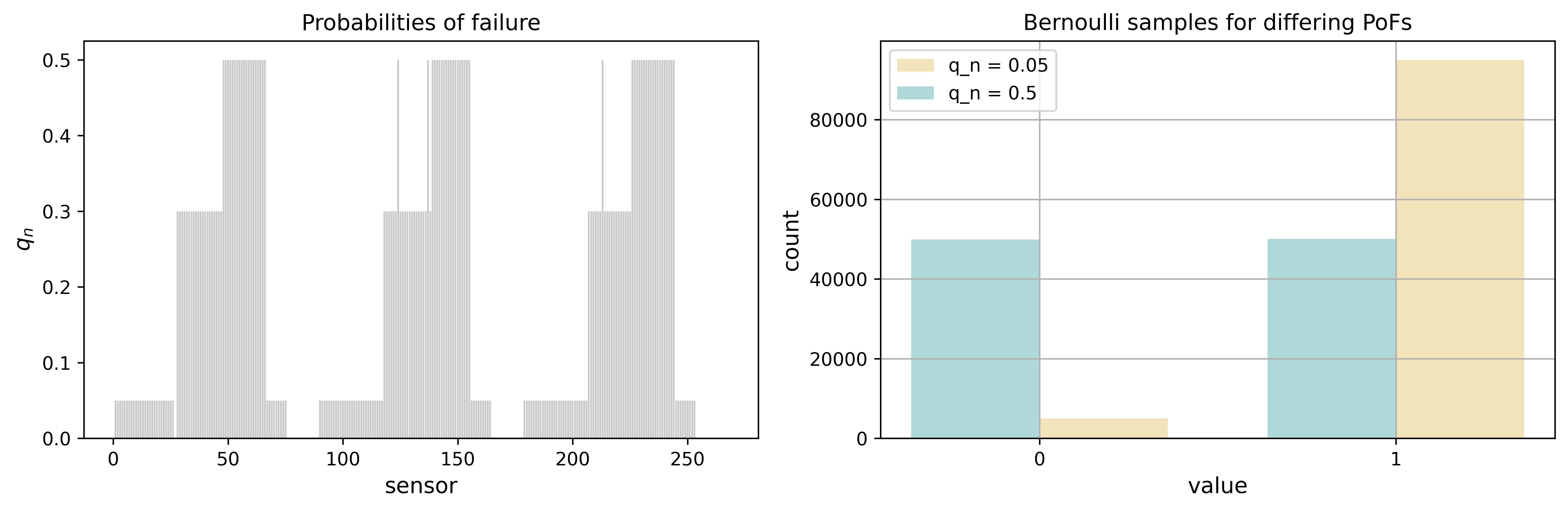
Figure 5: Sensor failure probabilities across the structure and histogram of simulated Bernoulli failures.
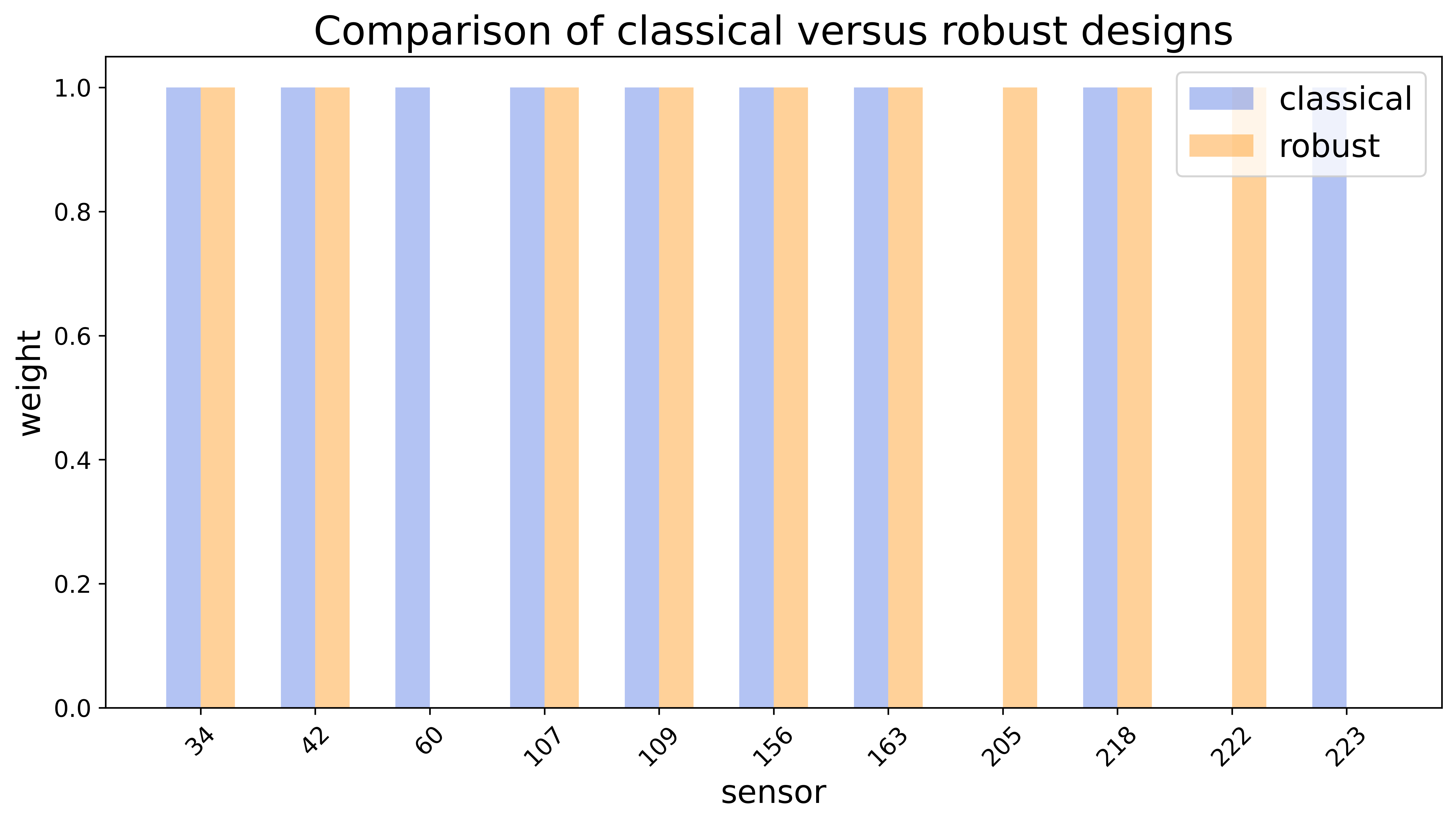
Figure 6: Binary robust and classical optimal designs, with robust layouts avoiding high-risk sensor positions.
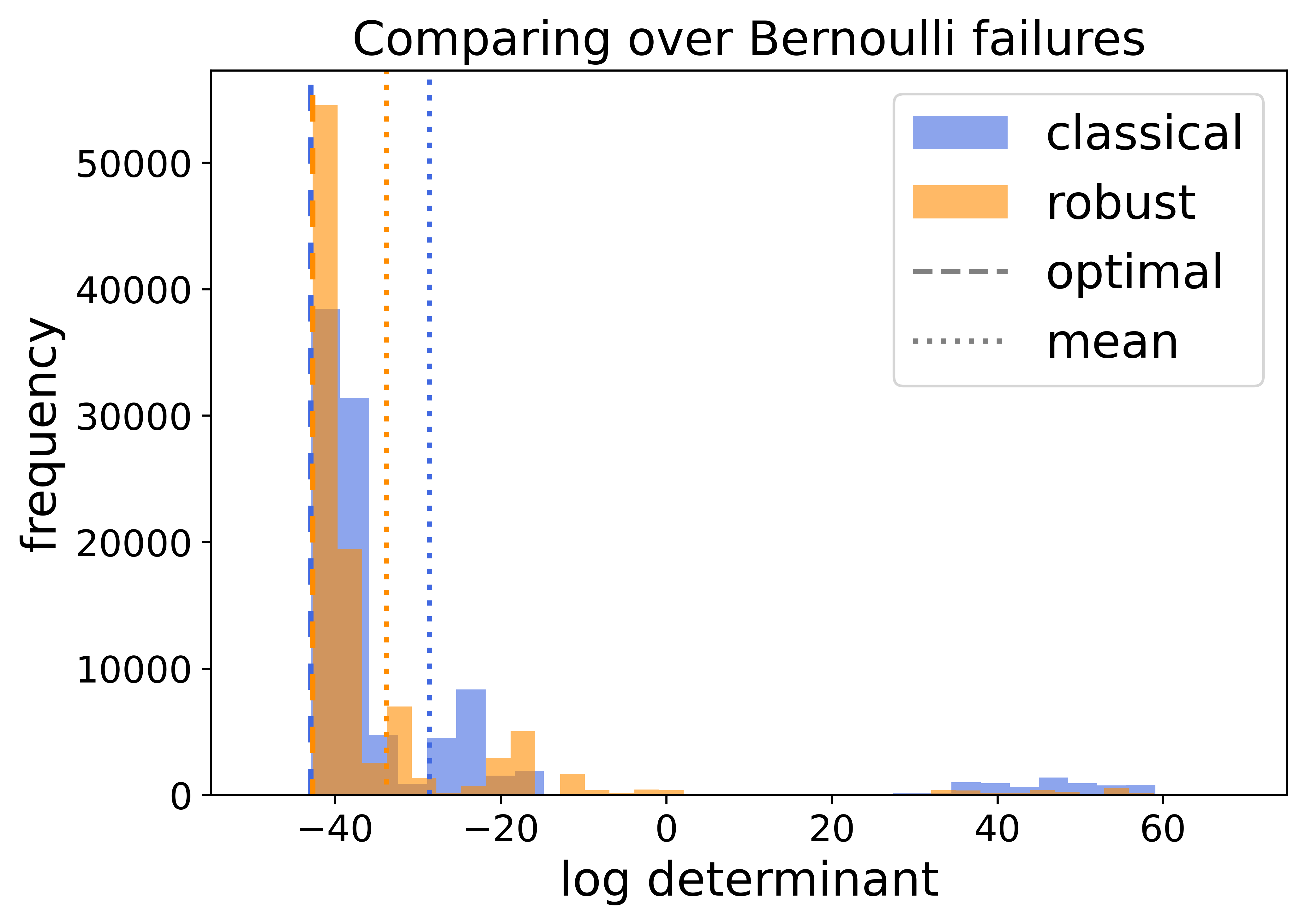
Figure 7: Histogram of log-determinant performance over sampled sensor failure scenarios, highlighting improved average robustness in the robust binary layout.
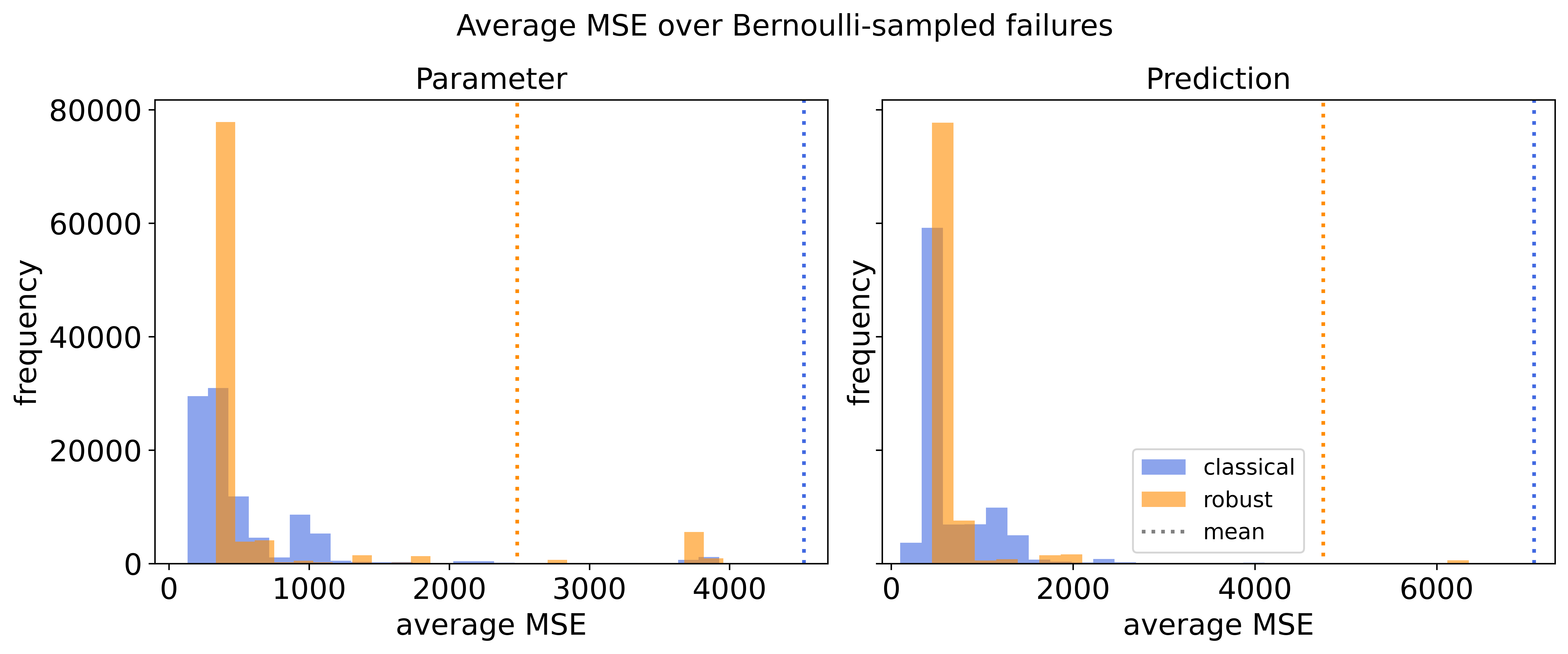
Figure 8: Robust designs yield reduced average parameter and prediction MSEs compared to classical designs under failure scenarios.
Robustness to Clipping-Induced Dropout
For sensor clipping, the authors integrate data-driven force realizations (predicted responses) to flag sensor dropout at candidate locations and again optimize for robustness using the scenario-based approach. The resulting robust design avoids placement at the structure's top level—where clipping is prevalent—demonstrating practical utility in environments where sensor range saturation is dominant.
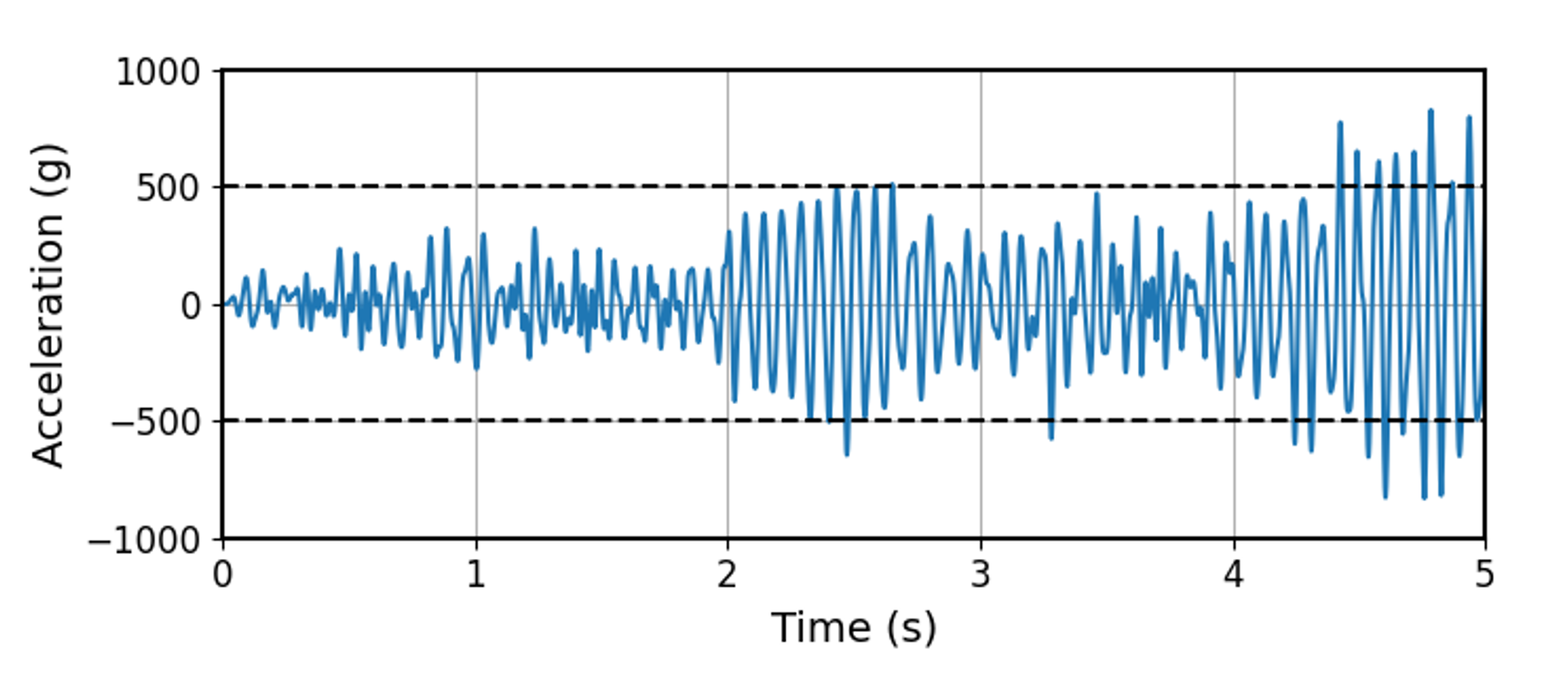
Figure 9: Example acceleration response at a sensor exhibiting clipping, with threshold indicated.
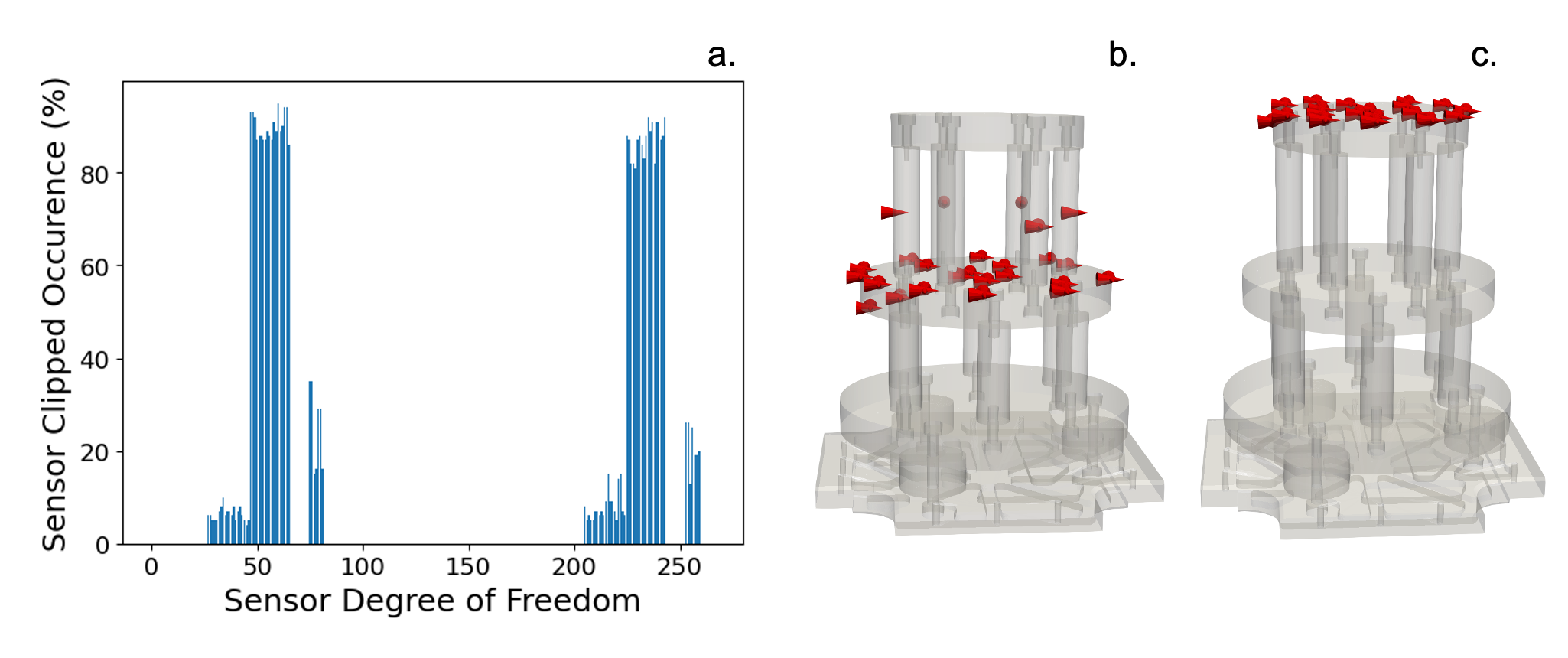
Figure 10: Sensor dropout frequency and spatial distribution due to clipping, highlighting vulnerable sensor locations.
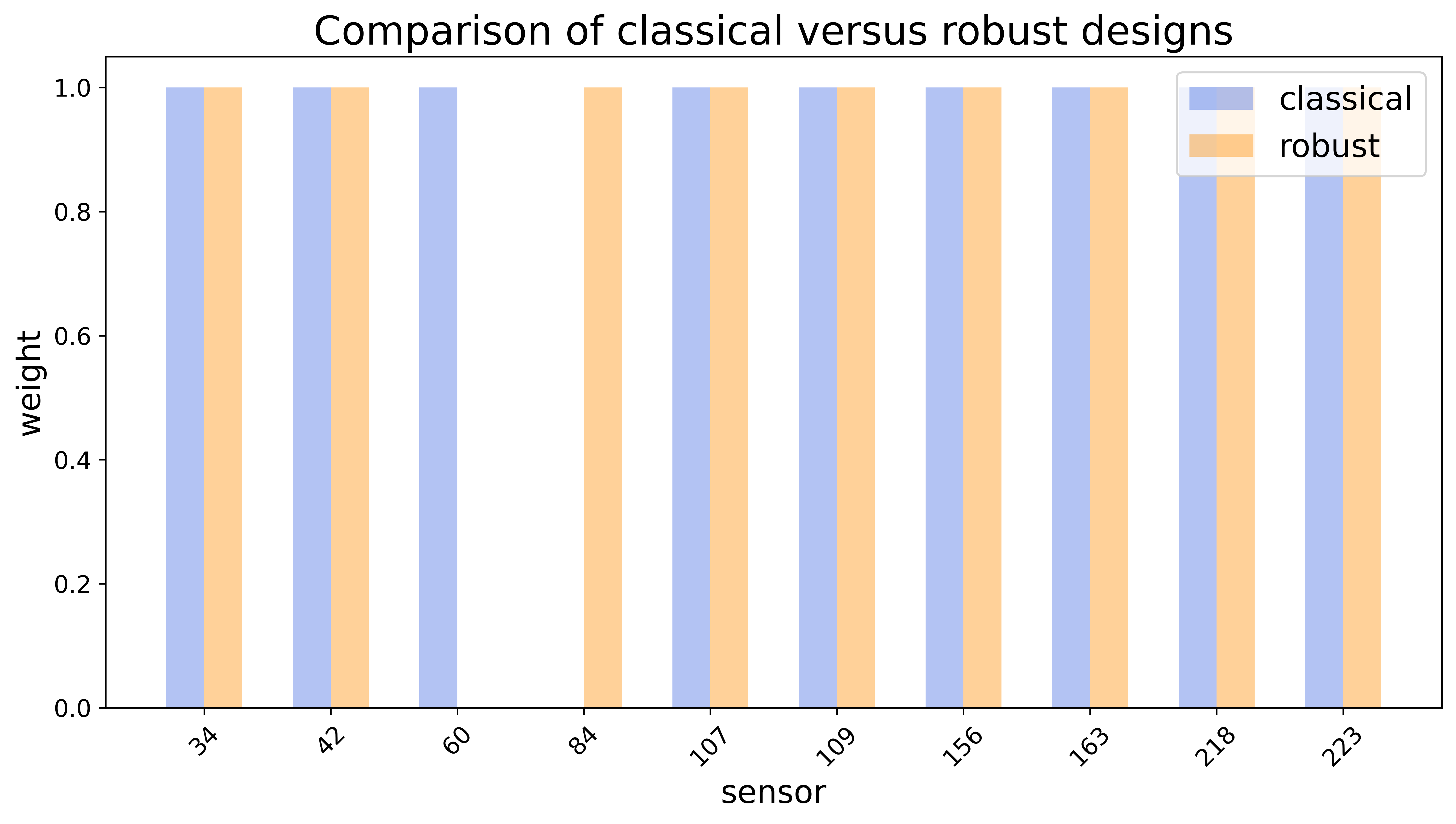
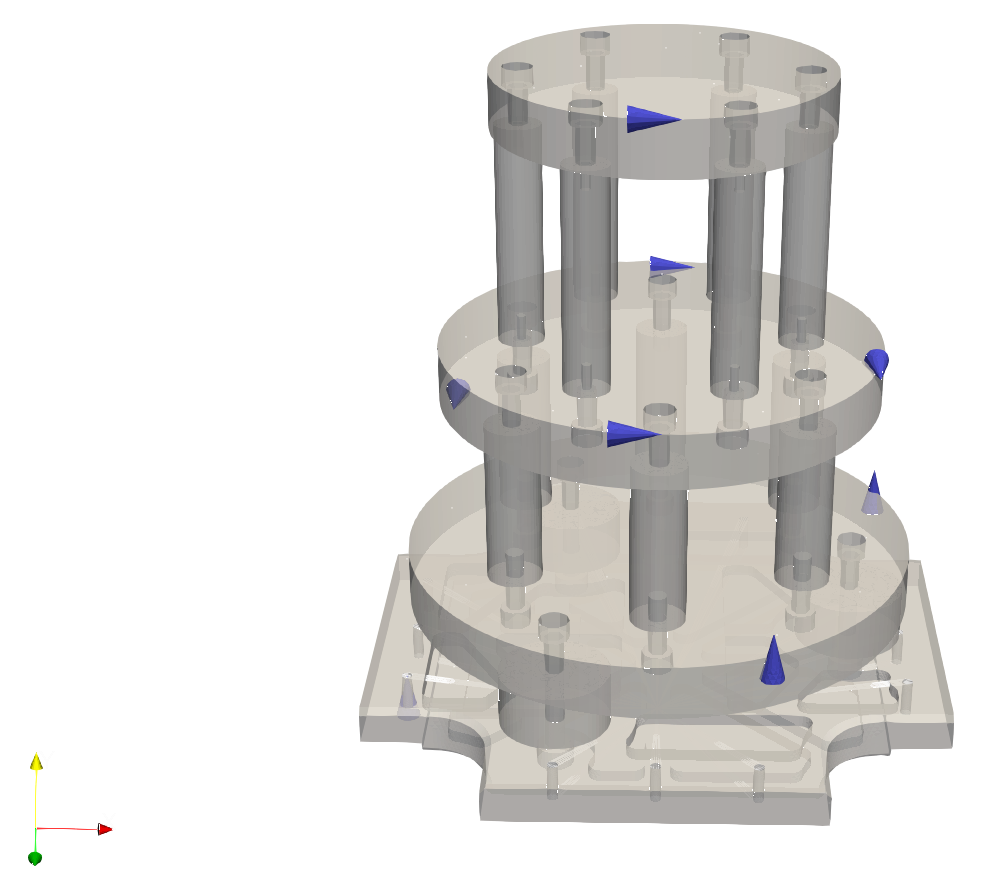
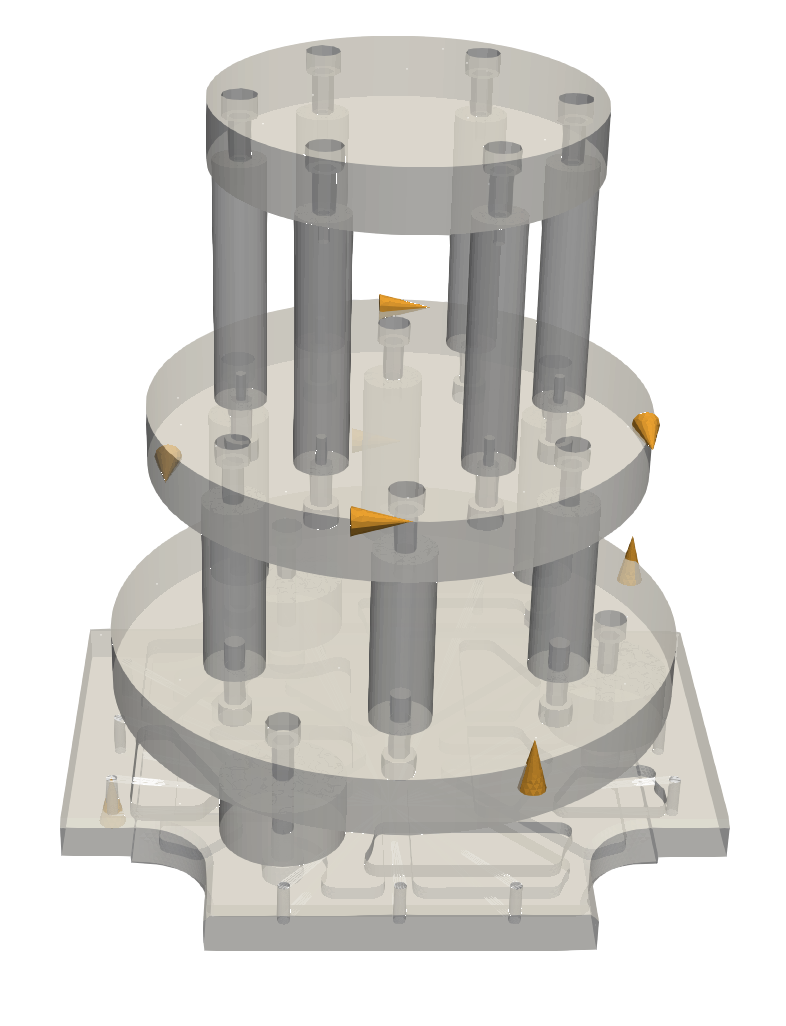
Figure 11: Binary robust and classical optimal designs for clipping scenarios, mapped onto the "wedding cake" structure.
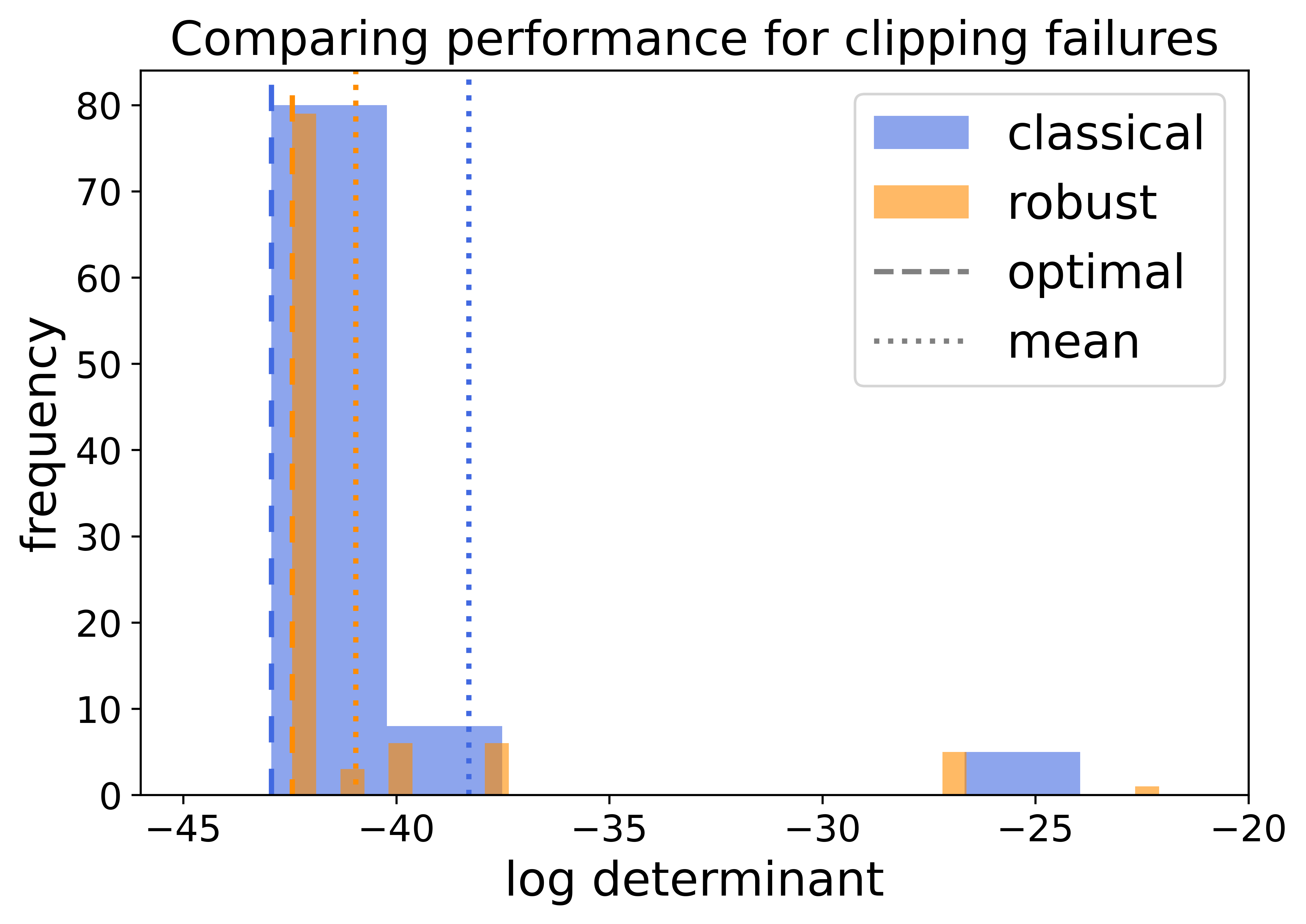
Figure 12: Performance histogram over clipping scenarios, illustrating the robust design's superior average and worst-case log-determinant.
Implications and Future Directions
The presented framework demonstrates that robust OED, when integrated into structural dynamics experimentation, yields sensor layouts that not only minimize information loss under anticipated sensor failures and clipping, but also maintain competitive performance in standard (no-failure) scenarios. Importantly, optimizing for robustness against one sensor failure imbues resilience against multiple failures, suggesting computational tractability and practical benefit in real-world deployments.
By leveraging relaxation-based optimization and the double-well penalty, robust binary designs can be efficiently computed in large-scale applications without prohibitive combinatorial complexity. The approach generalizes to variable failure probabilities and diverse scenario constructs, paving the way for its integration into sensor placement protocols in civil, aerospace, and mechanical systems.
Practical extensions may include multi-objective robust OED formulations, application to nonlinear or non-Gaussian measurement models, and the incorporation of active learning or adaptive sensor placement strategies under real-time monitoring conditions. The strong empirical results advocate for broad adoption in structural health monitoring under uncertainty.
Conclusion
This work establishes a mathematically rigorous and computationally efficient robust OED methodology for sensor placement in structural dynamics experiments subject to sensor failures and clipping. The robust designs consistently outperform classical approaches in average information gain and estimation accuracy under failure scenarios, and the proposed relaxation-plus-double-well penalty technique enables scalable binary sensor layout optimization. These results offer a robust foundation for future developments in reliable sensor network design and uncertainty-resilient experimental planning in engineering disciplines.

