- The paper's main contribution is computing quantum corrections to the diffusion coefficient in stochastic inflation via composite-operator renormalisation in SdSET.
- It employs dimensional regularisation and detailed operator mixing calculations to extend one-loop results to two-loop corrections, clarifying anomalous dimensions.
- The framework bridges EFT techniques in curved spacetime with stochastic dynamics, refining predictions for late-time behavior of superhorizon scalar fields.
Quantum Corrections to Stochastic Inflation Diffusion from Composite Operator Matching in SdSET
Background and Motivation
The study investigates quantum corrections to the diffusion term in stochastic inflation, employing the framework of Soft de Sitter Effective Theory (SdSET). The central issue is the computation of late-time correlators of a massless, minimally coupled scalar field in de Sitter spacetime, which are dominated by IR divergences due to secular growth from superhorizon modes. These divergences necessitate resummation techniques such as the stochastic inflation formalism, wherein superhorizon field dynamics are encoded via a probability distribution governed by a Fokker-Planck equation with diffusion coefficient D=H3/(8π2).
Recent work [Cohen et al.] established that the stochastic inflation picture can be derived from the renormalisation group evolution of composite operators within SdSET, providing an effective field theory description targeting superhorizon modes and establishing operator mixing as the mechanism for generating stochastic dynamics. This paper extends these results to higher-loop corrections, formalising composite operator renormalisation and matching in SdSET using dimensional regularisation, and explicitly computes quantum corrections to the diffusion coefficient.
The authors construct a general framework for renormalisation, mixing, and matching of composite operators in SdSET. Operators +n (powers of the dimensionless effective superhorizon field) require non-trivial renormalisation and mixing, even in the free theory, due to their vanishing scaling and mass dimensions in four dimensions. The renormalisation equation is given by an infinite triangular matrix Znm relating bare and renormalised composite operators; operator mixing proceeds both upwards (via interactions) and downwards (via contractions, even in the absence of couplings).
In dimensional regularisation, the scale μ governs operator anomalous dimensions, while a reference scale factor a∗ emerges due to the handling of time divergences. Matching of renormalised SdSET operators to full-theory (UV) counterparts introduces further matching coefficients Cnm, which encapsulate short-distance physics not resolved by the effective theory; these coefficients likewise obey their own RGEs and anomalous dimensions.
Explicit Results: Free Theory and Operator Mixing
The technical construction is illustrated first in the free theory, where operator mixing is extensive. The pattern of contraction of fields leads to closed-form expressions for all Znm and anomalous dimensions. For example, the mixing structure for +2 and +4 operators, and their one-point and multipoint expectation values, demonstrates nontrivial loop effects despite the absence of couplings. The resulting anomalous dimension matrix has non-vanishing elements even at zero coupling, which are linked directly to the diffusion term in stochastic inflation.

Figure 1: Diagram for operator mixing (specifically +4→_+2) arising from the free theory contractions.
Interacting Theory: One-Loop and Two-Loop Matching
The main computational advances are in the explicit renormalisation and matching of interacting composite operators, focusing on the +n0 operator. Matching is performed perturbatively to +n1, where +n2 is the quartic +n3 coupling.
One-Loop Bispectrum Matching
The renormalised one-loop bispectrum for +n4 is computed in both the full theory (with comoving IR regulator and dimensional UV regularisation) and SdSET, separating 1PI and 1PR contributions. A detailed calculation yields the operator mixing coefficients +n5 and +n6, which are local in position and time-dependent via +n7. The anomalous dimensions are extracted for these operators, displaying explicit logarithmic dependence on both +n8 and +n9.
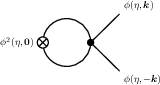
Figure 2: The 1PI diagram topology for the bispectrum of the operator Znm0 at Znm1.
Two-Loop One-Point Function Matching
For the two-loop correction to the one-point function Znm2, the relevant diagrams are computed, including necessary counterterms that subtract subdivergences proportional to Znm3. The operator matching coefficient Znm4 is determined at Znm5, yielding a genuine quantum correction to the diffusion coefficient (an NNLO effect in the Kramers-Moyal expansion). The renormalised result is spatially local, contains explicit Znm6-dependence, and, crucially, all IR-sensitive terms are reproduced by the effective theory while short-distance effects are captured by matching coefficients.

Figure 3: Topology from insertion of the SdSET mass counterterm into the correlation function for Znm7.
Kramers-Moyal Equation and Diffusion Coefficient Corrections
A pivotal insight is the link between operator anomalous dimensions in SdSET and the coefficients in the Kramers-Moyal expansion generalising the classic Fokker-Planck equation. Calculated anomalous dimensions yield explicit corrections to diffusion and drift terms, corresponding to quantum corrections from interaction effects. The new diffusion coefficient is
Znm8
where Znm9, and μ0 is the UV cutoff separating superhorizon and subhorizon modes. Scheme-dependence is systematically compensated by matching coefficients, yielding scheme-independent physical observables at NLO; higher-order corrections (NNLO) are newly constructed in this work.
Practical and Theoretical Implications
The development solidifies SdSET as a consistent, renormalisable effective field theory mirroring many features of non-relativistic EFTs. The explicit handling of operator mixing, anomalous dimensions, and matching across scales establishes general methods for quantum field theory in curved spacetime with nontrivial IR structure. Practically, the computed quantum corrections refine stochastic inflation predictions, yielding accurate estimates for late-time expectation values and probability distributions of superhorizon scalar fields.
Theoretically, the work bridges EFT intuition from flat space to the cosmological context, including the region structure and composite operator matching. The framework sets the stage for rigorous derivations of the Kramers-Moyal equation from operator renormalisation and extends the correspondence between time evolution and RG flow in SdSET.
Future Prospects
Further developments will likely address:
- Rigorous derivation of the Kramers-Moyal equation from dimensional regularisation,
- Elucidation of the role of multiple anomalous dimension matrices (μ1, μ2) and their interplay in time-dependent backgrounds,
- Complete computation of all NNLO effects and full scheme-independence in stochastic inflation,
- Extension of the formalism to multifield models and non-minimally coupled scenarios.
Conclusion
This work advances the quantitative treatment of quantum corrections in stochastic inflation by developing and applying a robust operator renormalisation and matching formalism in SdSET, calculated via dimensional regularisation. Strong technical consistency checks and explicit computations to two-loop order demonstrate the viability and predictive power of the approach. The results yield the first explicit quantum correction to the Fokker-Planck diffusion coefficient and reinforce the link between operator mixing, anomalous dimensions, and stochastic dynamics of inflationary fields. The methodology and results represent significant progress toward a comprehensive effective field theory for late-time cosmological IR dynamics.
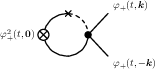
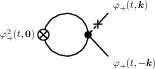
Figure 4: Representative operator contraction diagrams illustrating free-theory mixing and operator renormalisation in SdSET.