- The paper introduces explicit enumeration methods for countable C(n,m)-homogeneous linear orderings with precise recurrence and closed-form formulas.
- It constructs computable embeddings among sp-homogeneous, colored, and multi-colored orderings, linking combinatorial techniques with model theory.
- The findings offer actionable insights into computable categoricity, descriptive complexity, and classification of infinite structures in logic.
Enumerative Combinatorics of Homogeneous Linear Orderings
Overview and Motivation
The paper "Enumerative Combinatorics of Homogeneous Linear Orderings" (2604.14255) develops precise enumeration methods for countable homogeneous colored linear orderings and their relational approximations, namely Cn,m-homogeneous linear orderings. Homogeneity, as formulated by Fraïssé, requires that any isomorphism between finitely generated substructures extends to a global automorphism. Homogeneous structures are central to model theory and have numerous intersections with computability theory, permutation group theory, and combinatorics, influencing notions such as computable categoricity and Scott rank.
Beyond the classical study of homogeneous linear orderings, which yields only three countable types (empty, singleton, and the dense ordering without endpoints η), the paper advances the field with strong combinatorial results concerning more expressive models: colored linear orderings and linear orderings with additional relational predicates. These enriched structures exhibit finite classes of homogeneous models, despite being generally infinite in scope, and their precise counting yields novel insight into both finite and asymptotic combinatorics as well as the descriptive complexity of these theories.
Core Definitions and Structural Correspondences
Colored Linear Orderings and sp-Homogeneity
Colored linear orderings are countable linear orders partitioned by a finite family of unary predicates ("colors"). Homogeneity in this context refers to the extension of isomorphisms between colored finite suborderings to global automorphisms.
sp-homogeneity is defined relative to successor and predecessor functions, capturing intrinsic computable enumerability in the ordering. The paper establishes equivalences and transformations between sp-homogeneous orderings, colored linear orderings, and multicolored structures axiomatized without explicit homogeneity, using model-theoretic constructions.
Cn,m-Homogeneity: Relational Approximations
For n,m∈ω∪{∞}, a Cn,m-homogeneous linear ordering is defined by expanding the language with unary predicates for existence of i successors (Si), η0 predecessors (η1), and binary predicates (η2) for elements at distance η3. Homogeneity is assessed in the expanded relational language, providing a systematic approximation to η4-homogeneity. As η5 tend to infinity, η6-homogeneity captures the full expressive power of η7-homogeneity.
Main Results: Enumeration and Explicit Formulas
Enumeration of η8-Homogeneous Linear Orderings
The paper proves that for finite η9, there are only finitely many countable sp0-homogeneous linear orderings and gives explicit recurrence and closed-form combinatorial formulas for the enumeration.
Let sp1; then, for sp2 the number of sp3-homogeneous linear orderings:
sp4
where sp5 is the Stirling number of the second kind. The paper provides the asymptotic bound sp6, which is tight up to exponential order.
Enumeration of Homogeneous Colored Linear Orderings
For sp7, the number of homogeneous linear orderings with sp8 colors, the paper presents the exponential generating function:
sp9
and deduces asymptotic behavior:
sp0
where sp1 (with sp2 the product logarithm) and sp3. Notably, these results show that the growth rate of homogeneous colored orderings far outpaces that of sp4-homogeneous structures as sp5 increases.
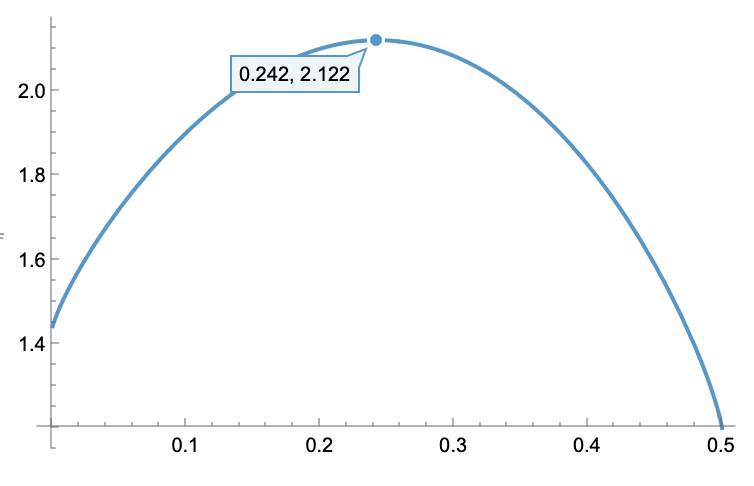
Figure 1: Asymptotic estimation for the growth of sp6, the models of sp7, dominated by the pole at sp8 in the exponential generating function.
The paper meticulously constructs computable embeddings between sp9-homogeneous linear orderings, colored linear orderings, and multi-colorings in axiomatized languages, demonstrating their homogeneity is preserved under these transformations. This deepens the connection between structural combinatorics and model theory.
Theoretical and Practical Implications
Descriptive Complexity and Computability Theory
The results have profound implications for computable structure theory. Homogeneity notions interact with computable categoricity and Scott complexity, influencing hierarchies such as relative sp0-categoricity. The explicit enumeration of homogeneous objects sets foundational limits on possible isomorphism types, enabling exact upper bounds for computable categoricity levels in extended languages.
Asymptotic Behavior and Growth Rates
Empirically, sp1 and sp2 diverge rapidly for large sp3, with the proportion of maximally colored homogeneous orderings converging to sp4. The paper quantifies, for the first time, the exponential gap between relational and colored homogeneity in infinite orderings. This distinction informs both theoretical complexity and practical classification in logic and combinatorics.
Model-Theoretic Classification
The characterization of sp5-homogeneity as precise finite approximations to sp6-homogeneity allows for constructive classification, revealing that the model-theoretic landscape for linear orderings is far richer when additional relational predicates or colors are considered. The paper's explicit constructions facilitate effective enumeration and tractable classification within the realms of both finite and countable structures.
Future Directions
The asymptotic bounds and explicit formulas open several avenues, including refinement of the exponential growth rate (e.g., the open question whether sp7), generalization to other relational languages, and exploration of computable categoricity limits for scattered linear orders. Additionally, leveraging these combinatoric results in descriptive set theory, permutation group theory, and dynamic classification problems remains an active area.
Conclusion
This paper rigorously advances the enumerative theory of countable homogeneous linear orderings, especially colored and sp8-homogeneous types, establishing explicit formulas, sharp asymptotics, and fundamental structural correspondences. It bridges combinatorics with deep logical and computational properties, creating a robust framework for further investigations into model-theoretic and computability-theoretic aspects of countable structures.