- The paper introduces MAPCA, a generalization of PCA leveraging a symmetric positive definite metric to achieve strict scale invariance under arbitrary rescaling.
- It constructs a β-family of metrics that provides a continuous trade-off between spectral bias and isotropy, clarifying the connections with self-supervised learning methods.
- Empirical validation on the Army Cadets dataset demonstrates that IPCA uniquely delivers exact scale invariance with a nondegenerate spectral structure.
Metric-Aware Principal Component Analysis (MAPCA): A Unified Framework for Scale-Invariant Representation Learning
Motivation and Limitations of Classical PCA
Traditional Principal Component Analysis (PCA) is a foundational technique for dimensionality reduction and representation learning. However, standard PCA is inherently scale-dependent: its principal components can change dramatically under feature rescaling, leading to instability and potentially misleading representations when variables differ in units or variance. Correlation PCA provides strict scale invariance but discards all variance information, creating a tension between preserving spectral structure and achieving invariance. The root cause of this trade-off is traced to the Euclidean geometry underlying classical formulations.
MAPCA: Generalized Eigenproblem and the Role of the Metric
This work introduces Metric-Aware Principal Component Analysis (MAPCA), generalizing PCA via the parameterization of the constraint with an arbitrary symmetric positive definite metric matrix M. The MAPCA optimization is
WmaxTr(W⊤ΣW)subject toW⊤MW=I
where Σ is the sample covariance matrix. The metric M determines the geometry and invariance properties of the learned representation. Standard PCA emerges as M=I, correlation PCA as M=D (the diagonal of marginal variances), and full output whitening as M=Σ. The core theoretical contribution is a precise characterization of scale invariance: MAPCA solutions are strictly invariant to feature rescaling if and only if M transforms equivariantly as M=CMC under diagonal rescaling C=diag(c1,…,cp).
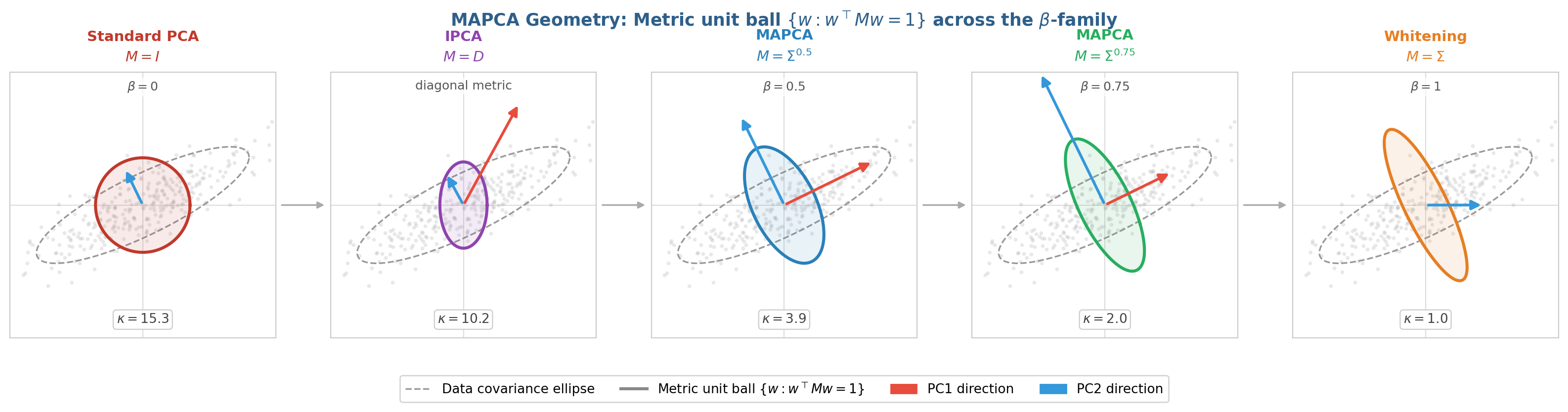
Figure 1: The geometric evolution of the MAPCA family, visualizing metric unit balls and principal directions across choices of WmaxTr(W⊤ΣW)subject toW⊤MW=I0 and WmaxTr(W⊤ΣW)subject toW⊤MW=I1.
WmaxTr(W⊤ΣW)subject toW⊤MW=I2-Family: Spectral Bias Control and Continuous Trade-off
MAPCA introduces the canonical WmaxTr(W⊤ΣW)subject toW⊤MW=I3-family of metrics WmaxTr(W⊤ΣW)subject toW⊤MW=I4, with WmaxTr(W⊤ΣW)subject toW⊤MW=I5, providing a continuous interpolation between standard PCA (WmaxTr(W⊤ΣW)subject toW⊤MW=I6) and full output whitening (WmaxTr(W⊤ΣW)subject toW⊤MW=I7). The effective operator is WmaxTr(W⊤ΣW)subject toW⊤MW=I8, and the associated condition number WmaxTr(W⊤ΣW)subject toW⊤MW=I9 reduces monotonically as Σ0 increases. At the endpoints: Σ1 is maximally scale-sensitive (high spectral bias), Σ2 is maximally isotropic (scale-invariant).
Intermediate values of Σ3 compress the spectral gap, interpolating between bias and invariance, but only the endpoints satisfy strict scale invariance under general diagonal rescaling. This is proven via the invariance theorem, leveraging transformation properties of Σ4.
Diagonal Metric and IPCA: Uniquely Strict Scale Invariance
Setting Σ5 defines Invariant PCA (IPCA), which occupies a geometrically distinct position within the MAPCA family. IPCA corrects for marginal variances without rotating the metric and achieves strict scale invariance under arbitrary diagonal rescaling (as established by Theorem 1 and its corollaries). IPCA’s spectral structure, governed by the correlation matrix Σ6, remains nontrivial.
The strict invariance property is unique to IPCA. Other values in the Σ7-family (Σ8) fail to achieve invariance except under uniform scaling, since Σ9 is not equivariant under arbitrary diagonal similarity transformations. Whitening (M0) achieves invariance trivially through complete isotropy.
Connections to Self-Supervised Learning and Whitening Techniques
MAPCA provides a geometric language unifying several self-supervised learning (SSL) objectives:
- Barlow Twins: Corresponds to output whitening (M1, M2), pushing representations to maximal isotropy.
- VICReg's variance term: Interprets as enforcing a diagonal metric (M3), correcting marginal variances without enforcing isotropy.
- W-MSE: Performs input whitening, corresponding to M4 (i.e., M5), which amplifies spectral bias; this direction lies outside the M6-family spectral compression range and is theoretically distinct from output whitening techniques.
- ZCA Whitening: Also corresponds to output whitening (M7).
MAPCA reveals that these methods target different regions in the metric space, some of which are not directly comparable at the level of loss functions but are clarified in terms of representation geometry and spectral bias.
Empirical Verification: Army Cadets Dataset
MAPCA’s theoretical claims are numerically validated on the Army Cadets dataset (height, weight, chest circumference in both metric and imperial units). The experiment demonstrates:
- Standard PCA: Severe scale dependence; eigenvalues and principal coefficients change radically under unit conversion.
- IPCA (Diagonal Metric): Exact invariance in eigenvalues and correct coefficient scaling to machine precision.
- Intermediate M8: Eigenvalues and principal directions do not match across unit systems, confirming strict invariance fails.
- Whitening (M9): Eigenvalues invariant but eigenspace comparisons are degenerate due to nonuniqueness.
These results confirm the invariance hierarchy and clarify the practical impact of metric selection within MAPCA.
Theoretical and Practical Implications
The MAPCA framework generalizes classical PCA and connects scale-invariance, spectral bias, and geometric interpretation in a unified formalism. The invariance theorem distinguishes methods with strict invariance (IPCA, whitening) from those with only uniform invariance (M=I0-family, intermediate metrics). By clarifying geometric distinctions between input and output whitening, MAPCA provides guidance for principled spectral bias control in representation learning, and underscores that loss-function-level similarities can mask essential geometric differences.
Potential future directions include adaptive selection of M=I1 based on task-specific spectral geometry, extensions to kernel or nonlinear covariance operators, exploration of geometric geodesics in the Riemannian cone, and evaluation of the input whitening regime for anomaly detection.
Conclusion
MAPCA offers a unified, rigorously characterized framework that subsumes principal component and whitening-based representation methods. The core theoretical result—a necessary and sufficient condition for strict scale invariance—clarifies the invariance hierarchy for representation learning. The geometric language provided by MAPCA reveals subtle distinctions in contemporary SSL algorithms, especially between input and output whitening, and highlights IPCA’s unique standing as strictly scale-invariant with nontrivial spectral structure. The framework establishes a foundation for principled metric selection and geometry-aware representation learning, enabling systematic exploration of invariance, bias, and isotropy in both classical and modern learning scenarios.

