- The paper demonstrates that splitting routing (gate) and representation (weight) parameters enables concurrent learning and stable online inference under distribution drift.
- It provides rigorous mathematical proofs and empirical evidence validating the architecture's ability to manage adaptation accuracy and prediction volatility.
- Empirical results show that gated models like DG-Soft, DG-Anneal, and MoE variants excel in drift recovery while offering computational efficiency.
Learning-Inference Concurrency in DynamicGate-MLP: Structural and Mathematical Justification
Introduction
The paper "Learning Inference Concurrency in DynamicGate MLP Structural and Mathematical Justification" (2604.13546) systematically analyzes the limitations of conventional dense neural networks for concurrent learning and inference, and establishes that the DynamicGate-MLP architecture can overcome these through structured separation of routing (gating) and representation weights. This separation facilitates well-defined online adaptation, allowing inference to remain stable under parameter updates. The paper provides rigorous mathematical conditions and proofs for this concurrency, positions DynamicGate-MLP as an enabling mechanism for efficient online/adaptive systems, and presents empirical results validating its theoretical claims in challenging environments with distributional drift.
Structural Separation and Mathematical Basis for Concurrency
Conventional neural networks require a rigid separation between learning and inference due to the instability introduced when all parameters are updated simultaneously; inference becomes non-stationary and the mapping x↦y^ is ill-posed. The DynamicGate-MLP solves this by splitting parameters into routing (gate) and representation (weight) sets. The gating network m(x;θ) determines the active computation path and only updates θ during inference, while maintaining W fixed or updating only the inactive subset. This structural sparsity allows inference outputs to be consistently interpreted as a snapshot of a valid model at any time step, even with asynchronous or partial updates.
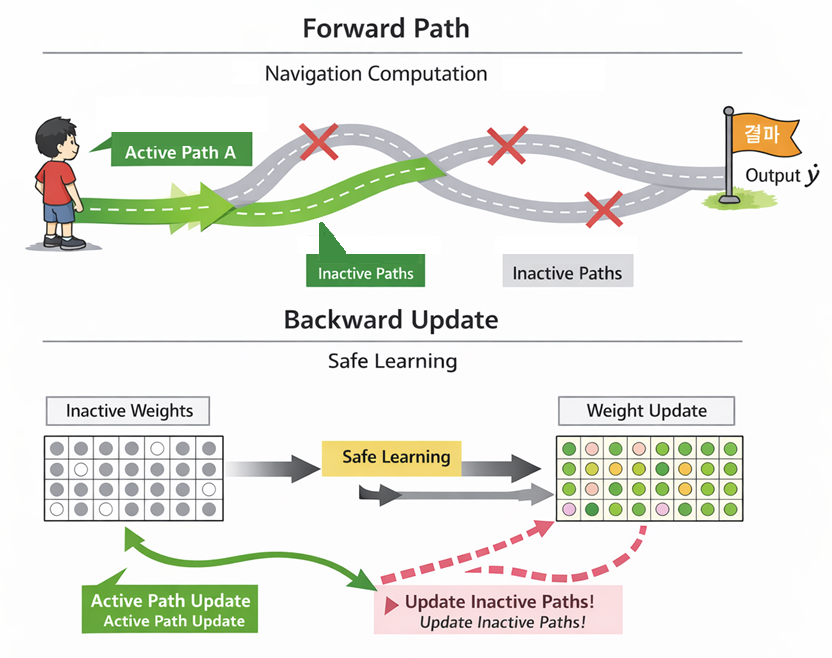
Figure 1: Conceptual diagram of concurrent learning during inference, demonstrating selective path activation and background weight updates.
Mathematical propositions are stated and proved for:
- Gate-only adaptation: updates restricted to θ maintain well-defined inference.
- Active-subspace updates: only weights in the inactive set are updated, leaving the inference function unchanged.
This results in a piecewise-stationary sequence of models, closely aligning with online convex optimization theory and distributed computing paradigms.
The paper discusses existing approaches for distribution shift, such as test-time adaptation (TTA), normalization-based updates, entropy minimization, self-supervised learning at inference, and parameter-efficient adaptation in foundation models. These usually update a fixed subset of parameters without structural sparsity. The DynamicGate-MLP extends these by offering input-dependent conditional computation, enabling path-level plasticity and systematic control over which parameters (routing, inactive weights) are updated online. Route diversity (flip-rate) is also introduced as a stability metric.
Empirical Evaluation Under Distributional Drift
The experimental protocol involves evaluating various model variants (Dense, DG-Hard, DG-Soft, DG-Anneal, MoE-Top1, MoE-Soft) under distribution shift, comparing accuracy before and after online adaptation, computational efficiency, and prediction stability. Adaptation modes included gate-only, inactive-weight-only, and joint (gate + inactive weights).
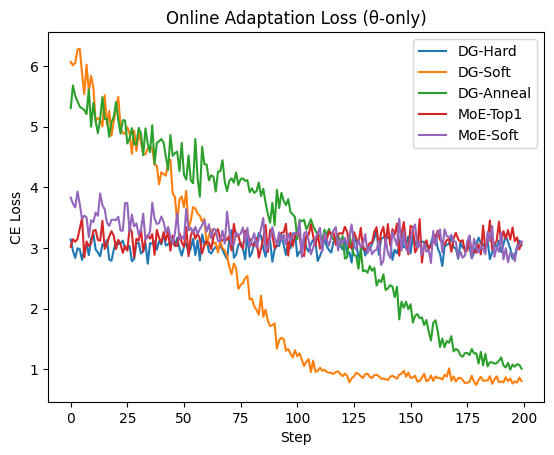
Figure 2: Accuracy under drift before and after θ-only online adaptation, demonstrating substantial improvement for gating-based models.
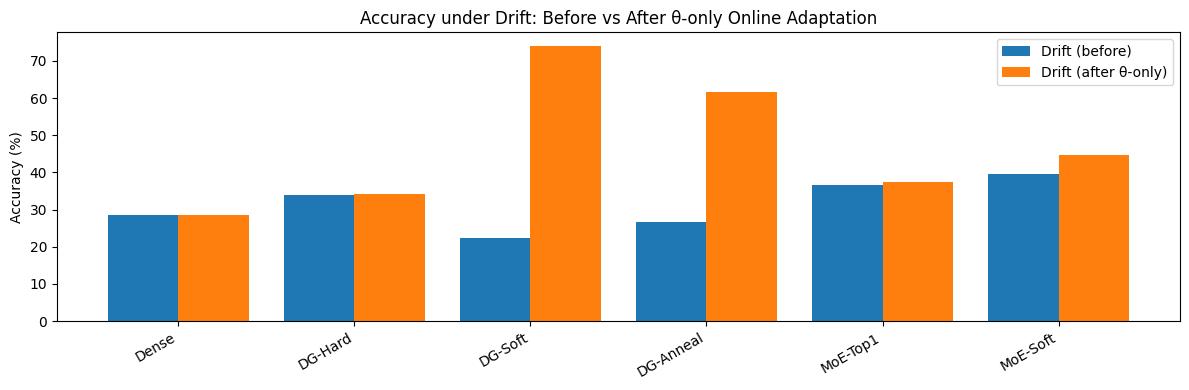
Figure 3: Compute Proxy (normalized FLOPs) under drift, illustrating substantial reductions in compute for hard-routing and MoE-Top1 models.
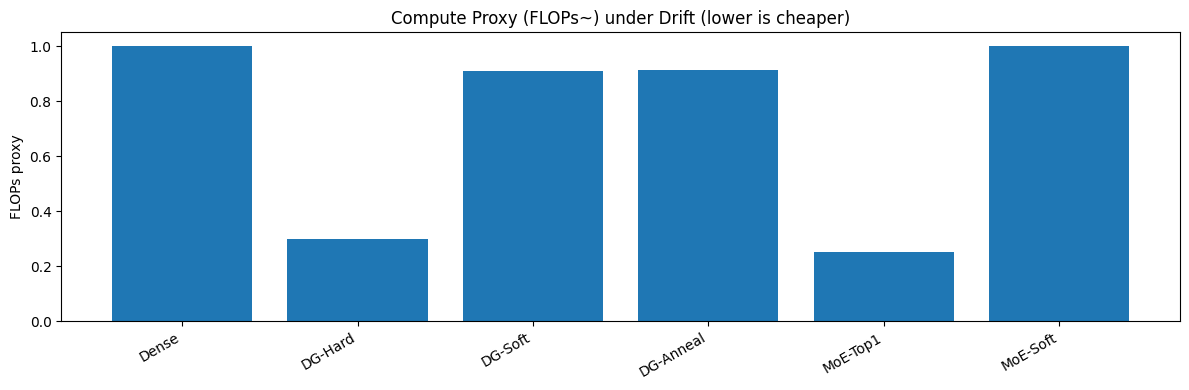
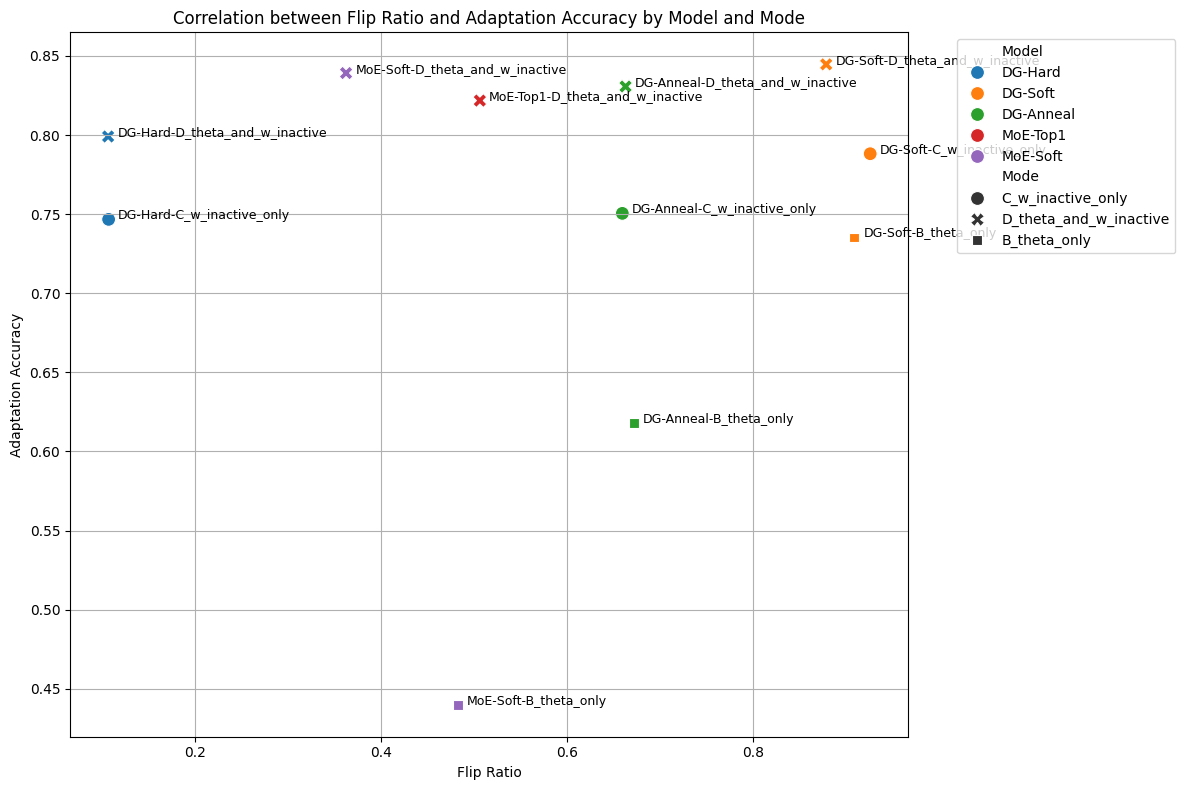
Figure 4: Routing flip rate under drift, indicating volatility in adaptive gating models and structural stability in hard-routing variants.
Strong numerical findings include:
Theoretical and Practical Implications
The mathematical formulation confirms that conditional computation architectures such as DynamicGate-MLP can safely support concurrent learning and inference in practice. This unlocks continuous, stream-wise adaptation for on-device, edge, or lifelong learning, aligning with low-overhead distributed training infrastructures (parameter servers, snapshot synchronization). From a hardware perspective, DynamicGate-MLP is block-sparsity friendly and minimizes synchronization costs. The biological analogy (slow synaptic update vs. fast path adaptation) is noted but not central.
Practically, the design tradeoff emerges between:
- Adaptation performance (DG-Soft, DG-Anneal, MoE-Soft: high AdaptAcc, high flip).
- Stability and efficiency (DG-Hard, MoE-Top1: low flip, low compute, moderate AdaptAcc).
This allows designers to select modes depending on constraints (stability, adaptation speed, compute budget). For personalized or rapidly changing environments, maximizing adaptation (with flip mitigation strategies) is preferred; for safety-critical or resource-dependent deployments, stable routing is advantageous.
Future Directions
DynamicGate-MLP provides the theoretical backbone for robust, concurrent online learning and inference. Future research might address:
- Stability regularization for high-adaptation, high-flip models.
- Automated path selection and active subspace learning algorithms.
- Hardware-accelerated block-sparse inference and real-time system integrability.
- Extension to multimodal foundation models with input-dependent prompt and adapter routing.
Conclusion
DynamicGate-MLP structures enable mathematically well-defined concurrent learning and inference by separating routing and representation parameters and applying input-dependent conditional computation (2604.13546). The architecture supports stable online adaptation under environmental drift, offering explicit control over adaptation performance, prediction volatility, and computational efficiency. This establishes DynamicGate-MLP and similar architectures as practical solutions for continual, adaptive learning in streaming and edge deployment scenarios.