On the Use of Evolutionary Optimization for the Dynamic Chance Constrained Open-Pit Mine Scheduling Problem
Published 15 Apr 2026 in cs.NE and cs.AI | (2604.13385v1)
Abstract: Open-pit mine scheduling is a complex real world optimization problem that involves uncertain economic values and dynamically changing resource capacities. Evolutionary algorithms are particularly effective in these scenarios, as they can easily adapt to uncertain and changing environments. However, uncertainty and dynamic changes are often studied in isolation in real-world problems. In this paper, we study a dynamic chance-constrained open-pit mine scheduling problem in which block economic values are stochastic and mining and processing capacities vary over time. We adopt a bi-objective evolutionary formulation that simultaneously maximizes expected discounted profit and minimizes its standard deviation. To address dynamic changes, we propose a diversity-based change response mechanism that repairs a subset of infeasible solutions and introduces additional feasible solutions whenever a change is detected. We evaluate the effectiveness of this mechanism across four multi-objective evolutionary algorithms and compare it with a baseline re-evaluation-based change-response strategy. Experimental results on six mining instances demonstrate that the proposed approach consistently outperforms the baseline methods across different uncertainty levels and change frequencies.
The paper introduces a bi-objective evolutionary framework that maximizes expected profit while minimizing risk via standard deviation.
A dynamic diversity-based response mechanism repairs infeasible solutions using hypermutation and random schedule insertion under changing capacities.
Comparative results on large-scale benchmarks confirm that diversity-enhanced MOEAs robustly handle varying confidence levels and dynamic perturbations.
Evolutionary Optimization for Dynamic Chance-Constrained Open-Pit Mine Scheduling
Problem Formulation and Motivation
The paper addresses a realistic extension of the open-pit mine scheduling problem (OPMSP), integrating stochastic block profits and dynamically varying resource capacities to more accurately reflect operational complexities. The economic value of each block is modeled as a spatially correlated normal distribution, and mining/processing capacities are subjected to periodic, random scaling, capturing effects such as equipment failure, fluctuating demand, and environmental variability. The aim is to maximize expected discounted profit while minimizing its standard deviation, facilitating Pareto-optimal risk-return tradeoff schedules that meet chance constraints at diverse confidence levels, α∈[0.5,1).
A formal bi-objective evolutionary optimization model is adopted. The first objective maximizes E[p(x)], the expected value, and the second objective minimizes Var[p(x)], the standard deviation, penalizing infeasibility via violation measures. This multi-objective framework obviates the necessity to pre-select a specific confidence threshold, producing a solution set spanning the risk spectrum in a single run.
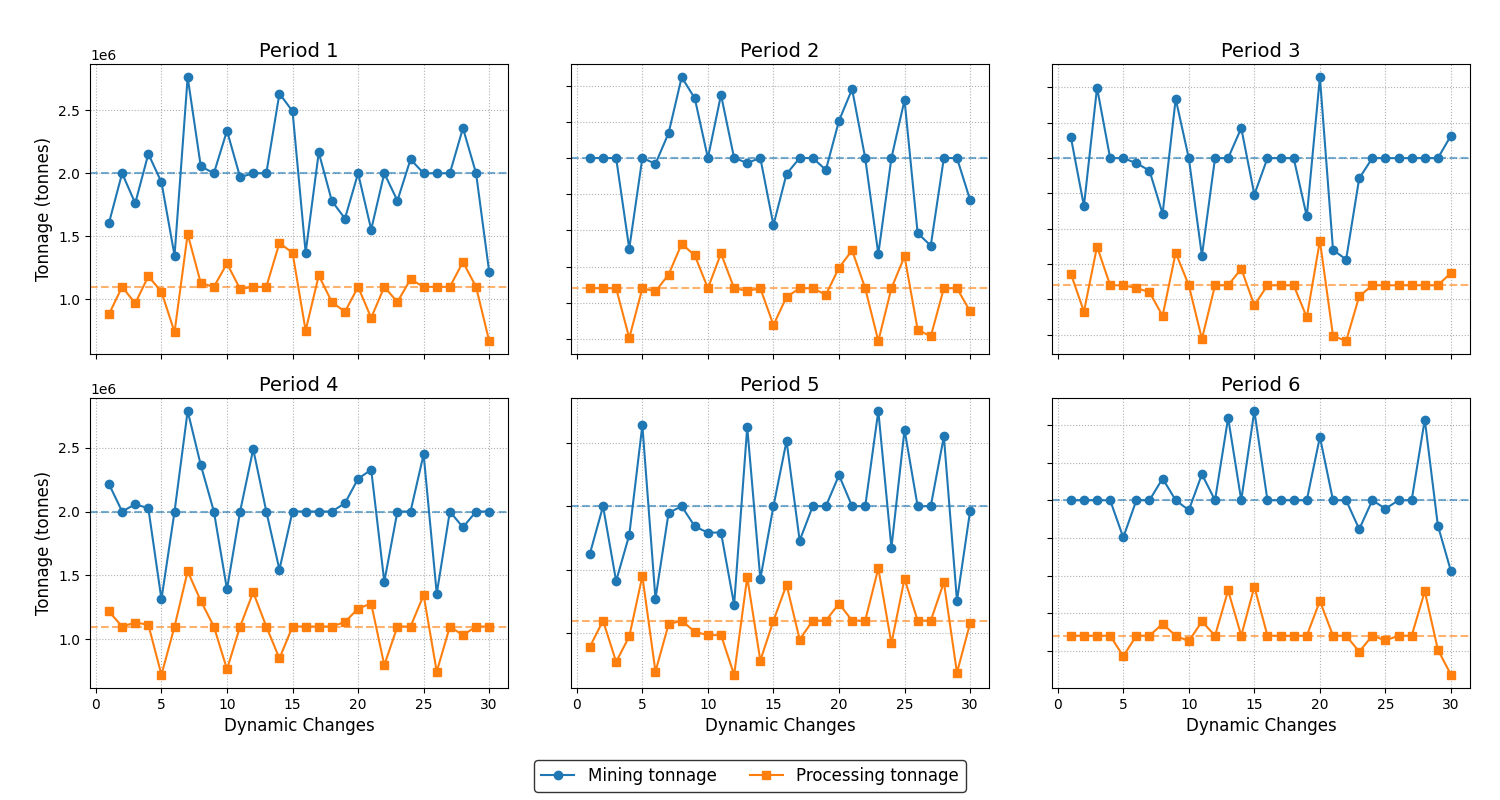
Dynamic change management in resource capacities (Figure 1) is operationalized via a diversity-enhancing response mechanism: upon change detection, infeasible solutions undergo hypermutation-driven repair, and additional feasible schedules are engineered to restore diversity and feasibility.
Figure 1: Dynamic changes in mining and processing capacities across six periods and thirty change events; deviations from baseline shown for Newman1.
Technical Approach
The paper implements a diversity-increasing change response mechanism integrated into four leading MOEAs: MOEA/D, NSGA-II, SMS-EMOA, and SPEA2, yielding variants with diversity-based response (MOEA/D-DIV, NSGA-II-DIV, SMS-EMOA-DIV, SPEA2-DIV) versus re-evaluation-only baselines (MOEA/D-RE, NSGA-II-RE, SMS-EMOA-RE, SPEA2-RE).
The dynamic change response algorithm, upon capacity perturbation, first reevaluates the population, then:
Repairs up to 20% of infeasible individuals using a hypermutation operator, prioritizing improved feasibility and lexicographic Pareto dominance.
Introduces up to 20% new random feasible schedules.
When necessary, admits the lowest-violation solutions to maintain population size.
Profit covariance and variance computation leverages ensemble-based simulation; negative covariances are truncated to zero to mitigate risk underestimation.
Benchmarking employs MineLib instances, spanning synthetic and real mines (KD, P4HD, Marvin, Newman1, Zuck Small/Medium), with stochastic values generated from block profit ensembles. Various change frequencies ν and confidence levels are tested, with fitness evaluation budgets and mutation operators selected as per domain standards.
Numerical Results and Comparative Analysis
Experimental evaluations demonstrate several strong findings:
Across all datasets (up to 53,271 blocks), diversity-based response mechanisms consistently yield lower offline error (distance to deterministic upper bound) versus baseline re-evaluation, especially under frequent dynamic changes (large ν) and high confidence levels. This is statistically significant (Bonferroni-corrected Kruskal–Wallis).
MOEA/D-DIV shows superior performance under high-frequency dynamic changes; SMS-EMOA-DIV performs robustly in all settings.
Offline error increases with stricter chance constraints (higher α), confirming the expected tightening effect on feasible scheduling, but the DIV variants adapt effectively across all α levels.
The bi-objective formulation generates solutions spanning the risk spectrum, allowing for ex post selection without re-optimization for new confidence levels.
These results confirm that dynamic diversity injection is critical for maintaining feasible high-quality solutions in large-scale, dynamically perturbed environments, and that single-run bi-objective MOEAs eliminate the need for repeated optimization at different confidence levels.
Implications and Future Directions
Practically, this research enhances operational planning under uncertainty in mining, facilitating quantifiable risk management and robust scheduling that adapts to real-time resource fluctuations. Theoretical implications validate the efficacy of diversity-centric MOEA design over simple reevaluation in dynamic, chance-constrained combinatorial contexts.
Potential lines for further investigation include:
Extension to hybrid MOEAs and domain-specific mutation heuristics.
More granular integration of spatial geological uncertainty, operational disruptions, and commodity price modeling.
Theoretical convergence and runtime analysis for large-scale, multi-period, dynamic chance-constrained settings.
Broader developments in AI for resource management could leverage these techniques for other dynamic, stochastic scheduling applications (power grids, logistics, manufacturing), integrating real-time sensor feedback and predictive modeling.
Conclusion
This paper offers a comprehensive modeling, algorithmic, and empirical framework for dynamic chance-constrained open-pit mine scheduling, grounded in bi-objective evolutionary optimization. Dynamic diversity-based repair substantially improves adaptation to capacity perturbations versus static reevaluation, and the bi-objective Pareto solution set broadens applicability for risk-averse resource allocation. The results strengthen the case for MOEA design tailored to nonstationary, stochastic, and operationally complex environments, contributing robust, risk-aware planning methodology to mining and allied sectors (2604.13385).
“Emergent Mind helps me see which AI papers have caught fire online.”
Philip
Creator, AI Explained on YouTube
Sign up for free to explore the frontiers of research
Discover trending papers, chat with arXiv, and track the latest research shaping the future of science and technology.Discover trending papers, chat with arXiv, and more.