- The paper introduces an analytic and numerical framework for generating scalar-tensor-induced gravitational waves across radiation, matter, and early matter-dominated epochs.
- It employs peaked primordial spectra with regularization to avoid ultraviolet divergences, revealing distinct oscillatory and frequency-localized spectral features.
- The study links stochastic GW background signals with PBH overproduction constraints, offering forecast analyses using NANOGrav 15-year and SKA datasets.
Probing Scalar–Tensor-Induced Gravitational Waves in the nHz Band: A Critical Synthesis
Introduction
The stochastic gravitational wave background (SGWB) detected in the nanohertz range by Pulsar Timing Array (PTA) experiments, including NANOGrav and forecasts for the Square Kilometre Array (SKA), has sparked intense exploration of both astrophysical and cosmological origins. This study systematically addresses scalar–tensor-induced gravitational waves (STGWs), focusing on their generation mechanisms, spectral signatures, and detectability in the nHz band, with careful attention to the thermal history of the early Universe and the possibility of concurrent primordial black hole (PBH) production.
The paper distinguishes itself by advancing the formalism for STGW production during matter-dominated (MD) and early matter-dominated (eMD) epochs, as well as the standard radiation-dominated (RD) era, extending prior analytic and numerical treatments of second-order cosmological gravitational wave sources.
The study employs the Poisson gauge metric perturbation framework, computing the evolution of tensor modes induced by the mixing of linear scalar and tensor fluctuations. The evolution equation for the tensor mode γij encompasses explicit background independence, allowing for application across various expansion histories. Importantly, the source term couples the primordial scalar and tensor power spectra through mode mixing, resulting in a convolution integral whose kernel depends sensitively on the background's equation of state.
To robustly treat the physical spectrum, peaked primordial power spectra—specifically monochromatic or log-normal forms—are chosen to avoid spurious ultraviolet divergences. The computation carefully distinguishes between pure STGWs (generated by the scalar–tensor source) and primordial GWs (PGWs, from linear tensor perturbations), facilitating clean interpretation in observationally relevant bands.
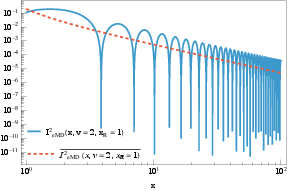
Figure 1: Squared kernel before and after oscillation averaging, highlighting the oscillatory imprint of the scalar–tensor mode mixing kernel as described in Section 2.
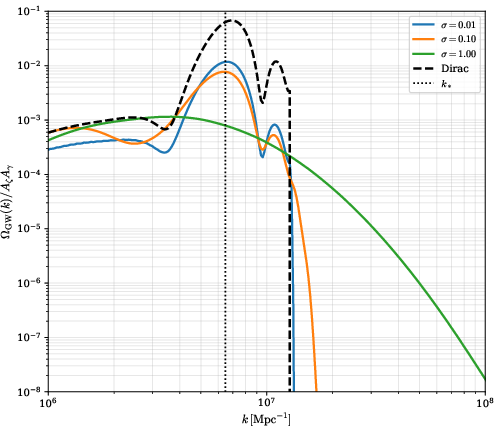
Figure 2: The normalized GW energy density as a function of wavenumber, illustrating the impact of the primordial spectrum's width and peak location.
RD and MD Epochs
For the RD case, the scalar–tensor mode energy transfer is encapsulated by regularized integrals with analytic kernels, exhibiting dependence on the scale and width of the primordial peaks. The characteristic spectral shape is less sensitive to peak position than in the eMD scenario due to the absence of explicit breaking of scale invariance in RD.
In a pure MD epoch, the formalism reveals rapid decay of the STGW energy density on sub-horizon scales; scalar perturbations remain constant while tensor modes decay, resulting in fast dilution (see Eq. (2.41) in the original text).
Early Matter Domination and Sudden Transitions
For an eMD scenario ending with a sudden transition to RD (motivated by, e.g., PBH or Q-ball dominated eras), the formalism is extended analogously to the poltergeist mechanism in SIGWs, tracking the continuity and oscillatory behavior inherited from the MD–RD transition. The analytic kernel derived in this context captures increased spectral richness, with oscillatory features and sharper frequency localization compared to RD-induced backgrounds.
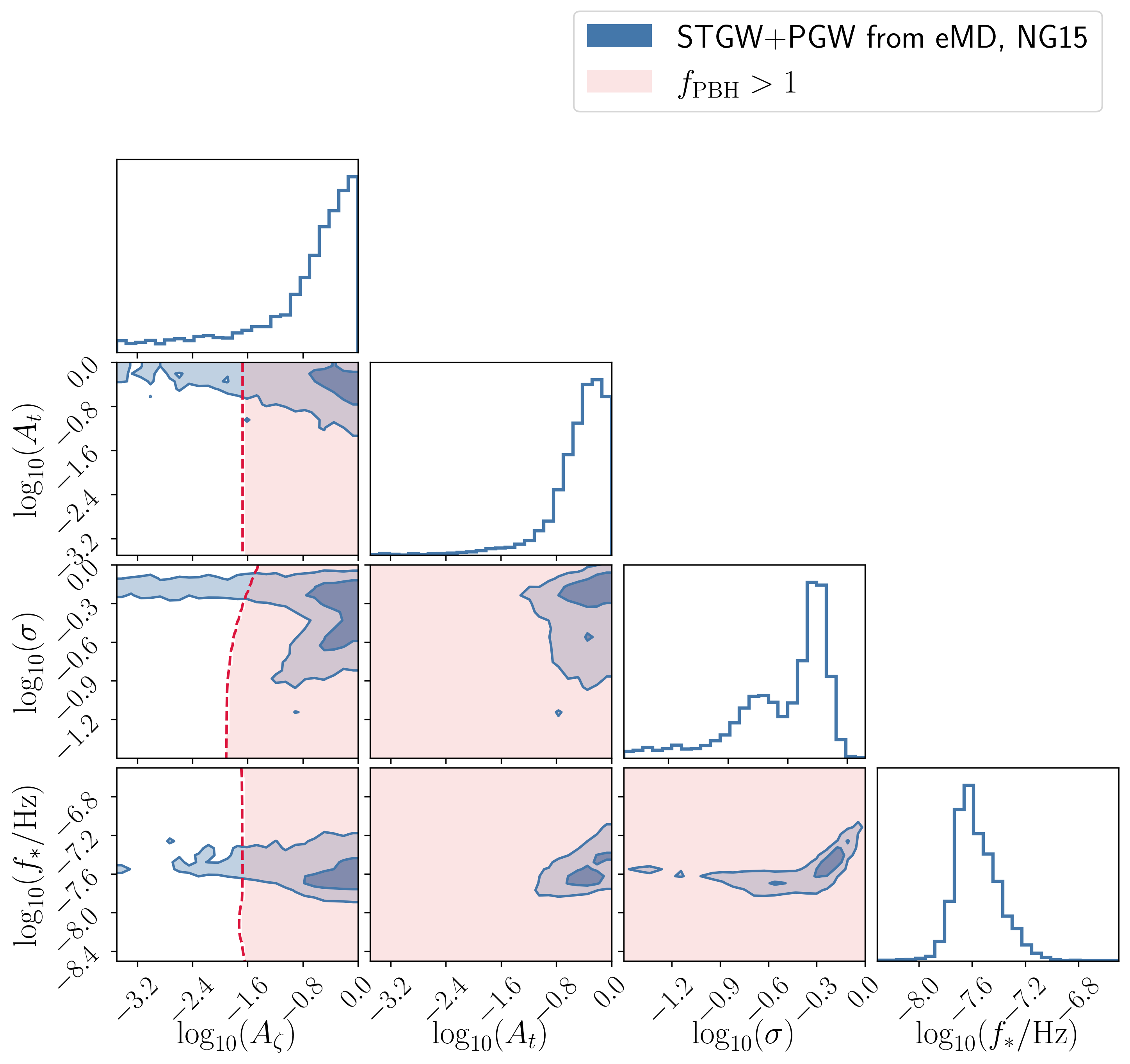
Figure 3: Posterior distributions (corner plots) for eMD+PGW parameters from NANOGrav 15-year data, revealing strong parameter degeneracies and regions excluded by PBH overproduction (red shading).
Bayesian Inference and Nanohertz Observations (NANOGrav, SKA)
Parameter estimation is performed via MCMC Bayesian analysis, using the NANOGrav 15-year dataset and simulated SKA configurations. The scalar (amplitude Aζ), tensor (amplitude At), spectral width (σ), and peak frequency (f∗) of the primordial spectra are the primary parameters. The presence of PBH overproduction constraints, evaluated using the present-day PBH dark matter fraction, decisively shapes the allowed parameter region.
For eMD-generated STGWs, the NANOGrav posterior is characterized by a strong normalization degeneracy: the amplitude of the STGW component is weakly constrained and limited primarily by the PBH threshold. The (f∗,σ) parameters are, however, more localized and exhibit a characteristic banana-shaped posterior due to the interplay between kernel features and spectral mapping.
In SKA forecasts, injection of both STGW and PGW signals yields more precise and nearly Gaussian posterior distributions, with the shape parameters tightly localized. The degeneracy is largely broken by the improved sensitivity and frequency coverage, and by the additional linear PGW component which fixes the tensor sector independently of the scalar amplitude.
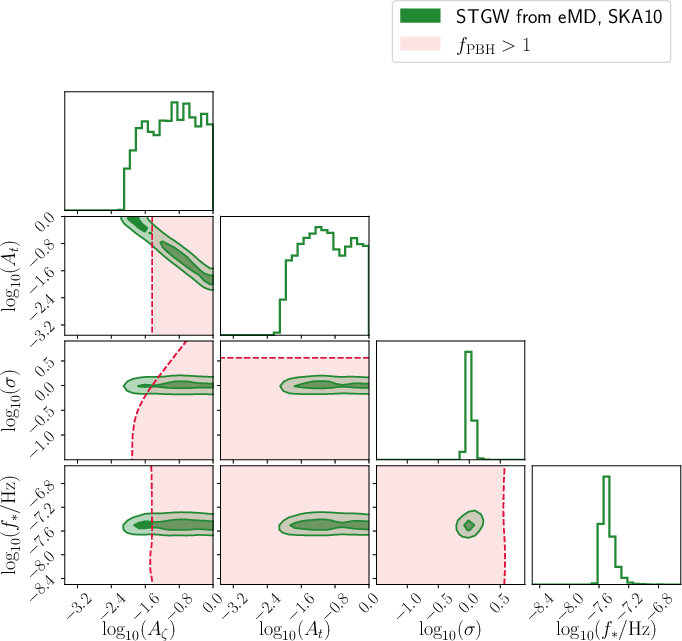
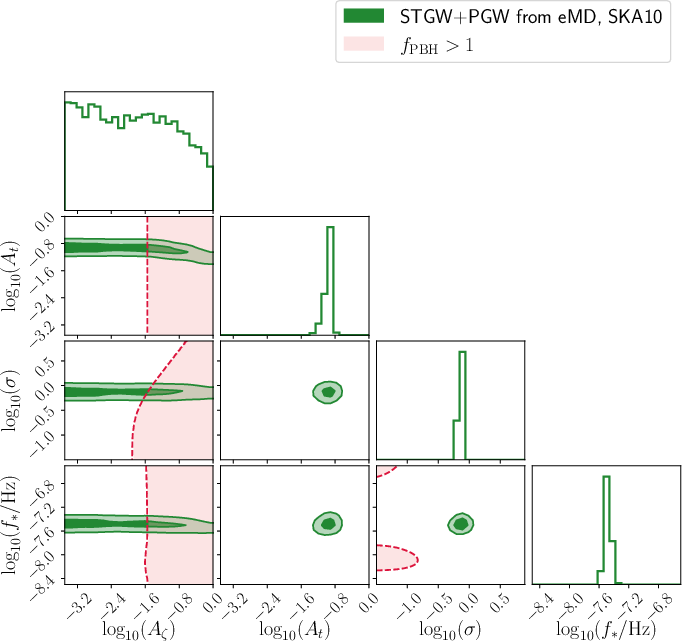
Figure 4: Posterior constraints for SKA10 on STGWs generated in eMD, with and without added PGW contributions. Shaded regions indicate PBH-excluded parameter space.
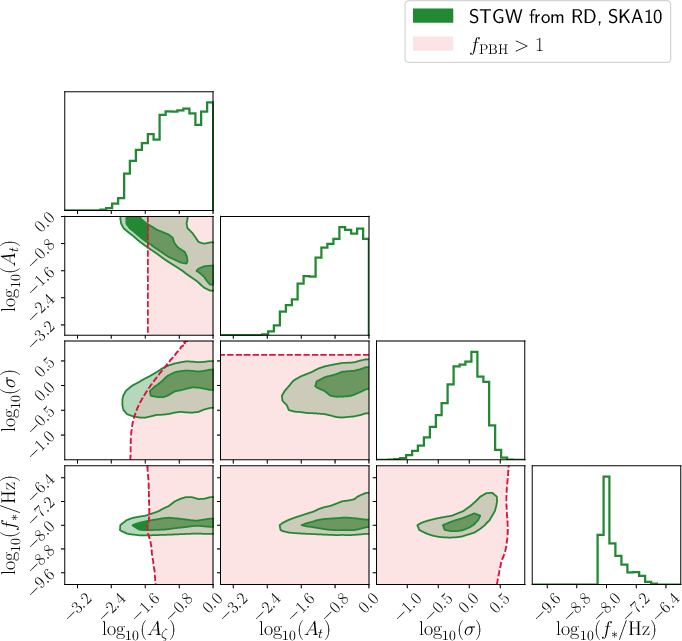
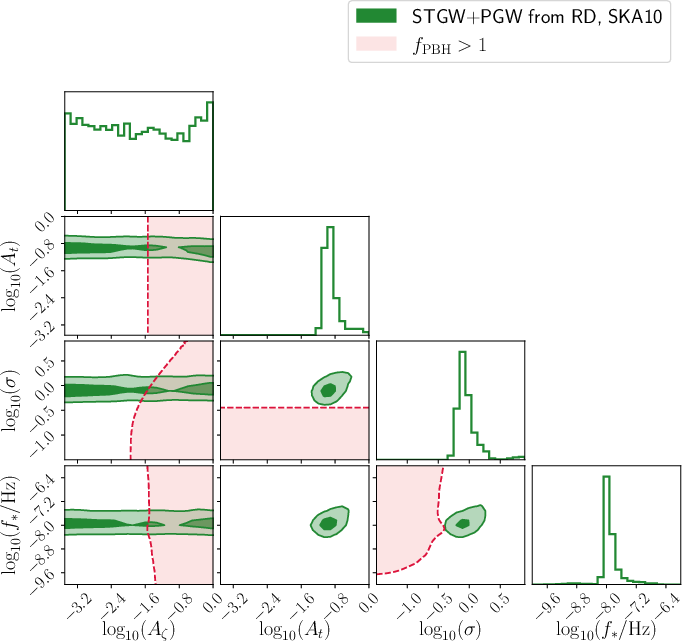
Figure 5: SKA10 parameter estimation for RD-produced STGWs, with the left panel excluding and the right including PGWs. PBH overproduction mainly constrains the scalar amplitude.
The analysis imposes strong constraints on allowed scalar amplitude and width by requiring fPBH<1, reflecting that overproduction of PBHs is generically anticipated for broad or high-amplitude primordial spectra. These constraints are especially effective in ruling out parts of parameter space that would otherwise provide viable fits to the observed PTA SGWB signal. Notably, SKA sensitivity enables detection and parameter separation in scenarios where NANOGrav-like data are fundamentally hampered by amplitude degeneracy vis-à-vis PBH bounds.
STGWs offer a diagnostic for the early Universe thermal history. Detection of a narrow, oscillatory structure in the PTA band would strongly favor an eMD or hybrid scenario with a sharp transition, while broader or smoother features would be compatible with RD production.
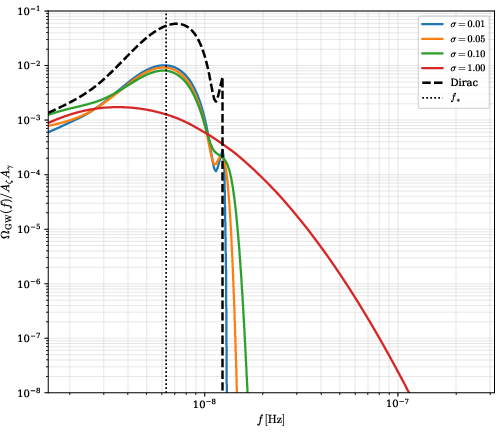
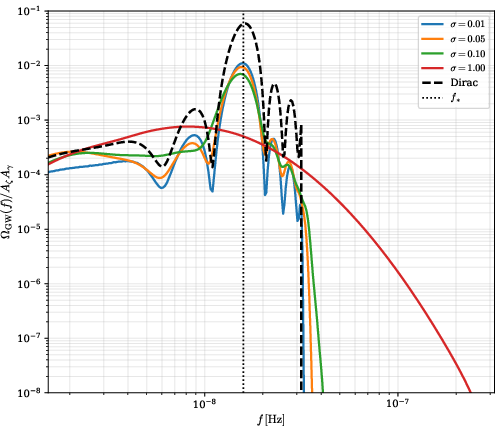
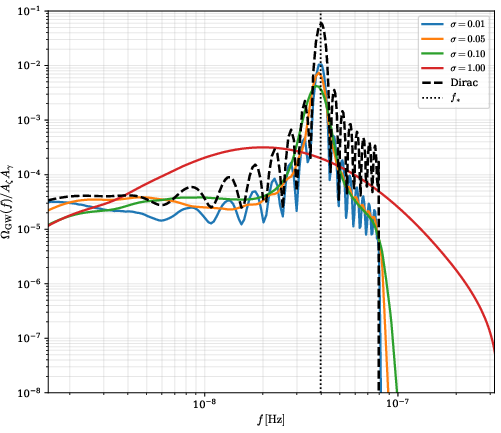
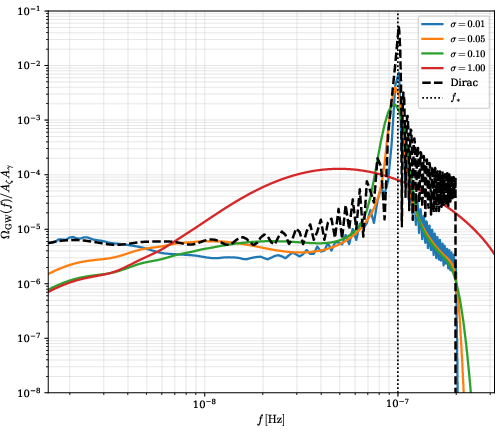
Figure 6: Spectral energy density for STGWs in eMD with various peak locations and widths, highlighting the transition from oscillatory monochromatic signatures to smooth, broad profiles.
Theoretical and Practical Implications
The results clarify that scalar–tensor-induced GW production during a pure MD epoch is negligible at nHz frequencies, while eMD scenarios with sudden transitions can imprint detectable, characteristic features in the GW background. The joint analysis with PBH abundance links the parameter space for GW generation tightly to early-Universe small-scale structure, offering the possibility to probe inflationary model-building, reheating, and nonstandard expansion histories.
The findings imply that upcoming SKA observations will be capable of distinguishing between scalar–tensor- and scalar-induced GW scenarios, and of identifying the signature of exotic thermal histories. The formalism further highlights the necessity of peaked primordial spectra and regularization schemes—flat or extended spectra are excluded due to unphysical enhancements.
Limitations and Future Directions
The analytic results rely on the sudden-transition approximation for eMD→RD and on linear perturbative treatment of density fluctuations; modes entering the nonlinear regime prior to reheating must be excluded by appropriate cutoffs. The scalar–tensor poltergeist mechanism lacks a full analogue of the scalar case due to the distinct evolution of linear tensor modes, warranting further theoretical and numerical investigation. The treatment of third-order (and higher) sources remains an open direction.
The approach could be refined by employing realistic, gradual reheating transitions, more varied primordial spectrum templates, and alternative matching conditions for tensor perturbations across cosmological epochs.
Conclusion
This study reconstructs and extends the formalism for STGW generation across cosmological epochs, delivering robust analytic and numerical predictions relevant for ongoing PTA observations and upcoming SKA sensitivity. Key findings are:
- In a pure MD epoch, STGWs rapidly dilute and are observationally irrelevant for nHz frequencies.
- An eMD epoch, terminating in a sudden transition to RD, leads to nonvanishing, sharply peaked GW signals with distinctive oscillatory structure, which can contribute significantly to the observed SGWB.
- Peaked primordial power spectra are necessary to avoid theoretical pathologies and match observational signatures.
- The parameter space relevant for observable SGWBs is tightly constrained by the requirement of avoiding PBH overproduction, especially for high amplitudes and broad peaks.
- Future SKA measurements will be able to efficiently disentangle the scalar and tensor sectors and differentiate between RD and eMD-induced GW backgrounds.
The methodology and results herein delineate both the opportunities and theoretical constraints for interpreting nHz GW observations, underscoring the interplay between early-Universe microphysics, gravitational wave cosmology, and multi-messenger probes of PBHs.
Reference: "Probing Scalar-Tensor-Induced Gravitational Waves in the nHz Band: NANOGrav and SKA" (2604.13012)

