Boosting Visual Instruction Tuning with Self-Supervised Guidance
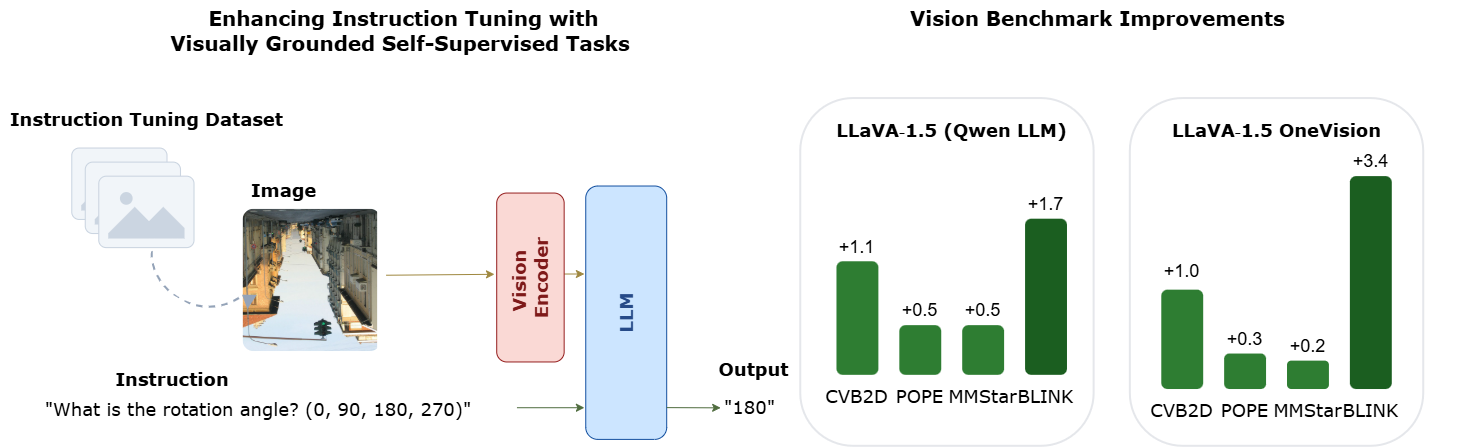
Abstract: Multimodal LLMs (MLLMs) perform well on many vision-language tasks but often struggle with vision-centric problems that require fine-grained visual reasoning. Recent evidence suggests that this limitation arises not from weak visual representations, but from under-utilization of visual information during instruction tuning, where many tasks can be partially solved using language priors alone. We propose a simple and lightweight approach that augments visual instruction tuning with a small number of visually grounded self-supervised tasks expressed as natural language instructions. By reformulating classical self-supervised pretext tasks, such as rotation prediction, color matching, and cross-view correspondence, as image-instruction-response triplets, we introduce supervision that cannot be solved without relying on visual evidence. Our approach requires no human annotations, no architectural modifications, and no additional training stages. Across multiple models, training regimes, and benchmarks, injecting only a small fraction (3-10%) of such visually grounded instructions consistently improves performance on vision-centric evaluations. Our findings highlight instruction tuning with visually grounded SSL tasks as a powerful lever for improving visual reasoning in MLLMs through simple adjustments to the training data distribution. Code available at: https://github.com/sirkosophia/V-GIFT
Paper Prompts
Sign up for free to create and run prompts on this paper using GPT-5.
Top Community Prompts
Explain it Like I'm 14
What is this paper about?
This paper looks at how to make image–text AI models better at truly “looking” at pictures when they answer questions. These models, called multimodal LLMs (MLLMs), are good at chatting about images but often rely too much on language guesswork instead of actual visual evidence. The authors propose a simple trick: mix a small number of vision-only practice problems into the model’s training so it must pay attention to the image to succeed. They call this approach V-GIFT.
What questions are the researchers asking?
- Can we get image–text models to use visual information more, not just language patterns?
- Is there a simple, low-cost way to do this without changing the model’s design or needing human labels?
- How much of this visual practice is needed to make a difference?
- When is the best time to add this practice during training?
- Do these improvements really come from better visual grounding, not just from training longer?
How did they do it? (Simple explanation of the method)
Most image–text models are trained in two steps:
- they learn to connect pictures with words, and
- they practice following instructions (like answering questions about images).
The problem: many training questions can be partly solved by “smart guessing” from text alone (language priors), without really looking at the picture.
The fix: add a small number (about 3–10%) of special, vision-only tasks into the instruction-following practice. These tasks are written as normal instructions and answers, but they cannot be solved without looking carefully at the image. No human labeling is needed; everything is generated automatically.
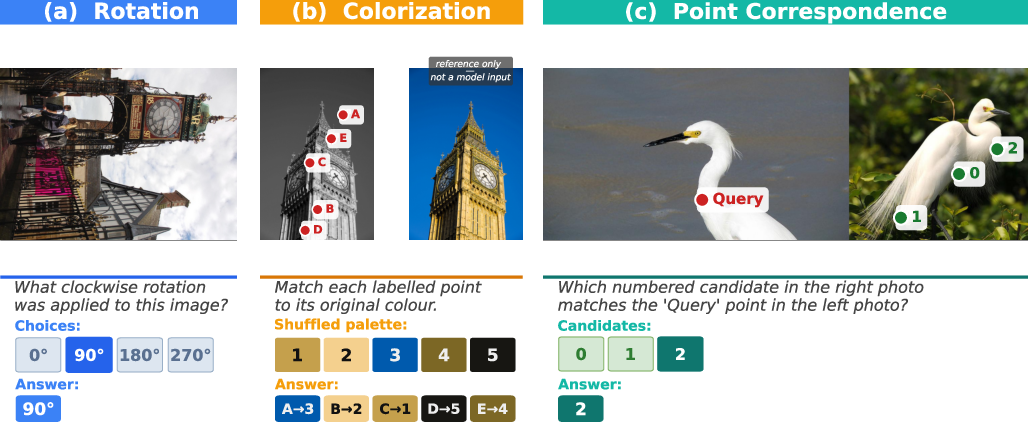
Here are the three types of tasks they use:
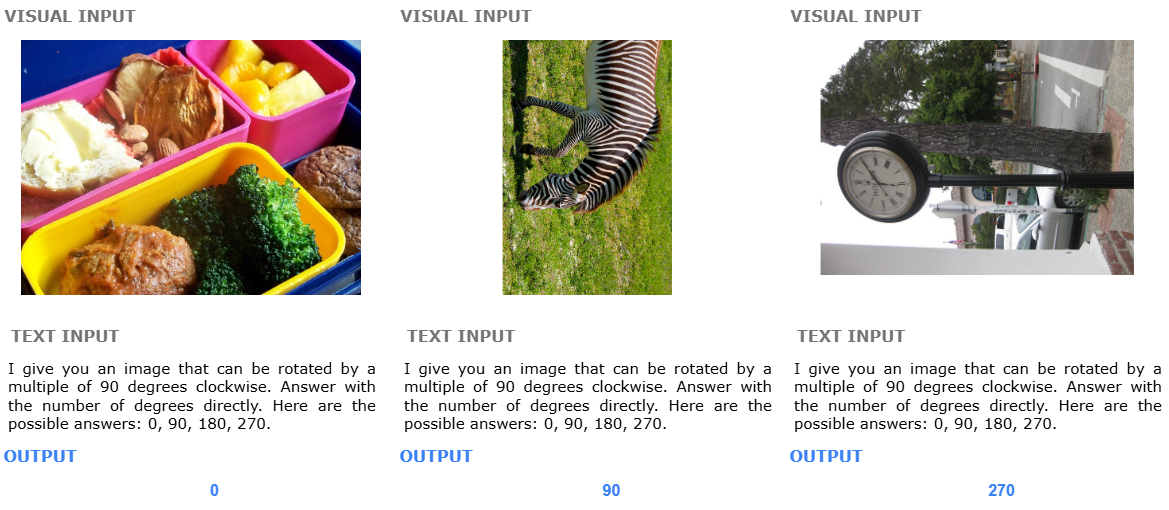
- Rotation prediction: Show a picture that has been rotated and ask, “By how many degrees is this image rotated?” The model must look at the objects’ orientation to answer.
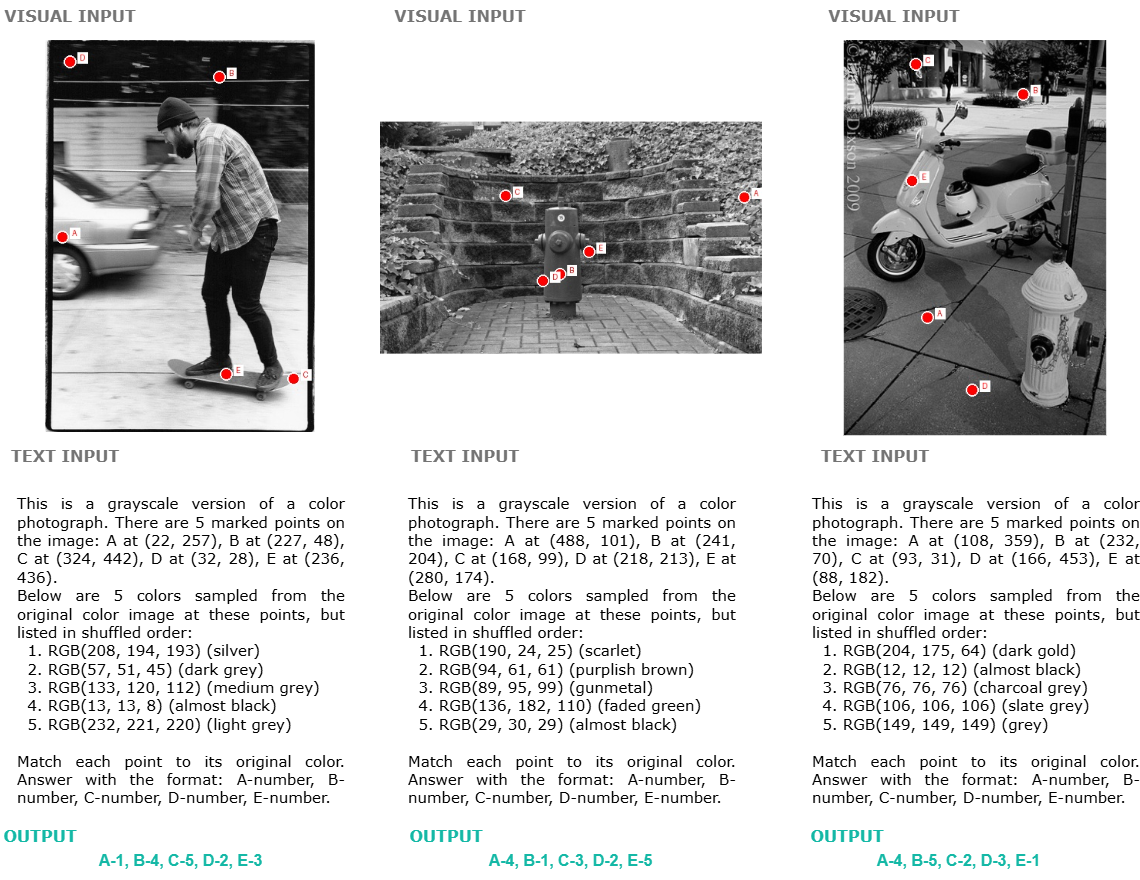
- Color matching: Show a grayscale image with a few labeled points (A, B, C…) and give a small list of possible colors. Ask “Which color did each point have in the original color image?” The model must connect location and appearance to the correct color.
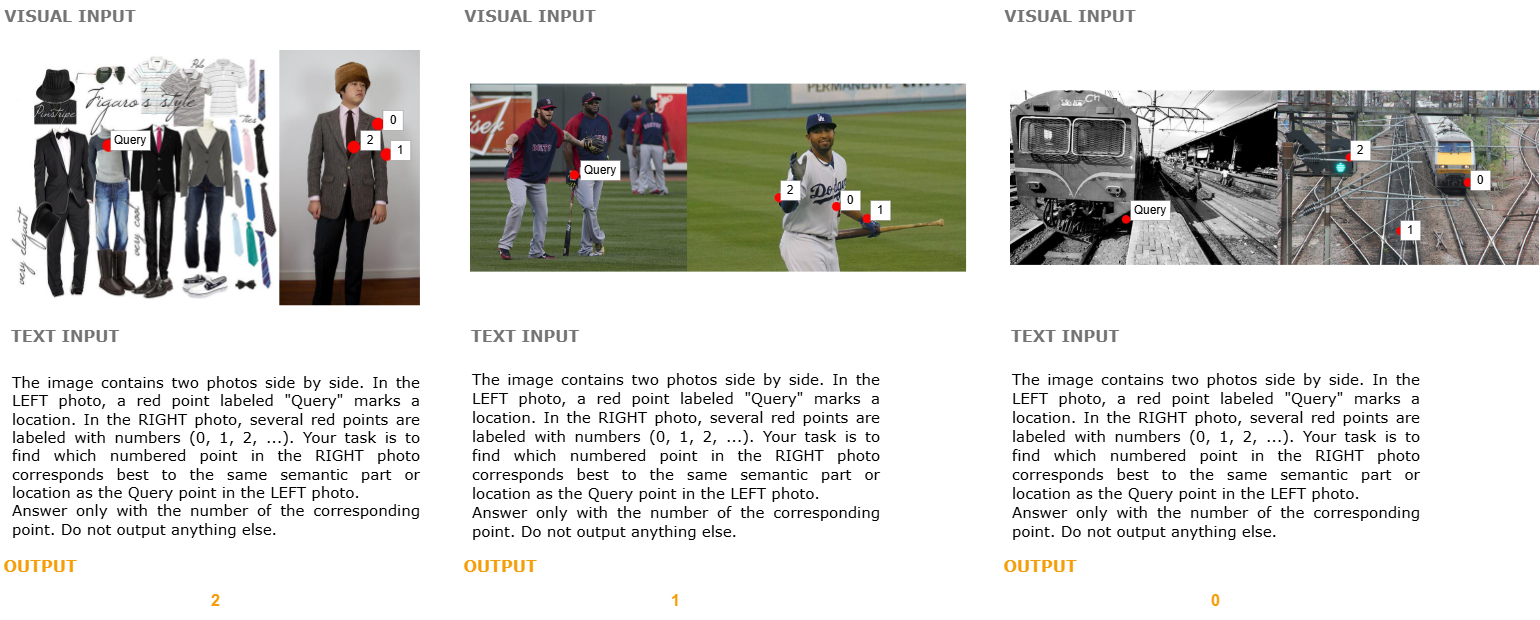
- Point correspondence: Show two pictures of the same object from different views. Pick a point in the first image and ask which point in the second image matches it among a few choices. The model must find the same spot across views.
They simply add these “image–instruction–answer” examples into the usual training set and keep training the model exactly the same way—no new losses, no new layers, no extra training stage.
What did they find, and why does it matter?
Main results:
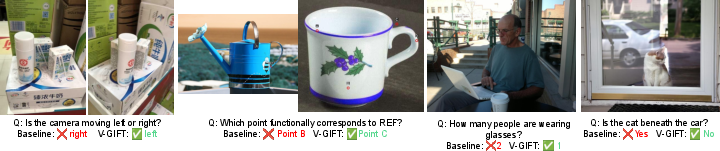
- Consistent gains on vision-heavy tests: Models trained with V-GIFT did better on benchmarks that test fine visual skills (like counting objects, understanding spatial relations, or matching details). This held across different model families and sizes.
- Works even with tiny amounts: Adding only 3–10% of these vision-only tasks improved performance. More than that didn’t always help.
- Not just “more compute”: When they trained longer without these visual tasks, performance did not improve. The gains come from better training data, not extra training time.
- Best timing: Mixing the visual tasks during instruction tuning worked best. Doing them before had little effect, and doing them after sometimes hurt performance.
- Data source flexibility: Even creating tasks from just one image (by making many cropped/augmented views) helped, showing that the type of supervision (vision-forcing) matters more than having a huge new dataset.
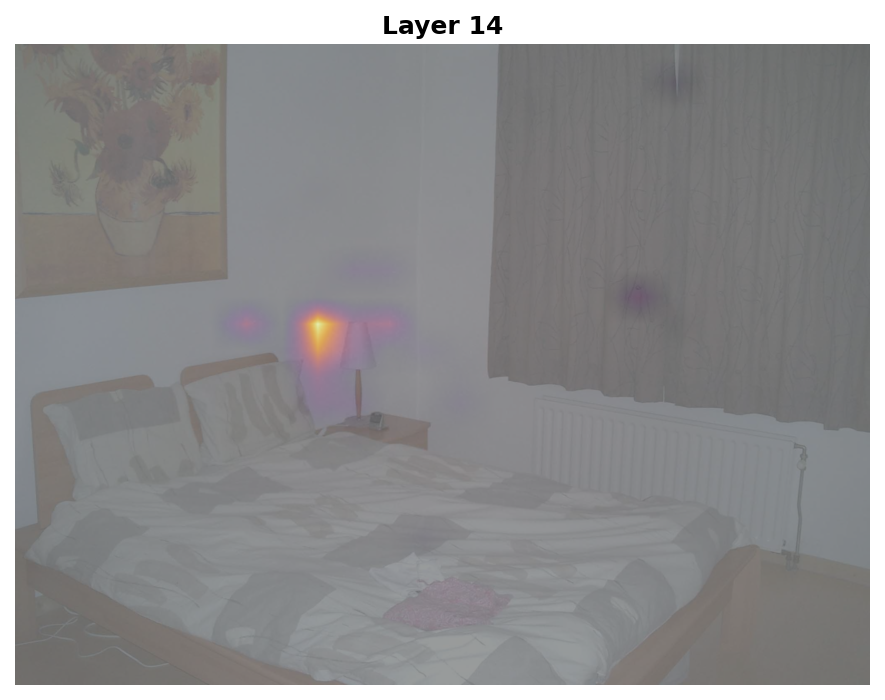
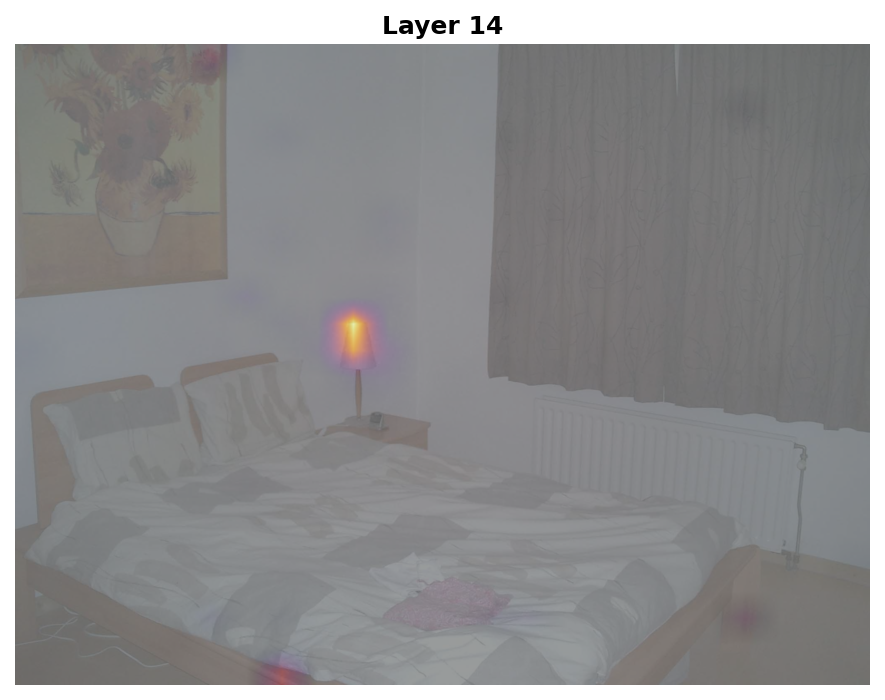
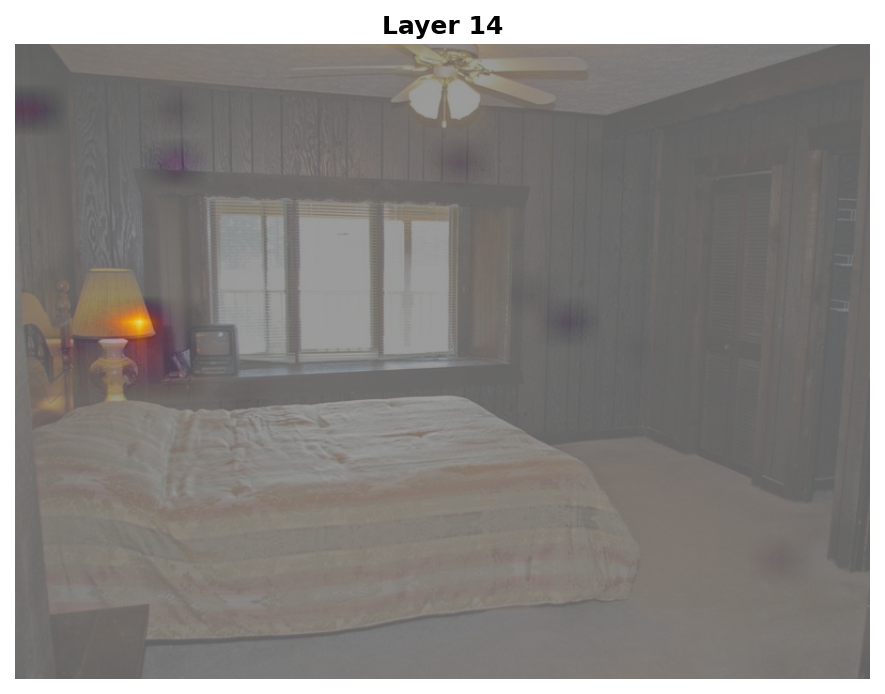
- Better visual grounding: Analysis showed the models relied less on language-only shortcuts and focused attention more precisely on relevant parts of the image.
Why it matters:
- It shows that the main bottleneck isn’t the model’s ability to “see,” but how training encourages it to use what it sees.
- A small, simple change to training data can make models more trustworthy on tasks that need real visual understanding.
What is the impact of this research?
This work is a low-cost, plug-and-play way to make image–text models more visually grounded:
- No human annotations needed.
- No changes to the model architecture.
- No extra training stages or complicated tricks.
It suggests that improving what models learn from (data) can be as powerful as changing how they learn (losses/architectures). In the future, this idea could be extended to other types of inputs, like 3D data or audio, to encourage models to rely on the right signals for the right tasks.
Knowledge Gaps
Knowledge gaps, limitations, and open questions
Below is a consolidated list of what remains missing, uncertain, or unexplored in the paper, phrased to guide actionable follow-up research:
- Task diversity and generality: Only three SSL tasks (rotation, point-wise colorization, point correspondence) are studied. It remains unclear which broader set of pretext tasks (e.g., masked image modeling, jigsaw, relative position, patch ordering, contrastive instance discrimination, prototype clustering) are most effective for visual grounding in instruction tuning and whether combinations beyond the three used here yield larger or more stable gains.
- Task difficulty calibration: The chosen SSL tasks are largely short-answer, low-entropy classification. How performance and transfer change with harder, more open-ended or compositional vision-forcing tasks (e.g., free-form color naming without candidates, 3D pose/orientation regression, dense correspondence sets, geometric reasoning with multiple objects) is untested.
- Negative side effects and trade-offs: Preliminary general-benchmark results show mixed changes (e.g., small drops on OCRBench for some configurations, BLINK drop for Vicuna). A systematic audit of trade-offs (reasoning fluency, long-form generation, hallucination, helpfulness, and safety) is missing.
- Impact on long-form and chain-of-thought visual reasoning: The paper measures short-answer accuracy but does not evaluate whether SSL injection improves multi-step, multi-sentence visual reasoning or chain-of-thought quality where visual tokens influence intermediate steps.
- Robustness and OOD generalization: Effects on robustness to distribution shifts (e.g., unusual viewpoints, occlusions, lighting, stylized images), common image corruptions, adversarial perturbations, and spurious textual cues are not evaluated.
- Multi-image and temporal reasoning: While a point-correspondence task involves two images, broader multi-image reasoning (e.g., cross-image logical inference) and extension to video MLLMs with temporal SSL tasks (e.g., order prediction, temporal correspondence) remain unexplored.
- Scaling to larger/other architectures: Experiments cover LLaVA-1.5 (Vicuna/Qwen) and OneVision-1.5. Generality to much larger LLMs (≥34B), cross-attention architectures (e.g., Flamingo-like), multi-encoder systems, and non-CLIP visual backbones is untested.
- Vision encoder finetuning interplay: The paper does not isolate how SSL injection interacts with whether (and how much) the vision encoder is fine-tuned during instruction tuning. A controlled study comparing frozen vs. unfrozen visual backbones is missing.
- Mechanistic understanding: Beyond qualitative attention maps and limited TVI scores, deeper analyses (e.g., attribution of logit contributions to visual tokens, cross-modal attention entropy, probing classifiers on visual features within the LLM) are absent.
- Statistical significance and variance: Results are averaged over three seeds but lack error bars and statistical tests. Whether reported improvements exceed run-to-run variance consistently across datasets remains unclear.
- Scheduling and curriculum strategies: Only uniform mixing is explored. The effect of curricula (e.g., increasing/decreasing SSL ratio over time), interleaving schedules, or adaptive sampling based on model confidence/utilization is not studied.
- Prompting and instruction phrasing: SSL instructions appear templated. The sensitivity of gains to instruction phrasing diversity, multilingual instructions, and few-shot exemplars is untested.
- Hyperparameters of SSL tasks: Design choices such as number of points K, neighborhood size r, color distinctness threshold δ, number of rotation bins, and number/placement of correspondence distractors are not ablated for sensitivity or optimal settings.
- Candidate-list bias in colorization: Using enumerated RGB candidates may constrain the task format. Whether free-form color prediction or color-word generation (without candidates) still yields benefits—or introduces new failure modes—remains unknown.
- Ambiguity handling and filtering: Rotation can be ambiguous (e.g., symmetric objects); color at a pixel may be ill-defined due to shading/specularities. The paper does not discuss ambiguity detection, filtering, or its effect on label noise and learning.
- Data source and coverage for correspondences: The correspondence task depends on image pairs depicting the same instance with pseudo masks and DINOv2 features. The acquisition pipeline’s scalability, coverage across categories, and failure cases (e.g., wrong pseudo masks, low-texture regions) are not quantified.
- Compute and memory transparency: While “marginal” overhead is claimed for small ρ, detailed wall-clock time, memory footprint, throughput, and energy usage across ratios and models are not reported. Practical budget guidance is missing.
- Optimal ratio selection and transferability: Ratio optima differ across models (10% for LLaVA-1.5-Qwen vs. 3% for OneVision-1.5). There is no principled method to choose ρ a priori or adapt it during training; portability of optimal ratios across datasets and scales is untested.
- Catastrophic forgetting management: Injecting SSL after instruction tuning harms performance despite using LoRA. Strategies to avoid forgetting (e.g., rehearsal, elastic weight consolidation, interspersed instruction replay) are not explored.
- Combination with other vision-utilization methods: Interactions with auxiliary losses (e.g., reconstructive/feature-distillation), RLVR approaches, or stronger projectors are largely untested. Whether effects are additive, redundant, or conflicting remains open.
- Safety and bias implications: Colorization tasks may entrench dataset color priors; rotation sensitivity could bias interpretations for culturally or context-dependent orientations. The paper does not assess demographic biases, fairness, or safety impacts.
- Evaluation breadth on vision-centric tasks: Benchmarks are limited (CVB-2D, POPE, MMStar, BLINK). Transfer to broader, specialized tasks (e.g., TextCaps, TallyQA, GQA, VizWiz, SQA, GeoVAQA) and real-world counting/spatial datasets is not assessed.
- Language and multilingual generalization: All experiments appear English-only. Whether SSL injections improve or interfere with multilingual multimodal instruction-following is unknown.
- Long-context and multi-turn dialogue: The method’s effect on multi-turn image-grounded conversations, context carryover, and retrieval-augmented settings (with interleaved images and text over long contexts) is not evaluated.
- Data contamination/leakage checks: Some SSL images reuse COCO. The paper does not audit potential overlap with evaluation sets or text leakage via captions derived from the same images.
- Instruction distribution shift: Adding many short-answer, vision-only samples may bias the output distribution toward terse answers. Impacts on verbosity, calibration, and uncertainty expression in general dialogue are not measured.
- Reproducibility of pseudo-label pipelines: The stability of DIP-like pseudo masks, dependence on Stable Diffusion and specific DINOv2 variants, and robustness to different pseudo-labeling toolchains are undocumented.
- Extending beyond images: Though future work mentions 3D and audio, concrete formulations of SSL-as-instructions for point clouds (e.g., rotation/permute parts, neighborhood prediction) or audio (e.g., temporal order, pitch shift detection) and expected cross-modal benefits remain unspecified.
- Failure case characterization: The paper lacks qualitative/quantitative analysis of where SSL injection fails or harms performance (e.g., specific categories, clutter, small objects), which is necessary to refine task design and sampling.
Practical Applications
Immediate Applications
Below are actionable, sector-linked use cases that can be deployed now by adapting existing MLLM training pipelines to inject a small ratio (3–10%) of visually grounded self-supervised (SSL) instruction data (rotation, color matching, point correspondence) during visual instruction tuning.
- Data-centric upgrade to vision-LLM training pipelines (software/AI platforms)
- What: Integrate the paper’s V-GIFT recipe (SSL-instructions mixed during instruction tuning) into existing LLaVA-style or similar MLLM fine-tuning jobs to reduce language-dominant shortcuts and improve visual grounding.
- How: Use the provided code to auto-generate rotation, color-matching, and point-correspondence instruction triplets from existing image corpora; set ρ≈3–10% during instruction tuning; keep architecture/optimizer unchanged.
- Outputs: Better accuracy on counting, spatial relations, and multi-view tasks; reduced hallucinations in vision-heavy prompts.
- Dependencies/assumptions: Access to image data; a VLM/MLLM that supports instruction tuning; small additional compute budget; ensure SSL tasks are mixed during (not before/after) instruction tuning.
- Product image QA and visual assistants (e-commerce, retail, manufacturing)
- What: Boost assistants that answer questions about product photos—e.g., item counts on shelves, color and orientation compliance, detecting mis-rotated labels, or verifying SKU presence.
- How: Fine-tune existing VLMs with V-GIFT on in-domain product imagery; add color-matching and rotation tasks; A/B test with POPE-like hallucination metrics and CVB-style spatial queries.
- Potential tools/workflows: “SSL-instruction generator” to enrich SKU image datasets; automated compliance checks in planogram pipelines; shelf analytics dashboards.
- Dependencies/assumptions: Sufficient product imagery; domain shift mitigation; human QA for edge cases and new SKUs.
- Document layout understanding and OCR QA (software, finance, govtech)
- What: Improve spatial reasoning on scanned documents: detect page rotation, count/form-field presence, verify alignment between multiple page views.
- How: Create SSL rotation tasks for scanned pages; use correspondence tasks across multi-scan/photograph views; LoRA-based adaptation if compute-limited.
- Tools/workflows: Pre-ingestion “rotation audit” for document pipelines; layout verification steps; triage for low-confidence correspondences.
- Dependencies/assumptions: Availability of multi-view or historical scans; robust handling of low-quality scans; privacy controls for sensitive documents.
- Robotic perception for pick-and-place and warehousing (robotics, logistics)
- What: Increase reliability of vision-grounded cues—e.g., detect part orientation, count items, identify correct bin via color and spatial cues.
- How: Train with V-GIFT on robot camera feeds; add rotation and color-matching tasks from unlabeled logs; introduce cross-view correspondences between wrist and overhead cameras.
- Tools/workflows: Data flywheel that generates SSL-instructions from warehouse video; on-the-fly LoRA adapters for new parts.
- Dependencies/assumptions: Sim-to-real gap management; latency budgets if models run on-robot; safety validation in the loop.
- Accessibility-focused visual question answering (assistive tech)
- What: Provide more reliable answers for blind/low-vision users: count objects, locate items (“left/right of”), identify color-coded signals.
- How: Apply V-GIFT to fine-tune general-purpose VLMs using everyday scenes; prioritize color and spatial tasks relevant to navigation and object finding.
- Tools/workflows: On-device or edge inference pipelines; prompt templates focusing on spatial queries; user feedback loops to flag errors.
- Dependencies/assumptions: Privacy safeguards; diverse training images; careful UX to manage residual uncertainty.
- Image safety and content policy enforcement (trust & safety)
- What: Reduce hallucinations in claim verification (e.g., “Does the image show three people?”) and improve visual evidence grounding.
- How: Add targeted SSL tasks to policy models to improve precision on object presence/absence and orientation queries; monitor TVI-like metrics.
- Tools/workflows: Vision-grounded evaluation checklists (POPE, CVB-2D); automated failover to human moderation for borderline cases.
- Dependencies/assumptions: Governance on false positives/negatives; curated escalation paths; bias audits on people/scene content.
- STEM and spatial reasoning tutors (education/edtech)
- What: Build tutors that correctly reason about diagrams, angles, rotations, and correspondences between views of the same object.
- How: Fine-tune with rotation and correspondence SSL tasks derived from synthetic or teacher-created diagrams; integrate with interactive exercise generation.
- Tools/workflows: “Exercise generator” that creates rotation/shape-count tasks; teacher dashboards tracking spatial reasoning wins/failures.
- Dependencies/assumptions: Alignment with curricula; student data privacy; safeguards against model overconfidence.
- Research reproducibility and diagnostics (academia/AI labs)
- What: Establish V-GIFT as a default baseline for vision-centric reasoning studies; use TVI or similar metrics to quantify reliance on visual tokens.
- How: Adopt the paper’s injection ratios and ablations; publish ρ and task mix; report TVI and vision-centric benchmarks in papers.
- Tools/workflows: “Vision-grounded trainer” config toggles; CI tests ensuring SSL is mixed during instruction tuning.
- Dependencies/assumptions: Access to compute for small ratio runs; standardization of metrics across labs.
- MLOps data curation kits (software tooling)
- What: Ship “SSL-Instruct Generator” and “Vision-Grounded Data Mixer” plug-ins to create and inject rotation/color/correspondence tasks into instruction datasets.
- How: Wrap code into pipelines that sample a configurable ρ of SSL items; enforce during-IT mixing; add dashboards that track vision-centric KPIs.
- Dependencies/assumptions: Integration with existing training stacks; license/usage compliance for image sources.
- Everyday camera assistants (consumer apps)
- What: More accurate answers to “How many screws are left?”, “Is this frame upside down?”, “Which swatch matches this wall color?”
- How: Fine-tune open-source vision assistants with V-GIFT on household scenes; enable offline or edge variants for privacy.
- Dependencies/assumptions: Device constraints; privacy settings; guardrails for error reporting and user override.
Long-Term Applications
The following opportunities build on the paper’s core idea (rebalancing supervision with visually grounded objectives) but require further research, scaling, domain adaptation, or regulatory clearance.
- Safety-critical perception in healthcare and autonomy (healthcare, automotive, aerospace)
- What: Increase trustworthiness of multimodal assistants that must rely on visual evidence—e.g., lesion counting, catheter orientation, instrument counts in ORs; situational awareness in autonomy.
- How: Extend V-GIFT with medically/operationally meaningful SSL tasks (domain-specific rotations, anatomical/part correspondences); co-train with verified supervision or RL with verifiable rewards.
- Dependencies/assumptions: Clinical validation, regulatory approvals, rigorous bias/risk assessments; domain-specific encoders; robust multi-view/video support.
- Multi-view/video reasoning products (media analytics, security, sports)
- What: Track correspondences across frames and viewpoints for player tracking, incident summarization, or object re-identification.
- How: Generalize point-correspondence tasks to temporal settings; mix SSL video tasks (cycle consistency, motion-aware correspondences) during instruction tuning.
- Dependencies/assumptions: Scale of video datasets; temporal grounding evaluations; privacy and consent for surveillance use cases.
- 3D and AR assistants with robust spatial grounding (AR/VR, CAD/CAM, industrial assembly)
- What: Guide users through assembly or maintenance with precise 3D reasoning, pose estimation, and part identification across views.
- How: Extend V-GIFT to 3D point-cloud or mesh-based SSL tasks (e.g., rotation/pose estimation, cross-view 2D–3D correspondences); integrate with SLAM and CAD models.
- Dependencies/assumptions: 3D-capable encoders; real-time constraints; accurate alignment between 2D cameras and 3D models.
- Drone and infrastructure inspection (energy, utilities, telecom)
- What: Identify component states/colors/orientations and track changes across inspection flights; reduce false positives in defect detection.
- How: Train with correspondence and rotation SSL tasks using unlabeled inspection imagery; combine with anomaly detection.
- Dependencies/assumptions: Domain shift across lighting/weather; dataset curation at scale; regulator acceptance of AI-assisted inspections.
- Retail and logistics digital twins (retail tech, supply chain)
- What: Planogram compliance and stock tracking across stores/cameras, matching items across views and time with fewer hallucinations.
- How: Blend V-GIFT with tracking and re-ID objectives; incorporate multi-camera correspondences into instruction tuning.
- Dependencies/assumptions: Consistent camera placements; privacy constraints; integration with POS/ERP systems.
- Finance and insurance visual claims analysis (finance/insurtech)
- What: Compare claim images to prior records, validate item counts and damage orientation; reduce hallucinations in decision support.
- How: Domain-adapt V-GIFT with correspondence tasks across pre-/post-event images; combine with structured policy logic.
- Dependencies/assumptions: Human-in-the-loop review; audit trails; bias and fairness audits for sensitive claims.
- Geospatial cross-view reasoning (geospatial intelligence, agriculture)
- What: Align aerial/satellite images across time or sensors, detect orientation changes, and perform consistent counting.
- How: Adapt SSL tasks to multi-sensor correspondences and large-scale tiling; add domain-specific augmentations.
- Dependencies/assumptions: Sensor variation and scale; labeling scarcity; QA against ground truth (where available).
- Privacy-preserving on-device multimodal assistants (edge AI, wearables)
- What: Deliver visually grounded assistants on constrained devices (e.g., Qwen-3–7B variants) with reduced hallucinations.
- How: Parameter-efficient V-GIFT (LoRA) on-device datasets; mixed precision/quantization; small-ρ SSL mixing.
- Dependencies/assumptions: Memory/compute limits; thermal and power budgets; robust on-device data governance.
- Standards and policy for visual grounding (public sector, standards bodies)
- What: Procurement and compliance frameworks that require evidence of visual grounding and hallucination control in MLLMs used for public services.
- How: Develop benchmark suites (e.g., POPE, CVB-2D, BLINK) plus TVI-like metrics as reporting requirements; encourage disclosure of SSL mixing ratios and evaluation results.
- Dependencies/assumptions: Cross-agency coordination; avoiding overfitting to benchmarks; periodic re-certification.
- Automated “visual grounding balancer” in MLOps (platforms, tooling)
- What: A training-time service that monitors language-vs-vision reliance drift and automatically injects SSL-instructions to re-calibrate models.
- How: Integrate TVI-like metrics and vision-centric evals into CI/CD; dynamically adjust ρ and task mix during training.
- Dependencies/assumptions: Reliable drift detectors; safeguards against catastrophic forgetting; governance for auto-tuning.
- Cross-modal extensions beyond vision (audio, tactile for robotics)
- What: Apply the same principle—inject inherently modality-dependent tasks during instruction tuning—to force reliance on audio/tactile cues.
- How: Design SSL audio/tactile pretexts as instruction triplets (e.g., sound event ordering, contact pattern correspondences) and mix during multimodal instruction tuning.
- Dependencies/assumptions: Mature encoders for non-visual modalities; synchronized data collection; evaluation protocols.
These applications hinge on the paper’s core finding: small, strategically mixed, visually grounded SSL tasks—added during instruction tuning—consistently enhance vision-centric reasoning without architecture changes or extra training stages. Feasibility depends primarily on access to relevant images, careful control of the injection ratio ρ, domain adaptation, and robust evaluation/monitoring to ensure the gains translate to the target environment.
Glossary
- Adapter: A lightweight module inserted to map or adapt features between components, often used to connect vision encoders to LLMs. "with a lightweight adapter (MLP \cite{liu2023visual} or Q-former-like \cite{li2023blip})"
- Attention map: A visualization of where a model focuses its attention over an image when generating or answering. "Attention map from the Baseline (LLaVA-1.5-Vicuna-7B) and V-GIFT on CV-Bench2D examples."
- Autoregressive cross-entropy training: Training that minimizes cross-entropy while predicting the next token conditioned on previous tokens (and possibly images). "We retain standard autoregressive cross-entropy training"
- Autoregressive language modeling objective: An objective where the model predicts each token in a sequence given prior tokens (and possibly visual input). "The model is optimized with an autoregressive language modeling objective:"
- Auxiliary losses: Additional loss terms used alongside the main training objective to inject extra supervision. "without requiring auxiliary losses, architectural changes, or expensive RLVR pipelines."
- Catastrophic forgetting: The tendency of a model to lose previously learned capabilities when trained on new tasks without safeguards. "Injecting SSL after instruction tuning causes significant performance degradation due to catastrophic forgetting."
- CLIP: A vision-LLM that learns joint image–text representations via contrastive training, often used as a vision encoder. "modern encoders such as CLIP~\cite{radford2021learning}"
- Contrastive learning: A self-supervised paradigm that learns representations by bringing related samples closer and pushing unrelated ones apart. "including contrastive learning~\cite{he2020momentum, wu2018unsupervised, chen2020improved, chen2020simple}"
- Cross-attention: An attention mechanism that allows one modality (e.g., text) to attend to another (e.g., vision) via specialized layers. "visual features are injected via dedicated cross-attention layers"
- Cross-view correspondence: The task of identifying matching points or regions across different views of the same object or scene. "such as rotation prediction, color matching, and cross-view correspondence, as imageâinstructionâresponse triplets"
- Dense feature similarity: Matching or comparing points using per-pixel (dense) feature vectors rather than global features. "via dense feature similarity"
- DINOv2: A self-supervised vision model producing strong features for downstream tasks, often used for dense descriptors. "dense DINOv2~\cite{oquab2023dinov2} features."
- DIP: A referenced method/framework used here to guide point correspondence supervision. "Following DIP~\cite{sirko2025dip}"
- Jigsaw puzzle solving: A self-supervised pretext task where image patches are permuted and the model predicts the correct order. "and jigsaw puzzle solving has been adapted as a post-training objective within RLVR frameworks~\cite{wu2026visual, wang2025jigsawr1}"
- Language priors: Statistical regularities in text that a model can rely on to guess answers without truly using visual input. "language priors alone"
- LoRA: Low-Rank Adaptation, a parameter-efficient fine-tuning technique that injects low-rank updates into weight matrices. "parameter-efficient adaptation using LoRA~\cite{hu2022lora}"
- Masked image modeling: A self-supervised task where parts of an image are masked and the model learns to reconstruct or predict them. "masked image modeling~\cite{he2022masked}"
- Mid training stage: An additional training phase inserted between pretraining and instruction tuning to inject extra knowledge. "introducing a mid training stage~\cite{an2025llava}"
- MLLMs: Multimodal LLMs that can process and reason over both text and images. "MLLMs have emerged as a natural extension of LLMs to modalities beyond text"
- Modality competition: A training dynamic where one modality (e.g., language) can dominate, reducing reliance on another (e.g., vision). "we reinterpret instruction tuning as a modality competition process"
- Parameter-efficient adaptation: Fine-tuning techniques that modify a small subset of parameters (or add small modules) instead of all model weights. "a parameter-efficient adaptation approach"
- Pretext tasks: Synthetic, annotation-free tasks used in self-supervised learning to induce useful representations. "self-supervised pretext tasks"
- Projection-based models: Architectures that project visual features into the LLM’s embedding space rather than using cross-attention integration. "In projection-based models, exemplified by LLaVA~\cite{liu2023visual, liu2024improved}"
- Projection module: A component that maps visual embeddings into the LLM token embedding space. "a lightweight projection module that maps visual features into the language embedding space"
- Prototype-based clustering: A self-supervised approach that groups features around learned prototypes to structure representation space. "prototype-based clustering~\cite{caron2020unsupervised, gidaris2020learning}"
- Pseudo-segmentation masks: Automatically generated masks approximating object regions without human labels. "pseudo-segmentation masks obtained with Stable Diffusion~\cite{ssd1b}"
- Q-Former: A query-based transformer module (popularized in BLIP-2) used to extract compact visual tokens; referenced here as a compatible adapter style. "Q-former-like \cite{li2023blip}"
- Reinforcement learning with verifiable rewards (RLVR): RL setups where rewards are constructed from verifiable signals (e.g., puzzles with known solutions). "reinforcement learning with verifiable rewards (RLVR)"
- Rejection sampling: A technique to sample items meeting a constraint by discarding those that fail a criterion. "using rejection sampling, where is a fixed threshold."
- RICE-ViT: A vision transformer backbone variant used as the vision encoder in a cited MLLM. "RICE-ViT~\cite{xie2025region} vision encoder"
- Rotation prediction: A self-supervised task where an image is rotated and the model predicts the rotation angle. "such as rotation prediction~\cite{gidaris2018unsupervised}"
- Self-distillation: A self-supervised approach where a model (teacher) provides targets for another copy (student) without external labels. "self-distillation~\cite{grill2020bootstrap, caron2021emerging, oquab2023dinov2, gidaris2024moca, gidaris2021obow, venkataramanan2025franca}"
- Self-supervised learning (SSL): Learning from unlabeled data by solving automatically constructed tasks to learn useful representations. "Self-supervised learning (SSL) proved to be useful in learning visual representations from unlabeled data through annotation-free pretext tasks."
- Spatial grounding: The model’s ability to associate textual concepts with precise locations or objects in the image. "yielding richer supervision and stronger spatial grounding"
- Stable Diffusion: A generative model used here to obtain auxiliary signals like pseudo-masks. "Stable Diffusion~\cite{ssd1b}"
- TVI: A metric (from prior work) used to quantify reliance on visual information versus language priors. "Mean TVI \cite{long2025understanding} comparison across datasets"
- Vision encoder: The component that converts raw images into visual feature representations. "a pretrained vision encoder"
- Vision–language alignment: The stage or objective of aligning visual and textual representations so they can be processed jointly. "Visionâlanguage alignment pretraining"
- Visual instruction tuning: Fine-tuning on image–instruction–response triplets to teach multimodal instruction following. "visual instruction tuning, models are optimized on imageâinstructionâresponse triplets"
- Visual tokens: The vector representations of visual inputs fed into the LLM as token sequences. "that compel the model to rely on visual tokens, as language priors provide no information"
Collections
Sign up for free to add this paper to one or more collections.