- The paper presents EMBER's key contribution: decoupling LLM reasoning from memory by integrating a biologically-inspired spiking neural network that autonomously triggers actions.
- The novel z-score top-k population coding achieves dimension-independent encoding, retaining 82–84% of concept discrimination even in high-dimensional spaces.
- Empirical results demonstrate rapid associative learning and impulse-driven action selection, with weight consolidation enhanced by episodic replay and cascade-scaled decay.
EMBER: Autonomous Cognitive Behaviour from Learned Spiking Neural Network Dynamics in a Hybrid LLM Architecture
Architectural Overview
EMBER (Experience-Modulated Biologically-inspired Emergent Reasoning) introduces a new cognitive architecture that fundamentally reorganizes how LLMs interface with memory. Departing from the standard retrieval-augmented generation paradigm, which frames memory as an information retrieval problem and relies on explicit queries, EMBER positions a persistent, biologically-plausible spiking neural network (SNN) as the associative substrate. The LLM is decoupled from memory, serving as a replaceable reasoning engine that operates over associations surfaced by the SNN, rather than constructing or searching for associations directly.
The architecture centers on a 220,000-neuron SNN, structured hierarchically with four functional layers: sensory encoding, concept abstraction, category formation, and meta-pattern discovery. It leverages spike-timing-dependent plasticity (STDP) for learning, maintains excitation/inhibition balance via an interneuron layer, and employs reward-modulated synaptic updates. Text input is embedded, encoded into spike patterns using a novel z-score top-k population code, and then injected into the SNN. The SNN forms lateral associations, notably person-topic links, and autonomously propagates activation during idle periods, which can trigger LLM actions without any external prompting.
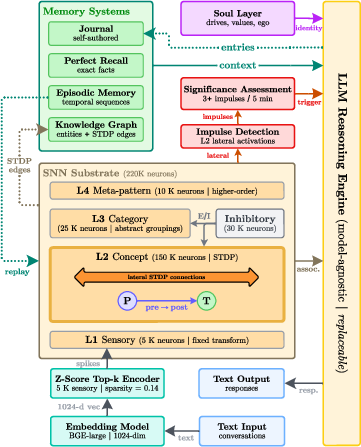
Figure 1: EMBER architecture overview, including text embedding, z-score population encoding, SNN substrate with STDP, and autonomous impulse-triggered action selection.
Z-Score Top-k Population Coding and Sensory Encoding
Traditional population coding techniques suffer from severe dimensionality dependence; power-law sharpening of cosine-similarities loses discriminatory power in high dimensions. EMBER resolves this by employing z-score standardization followed by top-k sparsification, which directly normalizes activation distributions to zero mean and unit variance, maintaining discrimination independent of embedding dimensionality.
At the operating point (s=0.14, N=5000), the z-score top-k code retains 82.2% of the separation between concepts at 1024 dimensions and 83.8% at 384 dimensions. This yields only a 1.6% delta across dimensionalities—demonstrating true dimension-independence. Discrimination retention, defined as the proportion of embedding-space separation preserved in the neural population code, is introduced as a model-independent efficiency metric.
Additionally, the architecture instantiates "person concept cells" modeled after medial temporal lobe units found in human neuroscience. These dedicated neural populations enable robust STDP-based person-topic associations, allowing for relational grounding of individuals and their conversational topics in the SNN substrate. Such associations can laterally propagate during idle periods, producing relational "who would find this interesting?" dynamics without explicit retrieval.
Autonomous Associative Behaviour and Experimental Results
A defining property of EMBER is that SNN-driven lateral propagation can autonomously trigger LLM actions. Autonomous actions (including journaling and unsolicited user reach-outs) are driven by the emergence of "impulses" (concepts firing above baseline via lateral propagation) rather than rule-based triggers.
Empirical results from clean-start experiments demonstrate rapid acquisition of associative behaviour: after only 7 conversational exchanges (14 messages), learned lateral associations enabled the SNN to surface context and autonomously prompt the LLM, without any direct stimulus. Notably, the system initiated contact with a user after person-topic associations propagated during an 8-hour idle period—a behaviour not observed in standard RAG-augmented or journaling memory architectures.
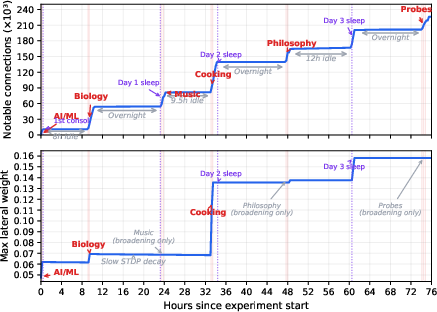
Figure 2: Weight growth trajectory from a clean start, showing step-function increases from conversation and offline consolidation, with persistent topology due to cascade-scaled decay.
Stepwise growth in the number of notable lateral connections was observed, primarily following conversational input and offline consolidation via episodic replay. Consolidation via replay yielded a 5-fold increase in notable weights compared to conversation alone. Weight topology was preserved during extended idle periods, with only weak connections decaying, as predicted by cascade-scaled synaptic consolidation.
Over three days and 52 conversational turns across five domains, the system generated 23 autonomous, impulse-driven actions, including a single reach-out and 22 journal entries. The prevalence of reach-outs versus journals was modulated not by prompt structure but by associative impulse patterns, indicating genuine associative, not scripted, control of behaviour. Ablation studies further established that the SNN facilitates richer, cross-domain association and action diversity than LLM+textual memory alone.
Implications for Cognitive Systems and Associative AI
EMBER’s architectural separation between learned associative memory (SNN) and reasoning/compositionality (LLM) yields several significant theoretical and practical implications:
- Dynamically emergent action selection: Autonomous system behaviour, determined by STDP-driven lateral activity, removes the need for scripting or explicit retrieval triggers, echoing biological memory and spontaneous association.
- Dimension-independent population encoding: By introducing z-score top-k coding, EMBER overcomes dimensionality scaling issues, opening the use of contemporary embedding models in spiking, population-based systems.
- Person-topic relational memory: The implementation of dedicated person concept cells facilitates the dynamic construction and consolidation of social/relational knowledge—an essential component for future social AI systems with persistent identity.
- Efficient memory consolidation: Weight growth trajectories confirm both the efficacy of episodic replay (testing effect) for memory consolidation and the selective retention of strong associations through cascade-scaled decay.
- Adversarial and ethical considerations: The persistent, hard-to-erase dynamics of network associations (e.g., person-topic links) underscore risks analogous to adversarial contamination of LLMs, but amplified through neuro-inspired persistence. This necessitates novel approaches for weight auditing and association quarantine.
Limitations and Future Directions
The study’s empirical scope is limited to single-instance experiments and a single LLM (Claude Sonnet 4.6); multi-run, cross-model, and longitudinal analyses are required for broader generalization. The present work does not address subjective experience or claims of consciousness; rather, it focuses on inspectable, traceable mechanisms. Finally, as associations in the SNN substrate resist decay, strategies for managing deleterious or adversarial connections must be developed for safe deployment.
Future research should explore:
- Scaling up to population-level user studies and diverse conversational domains.
- Systematic cross-LLM architectural validation to tease apart substrate- versus reasoning-engine-driven behaviours.
- Advancements in synaptic auditing and safety constraints for persistent association management.
- Neural-symbolic interface extensions to facilitate explainable reasoning grounded in dynamical, associative memories.
Conclusion
EMBER defines a new paradigm for integrating LLMs with memory by installing the LLM as a replaceable reasoning core within a persistent, autonomously associative SNN substrate. This division enables memory dynamics that are both biologically plausible and operationally distinct from current memory-augmented LLM architectures. The architecture’s z-score population code resolves dimensionality bottlenecks, facilitates robust person-topic associations, and permits idle-state associative propagation to meaningfully shape AI behaviour. Preliminary evidence suggests that this approach provides both richer emergent behaviour and more persistent, interpretable memory associations than LLM-centric or retrieval-augmented systems, thus paving the way for a new class of continual, association-driven cognitive agents.