- The paper demonstrates a novel transpilation pipeline that directly maps OpenQASM 3.0 control constructs to CUDA-Q, avoiding the overhead of static circuit expansion.
- The methodology employs a visitor pattern with a strongly-typed AST, enabling efficient handling of mid-circuit measurements, conditionals, and parameterized workflows.
- Benchmark results validate high-fidelity performance in both static and dynamic circuit simulations, supporting NISQ protocols and adaptive quantum algorithms.
Introduction
The paper "Efficient Transpilation of OpenQASM 3.0 Dynamic Circuits to CUDA-Q: Performance and Expressiveness Advantages" (2604.11599) addresses the lack of performant, expressive compiler infrastructure for converting OpenQASM 3.0 programs—including advanced dynamic circuits—into executable kernels on high-performance quantum simulators such as CUDA-Q. The motivation stems from the growing prevalence of dynamic circuits incorporating mid-circuit measurement and classical feedforward, now essential for NISQ-era protocols such as error mitigation, adaptive phase estimation, and VQE. The proposed approach fills a notable gap by providing a modular, Python-based transpilation pipeline fully supporting OpenQASM 3.0’s new control constructs, mapping them cleanly to CUDA-Q’s C++ and Python APIs, and thereby enabling both high-fidelity simulation and cross-ecosystem validation.

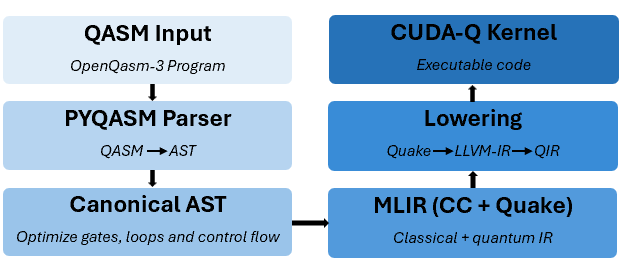
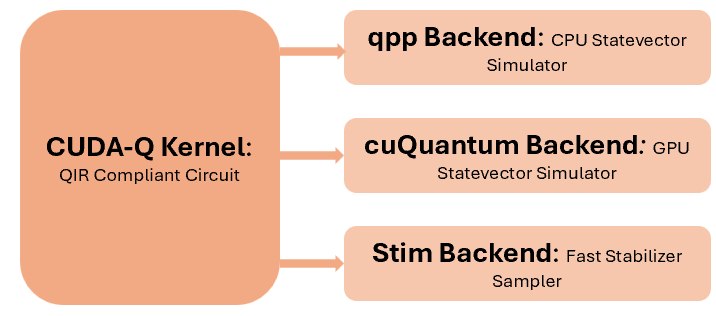
Figure 1: High-level ecosystem integrating user-written OpenQASM 3 circuits, the pyqasm frontend, and the CUDA-Q runtime.
Background and Context
Recent quantum software evolution highlights a migration from static, straight-line circuits towards highly dynamic workflows with extensive mid-circuit feedback and both classical and quantum logic. OpenQASM 3.0, as formalized in [cross22], extends upon previous standards by permitting first-class control flow (conditionals, loops), input parameter declarations, and pulse primitives. However, prevailing toolchains—including Qiskit and circuit-centric transpilers—rarely support the full dynamic feature set at the IR or simulator level, especially when the backend requires a statically-typed, high-performance kernel.
CUDA-Q, built on MLIR and its Quake dialect, is designed for optimal simulation (state-vector, tensor, stabilizer) on both CPU and GPU infrastructure. Prior to this work, robust and transparent integration between OpenQASM 3.0 and CUDA-Q was absent, inhibiting use of GPU acceleration for validating dynamic protocols.
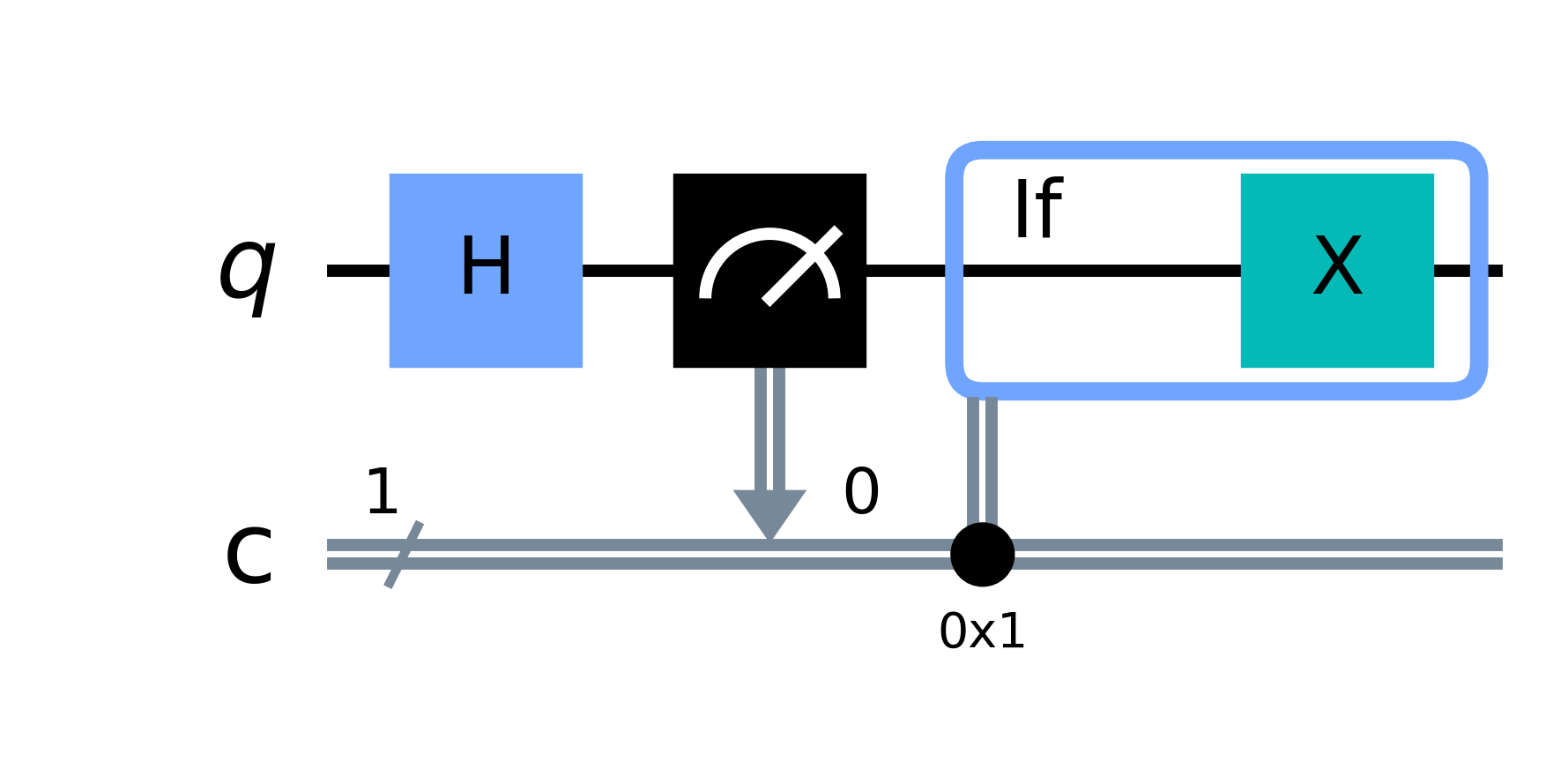
Figure 2: Schematic of the Conditional Reset Protocol. A qubit is prepared in ∣+⟩ using a Hadamard gate, measured mid-circuit, and classically controlled: if the outcome is `1', a Pauli-X gate resets the state to ∣0⟩.
Methodology
The transpiler operates through a multi-phase compilation pipeline. Initially, the pyqasm library is used for precise OpenQASM 3.0 parsing, constructing a strongly-typed AST and resolving compile-time constants, runtime variables, and symbolic classical registers during a symbol table pass. The core logic is structured as a visitor pattern, with a CUDAQVisitor class that traverses the AST and emits CUDA-Q (Python or C++) kernel code.
Crucially, quantum gates, modifiers, and control constructs are systematically translated. OpenQASM gate modifiers such as ctrl and inv are rewritten as calls to CUDA-Q’s functional interface, enabling dynamic construction of controlled or adjoint operations during runtime without static circuit expansion. If-statements in the AST are mapped to CUDA-Q’s kernel.c_if functionality, with classical conditions directly controlling quantum subroutines, dispensing with the traditional approach of branch duplication and thus reducing circuit depth. Input declarations yield kernel parameters, supporting parameter-efficient VQE workflows without repeated recompilation.
The transpiler further enables backend and device-agnostic execution: kernels are emitted for either CPU-based (qpp-cpu) or GPU-accelerated (nvidia/cuQuantum) backends, with optional support for Qiskit as a secondary verification target.
Validation and Numerical Results
Three benchmarking suites were designed: static circuit correctness (Clifford, QFT, Bernstein-Vazirani), dynamic control (conditional reset, teleportation), and hybrid parameterized algorithms (VQE HEA ansatz). For static circuits, bitwise fidelity between CUDA-Q and Qiskit simulations was exact, validating that complex gate modifiers and nested control blocks are preserved through compilation.
Dynamic control was assessed using the conditional reset protocol (see Figure 2): a single-qubit is initialized, measured, and conditionally reset to ∣0⟩. Over 104 shots, the target state was measured with probability exceeding $0.999$, matching theoretical expectation and demonstrating correct translation and execution of mid-circuit feedback. Quantum teleportation was similarly validated.
For hybrid VQE-style compilation, input variables in OpenQASM were mapped to CUDA-Q kernel arguments. This enabled compile-once, run-many execution; parameter updates did not trigger recompilation overhead, and energy expectation values for Hamiltonians such as H=Z0Z1 were found to be correct to within simulation tolerance for all 50 parameter sweeps.
Software Architecture and Practical Implications
The transpiler is packaged as a modular Python library with a Dockerized reference environment, enabling high-performance quantum simulation workflows independent of specialized GPU hardware. This accessibility is key for NISQ-era algorithmic research and prototyping. The framework supports end-to-end OpenQASM 3.0 workflows, from parsing through MLIR lowering to backend execution, and exposes extensibility for future integration with additional simulators (e.g., Stim for stabilizer sampling).
Strong claims include:
- Direct mapping of OpenQASM 3.0 control flow to backend API, completely avoiding static circuit expansion and its associated exponential depth overhead.
- Complete and deterministic validation of dynamic, mid-circuit feedforward circuits.
- No JIT recompilation penalty in parameterized kernel evaluation, optimizing VQE and QML algorithm deployment.
- Enabling of realistic error-correction protocol simulation due to support for true dynamic feedback.
The practical impact is transparent migration from OpenQASM 3.0 IR to high-performance CUDA-Q simulation, including for circuits with complex classical/quantum interaction.
Future Directions
Planned enhancements include support for pulse-level (timing and analog) instructions as OpenQASM 3.0 matures, mapping these to CUDA-Q’s analog kernel interfaces. Another direction is adopting QIR as a primary IR emission target, facilitating broader backend support (beyond NVIDIA hardware), and integrating with density-matrix and tensor backends for robust noise and error analysis. This opens the avenue for in-depth simulation of error-corrected codes beyond idealized statevector frameworks.
Conclusion
This work establishes a comprehensive transpilation pipeline bridging OpenQASM 3.0 and CUDA-Q, thereby equipping researchers with expressive, high-performance tooling for simulating dynamic quantum circuits and hybrid algorithms. The framework’s rigorous AST-to-backend mapping enables precise validation of classical feedforward, parametric runs, and general control flow, supporting near-term algorithm development and pre-hardware validation of error correction. Extensions to pulse-level and noisy simulation protocols are a natural progression, with broader theoretical significance for cross-ecosystem quantum software standardization.