- The paper’s primary contribution is a training-free, dual-branch output-level ensemble that merges a Hybrid+TLC branch for structure with a MambaIRv2 branch for details using scalar-weighted compensation.
- Experimental results on DIV2K show the ensemble improves performance, achieving up to 30.35 dB PSNR and robust high-frequency detail recovery compared to individual branches.
- The method offers a practical, parameter-free upgrade to existing models, reducing engineering overhead and simplifying deployment in SISR scenarios.
Training-Free Output-Level Ensemble for Single-Image Super-Resolution via Strong-Branch Compensation
Introduction
This paper investigates the problem of enhancing single-image super-resolution (SISR) in practical scenarios where multiple pretrained super-resolution (SR) models exhibiting complementary behaviors are already available. Unlike much of the prior art that focuses on either retraining larger networks for higher peak signal-to-noise ratio (PSNR)/structural similarity (SSIM) or on designing novel fusion modules, the work introduces a training-free, dual-branch output-level ensemble. The main branch is built on a Hybrid attention network with Test-Time Local Context (TLC) inference, prioritizing stable structural recovery. A parallel branch deploys MambaIRv2 equipped with geometric self-ensemble for improved high-frequency detail recovery. Outputs from both branches are merged by a single scalar-weighted combination in image space, yielding a simple, deployment-friendly framework with no parameter updates or requirement for new training data.
Methodology
The ensemble architecture consists of two complementary and intentionally asymmetric branches. The base branch leverages a Hybrid network with TLC to deliver stable and robust global structure restoration, critical for minimizing large-scale artifacts and maintaining fidelity across a wide input domain. The strong branch applies MambaIRv2 and geometric self-ensemble (K=8) to target improved high-frequency detail generation. Importantly, compensation is executed directly in the output image domain:
ISR=(1−α)Ibase+αIstrong
where α is a scalar fusion coefficient (typically in [0,1] based on validation performance). This operation preserves all pretrained weights and introduces no additional trainable parameters, perfectly suiting zero-shot model upgrade scenarios. The Hybrid+TLC branch acts as an anchor, ensuring structure stability, while the MambaIRv2 branch injects powerful detail priors that are not trivially recoverable by the base method alone.
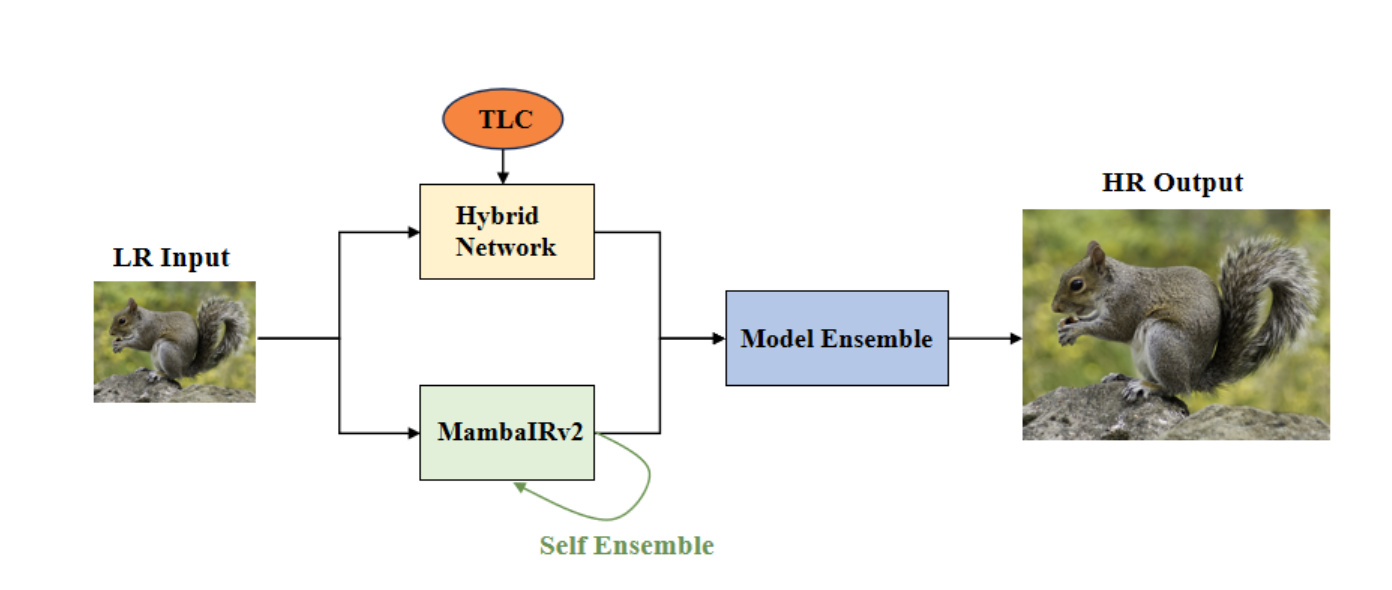
Figure 1: High-level pipeline of the output-level ensemble—Hybrid+TLC for the main prediction, MambaIRv2 for detail, fused by weighted image-space addition.
Experimental Results
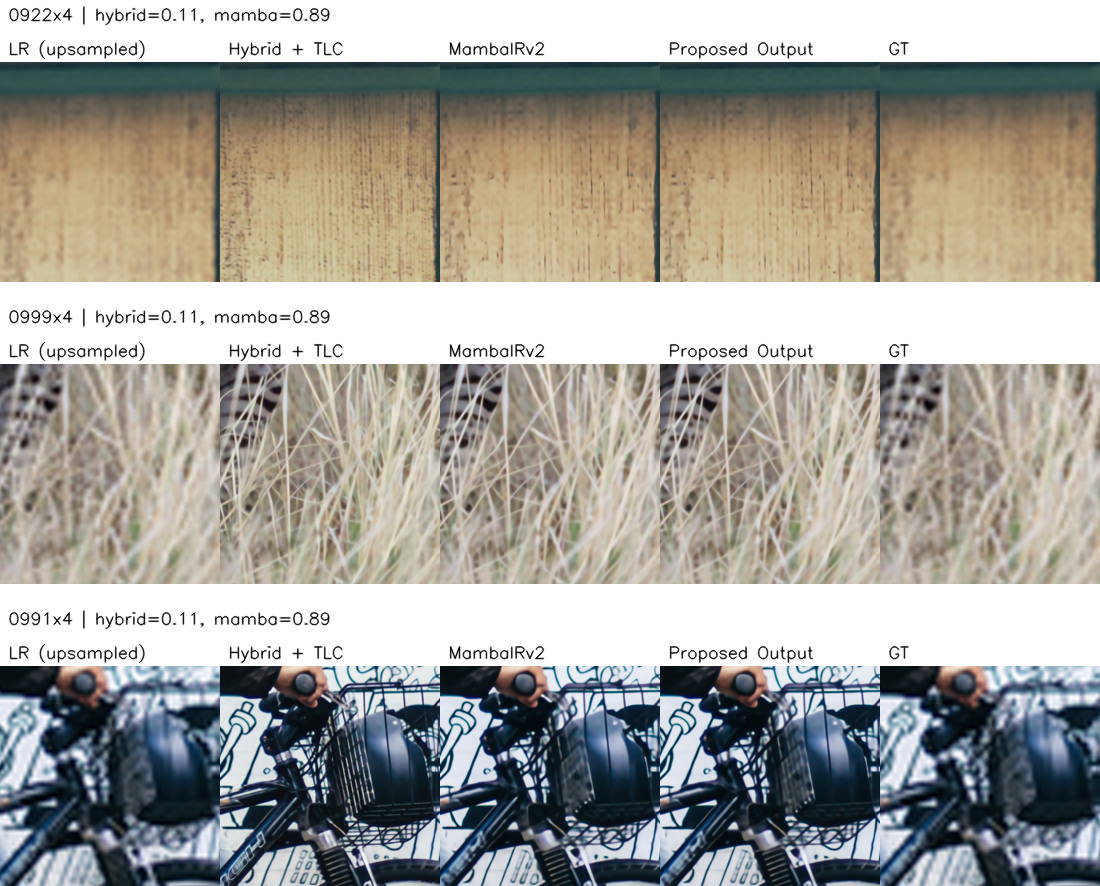
Extensive evaluation on the DIV2K bicubic ×4 dataset demonstrates the effectiveness of the proposed ensemble. On 200 test images, the following quantitative improvements are observed at the optimal weighting ($0.11$ for Hybrid and $0.89$ for MambaIRv2): the base Hybrid+TLC branch yields 29.17 dB PSNR and 0.8548 SSIM, MambaIRv2 with self-ensemble achieves 30.35 dB/0.8805, and the compensated output further increases PSNR to 30.35 dB (a marginal but consistent improvement over the strong branch) with 0.8804 SSIM.
The results confirm two main claims:
Qualitative analyses confirm that the compensated solution maintains the main image geometry from the base branch while integrating sharper local details from MambaIRv2. This property is especially valuable on textured regions (e.g., foliage, fabric, architectural details), where direct reliance on a single method often leads to either oversmoothing or artifact amplification.
Analysis, Implications, and Future Directions
The primary strength of this work is its practicality in the context of model reuse and deployment. When retraining is expensive or infeasible—such as in embedded or fielded systems—this approach supplies a transparent upgrade path requiring only inference-level modifications. The output-level fusion has two theoretical merits: it avoids entanglement between network feature spaces (which can lead to unpredictable behaviors in black-box model averaging) and exposes the ensemble dynamics through a single interpretable hyperparameter.
Practical implications include:
- Reduction in engineering overhead: No requirement for dataset curation, fusion module search, or hyperparameter sweeping beyond a single learned weight.
- Interpretability and deployment clarity: The behavior of the fused system can be explained and adjusted by varying α, and there are no hidden trainable components.
However, the dual-branch inference does increase runtime. Thus, the method is best positioned as a quality-focused augmentation rather than a replacement for lightweight, real-time applications. Its simplicity in static weighting may preclude optimal processing in spatially heterogeneous images; employing adaptive spatial or context-aware compensation weights could further increase gains, albeit at the cost of architectural purity.
The ensemble design could also generalize to other vision domains where complementary pretrained models exist but retraining is not practical, including denoising, deblurring, or real-world, non-synthetic degradations. Future avenues include adaptation to varying input quality and online weight selection, potentially based on no-reference image quality assessment.
Conclusion
This work establishes that in SISR, when multiple pretrained models are accessible, output-level, training-free ensemble strategies can outperform individual strong backbones, delivering immediate and measurable benefits. By explicitly treating the stronger branch as a compensation source for the stable base, the method provides both practical deployment value and theoretical insight into the utility of model complementarity, without relying on further retraining or data augmentation.
(End of essay)