ResearchCube: Multi-Dimensional Trade-off Exploration for Research Ideation
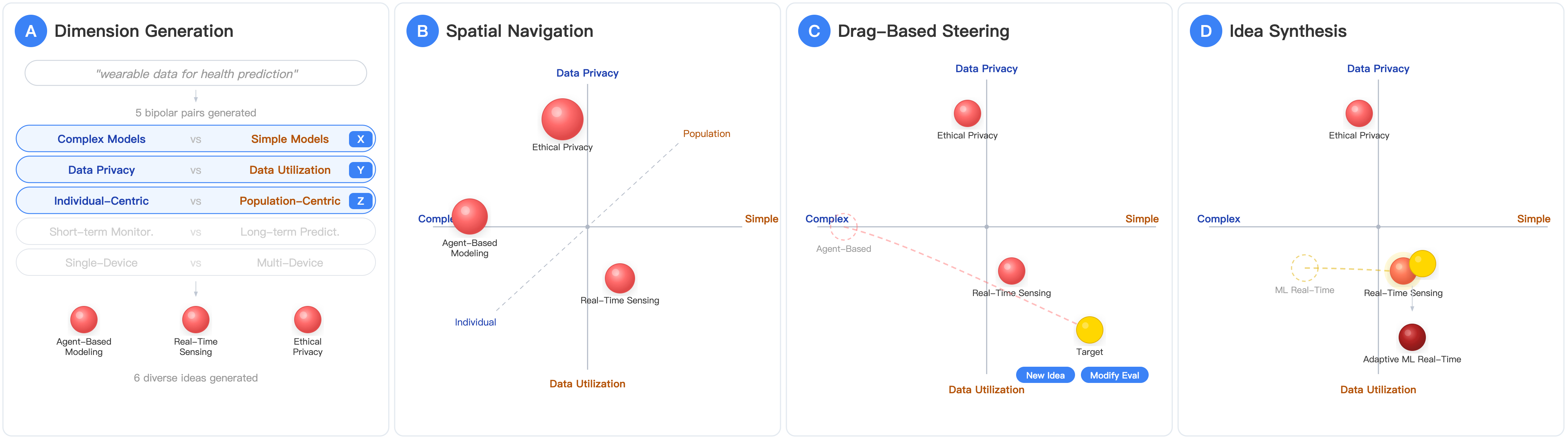
Abstract: Research ideation requires navigating trade-offs across multiple evaluative dimensions, yet most AI-assisted ideation tools leave this multi-dimensional reasoning unsupported, or reducing evaluation to unipolar scales where "more is better". We present ResearchCube, a system that reframes evaluation dimensions as bipolar trade-off spectra (e.g., theory-driven vs. data-driven) and renders research ideas as manipulable points in a user-constructed 3D evaluation space. Given a research intent, the system proposes candidate bipolar dimension pairs; users select up to three to define the axes of a personalized evaluation cube. Four spatial interactions -- AI-scaffolded dimension generation, 3D navigation with face snapping, drag-based idea steering, and drag-based synthesis -- enable researchers to explore and refine ideas through direct manipulation rather than text prompts. A qualitative study with 11 researchers revealed that (1) bipolar dimensions served as cognitive scaffolds that externalized evaluative thinking and offloaded working memory, (2) the spatial representation provided a sense of agency absent in chatbot-based AI tools, (3) participants desired fluid transitions across dimensionality levels -- from single-dimension focus to more than three dimensions, and (4) a productive tension emerged between AI-suggested starting dimensions and users' evolving desire for control. We distill these findings into design implications for multi-dimensional research ideation tools, including progressive dimensional control, fluid dimensionality, and transparent synthesis with provenance.
Paper Prompts
Sign up for free to create and run prompts on this paper using GPT-5.
Top Community Prompts
Explain it Like I'm 14
What is this paper about?
This paper introduces ResearchCube, a tool that helps researchers come up with better research ideas by making tough trade-offs easier to see and adjust. Instead of thinking “more is always better” on one score (like novelty 0–100), the tool shows ideas inside a 3D cube with axes that are trade-offs with two meaningful ends, like “theory-driven ↔ data-driven” or “privacy ↔ data use.” You can rotate the cube, see where ideas sit, and drag them toward the balance you want. The goal is to make thinking and exploring feel more hands-on and less like typing long chat prompts.
What questions did the researchers ask?
The team focused on two simple questions:
- How can we design a space where researchers can clearly see and compare trade-offs between ideas (like simple vs. complex, narrow vs. broad)?
- What kinds of interactions (like dragging and merging) make it easy to explore, improve, and combine ideas in that space?
How did they build and test it?
They built a working system called ResearchCube and tried it with 11 graduate-level researchers. Here’s how the system works, explained with everyday analogies:
- Picking the axes (AI help): You type your research goal (for example, “AI for mental health”). The AI suggests pairs of opposites—like a set of see-saws (theory-driven ↔ data-driven, simple ↔ complex). You pick up to three to form the X, Y, and Z axes of your cube.
- Seeing ideas in space: The tool generates several starting ideas and places each one as a point inside the cube based on how it balances the chosen trade-offs. Think of it like placing pins on a 3D map where each direction means something.
- Dragging to steer: If you want an idea to be, say, simpler and more data-driven, you drag its point toward that corner. The system then rewrites the idea to fit that new balance.
- Merging ideas: You can drag one idea onto another to blend them into a new hybrid idea. You can also save short “fragments” (useful phrases or parts) and drag those onto other ideas to mix and match.
- Easy navigation: Because 3D can be tricky on a 2D screen, the camera “snaps” to flat faces (like looking straight at one side of a Rubik’s Cube). That way, your drags clearly change only the visible axes.
To evaluate ResearchCube, they ran an hour-long session with each of the 11 researchers, collected usability ratings, logged interactions, and interviewed people about their experience.
What did they find, and why is it important?
Here are the main takeaways from the study, and why they matter:
- Bipolar trade-offs act like thinking tools. Seeing dimensions as meaningful opposites (e.g., privacy ↔ data use) helped people explain their choices, remember less, and reason better. It shifted evaluation from “more is better” to “find the right balance,” which is how real research choices usually work.
- Spatial control boosts agency. Many participants felt more “in control” than with chatbots. Instead of asking an AI to “do something” and hoping for a good answer, they could directly move ideas toward the balance they wanted and see the outcome.
- People want flexible dimensionality. Sometimes focusing on one axis helps; sometimes two or three are needed; sometimes more than three would be nice. Users wanted to zoom in and out across different levels of complexity, not be locked to a fixed view.
- Dragging works—but costs brainpower. Dragging to steer ideas was powerful and encouraged exploration of “empty” areas in the space. But some people found 3D thinking mentally tiring, especially on a 2D screen. The face-snapping helped, but it’s still a trade-off.
- Merging needs more transparency. Combining ideas often produced longer, blurrier text that was hard to audit (“What changed?” “What’s new?”). Participants asked for clear summaries of what was merged and why, so they can track and trust the result.
- Usability was good but polarized. Overall scores were above average, but opinions split: “spatial thinkers” loved the 3D approach; “text-first thinkers” found it heavier. This suggests design should adapt to different thinking styles.
Why this matters: Research often involves balancing competing goals (new vs. doable, broad vs. deep). Tools that show these trade-offs and let you adjust them directly can make ideation faster, clearer, and more creative.
What’s the bigger impact?
The authors suggest design principles for future AI tools that help people think:
- Progressive control: Start with helpful AI-suggested trade-offs, but let users edit, re-weight, and swap dimensions as their thinking evolves.
- Fluid dimensionality: Let users shift easily between 1D, 2D, 3D, and beyond, depending on the task and their comfort level.
- Transparent synthesis: When combining ideas or fragments, show what changed and where it came from (provenance), so people can trust and learn from the merges.
In short, ResearchCube shows a promising way to turn messy, multi-dimensional choices into something you can see, touch, and tweak—making AI feel more like a partner you can guide, not a black box you have to trust.
Knowledge Gaps
Below is a concise, actionable list of the paper’s unresolved gaps, limitations, and open questions to guide future research.
- Small, homogeneous sample and short, single-session usage (n=11 CS/HCI/ECE grad students; ~1 hour), limiting external validity and ecological realism; no longitudinal or in-the-wild deployments to assess sustained use, adoption, or downstream research impact.
- No controlled comparisons against strong baselines (e.g., chat-based LLMs, unipolar dashboards, 2D canvases), making it unclear which components (bipolar axes, spatialization, drag-based steering) drive benefits.
- Lack of objective outcome evaluation: no expert blind ratings of idea quality/novelty/feasibility, no task performance metrics, and no evidence that the system leads to better ideas than alternatives.
- Reliability of LLM-based evaluation (positioning ideas on bipolar axes) is unvalidated: no inter-rater reliability with human coders, no test–retest stability, no error analysis of evaluator hallucinations, and unclear effects of users’ “evaluation corrections” on subsequent consistency.
- Dimension-generation biases and fixation risks are unassessed: AI-suggested axes may anchor exploration or reflect model biases; there’s no mechanism to audit diversity of generated dimensions or to encourage dimension rotation/refresh.
- Strict limit of three active dimensions constrains exploration; untested strategies for higher-dimensional use (e.g., weighted axes, small multiples, PCA/UMAP projections, dynamic axis swapping) and their cognitive/UX implications.
- 3D-on-2D interaction constraints remain unresolved: snapping alleviates some ambiguity but alternatives (multi-view 2D “three-view” layouts, AR/VR, bimanual/3D input devices, axis locking widgets) are not evaluated.
- Scalability is untested: how the interface handles many ideas (clutter, occlusion, filtering, clustering, search, lenses) and long sessions with large trees remains unknown.
- Drag-to-steer fidelity is unverified: no analysis of whether content revisions produced by drags actually reflect intended directional shifts along axes, nor mechanisms to preview expected changes or quantify alignment.
- Idea synthesis lacks transparency and control: participants struggled to see “what changed” post-merge; no diff highlights, provenance-aware comparisons, or tunable merge parameters (e.g., weighting parents, constraint-based fusion).
- Exploration shrinkage after merging is unaddressed: repeated convergence may narrow the search; strategies to maintain breadth (e.g., branching, alternative merges, diversity-promoting prompts) are not explored.
- Confusing numeric encodings: users misinterpreted signed scores on bipolar axes; alternative visual encodings (e.g., dual-pole sliders, directional glyphs, zero-centered bars) and signifier design need systematic testing.
- Orthogonality assumption of axes is unchecked: many evaluative dimensions may correlate or interact nonlinearly; methods for non-orthogonal/curved trade-offs, interaction terms, or manifold representations are not examined.
- Uncertainty is invisible: no confidence intervals/uncertainty visualization for LLM scoring or synthesis rationales; users can’t judge when positions are tentative or contested.
- No integration with literature or evidence: ideas are not linked to sources, citations, or datasets, limiting traceability and feasibility checks; retrieval-augmented generation and citation grounding are untested.
- Collaboration is out of scope: no support for multi-user ideation, shared spaces, consensus-building along dimensions, or provenance/version control across collaborators.
- Accessibility and inclusivity are unaddressed: 3D spatial UIs may disadvantage users with lower spatial ability or visual impairments; accessible alternatives and adaptive interfaces are not provided.
- Cognitive load is not formally measured (e.g., NASA-TLX); onboarding adaptations for users with different spatial reasoning abilities are not assessed.
- Ethical and privacy considerations are under-specified: sending proprietary research ideas to external LLMs, evaluator/generator self-review bias, and model auditability are not addressed.
- Reproducibility and operational details are incomplete: model choice, prompt versions, latency, throughput, and cost are not reported; open-source link and prompts are not yet available for replication.
- Generalization beyond CS/HCI/ECE is unknown: applicability to other research domains (e.g., biomedical, social sciences, humanities) and to non-experts or industry researchers is untested.
- Alternative evaluation paradigms are not leveraged: despite evidence favoring pairwise comparisons over scalar scores, the system relies on scalar bipolar scoring; hybrid approaches remain unexplored.
- Dynamic dimension control is partial: users requested mid-session axis swapping, axis weighting, and generating new ideas at arbitrary positions; the system lacks robust re-projection/continuity when axes change.
- Provenance–spatial integration is limited: although a tree view exists, it’s weakly coupled with spatial view for lineage tracing; richer cross-view linking, rollbacks, and version snapshots are not implemented.
- Model bias audits are absent: no analysis of which dimensions the LLM tends to propose across topics, whether certain poles are over/under-represented, or how bias manifests in positioning and synthesis.
- Downstream pipeline integration is missing: there’s no bridge from ideation to structured proposals, experimental plans, or grant drafts; how spatial ideation accelerates concrete research milestones is unclear.
Practical Applications
Immediate Applications
Below are actionable, sector-linked use cases that can be deployed with today’s LLMs and standard web tooling, leveraging the paper’s bipolar trade-off framing, 3D spatial canvas, drag-based steering, and provenance-preserving workflows.
- Academia (research teams) — Structured lab ideation and proposal development
- What: Run lab/PI-led sessions to frame novelty–feasibility–impact (and similar) as bipolar axes; map seed ideas in a cube; steer or synthesize toward target trade-offs; capture provenance for grant text.
- Tools/Workflows: Web app for “ideation sprints”; integration with Google Docs/Notion for export; use “evaluation correction” to calibrate axes per discipline.
- Assumptions/Dependencies: Access to reliable LLMs; team onboarding to bipolar trade-offs; acceptance of spatial UI or fallback 2D views.
- Academia (advising & courses) — Teaching trade-off reasoning and research design
- What: Use bipolar spectra (e.g., theory-driven ↔ data-driven) to scaffold thesis scoping, peer critique, and studio critiques; switch between 1D/2D/3D to match student cognitive styles.
- Tools/Workflows: LMS plugin; prepared axis libraries by field; templates for common assignments.
- Assumptions/Dependencies: Instructor training; FERPA-safe LLM deployment if student data is used.
- Software/ML engineering — Model architecture and product trade-off decisions
- What: Map models across latency ↔ accuracy, interpretability ↔ performance, privacy ↔ personalization; drag ideas to target quadrants to generate alternative designs or prompts; log rationale.
- Tools/Workflows: Plugin for MLOps/Model Cards; export comparisons for design reviews.
- Assumptions/Dependencies: Domain-specific axis templates; governance for design decision logging.
- Product & UX — Feature prioritization and roadmap workshops
- What: Frame feature ideas across simplicity ↔ power, breadth ↔ depth, privacy ↔ utility; visually identify under-explored regions and generate options there; merge complementary features.
- Tools/Workflows: Integration with Miro/Figma/Jira; sprint kickoffs using “cube canvas.”
- Assumptions/Dependencies: Cross-functional adoption; workshop facilitation support.
- Healthcare (digital health, clinical innovation) — Concept exploration under constraints
- What: Explore ideas balancing privacy ↔ data utility, individual ↔ population, clinical validation ↔ speed; capture provenance for IRB/grant narratives.
- Tools/Workflows: On-prem/private LLM; axis libraries aligned to HIPAA, clinical validation stages.
- Assumptions/Dependencies: Compliance (HIPAA/GDPR); clinician-in-the-loop to set valid poles.
- Policy & public sector — Option framing and stakeholder workshops
- What: Surface tensions (e.g., growth ↔ equity, privacy ↔ safety) in participatory sessions; drag to generate alternatives at new balances; record transparent synthesis with provenance.
- Tools/Workflows: Facilitation kits; export to briefing memos; pairwise comparison mode for non-technical participants.
- Assumptions/Dependencies: Neutral axis design to avoid framing bias; public-sector LLM procurement.
- Security & privacy engineering — Privacy-by-design and threat modeling
- What: Map mitigations/usability trade-offs; generate alternatives targeting better balances; track decision lineage for audits.
- Tools/Workflows: Plugin for STRIDE/LINDDUN sessions; attach fragments (requirements) to ideas.
- Assumptions/Dependencies: Access to organizational threat libraries; security approval for LLMs.
- Finance & strategy — Investment theses and portfolio strategy exploration
- What: Explore ideas across risk ↔ return, liquidity ↔ yield, short-term ↔ long-term; steer to diversify under-explored regions; log rationales.
- Tools/Workflows: Internal strategy workshops; integration with research notes systems.
- Assumptions/Dependencies: Data confidentiality; compliance approvals for AI tooling.
- Education (HCI/design studios, capstones) — Studio critiques and ideation exercises
- What: Use the cube to externalize trade-offs in design briefs; students steer ideas to learn impact of choices; provenance aids reflection.
- Tools/Workflows: Classroom-ready templates; instructor dashboards.
- Assumptions/Dependencies: Device accessibility; scaffolding for non-spatial thinkers.
- Conferences/journals — Reviewer calibration and panel discussion aids
- What: Convert rubrics to bipolar spectra (e.g., generality ↔ depth); visualize paper positions to make tensions explicit; support calibration discussions.
- Tools/Workflows: Lightweight “review cube” embedded in PCS/OpenReview.
- Assumptions/Dependencies: Community buy-in; careful wording to avoid score anchoring.
- Knowledge management — Decision logs with provenance
- What: Replace ad-hoc meeting notes with spatial + tree provenance of options considered; attach fragments and rationale for future audits.
- Tools/Workflows: Integrations with Notion/Confluence; export to meeting minutes.
- Assumptions/Dependencies: API integrations; governance on sensitive content.
- Robotics/systems engineering — Trade-off exploration in system design
- What: Map autonomy ↔ safety, cost ↔ capability, robustness ↔ speed; generate design alternatives; track merges and iterations in design reviews.
- Tools/Workflows: Systems engineering tool plugin; axis presets per standard (e.g., ISO 26262 contexts).
- Assumptions/Dependencies: Connection to requirements repositories; safety review processes.
Long-Term Applications
These opportunities require further research, scaling, or domain integration beyond the current proof-of-concept (e.g., high-dimensional visualization, validated scoring, advanced interaction modalities).
- Enterprise decision-intelligence platform — Organization-wide “Trade-off Explorer”
- What: Unify strategy, product, and R&D decision-making on a shared bipolar framework with analytics, OKR linkages, and governance.
- Tools/Workflows: Data integrations; role-based access; audit trails.
- Assumptions/Dependencies: Enterprise data plumbing; change management; model risk controls.
- High-dimensional, adaptive ideation beyond 3 axes
- What: Fluid dimensionality (slicing, small multiples, parallel coordinates), automatic axis learning from user corrections and pairwise comparisons.
- Tools/Workflows: Progressive disclosure UIs; personalized axis weighting.
- Assumptions/Dependencies: Usability at scale; fast, stable embeddings; validation of learned dimensions.
- AR/VR and tangible interfaces for spatial co-ideation
- What: Room-scale cubes, hand/pen gestures, haptics for axis locking; enhanced spatial cognition for certain teams.
- Tools/Workflows: Virtual design rooms; hybrid remote collaboration.
- Assumptions/Dependencies: Hardware availability; accessibility; ergonomic studies.
- Multi-user, provenance-rich collaboration at scale
- What: Concurrent editing, branching/merging of idea graphs, permissions, and provenance visualization across teams and time.
- Tools/Workflows: Version control for ideas; CRDT-backed real-time collaboration.
- Assumptions/Dependencies: Conflict resolution UX; organizational policies.
- Domain-specialized modules tied to simulation or analytical models
- Healthcare/Clinical trials: Balance sample size ↔ power ↔ cost, link cube positions to trial simulators.
- Engineering/Robotics: Couple to digital twins or planners for performance estimates at positions.
- Energy/Sustainability: Tie to power-flow or emissions models for policy/tech options.
- Assumptions/Dependencies: Trustworthy model integration; validation with experts; compute resources.
- Policy design with impact forecasting
- What: Connect trade-off positions to econometric/agent-based models to forecast outcomes; support stakeholder negotiation.
- Tools/Workflows: “What-if” dashboards; explanation of model provenance.
- Assumptions/Dependencies: Transparent, trusted models; mitigation of framing and confirmation biases.
- Co-steering agents and recommendation systems
- What: Agents propose axis edits or “moves” based on under-explored regions, Bayesian optimization, or multi-objective search—always with explainable provenance.
- Tools/Workflows: Recommender side panel; active learning from user corrections.
- Assumptions/Dependencies: Explainability; guardrails; evaluation of suggestion quality.
- Education — Adaptive tutoring in trade-off reasoning
- What: Diagnose student misconceptions via moves in the space; scaffold with progressively complex dimensionality and reflective prompts.
- Tools/Workflows: LMS integration; learning analytics.
- Assumptions/Dependencies: Valid learning outcomes; privacy-compliant telemetry.
- Regulatory compliance and risk management
- What: Auditable decision trails for AI governance (e.g., model changes justified along axes like fairness ↔ performance).
- Tools/Workflows: Integration with governance platforms; exportable reports.
- Assumptions/Dependencies: Regulator acceptance; organizational policy updates.
- Hiring and team composition analytics
- What: Map role or project trade-offs (speed ↔ rigor, exploration ↔ execution) to align candidate strengths and team balance.
- Tools/Workflows: Structured interviews mapped to bipolar spectra.
- Assumptions/Dependencies: Fairness/ethics safeguards; avoid reductive profiling.
- Scientific publishing workflows with bipolar rubrics
- What: Conference management systems adopt bipolar evaluation for transparent discussions and rebuttals; provenance-aware meta-reviews.
- Tools/Workflows: PCS/OpenReview extensions; reviewer training.
- Assumptions/Dependencies: Community consensus; bias monitoring.
- Continuous improvement pipelines (manufacturing, operations)
- What: Explore interventions across cost ↔ quality ↔ throughput; link cube moves to KPI simulations.
- Tools/Workflows: CI/CD for ops decisions; digital twin integrations.
- Assumptions/Dependencies: Data quality; model validity; change control.
Cross-cutting assumptions and dependencies
- LLM reliability and bias: Axis suggestions and idea rewrites depend on model quality; require domain-tuned prompts, human calibration, and evaluation-correction workflows.
- Cognitive diversity: Provide fluid dimensional control (1D/2D/3D), face snapping, and non-spatial alternatives to accommodate different cognitive styles.
- Provenance and transparency: Synthesis and merges should expose what changed and why to maintain trust and auditability.
- Privacy/compliance: Regulated sectors need private/on-prem deployments and data handling policies.
- Standardization: Domain-specific axis libraries and bipolar rubrics benefit from community standards and validation studies.
Glossary
- AI-scaffolded dimension generation: Using AI to propose candidate evaluative dimensions from a user’s intent to help construct an evaluation space. Example: "Four spatial interactions--AI-scaffolded dimension generation, 3D navigation with face snapping, drag-based idea steering, and drag-based synthesis--enable researchers to explore and refine ideas through direct manipulation rather than text prompts."
- bipolar trade-off spectra: Evaluative axes framed with two opposing, meaningful poles (e.g., theory-driven vs. data-driven) rather than a single “more is better” direction. Example: "We present ResearchCube, a system that reframes evaluation dimensions as bipolar trade-off spectra (e.g., theory-driven vs. data-driven)..."
- cold-start problem: The initial difficulty users face when they lack a clear evaluative framework or starting point for exploration. Example: "This scaffolding addresses the cold-start problem---users who lack clear evaluative frameworks can bootstrap from AI suggestions while retaining full control over which trade-offs matter for their context."
- cognitive scaffolds: External structures that support and shape thinking by making implicit reasoning explicit and reducing working memory load. Example: "bipolar dimensions served as cognitive scaffolds that externalized evaluative thinking and offloaded working memory"
- design probe: A research-oriented prototype used to explore questions and gather empirical insights through use. Example: "We use ResearchCube as a design probe to explore the following research questions:"
- Direct Intent Manipulation (DIM): An interaction paradigm where users steer content generation by directly manipulating objects to express intent instead of issuing textual prompts. Example: "Direct Intent Manipulation (DIM)~\cite{dingDirectIntentManipulation2025} demonstrated that drag-based steering in a 2D canvas helps researchers iterate on ideas more fluidly than prompt-only interfaces."
- direct manipulation: An interaction style featuring continuous visual objects, physical actions instead of command syntax, and rapid, reversible operations. Example: "Direct manipulation, continuous representation of objects, physical actions instead of syntax, and rapid reversible operations~\cite{shneidermanFutureInteractiveSystems1982}, has proven effective for complex cognitive tasks"
- drag-based steering: Revising or exploring ideas by dragging their spatial positions to express desired changes along evaluative dimensions. Example: "The central interaction paradigm for manipulating ideas in the evaluation space is drag-based steering"
- drag-based synthesis: Creating a new, combined idea by initiating synthesis through a drag gesture in the spatial interface. Example: "Four spatial interactions--AI-scaffolded dimension generation, 3D navigation with face snapping, drag-based idea steering, and drag-based synthesis--enable researchers to explore and refine ideas..."
- drag-to-merge: Combining two ideas by dragging one node onto another to synthesize a hybrid. Example: "Drag-to-merge. When a user drags one idea node close to another (within a proximity threshold), the target node highlights to indicate a potential merge."
- evaluation correction: Adjusting an idea’s evaluative scores (position) without altering its content when the system’s initial evaluation is deemed inaccurate. Example: "Evaluation correction---the system updates the idea's scores without changing content, useful when users disagree with the AI's initial scoring."
- face snapping: Automatically aligning the camera/view to the nearest orthogonal face of a 3D cube to disambiguate axes for precise dragging. Example: "Four spatial interactions--AI-scaffolded dimension generation, 3D navigation with face snapping, drag-based idea steering, and drag-based synthesis"
- fragment incorporation: Integrating selected text snippets (fragments) into another idea to revise it at a finer granularity than full-idea merging. Example: "Fragment incorporation. Sometimes users identify a valuable phrase or concept within an idea that they want to incorporate elsewhere without adopting the entire idea."
- Friedman test: A non-parametric statistical test used to detect differences across multiple related samples or rankings. Example: "A Friedman test found no significant difference across features (, , Kendall's ), reflecting high individual variability."
- Institutional Review Board (IRB): A committee that reviews, approves, and oversees research involving human participants to ensure ethical standards. Example: "The study protocol was reviewed and approved by the Institutional Review Board (IRB) at the authors' affiliated university."
- Kendall's W: A statistic measuring the degree of agreement (concordance) among raters or rankings. Example: "A Friedman test found no significant difference across features (, , Kendall's )..."
- LLM-powered primitives: Backend operations implemented via LLMs that support core application functions. Example: "The back-end is implemented as a Flask service that exposes a small set of LLM-powered primitives corresponding to the core UI operations:"
- node-link diagram: A visualization of graph data where entities (nodes) are connected by lines (links), often used to show provenance or relationships. Example: "We render the tree as an interactive node-link diagram (D3)."
- pairwise agreement rate: The percentage of times two evaluators (e.g., model vs. human) agree when comparing items two at a time. Example: "Si et al.~\cite{siCanLLMsGenerate2024} found that evaluations using Claude-3.5 achieved a 53.3\% pairwise agreement rate compared to 56.1\% among NLP researchers."
- pairwise comparisons: An evaluation method comparing items two at a time rather than assigning absolute scores, often improving reliability. Example: "human-model agreement was higher for pairwise comparisons (0.71) than for scoring-based evaluations (0.64 vs.\ human-human 0.83)"
- progressive idea streaming: Incrementally displaying generated ideas and their positions as they are produced rather than waiting for a complete batch. Example: "The system supports AI-scaffolded dimension generation, progressive idea streaming, proximity-based synthesis, and fragment extraction for non-linear recombination."
- proximity-based synthesis: Triggering idea synthesis when nodes are brought within a certain spatial distance threshold. Example: "The system supports AI-scaffolded dimension generation, progressive idea streaming, proximity-based synthesis, and fragment extraction for non-linear recombination."
- provenance-preserving: Maintaining traceable lineage links between ideas and their ancestors during generation and transformation. Example: "ResearchCube, a proof-of-concept system that instantiates these design concepts in a 3D evaluation cube coupled with a provenance-preserving tree view."
- reflexive thematic analysis: A qualitative analytic approach involving iterative coding and theme development, emphasizing researcher reflexivity. Example: "Semi-structured interviews were analyzed using reflexive thematic analysis~\cite{braunUsingThematicAnalysis2006}."
- semantically grounded coordinate system: A spatial representation where each axis has explicit, interpretable meaning tied to evaluative trade-offs. Example: "A semantically grounded coordinate system, where each axis represents an explicit evaluative trade-of, could make the evaluative structure of the ideation space directly visible and manipulable."
- semantic interaction: Interaction paradigm where users’ direct manipulations of spatial layouts drive updates in underlying computational models. Example: "Semantic interaction systems like ForceSPIRE~\cite{endertSemanticInteractionVisual2012} leverage this capacity by mapping drag gestures to updates in underlying analytical models"
- symmetric integer scale: A centered numeric scale with equal positive and negative ranges denoting opposite poles of a dimension. Example: "We use a symmetric integer scale in [50, 50], where 50 indicates full alignment with one pole of a trade-off dimension, +50 with the opposite, and 0 a balance"
- System Usability Scale (SUS): A standardized 10-item survey producing a single score to assess perceived usability of a system. Example: "Participants completed the System Usability Scale (SUS)~\cite{brookeSUSQuickDirty} questionnaire and ranked six system features by preference."
- Three.js via React Three Fiber: A web-based 3D rendering stack where Three.js is used through React Three Fiber bindings for React applications. Example: "For 3D interaction, we render the cube and nodes with a WebGL scene (Three.js via React Three Fiber), and provide camera rotation and face snapping to switch between overview and precise, plane-aligned drags."
Collections
Sign up for free to add this paper to one or more collections.