- The paper introduces LitPivot, an AI-based system that facilitates dynamic research idea evolution through literature-initiated pivots.
- It employs facet-driven literature retrieval and clustering, leveraging LLMs to segment research ideas into problem, contribution, and evaluation facets while using graph-based critique for consistency.
- Empirical evaluations show LitPivot significantly improves literature engagement, idea novelty, and grounding compared to traditional tools.
LitPivot: Dynamic Contextualization and Critique in Research Ideation
Motivation and Problem Definition
The process of developing a novel research idea is highly interdependent with ongoing literature review. As a research idea evolves, the subset of relevant literature shifts; at the same time, engagement with the literature motivates pivots in the reframing, differentiation, or grounding of ideas. Existing ideation and literature tools largely treat idea development and literature exploration as distinct or static processes, failing to support the tightly coupled, iterative dynamics observed in real research practice. The paper introduces the concept of "literature-initiated pivots": moments when reading or critique via the literature precipitates substantive changes to a research idea, which in turn recalibrates the set of most relevant prior work. Supporting these pivots is proposed as critical for improved research ideation.
System Design: LitPivot
LitPivot is introduced as an AI-assisted ideation environment where researchers co-develop a research idea and its literature grounding. Drawing on the notion of idea facets (problem, contribution, evaluation), LitPivot enables dynamic, facet-driven literature retrieval and clustering, and provides automated, literature-informed critique and revision suggestions specific to the selected facet.
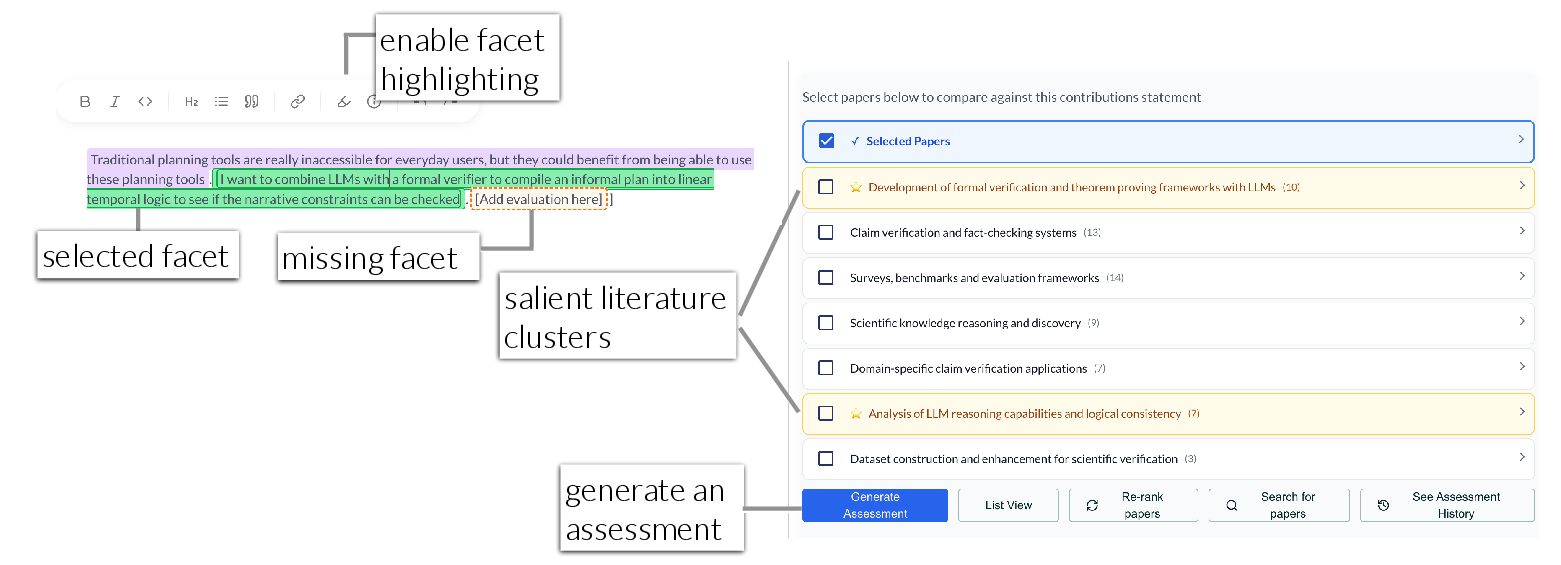
Figure 1: The main LitPivot interface, supporting facet-driven manuscript editing and dynamically clustered literature exploration grounded by idea segment type.
Core architectural stages involve: (1) using a researcher's draft to query a scientific literature search engine; (2) extracting idea-relevant segments from papers with LLMs; (3) clustering the corpus by facet using another LLM; (4) extracting frequently cited/meaningful papers per facet for an expanded literature set.
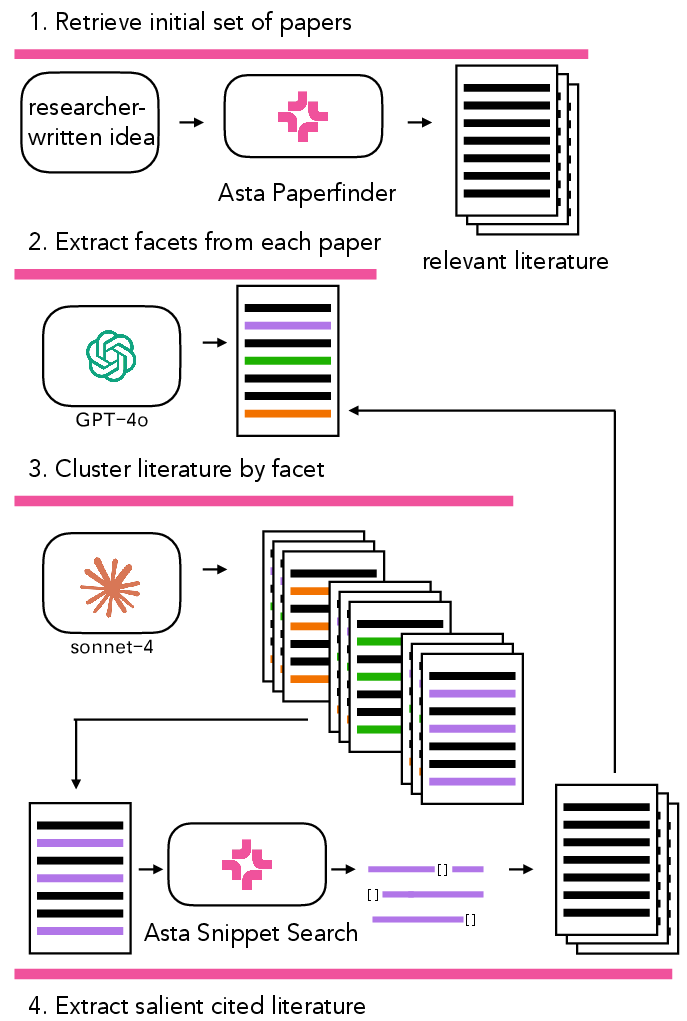
Figure 2: The LitPivot pipeline for literature retrieval, facet extraction, and dynamic clustering and expansion of the literature set based on citations.
Critique and rewrite recommendations use retrieval-augmented LLMs and are informed by graph-based alignment checks between the current idea facet and literature clusters. Novelty is evaluated via a simulated bipartite graph connecting proposed contributions to limitations and open questions in the literature. The system maintains cross-facet coherence, proactively identifying when edits to one idea facet necessitate edits to related facets.
Empirical Evaluation
Three evaluation studies are conducted:
- Formative Study and Artifact Analysis (n=9): Qualitative investigation of when and how literature-initiated pivots arise in practice, and the barriers faced. Researchers are observed to experience tension between expanding ideas and critically evaluating them, especially when novelty is challenged by related prior work. There is demand for tools that not only retrieve literature but suggest specific, literature-grounded paths for pivots.
- Comparative Usability Study (n=17): LitPivot is compared to a baseline "chat-with-papers" interface on pre-assigned ideation tasks. The study reveals that participants using LitPivot select significantly more unique papers per task (mean 7.1 vs. 4.4), report higher perceived understanding of the literature (M=5.71 vs. M=3.88 on a 7-point scale, t(16)=5.85, p<.001, dz=1.42), and produce ideas rated by blinded experts as far more well-grounded (median rating improvement 2 to 5 out of 7, with mean difference =2.59, t(16)=5.33, p<.001, dz=1.29).
- Self-Reported Change in Idea Quality: Participants report larger increases in perceived novelty (Δ=2.29 vs. M=3.880) and utility (M=3.881 vs. M=3.882) with LitPivot compared to baseline, with statistical significance after correction.
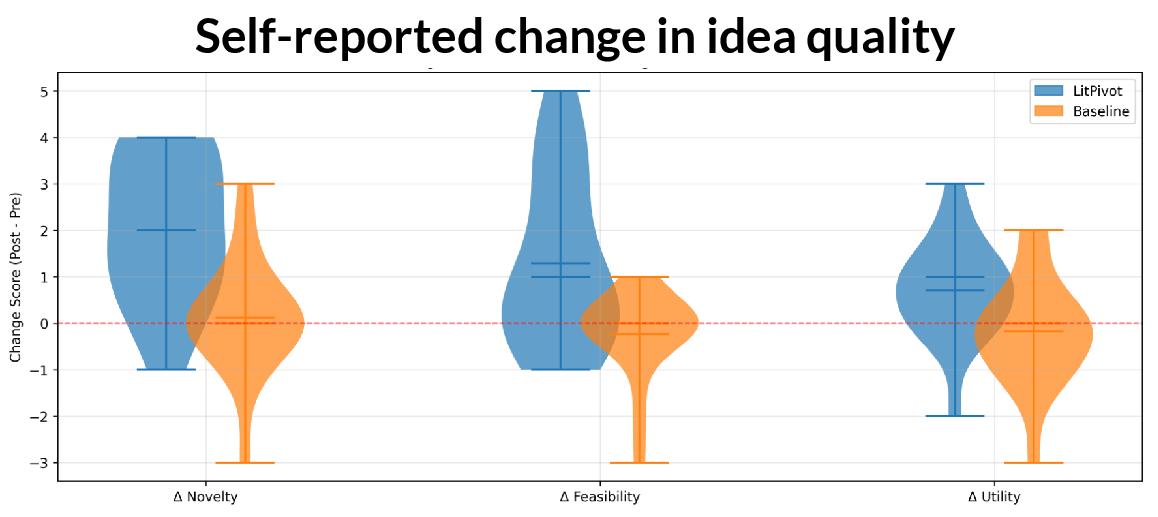
Figure 3: Distribution of self-reported deltas in Likert scores for perceived novelty, feasibility, and utility across conditions, with LitPivot yielding strongly positive shifts.
- Open-Ended Qualitative Study (n=5): When developing their own ideas, participants use LitPivot both for vetting and refining mature ideas, and for early-stage framing. Dynamic clusters and facet-based retrieval support new kinds of literature-initiated pivots, with researchers often reframing their contribution or problem statement in response to revealed relations and gaps in the literature.
LitPivot operationalizes dynamic co-evolution of literature and ideas through:
- Faceted decomposition: Researcher's manuscript is segmented by LLMs into problem, contribution, and evaluation, enabling precision in mapping literature clusters contextually.
- Dynamic literature retrieval and organization: Asta PaperFinder and LLMs expand and cluster the relevant corpus on-demand by facet.
- Graph-based reasoning: Formalizes differentiation and alignment by constructing bipartite graphs between literature limitations/open questions and proposed contributions, using LLM reasoning and JSON-structured graph outputs.
- Consistency maintenance: Systemic tracking of cross-facet dependencies ensures that adjustment of one idea segment prompts revision recommendations for others to maintain internal congruity.
Through these mechanisms, LitPivot supports bidirectional, context-sensitive coupling between idea and literature, departing from static or manually curated approaches found in prior ideation or literature exploration platforms.
Implications and Future Work
Practically, LitPivot offers a paradigm shift in research tool design: retrieval, critique, and document organization are not query-centric but idea-evolution-centric, adaptive to both document edits and literature discovery. This architecture supports deeper, more iterative engagement with the literature, facilitating richer articulation of novelty, rigor, and coherence in research ideas.
Theoretically, the formalization of literature-initiated pivots structures empirical understanding of creative cognition in scientific work, aligning with dual-space theories of design and scientific reasoning. The mechanism and interface design generalize beyond pure research ideation, with potential applications in expository writing, legal argumentation, and clinical reasoning, where continuous realignment between evolving positions and knowledge corpora is needed.
Potential limitations include dependence on accessible and high-quality literature corpora, possible loss of nuance in automated literature segmentation, and the challenge of operationalizing genuine "novelty" beyond graph coverage.
Ongoing directions include broadening to other expository and high-stakes domains, exploring mixed-initiative search and vetting strategies, and investigating long-term impact on research outcomes and information synthesis.
Conclusion
LitPivot demonstrates that supporting the dynamic, reciprocal relationship between research ideas and literature through AI-driven, facet-aware retrieval and critique mechanisms substantially improves both researcher engagement with prior work and the situatedness of their resulting contributions. This work establishes literature-initiated pivots as a key operational target for ideation tools and provides a validated framework and architecture for computational support systems intended to foster rigorous, novel research grounded in the academic landscape (2604.02600).