- The paper introduces an EnKI framework that achieves parameter estimation errors below 0.3% for the TheveninT model in both simulation and experimental setups.
- It demonstrates robust convergence within three iterations while accurately capturing both electrical and thermal dynamics in high-dimensional systems.
- The method bypasses gradient computation, enabling scalable and online calibration for complex lithium-ion battery management systems.
EnKI-Based System Identification for Lithium-Ion Battery Equivalent Circuit Models
Introduction
Robust system identification for lithium-ion battery (LiB) equivalent circuit models (ECMs) is critical for battery management systems (BMS), impacting state estimation, control, and safety diagnostics. Standard ECM parametrization via linear fitting or experiment-driven calibration does not scale well to nonlinear, thermally coupled models with high-dimensional parameter spaces. This work addresses these challenges through the application of Ensemble Kalman Inversion (EnKI), a gradient-free, Monte Carlo-based maximum a posteriori estimation framework, for parameter extraction in nonlinear ECMs with electrothermal coupling. The efficacy of EnKI is demonstrated on both Thevenin-type and nonlinear double-capacitor ECMs using simulated and experimental datasets (2604.10813).
Model Structure: TheveninT and NDCT
The investigation centers on two ECMs, each integrating both electrical and thermal dynamics within a unified nonlinear state space.
The TheveninT model extends the canonical Thevenin RC network with a lumped two-node thermal submodel. This model couples polarization voltage evolution with temperature-dependent resistance elements, critical for high-fidelity prediction under dynamic load and varying ambient conditions.
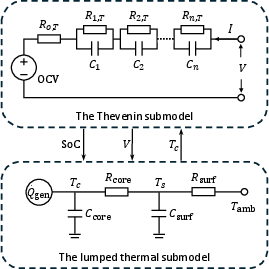
Figure 1: The TheveninT model, which couples the Thevenin submodel and the lumped thermal submodel.
In parallel, the NDCT model (Nonlinear Double-Capacitor with Thermal coupling) augments the NDC architecture—a configuration adept at capturing electrode diffusion and voltage dynamics—with equivalent lumped thermal states.
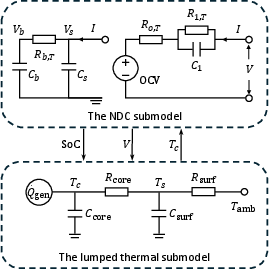
Figure 2: The NDCT model, which couples the NDC submodel and the lumped thermal submodel.
Both models encode nonlinear Arrhenius-type temperature dependencies for resistive parameters, Table-driven OCV-SoC relations, and endogenous state evolution for voltage and temperature. The state and parameter vectors integrate electrical, thermal, and kinetic coefficients, forming a high-dimensional, strongly coupled system.
Ensemble Kalman Inversion for Parameter Identification
The EnKI framework iteratively updates an ensemble of parameter samples {θ(i)}i=1M via Bayesian inference, using output measurements (voltage, surface temperature) corrupted by additive Gaussian noise. Critically, global joint Gaussian assumptions are locally tempered through successive incremental updates, each employing empirical ensemble statistics for both prior and predicted data distributions. The tempering schedule is adaptively governed by the data misfit controller (DMC), which dynamically modulates the annealing parameter αℓ to maintain ensemble diversity and prevent collapse.
This iterative procedure inherently accommodates nonlinearity and nonconvexity without explicit gradient computation, sidestepping issues endemic to classical least-squares or evolutionary optimization in these models. The result approximates the MAP estimate by evolving empirical means and covariances of the ensemble, delivering robust convergence even in regimes of low measurement sensitivity.
Numerical and Experimental Results
Simulation Evaluation
Synthetic datasets are generated using standard automotive drive cycles (US06, LA92, UDDS, SC04) applied to both ECMs at variable ambient temperatures, with injected Gaussian sensor noise. A 3.3 Ah NCA cell parameterization provides the ground truth.
TheveninT model results: The EnKI procedure yields parameter estimates with relative errors predominantly below 0.3%, reflecting high identification precision across electrical and thermal parameters. Notably, the method converges typically within three iterations, with ensemble contraction and median stabilization observed throughout the process.
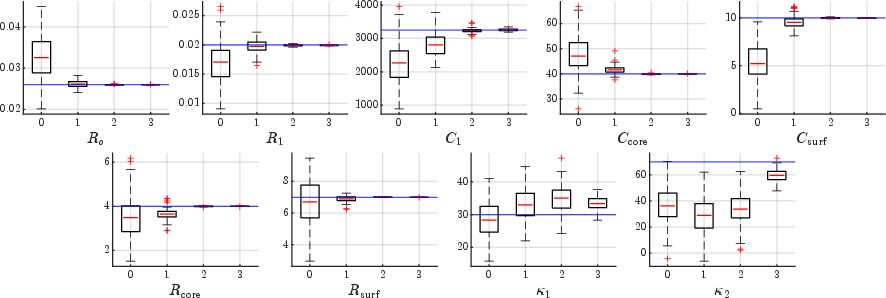
Figure 3: Boxplots of the ensembles for the parameters during the iterations in identifying the TheveninT model.
Model predictions for both voltage and surface temperature track ground-truth measurements closely, validating both steady-state and transient tracking fidelity.
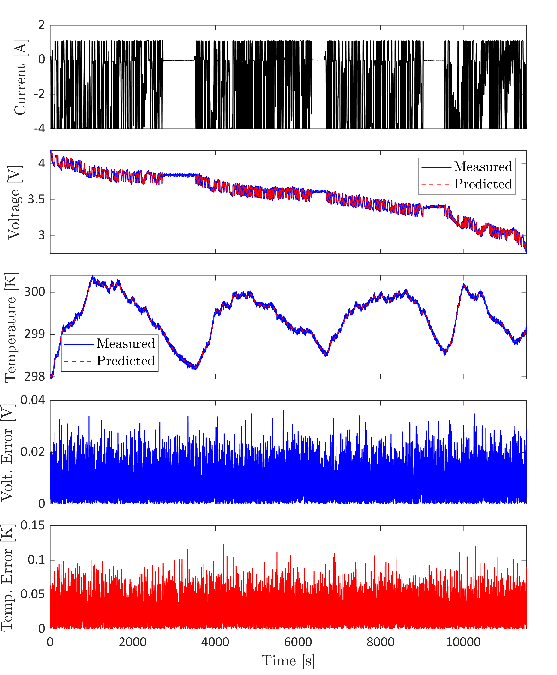
Figure 4: Comparison of the measured and predicted voltage and surface temperature under the current profile, involving both charging and discharging, at Tamb=298 K for the TheveninT model.
NDCT model results: Despite increased parameter dimensionality, EnKI again demonstrates robust performance. Most parameter errors fall under 1%, with minor deviations for Arrhenius activation coefficients (κ1,κ2), attributable to their weak observability.
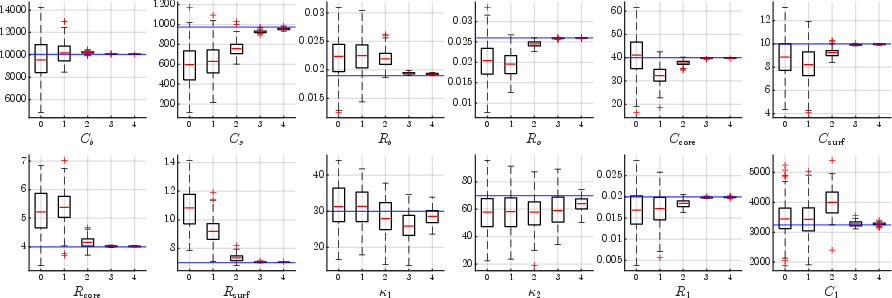
Figure 5: Boxplots of the ensembles for the parameters during the iterations in identifying the NDCT model.
Resultant model outputs for voltage and temperature maintain close correspondence with ground truth.
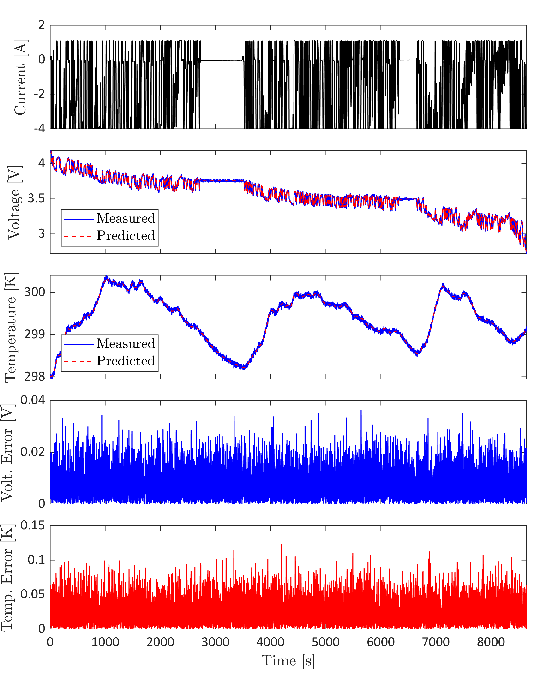
Figure 6: Comparison of the measured and predicted voltage and surface temperature under the current profile, involving both charging and discharging, at Tamb=298 K for the NDCT model.
Experimental Validation
The methodology is further validated on real measurement data from a Samsung INR18650-25R cell subjected to variable load under controlled temperature conditions. Priors are informed by the synthetic studies, reflecting a realistic identification pipeline.
Both ECMs achieve high-fidelity reproduction of measured voltage and temperature trajectories. The NDCT model demonstrates superior accuracy—especially at SoC boundaries and high C-rate conditions—highlighting the benefit of enhanced nonlinear and electrochemical structure in the model.
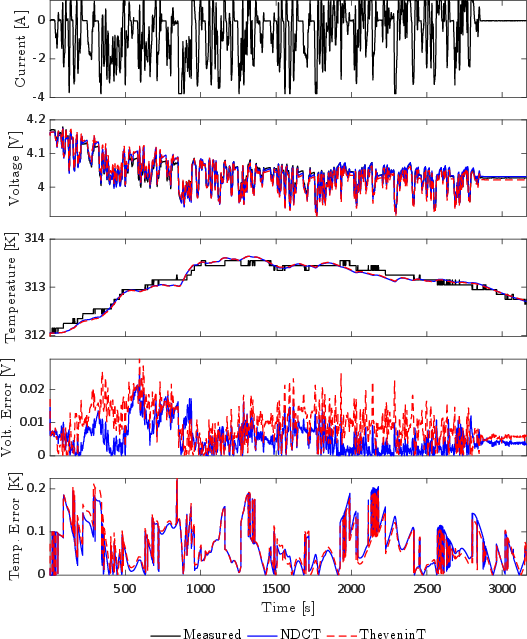
Figure 7: Experimental validation and comparison of the TheveninT and NDCT model in voltage and temperature prediction.
Implications and Future Directions
This work substantiates EnKI as a scalable, empirically stable method for parameter identification in nonlinear, thermally coupled ECMs. By eliminating the need for derivative computation and handling large, coupled parameter spaces, EnKI expands the applicability envelope of ECM approaches to richer physics-based models and diverse operating data. The superior convergence rates and insensitivity to initial ensemble coverage suggest practical deployability for online or adaptive BMS calibration routines.
The main limitation lies in sensitivity to poorly observable kinetic parameters, motivating further work in experiment design for enhanced identifiability or hybridization with global optimization strategies. The framework is extensible to more detailed ECM or pseudo-2D models, estimation under model mismatch, and real-time, model-predictive control settings.
Conclusion
The proposed EnKI-based identification strategy systematically addresses the high-dimensional, nonlinear system identification problem for lithium-ion battery ECMs, integrating electrical and thermal dynamics. Empirical results on both simulated and experimental data confirm accurate, fast, and robust parameter convergence for both TheveninT and NDCT models. The approach offers a compelling alternative to classical or evolutionary identification schemes, particularly as LiB modeling shifts toward richer, more complex physics-based representations (2604.10813).

