- The paper presents a tripartite framework that delineates responsible consumerism as an IR challenge involving extraction, complex search, and knowledge calibration.
- It empirically classifies consumer behavior through a survey of 601 individuals, highlighting significant disparities between ethical intent and search practices.
- The study advocates a dual optimization approach in IR systems by integrating fair metadata extraction, enhanced ranking, and innovative user interfaces to support SRCs.
Introduction
This paper advances a structured and empirical examination of the technical and behavioral challenges within ethically minded consumer behavior, specifically in the context of information retrieval (IR) for socially responsible consumption (2604.10751). It pivots the traditional focus of e-commerce IR research from commercial optimization to the user-centric task of empowering Socially Responsible Consumers (SRCs) in making purchasing decisions aligned with ethical, social, and environmental values. Grounded in a survey of over 600 consumers, the study exposes the multifaceted barriers encountered by consumers in bridging the well-established intention–behavior gap, and provides three interlocking IR perspectives: information extraction, complex search task modeling, and knowledge calibration.
Empirical Analysis of Consumer Search Behavior
The paper’s empirical core comprises a large-sample survey (n=601) operationalizing the Ethically Minded Consumer Behavior (EMCB) scale. Cluster analysis delineates three cohorts: ethically agnostic (29.09%), moderately minded (43.72%), and highly ethically minded (27.19%) consumers. Results indicate substantial heterogeneity in the integration of ethical criteria into purchase consideration and subsequent information search.
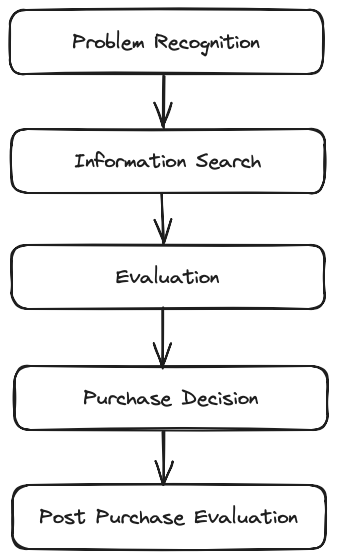
Figure 1: Engel et al.'s consumer purchasing model is the basis for structuring the information-seeking challenges across stages from need recognition to post-purchase evaluation.
Notably, even among the most ethically predisposed consumers, 73.3% did not consistently consider or seek further information on secondary (ethical, social, environmental) aspects when making high-value online purchases. This intention-search gap is exacerbated by information asymmetries, lack of convenient retrieval, and the cognitive burden of multi-faceted product assessment. Quantitative and qualitative data converge to show that primary product aspects (price, quality) drive search and consideration, while secondary aspects are frequently neglected due to unawareness, high search costs, and perceived irrelevance.
Responsible consumption is rigorously framed as an information extraction problem characterized by high information asymmetry: producers and platforms selectively disclose attributes conducive to sales while obscuring data relevant to ethical assessment. The prevalence of greenwashing and the scarcity of standardized, machine-readable secondary product metadata compound this asymmetry.
The authors review emerging initiatives (e.g., GreenDB, OpenFoodFacts) and propose that IR should prioritize scalable, automated information extraction using advanced NLP and LLM-based methods, as well as socio-technical aggregation of consumer-generated metadata. The technical bottleneck remains the integration and normalization of disparate social, environmental, and governance metrics at sufficient product-level granularity. Cross-source information fusion with provenance-aware modeling is identified as an open research area.
Responsible Consumption as a Complex Interactive Search Task
The paper conceptualizes ethical online purchasing as a complex IR task. The need to synthesize primary and secondary criteria across often non-standardized sources places high cognitive and procedural load on consumers. The logic models in the paper draw on complex search task frameworks, situating responsible consumerism within the class of exploratory, multi-session, high-cognitive-load IR problems.
The authors recommend that IR research in e-commerce embrace dual optimization: improving retrieval effectiveness (precision, recall, and debiasing for secondary aspects) and human-centric search user interface (SUI) design that reduces cognitive burdens and supports sense-making. Interventions include enhanced ranking signals for ethical dimensions, diversified SERP composition, and context-sensitive SUIs (e.g., conversational agents, faceted overviews, and real-time nudges). Existing systems often fail to expose or properly weight secondary attributes, yielding commercially skewed recommendations and suboptimal user support for SRCs.
Search as Knowledge Calibration
The “knowledge calibration” perspective posits that consumers’ over- or under-confidence in their ethical knowledge contributes materially to omission neglect—misalignment between assumed and actual knowledge regarding secondary product aspects. Search systems and interfaces affect this calibration by selectively presenting information, signaling missing data, and offering opportunity for reflective learning and re-evaluation of decision criteria.
The authors advocate experimental research measuring not only direct decision outcomes, but also metacognitive states: awareness of knowledge gaps, motivation to seek further ethical information, and dynamic shifts in aspect recall and consideration. Interface interventions calibrated for nudging awareness (rather than prescriptive behavior change) may better support authentic preference emergence and long-term knowledge updating. This is aligned with cognitive IR evaluation methodologies that focus on omission neglect, aspect recall, and knowledge confidence.
Implications for IR Research and Practice
The theoretical and empirical synthesis in this paper reframes the technical agenda for IR in socially responsible shopping:
- Algorithmic Implications: Standard e-commerce retrieval objectives should be broadened to incorporate fairness constraints, diversity, and secondary aspect coverage. LLM-based entity recognition and information fusion are needed to address noisy, incomplete, or adversarial product metadata.
- Evaluation Paradigms: Beyond classical relevance-based IR metrics, new evaluation protocols are necessary, including aspect-level recall, calibration of cognitive states, and user-centric convenience/cost models. Objective measures of information asymmetry reduction and ethical knowledge calibration are preferred over raw behavioral “conversion” metrics.
- Interface and Interaction: Responsible IR requires interface innovation supporting exploration, serendipity, and calibration nudging (e.g., reminders of neglected aspects, context-dependent queries, and dynamic aggregation of missing metadata).
- Socio-technical Ecosystems: Sustainable progress will require partnership among NGOs, regulators, retailers, and end-user communities for open, crowdsourced, and machine-readable secondary aspect datasets.
Conclusion
This study systematically demonstrates that responsible consumerism is critically undermined by gaps in IR support for secondary aspects. The continued intention–behavior gap observed, even among highly motivated consumers, is largely a function of information asymmetries and suboptimal IR pipeline design.
The paper’s tripartite framing—responsible shopping as information extraction, complex search, and knowledge calibration—provides a precise research agenda for the IR community. Future work should focus on scalable secondary aspect extraction, context- and cognition-sensitive search interfaces, and comprehensive evaluation of information and knowledge effects for supporting SRCs. Addressing these challenges is essential for aligning IR systems with broader societal goals of sustainability, transparency, and user empowerment.

